Tag Archives: Down East

High in the Sky

By Ed Staskus

   “Where are you staying?” Isabelle asked. Her name was officially Isabella, but everybody called her Isabelle. Her close friends called her Izzy.

   “In North Rustico, but not exactly. We’re in the National Park, up from Doyle’s Cove, in the Coastline Cottages.”

   “Where the seaweed smells bad?”

   “That’s the place, except it doesn’t usually smell bad, only when there’s a strong wind blowing onshore that piles it up, or there’s a storm that tears Irish moss from the ocean floor and dumps it on the beach there.”

   “How do you know where the smell comes from?”

   “My older sister Emma told me. She knows everything. She’s always reading books and stuff. She’s my right hand man.”

   “Isn’t she a girl?”

   “I don’t mind. She helps me hunt monsters where we live in Ohio.”

   “Oh, I see. Anyway, we’re in the Gulf View Cottages on that hill above the guard station where you have to stop before coming into the park, except not this year. They have something special going on so everybody can just come and go.”

   “You’re not far away, at all. I could walk over and visit.”

   Isabelle and Oliver were talking on the front deck of the Stanley Bridge Hall, watching cars going in circles on the roundabout. They had spent the past two-some hours listening to Lennie Gallant tell stories and sing songs about Atlantic Canada, the two of them coincidentally sitting in the same row. It was where they met for the first time. Oliver and Emma were with their parents, come from away in Ohio, and Isabelle was with her parents, who were from Louisiana.

   “My people came from Spain, around 1800, when Louisiana was a Spanish colony, and my husband’s people are from here, from even longer back, when the Acadians were deported by the British,” Isabelle’s mother said. 

   “My name is the same as my grandmother’s,” Isabelle chimed in.

   “We live in Lafayette, which is more-or-less the cultural capital of Acadiana, which is where the Cajuns live in the southwest part of the state. My husband has long wanted to visit the island here, around the Rustico lands, where his family came from.”

   Acadians were from the Canadian Maritime Provinces. Most of them were deported in the mid-18th century during the French and Indian War. It was called the Great Expulsion. Thousands of them died of disease or drowning when ships sank. Their land was given to Scottish settlers. Many Acadians were transported to the American colonies. Those that ended up in Louisiana settled in the Atchafalaya Basin and the prairie lands to the west. 

   “Mom, can Isabelle and I go the Sandspit tomorrow?” Oliver blurted out. He wasn’t especially interested in history lessons. School was going to start soon enough and he would soon enough have more history than he could handle.

   “I don’t see why not. Check with her mother, and if she agrees we will take the two of you tomorrow.”

   The next day the mothers dropped the two children off at the Sandspit.

   “We’re going to Raspberry Point Oysters to hear a talk all about oysters and afterwards eat some of them,”  Oliver’s mother said. “Then we’re going to drive to New London to see Lucy Maud Montgomery’s birthplace, before she moved to Cavendish. They have a museum there with some of her personal scrapbooks from when she was working on ‘Anne of Green Gables.’ We will probably stop for coffee somewhere and pick you up around five o’clock.”

   “OK, mom,” Oliver said, barely listening, and running off with Isabelle in train.

   The Sandspit is an amusement park in Cavendish, about six miles from  North Rustico on Route 6, except they didn’t take Route 6. They had taken the Gulf Shore Parkway through the National Park, stopping at the overlook at MacKenzies Brook to see where the Cactus Pot had once been. It had been a sandstone sea arch that was lashed black and blue by Hurricane Fiona in September 2022 and collapsed one Sunday morning two months later after the tropical depression Nicole passed through. 

   “It’s not there anymore,” Oliver said, looking at the nothing where the sea arch had been.

   “When Fiona went by it took a nice little chunk out on the right-hand side of it and that kind of weakened the structure a lot more, and then we had Nicole, and I guess with the heavy rains and winds that we had, it was the last straw, “ said Timothy Gallant from nearby Rusticoville, who was taking photographs of the coastline. “We had been watching it deteriorate for quite a little while, well, since Fiona, and we were wondering when it was going to happen.”

   “It’s scary, but it’s Mother Nature, the  hurricanes, like where we live in Louisiana,” Isabelle said.

   “Dad says they’re scarier these days,” Oliver said.

   “So does my dad,” Isabelle said.

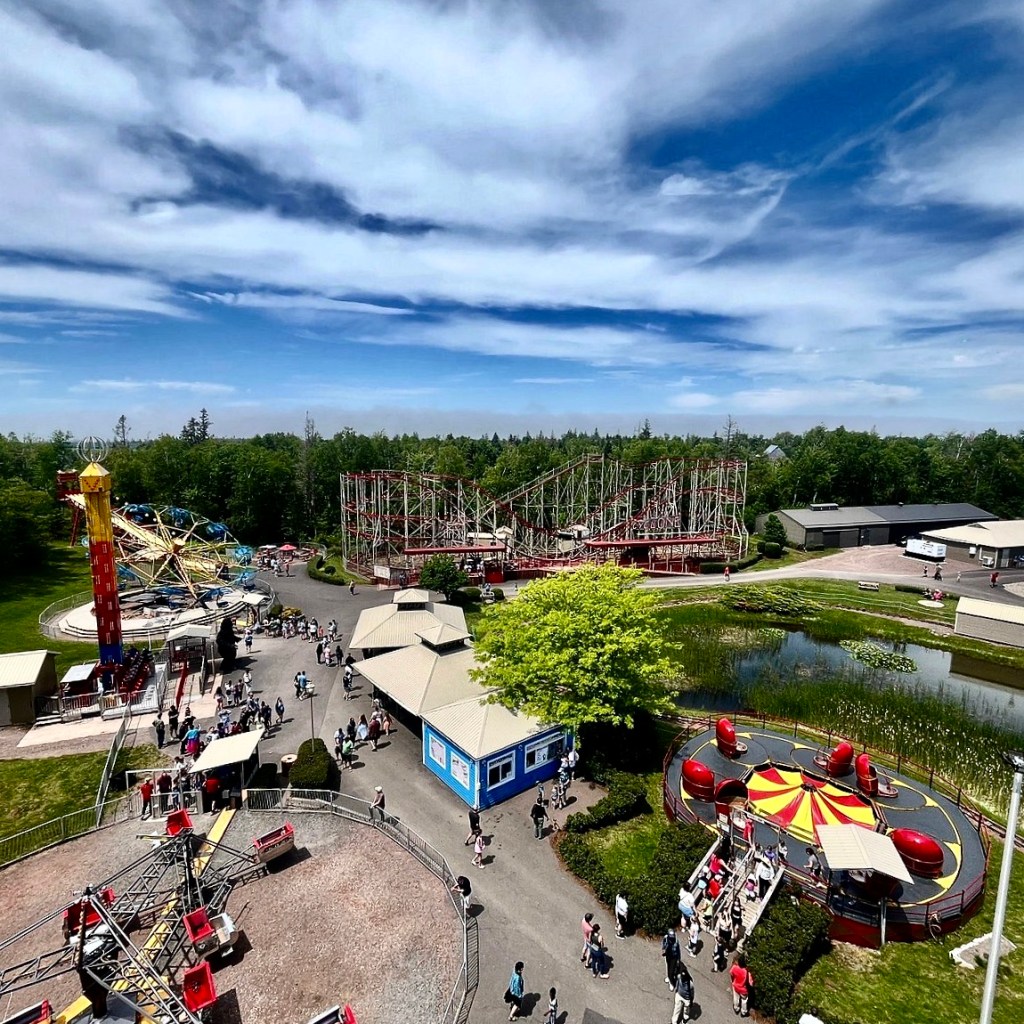
   The first ride Oliver and Isabelle went on at the Sandspit was the Ferris wheel. It was seventy feet high and they could see the whole amusement park from the top. Once they got their bearings they ran from one ride to another. They rode the Cyclone roller coaster, the longest roller coaster in Atlantic Canada, screaming down the sharp drops and through the corkscrews. They rode the Sandstorm 360 pendulum with full rotations. They rode the Paratrooper and Tilt-a Whirl and after that the bumper cars and bumper boats. They whooped it up on the Landslide and the Scrambler. The last ride they went on was the Cliffhanger.

   The Cliffhanger was a drop tower that took its riders fifty two feet up in the air before plunging straight down, creating sudden G-forces, making the riders feel weightless. At least, that is what it was supposed to do, except it didn’t. The ride was halfway up its fifty two feet when it suddenly peeled rubber. By the time it got to the top it was going like a rocket and shot their seat into the sky, scattering a formation of cormorants. The jet stream got behind them. Before they knew it they were  flying over North Rustico. 

   Ten minutes later they were flying over Brackley Beach. The seat was open-air bench-style with an over the shoulder restraint and a lap bar. They kept the restraint and bar where they were. They passed over Stanhope, Grand Tracadie, and Wild Harbour. They were on course for St. Peter’s Bay.

   “I like the green fields, the way they look right next to the red cliffs,” Oliver said.

   “The farm fields down there look like a patchwork quilt my mom has,” Isabelle said.

   They almost slammed into an osprey head on, but the big bird veered away at the last second, whistling and screeching its disapproval.

   “Maybe we could stop at Rick’s Fish & Chips when we get to St. Peter’s Bay,” Oliver said. “The man and his wife in the cottage next to us were there yesterday and said their fish hits the spot.”

   “That sounds great, let’s do that,” Isabelle said. “I’m getting hungry, but, how do we land this thing?”

   Oliver looked all around but didn’t see a joystick or any brakes, or even a parachute.

   “That’s a good question,” he said.

   Frank Arsenault was on St. Peter’s Highway outside of Morell when he saw the seat in the sky. He was driving his Dodge Ram 3500, transporting the drone that he used for crop scouting and monitoring field health back to his barn. That don’t look right, he thought, especially not with two kids along for the ride. He kept them in sight. As they were approaching St. Peter’s Isabelle noticed the pick-up truck tracking them. She made the one-handed Signal for Help sign, waving her hand back and forth.

   Frank sped up to get ahead of them and pulled off into a gravel lot next to the St. Peter’s Bay Volunteer Fire Department. He jumped out of the pick-up truck, unlocked the clamps and tie-down anchors holding the drone in its cradle, freed  the soft straps keeping the folding arms in place, and released the drone. He controlled it to the rear of the Cliffhanger seat and shot a tow line at it. The tow line’s hook snagged the seat. Frank brought it down in ever diminishing circles, landing it in the gravel lot like laying a baby in a cradle.

   “Are you kids OK?” he asked, rushing over to them.

   “Thanks mister,” Oliver said. “We couldn’t have done it without you.”

   “What happened?”

   “The Cliffhanger took off and we just hung on.”

   Frank Arsenault had no idea what Oliver was talking about, but seeing they were unhurt didn’t ask any more questions, packed up his drone, and drove away.

   “Look, there’s Rick’s Fish & Chips across the street,” Isabelle said. 

   “Let’s go.” 

   They ordered a bowl of mussels swimming in garlic butter and a plate of haddock with fries and split their order, eating outside at a red picnic table in the shade of a white spruce.

   “I was getting dizzy up there,” Oliver said. “You came through with that S. O. S. sign. You’re like another right hand man.”

   “Call me Izzy,” Isabelle said, reaching for the last piece of haddock.

Ed Staskus posts monthly on 147 Stanley Street at http://www.147stanleystreet.com, Made in Cleveland at http://www.clevelandohiodaybook.com, Down East at http://www.redroadpei.com, and Lithuanian Journal at http://www.lithuanianjournal.com. To get the site’s monthly feature in your in-box click on “Follow.” His books are available on Amazon and Apple Books.

“Ebb Tide” 

Summer, 1989. North Rustico, a small town on the north coast of Prince Edward Island. Mob money gone missing. A double cross and muscle from Montreal. One RCMP constable working the back roads stands in the way.

A Crying of Lot 49 Publication
At the Blue Cat Cafe

By Ed Staskus

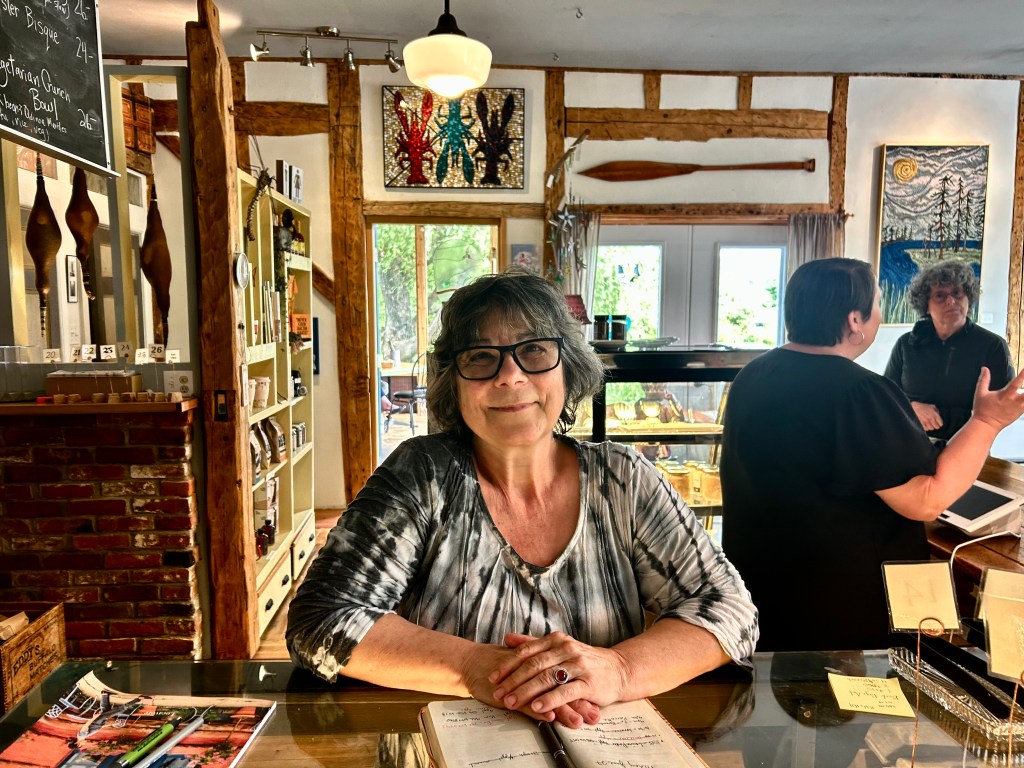
   Some places are in the middle of nowhere. Other places are around the corner. The Bistro Le Chat Bleu is both in the middle of nowhere and around the corner. It is somewhere special. Locals in Baie Verte eat there. Others come down Route 16 from Sackville. Some drive from Nova Scotia, the province southeast of New Brunswick. Many call the place the Blue Cat.

   “Fabulous food at the Blue Cat,” said Robert Thomas, front man of the New Brunswick roots band Robert Thomas and the Sessionmen. “Gisele has created an oasis off the beaten path not to be missed.” The band is on the road more often than not. They know where to get a home-cooked kind of meal when they are away from home.

   “We pay homage to a classic bistro tradition,” said Gisele Landry. She is the owner and operator of the Blue Cat. She turns the lights on every morning. “We devote themselves to providing flavorful food in a cozy setting, using ingredients that, where possible, are sourced here. We buy from local farmers and friends including Bancroft Farm, Wysmykal Farm, and Portage Pork. We love growing our own food, too.” There is a garden outside the back door.

   The back door and garden are on the banks of a creek, some wetlands, and the Northumberland Straight, the body of water that separates New Brunswick from Prince Edward Island. The nearby Baie Verte Nature Preserve helps support eel-grass beds, tidal creeks, and salt marshes. Migratory birds have come and gone from the timeless past.

   The building that houses the eatery is nearly two hundred years old. It was built in the 1830s in a post and beam style. “It was built as a small church while a larger church was being built,” Gisele said. “When the larger church was finished the smaller church was moved across the street and became a store. The back of that church became the front of the store.”

   Robert Goodwin bought the building in 1880 and renamed it Goodwin’s General Store. The town of Baie Verte was flourishing. There were several blacksmith shops, a hotel, and a train station. The general store was in business for generations. It became a community hub. Robert Goodwin’s grandson took up the task of providing necessities, from buttons to dry goods to farming implements, after World War Two.

   In the 1980s another family acquired the building and made it into a variety store. When they went out of business a second family worked it as an antique shop, but quit after a few years. “They complained that when November rolled around it was too cold inside the building,” Gisele said. “They abandoned it.”

   Gisele’s background is in contemporary dance and the arts. “But sometimes life tosses you an opportunity. I discovered this tiny village with it’s beautiful coastal landscape and its big old general store which I thought I could turn into a bistro. I like to say I created the place I was looking for but couldn’t find.”

   She began trying to buy the building in the early 2000s. “By then it belonged to Mike Spence, who was the great grandson of the original owner. He was reluctant to sell because it had finally come back into his family. It took him two years to decide.” It eventually took meeting Mike’s mother. Gisele and her partner were invited to dinner. “She must have approved of us because before long Mike decided to sell.” By then it was 2006.

   “My partner and I were both foodies but he had more experience. He had gotten through university by working in restaurants and had gotten to be a very good cook. The only cooking I had really done was on a 50-foot sailboat when I was working in eco-tourism in British Columbia.” She had moved from her hometown of Moncton, New Brunswick to the west coast in the 1980s. “I stayed for nearly 20 years but came back after a relationship I had there broke up and I was wanting to spend more time with my family, especially my folks.”

   She and her partner started renovations in 2007. “It was freezing cold,” she said. “There was no insulation in the walls. The wiring was ancient.” They stripped the interior. “We exposed the beams and repurposed as much as we could.” They insulated the building and rewired everything. “There was no running water. We had to do plumbing, do a septic system, and dig a well.” They did most of the work themselves, nights and weekends and summers. Gisele had summers off, being a schoolteacher, although it meant no time off.

   She had bought a house in Shediac, a 25 minute drive from Baie Verte, and was teaching French and French culture in an elementary school. When she finally had running water, indoor plumbing, and insulation, she sold her house and moved to Baie Verte.“ The renovations began to move more quickly then,” she said. “We lived in a small room in the back. We had a table, chairs, and a bed.” She has since moved upstairs where she maintains a bigger and more habitable loft apartment.

   In the end, renovating the general store took nearly nine years. “Plenty of people said we were crazy. They said you’re in the middle of nowhere, it will never work. When we finally opened I didn’t know what would happen, but it was the community and the cottagers who surround us who made it happen. The first day many folks showed up. I was serving, my partner was in the kitchen, and we had one helper. At the end of the evening a young man,  a high school student, said he wanted to help. He came back with a resume. It was everybody around here who made it take off. Within a year we had ten full-time and part-time employees.”

   The Blue Cat opened on June 21, 2015. “Ça été un coup de coeur” Gisele said. In other words, “Creating this place was a labor of love.” It was Father’s Day. “My dad always supported me but he passed away six months before we opened. I didn’t consciously open on Father’s Day, but maybe subconsciously it was meaningful for me.”

   The bill of fare at the Blue Cat is eclectic. “We’ve got Greek items, Tuscan items, and Canadian items. We stress fresh, made in house, organic and local as much as possible. I love to travel and experience new flavors, but if I can’t I travel I go to cookbooks. I experiment with recipes, make them my own. I’m curious and like investigating other cultures.”

   Early in the 2025 season she offered up Espagut de Marisco, brought back from Madeira, an archipelago west of Morocco. “After a long hike while we were there, a group of us found a simple place to tuck in for a bite to eat,” Gisele said. “A large cooking pot was placed on the table. Lifting the lid, we were met with the wonderful aroma of seafood. Clams and fish of all sorts in a delicious broth with pasta. It was heaven!”

   A mid-summer 2025 addition to the chalk board behind the counter, which is the only menu, was a karaage crunch bowl. It is a Japanese dish, chicken marinated with soy sauce, ginger, and mirin, then coated in starch, and finally deep-fried until golden brown and crispy. “I didn’t know what it was until we made it.” She didn’t know until she did. “That kind of thing satisfies my curiosity and creativity.”

   The creativity goes hand in hand with intention. Creativity is facing a blank page and taking a leap of faith. Intention is the first step in getting it done. The chalk board menu behind the front counter with its diverse offerings is the proof of the pudding.

   “The Blue Cat is definitely a place to stay away from, that is, if you don’t appreciate gracious service with a smile, a charming and airy atmosphere, and delicious food,” said Carolyn Stampeen, a photographer from Nova Scotia. “And I do mean delicious food. They have a limited menu that changes frequently, but they manage to have options for meat and fish eaters as well as vegetarians. The food is unique and freshly prepared. The first bite of my fish cakes made it instantly apparent they really do make their own food and I appreciate that they don’t rely on salt and fat to make their food taste good.”

   There are some dishes at the Blue Cat that have been on the menu since day one. One of them is the French Onion Soup. “I tried taking it off once, but I got so much feedback that it went back rather quickly,” Gisele said. “What’s comfortable for me is having a portion of the menu that stays and another portion that can change from year to year. I throw in occasional rotating  features. We try to balance staying power with new culinary experiences.”

   There is a Francis-Barnett motorcycle standing on its kickstand between the kitchen and the front counter. It is a lightweight bike nicknamed Fanny-B by enthusiasts. It was manufactured in England from 1919 to 1966. it was popular for its innovative design, two-stroke engine, and speediness.

   “A pal’s father on the west coast had one,” Gisele said. “My former partner loved motorcycles.  When he spotted one for sale in Montreal, he picked it up. We put it in the front window for a while. It attracted a lot of attention. Our thinking was to attract men. Women sometimes say they can’t get their husbands to come to the bistro because their husbands say there’s nothing for them to eat. They want their meat and potatoes. When they saw the motorcycle they became a little more willing to come in and give us a try.”

   Gisele planned on restoring the motorcycle and riding it on the back roads. “But I haven’t had the time. The  bistro takes most of my time and energy. I never say never, though. It’s light enough and small enough for me, so maybe it will happen.”

   Across the street from the Blue Cat is a cairn. A weatherbeaten Monuments Board of Canada bronze tablet is set into the front of it. The tablet is engraved in English and French. “Prehistoric Indian Portage. This route from the Gulf of St. Lawrence to the Bay of Fundy was the chief means of communication between Quebec, Isle Royale and Chicnecto. The portage connected the Baie Verte and Missaquash rivers.”

   There aren’t any Indians in canoes hunting game and trading up and down the riverways and coast anymore. But if there were and they happened to be riding motorcycles instead of paddling canoes, the Blue Cat would be a good place for them to stop for lunch. They wouldn’t be able to read the chalkboard menu, wouldn’t have any idea what coffee is, but the fresh local fare, like wild mushroom ravioli and salmon fish cakes, would be right up their alley.

Photograph by Vanessa Staskus.

Ed Staskus posts monthly on 147 Stanley Street at http://www.147stanleystreet.com, Made in Cleveland at http://www.clevelandohiodaybook.com, Down East at http://www.redroadpei.com, and Lithuanian Journal at http://www.lithuanianjournal.com. To get the site’s monthly feature in your in-box click on “Follow.”

“Ebb Tide” by Ed Staskus

“A thriller in the Maritimes, out of the past, a double cross, and a fight to the finish.” Sam Winchell, Beyond Books

Available at Amazon: https://www.amazon.com/dp/B0CV9MRG55

Summer, 1989. A small town on Prince Edward Island. Mob money on the move gone missing. Muscle from Montreal. A constable working the back roads stands in the way.

A Crying of Lot 49 Publication