Tag Archives: Cavendish PEI

High in the Sky

By Ed Staskus

   “Where are you staying?” Isabelle asked. Her name was officially Isabella, but everybody called her Isabelle. Her close friends called her Izzy.

   “In North Rustico, but not exactly. We’re in the National Park, up from Doyle’s Cove, in the Coastline Cottages.”

   “Where the seaweed smells bad?”

   “That’s the place, except it doesn’t usually smell bad, only when there’s a strong wind blowing onshore that piles it up, or there’s a storm that tears Irish moss from the ocean floor and dumps it on the beach there.”

   “How do you know where the smell comes from?”

   “My older sister Emma told me. She knows everything. She’s always reading books and stuff. She’s my right hand man.”

   “Isn’t she a girl?”

   “I don’t mind. She helps me hunt monsters where we live in Ohio.”

   “Oh, I see. Anyway, we’re in the Gulf View Cottages on that hill above the guard station where you have to stop before coming into the park, except not this year. They have something special going on so everybody can just come and go.”

   “You’re not far away, at all. I could walk over and visit.”

   Isabelle and Oliver were talking on the front deck of the Stanley Bridge Hall, watching cars going in circles on the roundabout. They had spent the past two-some hours listening to Lennie Gallant tell stories and sing songs about Atlantic Canada, the two of them coincidentally sitting in the same row. It was where they met for the first time. Oliver and Emma were with their parents, come from away in Ohio, and Isabelle was with her parents, who were from Louisiana.

   “My people came from Spain, around 1800, when Louisiana was a Spanish colony, and my husband’s people are from here, from even longer back, when the Acadians were deported by the British,” Isabelle’s mother said. 

   “My name is the same as my grandmother’s,” Isabelle chimed in.

   “We live in Lafayette, which is more-or-less the cultural capital of Acadiana, which is where the Cajuns live in the southwest part of the state. My husband has long wanted to visit the island here, around the Rustico lands, where his family came from.”

   Acadians were from the Canadian Maritime Provinces. Most of them were deported in the mid-18th century during the French and Indian War. It was called the Great Expulsion. Thousands of them died of disease or drowning when ships sank. Their land was given to Scottish settlers. Many Acadians were transported to the American colonies. Those that ended up in Louisiana settled in the Atchafalaya Basin and the prairie lands to the west. 

   “Mom, can Isabelle and I go the Sandspit tomorrow?” Oliver blurted out. He wasn’t especially interested in history lessons. School was going to start soon enough and he would soon enough have more history than he could handle.

   “I don’t see why not. Check with her mother, and if she agrees we will take the two of you tomorrow.”

   The next day the mothers dropped the two children off at the Sandspit.

   “We’re going to Raspberry Point Oysters to hear a talk all about oysters and afterwards eat some of them,”  Oliver’s mother said. “Then we’re going to drive to New London to see Lucy Maud Montgomery’s birthplace, before she moved to Cavendish. They have a museum there with some of her personal scrapbooks from when she was working on ‘Anne of Green Gables.’ We will probably stop for coffee somewhere and pick you up around five o’clock.”

   “OK, mom,” Oliver said, barely listening, and running off with Isabelle in train.

   The Sandspit is an amusement park in Cavendish, about six miles from  North Rustico on Route 6, except they didn’t take Route 6. They had taken the Gulf Shore Parkway through the National Park, stopping at the overlook at MacKenzies Brook to see where the Cactus Pot had once been. It had been a sandstone sea arch that was lashed black and blue by Hurricane Fiona in September 2022 and collapsed one Sunday morning two months later after the tropical depression Nicole passed through. 

   “It’s not there anymore,” Oliver said, looking at the nothing where the sea arch had been.

   “When Fiona went by it took a nice little chunk out on the right-hand side of it and that kind of weakened the structure a lot more, and then we had Nicole, and I guess with the heavy rains and winds that we had, it was the last straw, “ said Timothy Gallant from nearby Rusticoville, who was taking photographs of the coastline. “We had been watching it deteriorate for quite a little while, well, since Fiona, and we were wondering when it was going to happen.”

   “It’s scary, but it’s Mother Nature, the  hurricanes, like where we live in Louisiana,” Isabelle said.

   “Dad says they’re scarier these days,” Oliver said.

   “So does my dad,” Isabelle said.

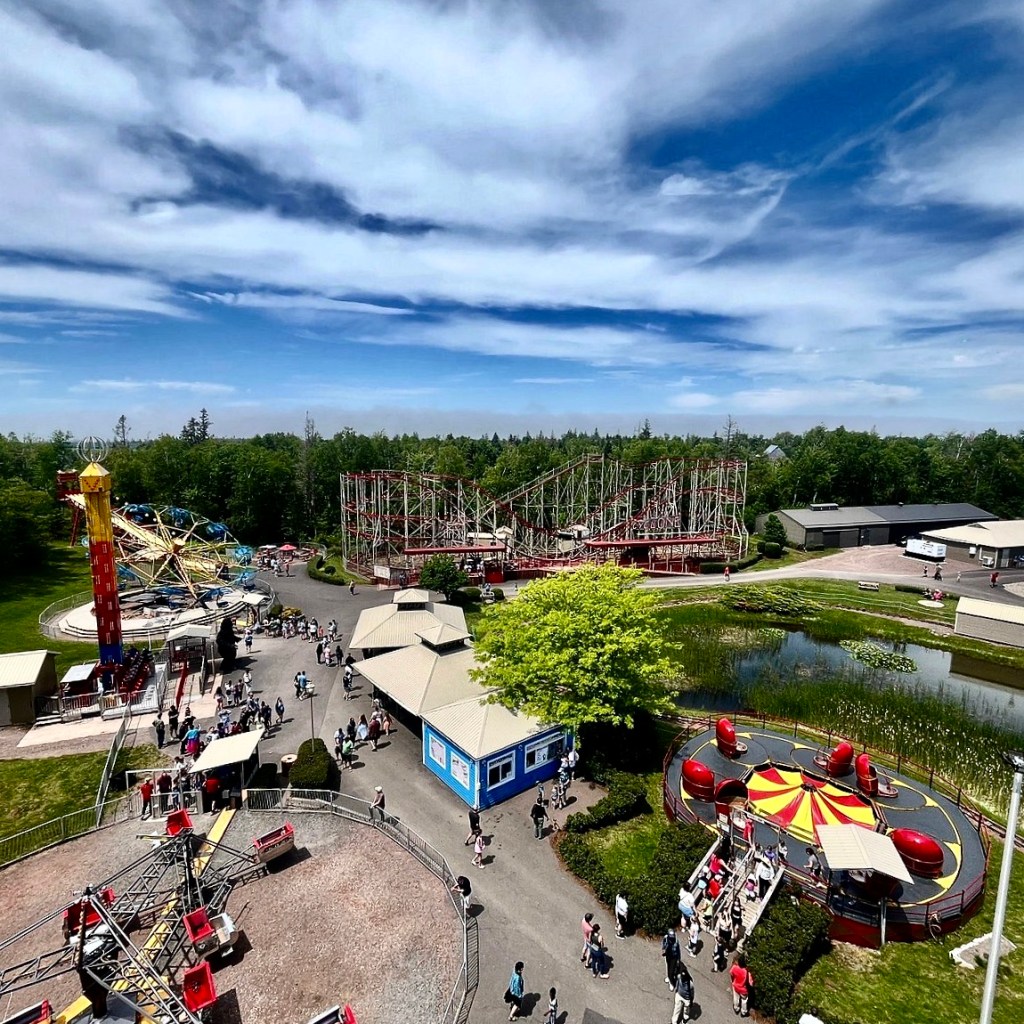
   The first ride Oliver and Isabelle went on at the Sandspit was the Ferris wheel. It was seventy feet high and they could see the whole amusement park from the top. Once they got their bearings they ran from one ride to another. They rode the Cyclone roller coaster, the longest roller coaster in Atlantic Canada, screaming down the sharp drops and through the corkscrews. They rode the Sandstorm 360 pendulum with full rotations. They rode the Paratrooper and Tilt-a Whirl and after that the bumper cars and bumper boats. They whooped it up on the Landslide and the Scrambler. The last ride they went on was the Cliffhanger.

   The Cliffhanger was a drop tower that took its riders fifty two feet up in the air before plunging straight down, creating sudden G-forces, making the riders feel weightless. At least, that is what it was supposed to do, except it didn’t. The ride was halfway up its fifty two feet when it suddenly peeled rubber. By the time it got to the top it was going like a rocket and shot their seat into the sky, scattering a formation of cormorants. The jet stream got behind them. Before they knew it they were  flying over North Rustico. 

   Ten minutes later they were flying over Brackley Beach. The seat was open-air bench-style with an over the shoulder restraint and a lap bar. They kept the restraint and bar where they were. They passed over Stanhope, Grand Tracadie, and Wild Harbour. They were on course for St. Peter’s Bay.

   “I like the green fields, the way they look right next to the red cliffs,” Oliver said.

   “The farm fields down there look like a patchwork quilt my mom has,” Isabelle said.

   They almost slammed into an osprey head on, but the big bird veered away at the last second, whistling and screeching its disapproval.

   “Maybe we could stop at Rick’s Fish & Chips when we get to St. Peter’s Bay,” Oliver said. “The man and his wife in the cottage next to us were there yesterday and said their fish hits the spot.”

   “That sounds great, let’s do that,” Isabelle said. “I’m getting hungry, but, how do we land this thing?”

   Oliver looked all around but didn’t see a joystick or any brakes, or even a parachute.

   “That’s a good question,” he said.

   Frank Arsenault was on St. Peter’s Highway outside of Morell when he saw the seat in the sky. He was driving his Dodge Ram 3500, transporting the drone that he used for crop scouting and monitoring field health back to his barn. That don’t look right, he thought, especially not with two kids along for the ride. He kept them in sight. As they were approaching St. Peter’s Isabelle noticed the pick-up truck tracking them. She made the one-handed Signal for Help sign, waving her hand back and forth.

   Frank sped up to get ahead of them and pulled off into a gravel lot next to the St. Peter’s Bay Volunteer Fire Department. He jumped out of the pick-up truck, unlocked the clamps and tie-down anchors holding the drone in its cradle, freed  the soft straps keeping the folding arms in place, and released the drone. He controlled it to the rear of the Cliffhanger seat and shot a tow line at it. The tow line’s hook snagged the seat. Frank brought it down in ever diminishing circles, landing it in the gravel lot like laying a baby in a cradle.

   “Are you kids OK?” he asked, rushing over to them.

   “Thanks mister,” Oliver said. “We couldn’t have done it without you.”

   “What happened?”

   “The Cliffhanger took off and we just hung on.”

   Frank Arsenault had no idea what Oliver was talking about, but seeing they were unhurt didn’t ask any more questions, packed up his drone, and drove away.

   “Look, there’s Rick’s Fish & Chips across the street,” Isabelle said. 

   “Let’s go.” 

   They ordered a bowl of mussels swimming in garlic butter and a plate of haddock with fries and split their order, eating outside at a red picnic table in the shade of a white spruce.

   “I was getting dizzy up there,” Oliver said. “You came through with that S. O. S. sign. You’re like another right hand man.”

   “Call me Izzy,” Isabelle said, reaching for the last piece of haddock.

Ed Staskus posts monthly on 147 Stanley Street at http://www.147stanleystreet.com, Made in Cleveland at http://www.clevelandohiodaybook.com, Down East at http://www.redroadpei.com, and Lithuanian Journal at http://www.lithuanianjournal.com. To get the site’s monthly feature in your in-box click on “Follow.” His books are available on Amazon and Apple Books.

“Ebb Tide” 

Summer, 1989. North Rustico, a small town on the north coast of Prince Edward Island. Mob money gone missing. A double cross and muscle from Montreal. One RCMP constable working the back roads stands in the way.

A Crying of Lot 49 Publication
The Well Gone Dry

By Ed Staskus

   Cavendish is an unincorporated community on the central north coast of Prince Edward Island, a half hour drive from Charlottetown, the capital of the province. The population is less than 200, although in the summer it swells to more than 8,000, who sleep in tents, campers, motels, cottages, and resorts. In the dead of winter it is a ghost-of-a-place with only a red fox or a white hare crossing Route 6.

   The place was founded in 1790 and named after Lord Cavendish, Colonel of the 34th Regiment of Foot. In 1893 the world-record holding clipper ship Marco Polo got caught in a storm, grounded, and broke apart on its coastline. Lucy Maud Montgomery, the author of “Anne of Green Gables,” grew up there. She is buried in the Cavendish Community Cemetery. It was largely a quiet whistle-stop through the first half of the 20th century

   In the second half of the 20th century campgrounds, amusement parks, restaurants, and bars were built. The PEI National Park was created along 40 miles of the Gulf of St. Lawrence. Some of the province’s best beaches are in the park, including Cavendish Beach. There are four championship golf courses, each one only a few minutes from the others.

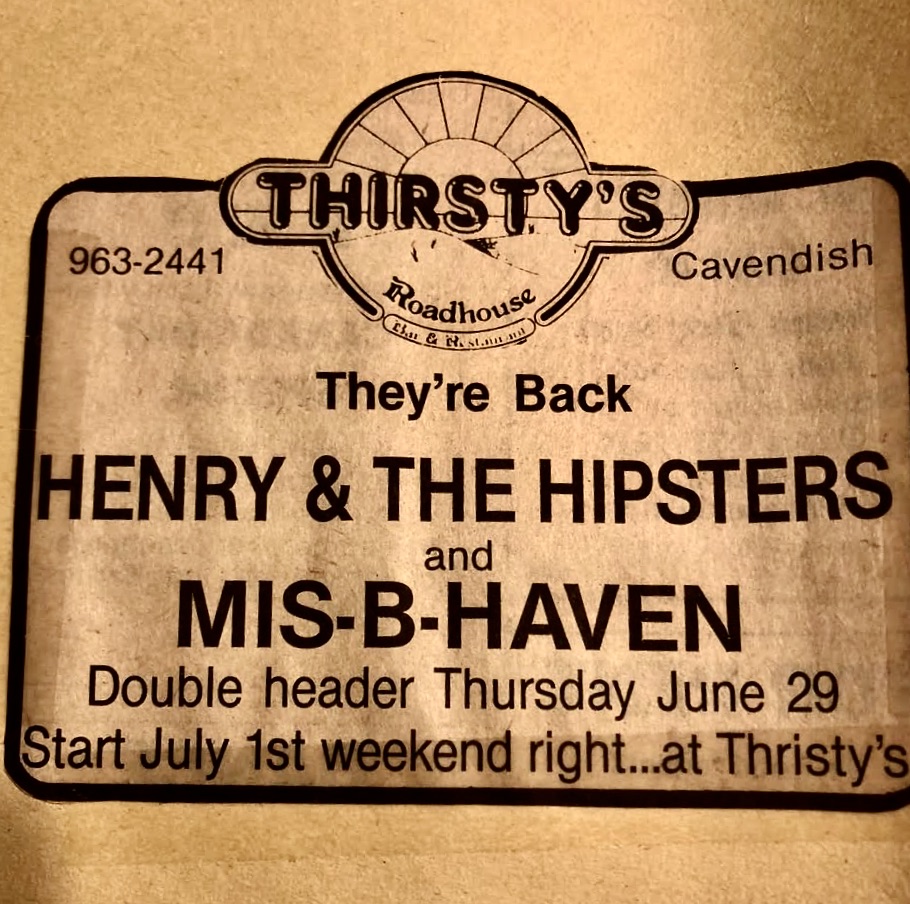
   Cavendish caters to family vacations, romantic getaways, and golfers. It wasn’t always like that. It was once more like Dodge City and Thirsty’s Roadhouse was where to be and be seen. “Cavendish was the place to be on Prince Edward Island,” said Rob Gibson, who was the long-time general manager of the roadhouse. “And Thirsty’s was the place to be in Cavendish, bringing in up to seven hundred people on a Saturday.”

   My wife and I first discovered Cavendish the second summer we went to Prince Edward Island. We had been on an improvised road trip around Nova Scotia three years earlier when somebody we met in Halifax suggested we take the ferry to Prince Edward Island for a look-see. 

   “What is Prince Edward Island?” I asked.

   “It’s a big island on the other side of the Northumberland Strait. It’s one of Canada’s original provinces. Mapmakers sometimes forget to include it on their maps. I shouldn’t say so, I suppose, but it’s even nicer than Nova Scotia.”

   “I’ve never heard of it and I’m from Canada.” I said. 

   I was born in Sudbury, Ontario. My parents were refugees from the Baltics, which they fled after World War Two and before the Iron Curtain came down. My father worked in the nickel mines of the Sudbury Basin for almost ten years. My mother worked as a nanny for thirteen children until she began having children of her own. They left for a better life in the United States once they had saved enough money to make the move. Even though I lived in the United States ever after, I had dual citizenship, which meant I could say I was a compatriot whenever I went to Canada. That and some loose change meant I could get a cup of coffee at Tim Horton’s.

   We took the ferry to Prince Edward Island. We had a Rand McNally road atlas but no idea where to go. We ended up in Cornwall. When it started to get dark we started looking for a place to sleep. We found the Sunny King Motel, which was clean and affordable. We stayed there three nights. We spent two days roaming around the island. It was on the second day, the day before we had to go home and get back to work, that we stopped in North Rustico to get a bite to eat. It was late morning. There was an unassuming place called Lorne’s Snack Shop on the side of the road. They had a fisherman’s breakfast that amounted to an all-you-can-eat plate. The plate was full of fried eggs, a slab of bacon, sausage, grilled tomatoes, chunky home fries, and thick toast with jam. There was a side of baked beans. We took a pass on dinner that night.

   A woman speaking a dialect of English we had to pay very close attention to suggested we take a drive along the coast on the Gulf Shore Parkway. We found out later she was from Newfoundland. We also found out later about poutine at Lorne’s Snack Shop. It wouldn’t be long before we started dashing in for the French fries topped with cheese curds and gravy. We took a drive along the coast and discovered the landscape was pretty as a postcard. 

   We decided to come back the next summer for a two week in one place vacation. There were several groupings of cottages on the Gulf Shore Parkway between North Rustico and Cavendish. One was across the street from MacNeills Brook, but it was too expensive. One was on a hillside overlooking North Rustico Beach, but it wasn’t to our liking. We stopped at the Coastline Cottages across from Doyle’s Cove. It was just right. We made a reservation for the next year.

   Thirsty’s opened the summer of 1984, except it wasn’t Thirsty’s at first. It was G. J.’s North. Phil Manovilli, who was part owner of Gentleman Jim’s in Charlottetown, created the near-to-the-beach bar. He changed the name the next year. It became one of the two most popular watering holes in Cavendish. The other one was the Cavendish Arms, which later became Chevy’s. A sign behind the bar at Thirsty’s said “Hangovers Installed and Serviced Here.”

   Loose-knit groups of the young trekked across the street from nearby campgrounds for drinking, dancing, local bands, high-spirited conversation, and Silly Olympics. The dancing was haphazard, but if you can dance you’ve got a chance. When the night was done there was no need for designated drivers. Everybody walked back to their  campgrounds. There was plenty of grass to cushion face-first encounters.

   The next summer, after miscalculating our ability to drive 1,236 miles from Cleveland, Ohio to North Rustico in one-and-a-half days, we got to the intersection of Cavendish Lane and Route 6 at two o’clock in the morning. When we did we realized we had little idea of where the Coastline Cottages actually was. Everything looked different in the dark a year later. We pulled off onto the shoulder of the road in front of Shining Waters. We were standing outside of our car looking at everything with no lights on anywhere when we heard talking and laughing. Four men were sitting by the light of an electric lantern on the front deck of one of the Shining Waters cottages drinking beer. We explained out predicament.

   “From the States, are you?” one of them asked.

   “Yes, but I’m originally from Canada.”

   “Ah, then,” he said. “Just go that way to the ocean, follow the road to the right, and you’ll come to the Coastline Cottages soon enough. If you get to North Rustico, you’ve gone too far.”

   We found our beds without any trouble and fell into them without unpacking. We woke up to a bad-tempered rainstorm that cleared up by noon and became a sunny day. We were at the top on a long gradually sloping  lawn that ended at the Gulf of St. Lawrence. Every so often a flock of cormorants flew past.

   Now and then Thirsty’s was cited for something or other. Overcrowding was one of the things they were cited for. “The Prince Edward Island Liquor Control Commission has suspended the lounge operation as well as the liquor service in the dining-room of the licensed premises known as ‘Thirsty’s Roadhouse’ located in Cavendish, PEI, for a three day period. The violations of the Liquor Control Act Regulations are ‘A Licensee shall not admit more persons in his licensed premise than the capacity established and posted by the Fire Marshal’s Office’ and ‘A licensed premise shall comply with the Fire Prevention Act.’”

   We stopped in a few times, although we never stopped in on happening weekend nights when there was barely enough room to stand or turn around, much less find a table or a bar stool. The drinks were abundant, the food was fair, redeemed by its agricultural island roots, but the music was mostly unremarkable, cover bands skilled at a few chords and not much else. We did see Mis-B-Haven there, who were three guys and two gals who knew what they about and were fine to listen to.

   “I still have the note my mother wrote allowing me to perform at Thirsty’s when I was under age,” said Janet Boulter, who was one of the gals. “Man, did we have fun!”

   We discovered the roots music of the Maritimes and started going to a Women’s Institute in Stanley Bridge,  a Lion’s  Club in Cymbria, and a community hall in Brackley Beach to hear it. The music is based on Scottish and Irish and Acadian traditions. We especially liked Acadian fiddle music. We went to the Agricultural Fair in Abram-Village to hear Eddie Arsenault and to Charlottetown to hear Barachois. We went to the Piping College in Summerside to hear everything else, including a bagpipe marching band.

   Somebody once said a gentleman is a man who knows how to play the bagpipes but doesn’t. There were no gentlemen in the marching band. You could hear them a mile away.

   Thirsty’s closed at the end of the Labor Day weekend in 2010. “The 1980s and after the bridge opened in 2000 were good to Thirsty’s but the downward spiral began in 2005,” Phil Manovilli said. “Part of it is my fault, our fault. I’m 52 years old now. When I started I was 28. I’m out of that loop,” He was sitting at a table near the dance floor. “Successful bars need to be in touch with their age groups. I’m just so far removed from that now. Kids here now could be my kids.” He watched his two growing children playing on top of a pool table.

   “Cavendish has been changing over the last 10 or 12 years,” said Donald McKearney, the Chairman of the Cavendish Resort Municipality. He said it wasn’t going after the party crowd any longer. “We don’t want the party people. They bring some money to the economy but basically they’ll pitch a tent, 25 people will be there, and they just drink, fight among themselves, and generally carry on. That’s not what we’re looking for.” He said the Victoria Day weekend in Cavendish had gotten to be nothing but a boisterous party weekend on the north shore.

   All good things come to an end. That’s not necessarily a bad thing. It usually means something else is about to begin. The goal of a song isn’t to get to the end but if it doesn’t get there it doesn’t reach its goal. “Thirsty’s holds a special place in people’s hearts and I think they’ll remember it fondly,” Rob Gibson said after the roadhouse’s closing day, standing behind the bar in front of shopworn signs for Alpine and Moosehead beer.

   Yesterday is always just a memory. It’s what is left when the past doesn’t completely unhappen.

Ed Staskus posts monthly on 147 Stanley Street http://www.147stanleystreet.com, Made in Cleveland http://www.clevelandohiodaybook.com, Down East http://www.redroadpei.com, and Lithuanian Journal http://www.lithuanianjournal.com. To get the site’s monthly feature in your in-box click on “Follow.”

“Ebb Tide” by Ed Staskus

“A thriller in the Maritimes, magic realism, a double cross, and a memory.” Sam Winchell, Beyond Books

Available at Amazon: https://www.amazon.com/dp/B0CV9MRG55

Summer, 1989. A small town on Prince Edward Island. Mob money on the move gone missing. Two hired guns from Montreal. A peace officer working the back roads stands in the way.

A Crying of Lot 49 Publication