All posts by Edward Staskus

Edward Staskus is a freelance writer from Sudbury, Ontario. He lives in Lakewood, Ohio. His crime thrillers "Cross Walk" and "Bomb City" can be found on Amazon.

Six Oysters Ahoy

By Ed Staskus

   “I checked the weather report,” Frank Glass said.

   “What did you find out?” Vera Glass asked.

   “It’s going to be the same today as it was yesterday.”

   “Do you mean it’s going to rain all day?” 

   “You don’t need a weatherman to know which way the wind blows, or in this case, rain” Frank said, throwing a glance at the window.

   A steady rain was falling outside the front window of the cottage, down on the long sloping lawn of the Coastline Cottages, on the Gulf Shore Parkway, on the three houses on the other side of the road, and out to the horizon of the Atlantic Ocean as far as they could see. The sky was dark over Doyle’s Cove. Rhino size waves worked up the water. When Frank looked out the northwest-facing back window, the sky, where the weather was coming from, was even darker.

   “What should we do? It rained all day yesterday. I’m getting cabin fever.”

   “We could play cards and talk. Or how about dinner and a show?”

   “That sounds good, especially the part about dinner,” Vera said. “Where do you want to eat?”

   “There’s a show opening tonight at the Victoria Theatre.”

   “All right, but what about dinner?”

   “We could eat at the Landmark, it’s right there, and then go see the show.”

   “I’ve always liked the Landmark,” Vera said. “Eugene is a great cook. They have the best meat pies.”

   “You mean they had the best meat pies,” Frank said. “Somebody told me Eugene sold it and there are new owners.”

   “What? How can that be? Eugene is gone? Did he sell it to his kids, Oliver and Rachel.”

   “I heard they wanted it, but Eugene is all business when it comes to business. He got a better offer.”

   The Sauve family had repurposed an old grocery store in Victoria into a café restaurant in the late 1980s, adding a deck, digging a basement for storage and coolers, and expanding their dining space several times. They were a perennial ‘Best Place to Eat on Prince Edward Island’ in the magazine Canadian Living.

   “It’s now called the Landmark Oyster House,” Frank said.

   “I love oysters,” Vera said. “Let’s go.”

   It was still raining when Frank and Vera drove up Church Hill Road and swung onto Route 6, through North Rustico to Route 13, through Hunter River and Kelly’s Cross. It was still raining when they pulled into the small seaside town of Victoria on the other side of Prince Edward Island, on the Northumberland Straight side, after 45 minutes of wending their way. It rained on them as they hurried into the Landmark Oyster House. There wasn’t a table to be had, but there were two seats at the bar. They took the two seats.

   “Look, we’re right in front of the oysters,” Vera said, as they sat down at the closed end of the bar. “I love this spot.”

   Kieran Goodwin, the bartender, agreed. He was a burly man sporting a trim beard, standing on the other side of the bar, on the other side of a stainless steel bin full of raw oysters on ice. “Best seats in the house,” he said. “They were going to put the bar in the front room, but the dimensions didn’t work out.”

   “Who’s they?” Frank asked.

   Vera looked the chalkboard on the wall up and down. The names of the oysters on ice were written on the board. There were six of them, Valley Pearl, Sand Dune, Shipwreck, Blackberry Point, Lucky Limes, and Dukes. She looked down into the bin. She couldn’t make heads or tails of which were which. She knew raw oysters were alive, more-or-less. That’s all she knew.

   “They are Greg and Marly Anderson,” said Kieran. “They own a wedding venue up the road.” The venue is the Grand Victoria Wedding Events, in a restored former 19th century church. “When this opportunity came up, when Eugene was looking to tone it down a bit, they decided to purchase it.”

   “I worked at the Oyster House in Charlottetown shucking oysters for almost five years,” the new owner Marly said. “We heard that the family wanted to retire because they had been working at this restaurant for 29 years. We already felt a connection to this place and we are friends and neighbors with the family.”

   “They’ve put their roots down in the community, are making their stand here,” Kieran said.

   “It was important that whoever bought the Landmark be somebody who was going to be a part of the community,” Eugene said. “Who was going to open the place and run it and put some effort into it. Greg and Marly are the perfect people.”

   “I like what they’ve done in here, casual but upscale,” Vera said.

   “It looks like the kitchen is more enclosed than it was,” Frank observed.

   “Yeah, they put up a wall,” Kieran said. “Before that, when you used to walk in, you could see right in.”

   “I remember Eugene telling us once he learned all his cooking from his mom. Who does the cooking now?”

   “Kaela Barnett is our chef. She can shuck with the best of them.”

   “We couldn’t do this without her,” Greg said. Somebody has got to have a steady hand on the ladle that stirs the soup. Owners of eateries often spend more time with their chef, keeping the drumbeat rat-tat-tatting, than they do with their loved ones.

   “I’m thinking of doing oysters and a board,” Vera said.

   “That’s a good choice,” Kieran said. “I recommend the large board. You get a bit of everything. I personally like getting some cheese.”

   “Me, too.”

   “Are you oyster connoisseurs?” Kieran asked.

   “Not me,” Frank said. “I can’t remember the last time I ate an oyster, if I ever have.”

   “I wish I was, but I love them,” Vera said. “We were on the island two years ago and went to the Merchantman in Charlottetown with Rachel, Eugene’s daughter, and Doug, her boyfriend. I had oysters and she went through all the ones we ate, explaining them to me.”

   “You know what King James said.”

   “What was that?”

   “He was a very valiant man who first adventured on the eating of oysters.” 

   “Who’s King James?”

   “The guy who wrote the Bible.”

   “No, that was God.”

   “Whoever.”

    “Would you like something from the bar?” Kieran asked.

   “I’ll take the Gahan on tap, the 1772 Pale Ale,” Frank said.

   “What wine goes with oysters?” Vera asked.

   “We have a beautiful California chardonnay,” Kieran said. “It’s great with shellfish. I recommend it.”

   “This is good, fruity,” Vera said, tasting it.

   “We have six oysters,” Kieran said. “You could do one of each.”

   “That’s what I’ll do.”

   “I think I’ll have the seafood chowder and some of the board,” Frank said.

   “Oh, Frank, try one,” Vera said.

   “Lucky Limes are my favorite,” Kieran said. “It’s a good medium oyster.”

   “OK, I’ll try it,” Frank said, shrugging.

   Kieran handed him a Lucky Lime.

   “How do I eat this thing?” Frank asked Vera.

   “Sometimes I chew it, sometimes I don’t,” she said.

   “Some people like putting stuff on it, like horseradish, but it kills the taste,” Kieran said. “Straight up is best. That’s how islanders do it, just shuck it and suck it down.”

   Frank looked at the liquid-filled half shell.

   “From the wide end,” Kieran explained.

   Frank slurped the oyster into his mouth and swallowed it.

   “Now you’re a pro,” Vera said.

   “That wasn’t bad,” Frank said. “How could you tell it was a Lucky Lime? They all look the same to me.”

   “If you look at the chalkboard, it’s one through six. That’s one way.”

   “Can you tell by looking at them?” Vera asked.

   “I can tell by the shell,” Kieran said. “The ones that are more green, that means there’s more saltwater content. So, this is a Sand Dune, quite briny. That one is almost straight salt water.” He pointed to an even darker greener shell.

   “The Shipwreck made me nervous to have it, the name and all, but it was mild,” Vera said.

   “It would be farther up the estuary, closer to fresh water. The Blackberry ones are from Malpeque, which is near Cavendish. The Sand Dune is from Surrey, down east, and the Lucky Limes are from New London Bay. Valley Pearl is from Pine Valley and the Dukes are from Ten Mile Creek.”

   “I thought you were just making all this up,” Frank said.

   “No, it’s like wine,” Kieran said.

   “How did you get into the shellfish racket?” Frank asked.

   “I graduated in business, traveled, lived in New Zealand and Australia, and then came back here, back home, and worked in a bank as a financial advisor for six years, in Summerside and Charlottetown, but then I just got tired of working in a bank, and went back to school.”

   “How did you find your way here, behind the bar?”

   “I date Jamie, who is Marly’s sister.”

   “Are those pickled carrots?” Vera asked, pointing at the charcuterie board in front of her.

   “Yes, and you have raisin jam, too,” Kieran said.

   “Chutney, stop the madness!” Vera exclaimed, spying another glob. “Oh, it’s strawberry jam. It just looks like chutney. It’s delicious.”

   “We had raisin pie at a small diner in Hunter River the other day,” Frank said.

   “The one by the side of the road, up from the Irving gas station?” Kieran asked.

   “That’s the one,” Frank said. “The waitress told us she always thinks of raisin pie as funeral pie, because back in the day, if there was a funeral in the winter, women always had raisin pies for the reception after the memorial service, because raisins keep all year round.”

   “Can I take my oyster shells with me?” Vera asked.

   “Sure,” Kieran said. ”We can get a little bag for you.”

   “You can really taste the sea eating oysters,” Vera said. “Blackberry Point was a little thin and too salty, but once you eat one, and you don’t like it, whoa, what are you going to do? Valley Pearl didn’t have a lot of flavor, but there was some good texture to it. Lucky Lime was very good. My favorite was Sand Dune. It had a strong ocean flavor, briny.”

   “I’ve heard people say oysters are slimy, but the one I had, it didn’t seem that way,” Frank said. “I can see having oysters again.”

   “Don’t people sometimes say the world is your oyster?” Vera said.

   “Do you want dessert?” Kieran asked.

   “Do you have carrot cake?”

   “It’s made here.”

   “We’ll split a slice of that, and two coffees, thanks.”

   As Vera and Frank dug into their carrot cake, there was a bustle at the other end of the bar. Kieran, Jamie, and Marly were huddling over a glowing screen. They looked concerned.

   “Did your electronics go haywire?” Frank asked when Kieran brought them coffee.

   “The microwave in the basement tripped the breaker and knocked out our internet. We hardly ever use the microwave, except to melt butter sometimes. It’s weird, it’s been working until now. We have a thing that magnifies our wi-fi signal. We just found out it’s on the same circuit.”

   “My mother was a pastry chef,” Vera said.” She didn’t use microwaves much, but whenever she did, she always said, ‘Stand back, I’m going to nuke it now!’”

   Frank and Vera used their forks on the last crumbs of their cake and finished their coffee. Frank checked the time on his iPhone. “Time to go, sweetheart,” he said. They paid the bill and stood up to go.

   “Enjoy the show, hope to see you again,” Kieran said as Frank and Vera walked out of the Landmark Oyster House.

   “It’s rainy and sunny at the same time,” Frank said as they darted across the street to the Victoria Theatre, yellow slanting sunlight leading the way through drizzle.

   “That’s Prince Edward Island for you,” Vera said. “By the way, what are we seeing?”

   “Where You Are.”

   “I know where we are,” Vera said.

   “That’s the name of the show,” Frank said.

   “Oh, I see.”

   “Hustle it up, we’re almost late.”

   They went up the steps into the theater, handed over their tickets, got their programs, and sat down. Vera tucked the bag of oyster shells under her seat. “Wherever you are, there you are, boys and girls,” she whispered, making sure they were safe and sound as the lights went down and the show started.

Ed Staskus posts monthly on 147 Stanley Street http://www.147stanleystreet.com, Made in Cleveland http://www.clevelandohiodaybook.com, Atlantic Canada http://www.redroadpei.com, and Lithuanian Journal http://www.lithuanianjournal.com

“Ebb Tide” by Ed Staskus

“A big story in a small town.” Barron Cannon, Adventure Books

“Foul play in the Maritimes, wildlife and all.” Sam Winchell, Beyond Fiction

Available on Amazon: https://www.amazon.com/dp/B0CVDP8B58

Atlantic Canada, 1989. A town on the Gulf of St. Lawrence. A satchel of stolen counterfeit money. Two contract killers from Montreal. A gravel road cop stands in their way.

Home Front

By Ed Staskus

   The green house and the shore road on Doyle’s Cove on the Gulf of St. Lawrence have both been there for more than a century, except last century they changed places. The road used to be on the shoreline and the house nearer the hillside. The green house is on the shoreline today and the road has been moved away from the ocean. It is now the National Park road. The slow steady erosion of Prince Edward Island’s shoreline will take the house before it takes the road.

   “It was on the property but maybe a few hundred yards away,” Kelly Doyle said about what became the green house. When Kelly’s father, Tom, hauled it down to the water’s edge, it was because his new bride refused to stay in the white family house.

   “Dad in the back of his head thought his mother and wife would get along, but they were both very damned strong women,” Kelly said. “They just couldn’t live in the same house, both determined about that.”

   When Doris and Tom Doyle married in 1947, both in their early 20s, Dottie came from Boston and Tom was native to the island. After their honeymoon they moved into the white house on the cove built in 1930 that Tom grew up in.

   “They moved there because it was the only place to live,” Kelly said.

   The houses are on the water’s edge of North Rustico, on the north side of Prince Edward Island, near the entrance to the harbor. The white house is a clapboard two-story home with a dozen windows, two dormers, and three porches on the side facing the water. A broad lawn slopes down to the cliffs. 

   “The first house was bigger,” Kelly said. It had been bigger, but it was gone.

   Kelly’s grandparents, Mike and Loretta Doyle, were playing cards at a neighbor’s house one night in 1929. It was winter, cold and snowbound. Their friends lived about a mile away. At the end of the evening, going home in their horse-drawn sled, they crested a frozen hill. A red glow lit up the sky and flared across the icy cove below them. 

   The pitch-dark night was lit up. The house was on fire. They had left seven children behind in the care of the eldest. Tom was the youngest, four years old at the time.

   “It was a flue fire,” Kelly said. “It burnt down because of the stove.”

   By the time their horses raced down to the house, the parents finding all their children safe and sound outside, there wasn’t much Mike and Loretta could do. There were no neighbors nearby to help and there was no fire department. Mike was able to drag some furniture from the first floor out the front door and saved as many fox furs as he could.

   The house was rebuilt the next year and finished the following year. “The foxes my grandfather saved from the fire built the new house.” Kelly’s grandfather was a fox farmer. What he sold the pelts for went to pay for lumber and the work of the nomadic immigrant laborers who built the house.

   “Nobody knew them,” Kelly said. “They weren’t from around here.”

   It took the Great Depression a year to get to Prince Edward Island, but when it did it disrupted farming, which was what the island did for a living. In 1930 PEI farmers had a large grain and potato harvest. They had never had problems selling to their markets, but by then their markets were going broke. For the next couple of years, nobody was buying. By 1933 average net farm income on PEI was only twenty dollars a year, selling what fruits and vegetables they could. 

   Although agriculture and the fisheries crashed, tourism and fox fur farming boomed during the 1930s. It was how many islanders kept their heads above water. One in ten PEI farmers were involved in keeping foxes. There were 600-some fox farms on the island in 1932. Five years later there were double that. By the end of the decade ten times the number of pelts went to market as had the previous decade.

   “When my mom married my dad, she didn’t get along with my grandmother all that well,” Kelly said. They were living all together in the family house. “My mom and grandmother liked each other enough, but not enough to live in the same house. She finally said to my dad, Tommy boy, you better build me a house.”

   It put Tom Doyle on the spot. There wasn’t the money available for a new house, even though they had the ground for it. “Dad had a choice to make, either lose his wife, or build a house.” He didn’t want to lose his wife, but couldn’t build a house, so he improvised.

   “I don’t know what kind of a building it was originally, maybe a barn,” Kelly said. “It was a few hundred yards away. He hauled it down the hill to the cliffs and turned it into a house, even though he had his hands full farming at the time.”

   Moving a building is no small amount of work. Fortunately, the building was on the small side, there was a short clear route, and there weren’t any utility wires that had to raised. There was no electricity or plumbing to disconnect, either. Still, wooden cribs had to be inserted to support the building inside and out, jacks had to raise it at the same exact rate and lower it the same way, and it had to be trailered slowly and carefully to its new foundation, between the barn and the white house.

   “The structure was almost eighty years old when my dad moved it,” said Kelly. “It was two thirds the size of what it is now. When I grew up in it, it was pretty small. They built onto it in 1964 when I was eight years old. We spent that winter in my grandmother’s house while our house was being renovated.”

   The Doyle kids, Cathy, Elaine, Kenny, John, Mike, and Kelly grew up in what became a two-story, gable-roofed, green-shingled house, even though it was never big enough for all of them. There were never enough bedrooms. “It wasn’t bad, since there was a fifteen-year difference between the youngest and the oldest. We all left the house at different times.”

   Mike Doyle died in 1948, soon after Tom and Dottie’s marriage, leaving Loretta a widow. She started taking in summer tourists, putting up a sign that said Surfside Inn. She harvested her own garden for the B & B’s breakfasts. “My grandmother filled all the rooms every summer. Some Canadians came, and more Europeans, and Americans because they had lots of money.” 

   She ran the inn for more than twenty years. “She got a little bit ill around 1970, and lived alone for six, seven years until my dad moved her into the senior’s home in the village. After that nobody lived in the house for ten years.”

   In the late 1980s Andy Doyle took it over, rechristening it Andy’s Surfside Inn. “My uncle had been gone for more than twenty years, nobody ever heard from him, and then he came out of the woodwork and took it over,” Kelly said. Nobody could believe that a man in his late 60s wanted or could run a five-room inn. He ran the show for almost twenty-five years, outliving all his siblings until dying in his sleep.

   It was the end of Andy’s Surfside Inn, but not the end of the white house. Erik Brown, the son of Elsie, Andy’s sister, moved in, keeping it in the family. The next summer he started renovating the house, restoring it to a home.

   “It was a rambling old house with large rooms and a spectacular view,” said a woman who came to the Surfside Inn every summer from Montreal. “The best thing is having breakfast in the morning with all the guests around one table. One year ten years ago it was filled with mime artists from Quebec, an opera singer from Holland, and a lady from Switzerland. A dip in the cove outside the front door is a must before breakfast. There are lovely foxes gambling outside, in the evening, on the large lawn!”

   “It was neat when I was growing up,” said Kelly. It was the 1960s. “There were ducks geese and sheep and white picket fences. She had lots of tourists from Europe. We were just kids, all these little blond heads running around. I started meeting those people from overseas. It was exciting.”

   Up the hill from the bottom of the pitch where today there is forest land there was in the 1970s a summer camp for clansmen kids. “They called it ‘Love it Scots.’ There wasn’t a tree up there then. A couple hundred kids from around the Maritimes would come and they would teach them Scottish music and all about their heritage. We could hear the bagpipes being played every night on our farm down here.”

   Highland College staged the PEI Scottish Festival there. “After that it was a campground, three or four hundred families up there.”

   When the campground closed, the trees began to grow back until today it looks like the trees have always been there, rimming out the horizon, alive with damp and shadow. Blue jays, weasels, red squirrels, and red foxes live there. The foxes hunt mice and rabbits. The blue jay is the provincial bird and stays above the fray.

   “I grew up with tourists,” Kelly said. “It was different back then. Now people come here and expect to be entertained.” There is Anne of Green Gables for the kids. There is harness racing and nightlife. There are performing arts in Charlottetown, Summerside, and even North Rustico. There are ceilidhs every summer evening all over the island. There is a country music festival in Cavendish that draws tens of thousands of people. There is cultural tourism. There are bus tours. Cruise ships dock in Georgetown, Summerside, and Charlottetown, disgorging hundreds of passengers on shore excursions, looking for something to do.

   Provincial authorities quixotically opened a buffalo park in the 1970s after accepting a score of bison as a gift. Bison is not native to the island. Nevertheless, tourists lined up to see the car-sized animals with horns curving upwards. Bison can run three times faster than people and jump fences five feet high. Fortunately, they were behind six-foot fences.

   “Back in the day people came here with a different attitude. There was lots to do, too, because they found the local life interesting. They liked the humbleness of everybody, the way of life that was so honest and down to earth. PEI wasn’t like the rest of the world back then. The Maritimes were kind of cut off from the rest of the world once the Merchant Marine was taken away. We kind of fell behind.”

   Many of the tourists of the 1950s and 60s were young couples travelling with children. Some were older couples from the American east coast. There were nature lovers. There were artists. Some of them were bohemians. Others came because PEI was the “Cradle of Confederation.”

   “It was a dump here when I was growing up, to be honest,” Kelly said. “Everyone had an outhouse and a pig in the backyard. There were rats everywhere. It wasn’t all that nice in Rustico, but a lot of artists, writers, photographers, people who liked nature came here. It took a long time to come back, in the 70s and 80s, before it became looking like a real village.”

   In the 1970s the provincial government invested in tourism and has stayed invested ever since. It partnered in the Brudenell Resort near Georgetown and the Mill River Resort. Both include golf courses, which are seen as important tourist attractions. Fifty years later, Prince Edward Island is a different place.

   “It’s sterilized now,” Kelly said. “It’s a completely different PEI, and the people who come here are different, different attitude, different interests.”

   Kelly grew up in the green house, on the cove. After storms the beach and red sandstone were often choked with seaweed, stinking for hundreds of yards in all directions Back when some men collected it as fertilizer for their gardens and banked it against their house walls as insulation against the cold winter weather.

   Everybody went to school in town. After school Kelly and his friends didn’t have to go far for fun. “Between the pool hall and the rink, those were my social events, before I could drink. We grew up in the pool hall here.” To this day John Doyle is an outstanding pool player and participates in tournaments. “John is a decent shot,” said Kelly. “Keep your money in your wallet if you want to keep your money.”

   The pool hall was around the corner from Church Hill Road. A boatbuilder had several shops there and one of his sons converted one of them. The shop that became a pool hall was green like the green house. “There were a couple of pinball machines up front and eight tables in the back. it was the spot for boys and girls on weekends.”

   By the time he was 16 years old and finished with ninth grade, he was finished with school. Many boys did the same, going to work with their fathers, or simply going to work. Kelly went west to Quebec and Ontario. When he returned to Prince Edward Island and started going into the tourist trade, the green house was still there. He built a cottage up the hill from it. He eventually built more cottages for travelers.

   In the years since then Kenny Doyle built a brown house behind the barn. After Tom and Dottie passed away, the green house was rented to a young woman from the village for a few years, but John Doyle has taken it over. Bill and Michelle DuBlois, sprung from Elaine Doyle, have built a blue house across the street. It is Doyle’s Land, from the edge of the ocean to the edge of their fields.

Ed Staskus posts monthly on 147 Stanley Street http://www.147stanleystreet.com, Made in Cleveland http://www.clevelandohiodaybook.com, Atlantic Canada http://www.redroadpei.com, and Lithuanian Journal http://www.lithuanianjournal.com

“Ebb Tide” by Ed Staskus

“A big story in a small town.” Barron Cannon, Adventure Books

“Foul play in the Maritimes, wildlife and all.” Sam Winchell, Beyond Fiction

Available on Amazon: https://www.amazon.com/dp/B0CVDP8B58

Atlantic Canada, 1989. A town on the Gulf of St. Lawrence. A satchel of stolen counterfeit money. Two contract killers from Montreal. A gravel road cop stands in their way.

Rat in the Hat

By Ed Staskus

   Aksel was a Norwegian rat, although it would have been a matter of rough-and-tumble if anybody had tried to tell him that. He believed he was a Norman rat since his forebears had come to the New World aboard a French ship that sailed from Bayeaux long ago. The Normans were hardy explorers. Norwegians sat around their fjords moon eyed. It had been more than a hundred generations of his family saga since his ancestors landed on the island. He had never met a Norwegian. He had no idea about any Norwegians. He didn’t even know where Norway was.

   He didn’t know what day week or month it was. He didn’t know it was 1989. He didn’t know he was living in North Rustico on Prince Edward Island, either. He had no clue he was on the North American continent, for that matter, although if he had known it wouldn’t have mattered. He knew where Rollings Pond was. The pond was where he spent most of his nights. During the day he slept in the basement of the Stella Maris Catholic Church. He never went to mass or confession, though. It wasn’t that he was an atheist, not exactly. He simply couldn’t wrap his head around the idea of a Supreme Being who had his best interests in mind. Something was always out to get him. He always had to do everything for himself. He didn’t own anything, not even a fork, knife, or plate, but his bedroom was cozy. He stored some dried food there and had a bed of straw and a small pillow. He kept a handful of loose change he had found at Orby Head under his pillow for a rainy day.

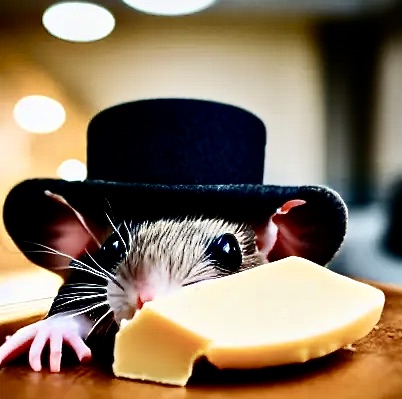
   Aksel was known by the nickname of Left-Hand. How he came to be called Aksel the Left-Hand was beyond him, since he was right-handed. In the event, he didn’t gripe about it. It was better than some of the other rat nicknames he had heard in his neck of the woods, like Seaweed Neck and Foul Fart. He liked to think of himself as a man about town and sometimes wore a bowler hat.

   He wasn’t a farmer. He foraged for food instead of sowing seeds. He gleaned grub far and wide. He ate anything and everything. He thought he had probably eaten hundreds of different foods in his lifetime. He ate any discarded morsels he came across as well as all crops from all fields. He ate all the time, snacking on whatever came his way. Some people said he was a glutton. He didn’t bother disagreeing with them. He preyed on chicks, lizards, and other rodents. He caught fish on Fridays, just in case there was a God.

   His mother let it slip one day that their kind only lived two or three years. He was aghast. There was apparently no time to waste. His eyesight had always been bad. He needed glasses. He was colorblind, too. His other senses, smell, taste, touch, and hearing, were outstanding. He wasn’t especially Olympic Games agile, but he could run, jump, climb, and swim enough to keep danger at bay. He used his face whiskers to feel the world around him. He could wiggle each one of them individually, unlike cats like Snaps, who was from Murphy’s Cove and was always messing with him. He and Snaps were going to have it out one day. The cat was a menace. He was always lying in ambush for him. He had to find a way to cancel out the mouser’s claws, which were razor sharp and deadly. He had the scars to prove it. 

   Except for Snaps, cats rarely bothered Aksel. He was too big for most of them, feral or otherwise. Snaps was a different order of things. He was as big as cats come. The beast was a dangerous son-of-a-gun. The cat and the rat were a stop-and-go dance in the dark. When Aksel stopped, Snaps stopped. When he started up again, the cat was on his heels again, low-down and deadly quiet.

   Islanders didn’t always give Aksel his due. Some called him a street rat, even though he was a field rat. Others with college educations called him a Hanover rat. He tried to explain he was a Norman rat, but couldn’t speak the language of the learned. He didn’t like it whenever he was called a dirty rat. He was fastidiously clean. He washed and groomed himself ten times a day. He was a brown rat with a white underside. He was a big boy, his body length almost a foot long with a tail slightly shorter than a foot. All he had to do was flash his teeth and wiggle his tail at passersby to make them jump and lose their sandwiches.

   He  liked hanging out in the back room of Lorne’s Snack Shop, where out of work fishermen hung around looking for something to talk about. Aksel wore morning dress, a bowler hat, and pantomimed Charlie Chaplin on table tops for handouts.

   One night he met one of his own kind in the dumpster behind the co-op store next to Angie’s Eatery. After giving each other the secret handshake, after which both rats were sure the other one was legit, they chewed the fat and gossiped about local doings. His new-found friend, it turned out, had come off a cruise ship in Charlottetown three weeks ago, gone on a self-guided tour, been late getting back, and was now stranded until another boat rolled in. He had strayed up to North Rustico and was thinking of staying

   “I’m a free agent,” he said. “I can hi-jack myself back onto any boat anytime I want to. You know those round things they attach to mooring lines, what they call rat guards, and how they coat them with grease? First, I puff up my cheeks. Second, I suck up the grease. Third, I spit it out over my shoulder when I go over the rat guard.”

   Cruise ships had been docking in Charlottetown since just after the turn of the century, pulling into port to hearty welcomes. They let loose hundreds sometimes thousands of tourists all at once to stretch their legs, eat, drink, see the sights, and buy “Anne of Green Gables” dolls and effigies. They bought on-the-spur memories to put away in their closets.

   It was after midnight when Aksel and Yeoman Purser, which was what his  friend called himself, went their separate ways. “I know I’m just a rat and a mug, to boot, but I have got to say this seaside place here is something else, just beautiful, and everywhere I look there is food.” The hometown boy twitched one whisker in agreement.

   Aksel was more nocturnal than not, so when Bernie Doiron found something sticking out of the ground when he was plowing on the other side of the hill from Rollings Pond and every nearby cop car, ambulance, and fire truck descended on his stomping grounds, the noise that morning woke him up. He had just rolled over in his straw bed. He coughed and cleared his throat, blinking. He was curious and made his way to the top of the field where it was all happening to see what was happening.

   He had a love hate relationship with members of the human race. On the one hand, he preferred living near them since they were a rat’s number one fast food outlet. On the other hand, they were always trying to kill him. They checked his droppings unceasingly and tracked him by them. They were always putting out traps and bait stations. Whenever they found his nest they gassed it. He had gotten to be as cautious as an accountant. He knew full well what glue boards and snap traps were about. It didn’t matter if they were baited with his favorite fish and cereals. He gave them a wide berth.

   “My mama didn’t raise no fool,” he grumbled to himself.

   He saw what Bernie had seen and what the cops were seeing sticking out of the ground. It was an arm that had been chopped off. He guessed the rest of the body was still in the ground. It looked like they were digging it up, although why was beyond him. He knew they weren’t going to eat the remains, so what was the point? What the human race did day in and day out puzzled him more often than not.

   Aksel quickly lost interest in the unearthing. There wasn’t going to be a free meal in it for him anytime soon unless somebody dropped some crumbs. That was something else that baffled him about men and women. They seemed to never want to pick up food they had dropped, especially the women. In his world no rat did that. They ate everything, no matter what, no matter where it was., and no matter how small it was.

   He ran across the open ground behind him. He could run faster than any man alive. He could run six times his body length in a single second, but he couldn’t keep it up for long. When he got to the tree line and was out of sight, he slowed down and caught his breath. When he got to Church Hill Rd., he looked both ways before crossing to the Stella Maris Catholic Church. There was no sense in being run over on his own doorstep by a four wheel bucket of bolts rolling past.

Excerpted from “Ebb Tide.”

Ed Staskus posts monthly on 147 Stanley Street http://www.147stanleystreet.com, Made in Cleveland http://www.clevelandohiodaybook.com, Atlantic Canada http://www.redroadpei.com, and Lithuanian Journal http://www.lithuanianjournal.com

“Ebb Tide” by Ed Staskus

“A thriller in the Maritimes, out of the past, a double cross, and a fight to the finish.” Sam Winchell, Beyond Books

Available at Amazon: https://www.amazon.com/dp/B0CV9MRG55

Summer, 1989. A small town on Prince Edward Island. Mob money on the move gone missing. Two hired guns from Montreal. A constable working the back roads stands in the way.

A Crying of Lot 49 Publication

Born on the Barachois

By Ed Staskus

“Everybody went to church back then,” said Connie Lott. “Especially in a small community like South Rustico. My goodness, we all went. I just walked up the road from home to the church and the school. It was the same way we walked to the beach and went swimming.”

Walking to the beach was easy. There is ocean to see and wade into on three sides of the school and church.

There were four classrooms to the school and eleven grades, overseen by the Sisters of Notre Dame. Many of the nuns came from the Magdalen Islands, an archipelago not far away in the Gulf of St. Lawrence. “They were one hundred percent French,” said Robin Lott. “Connie’s French is fluid to this day.”

“He means fluent,” said Connie.

“My teachers were Mother Saint Alphonse, Mother Saint Theodore, and Mother Saint Cyril, who was sort of icky,” she said, almost seven decades later. “Kids came to our school from all over, from Hope River and Oyster Bed Bridge.”

South Rustico is on the north-central shore of Canada’s Prince Edward Island, where Route 6 and Church Road cross. The Lion’s Club, caty-corner to the church, hosts ceilidhs featuring local talent in the summer. There is a handsome beach on Luke’s Creek, which is a bay on the far shoreline, near the National Park.

“I went to mass once twice in twelve hours,” said Robin, Connie’s husband. “We were dating, I was on the island, and her mother insisted we go to church Saturday night before stepping out. So, OK, that’s it, we go. Sunday morning they wake me up and say it’s time to go to church again. I said, what? I thought, I must be desperate for a girlfriend!”

“You must have really liked me,” said Connie.

Built in 1838, the oldest Catholic Church on PEI, St. Augustine’s in South Rustico was already an old church when Cornelia ‘Connie’ Doucette and Robert ‘Robin’ Lott got married there in 1960.

“Our wedding party was in Connie’s yard,” said Robin “The barn was behind the house and they brewed homemade beer. We didn’t have five cents to rub together.”

Connie Doucette was born at home in 1938. “I lived in what is now the Barachois Inn on the Church Road,” she said. A barachois is like a bayou, what Atlantic Canadians call a coastal lagoon separated from the ocean by a sandbar. But the home she grew up in wasn’t where she was born, nor were her parents the parents she was born to.

“When my twin sister and I were born, our mother died,” she said.

Her father, Jovite Doucette, a farmer with eight children, owned a house behind the church and croplands between Anglo Rustico and the red sand shore. “Where the new school was built,” said Connie, “that was once part of his fields.” Suddenly a widower, he was unable to care for the newborns of the family.

Cornelia and her sister, Camilla, were placed with foster families. Her sister went to Mt. Carmel, on the southwest side of the island, while she became a permanent ward of the Doucette’s, a husband and wife in their 50s, who lived down the street, literally down the street, on the front side of the church.

“It wasn’t traumatic,” said Connie. “I saw my brothers and sisters, and my father, all the time, and my foster parents made sure I saw my twin sister now and then.”

The Doucette’s she went to live with were islanders who had long worked in Boston as domestics, saved their money, and returned to Prince Edward Island, buying a house and farm. They kept cows and some horses. The Doucette’s were childless, and despite the surname, no relation to Connie’s family.

“I was spoiled since I was their only child,” said Connie “They were older and well-to-do. We had a car, a Ford. I didn’t do too much, although I might have milked a cow once in awhile.”

Before mid-century most of the roads on Prince Edward Island were dirt or clay, muddy when it rained, dusty when it was dry. The first paved road, two miles of it, was University Avenue in Charlottetown, the capital, in 1930. “They eventually paved the road up to the church,” said Connie. “We used to say, ‘Meet me at the pave,’ which was where the pavement ended.”

“Our generation, their children have built modern homes on the island, it’s not as basic as it used to be,” said Robin.

“Everybody’s got washers and dryers now,” said Connie.

Her mother’s sister washed clothes by hand in a washtub and dried them on the line. “We visited them in the late 1960s,” said Robin. “Their house didn’t have running water or electricity. I went out to the well and pulled the bucket up. There was meat and butter in the bucket.”

“That was their refrigeration,” said Connie.

“They finally moved across the road to an old schoolhouse that had power,” said Robin.

“They had thirteen children,” said Connie.

Although he was born in Quebec in 1936, Robin grew up in Ontario.

“My father worked on the boats all the time, Montreal to Thorold, where the locks are, and we ultimately moved there,” he said. From Montreal the passage is down the St. Lawrence and across the length of Lake Ontario to Niagara. The Welland Canal at Thorold, sitting atop the Niagara Escarpment, is ‘Where the Ships Climb the Mountain.’ Standing on viewing platforms, you can watch enormous cargo ships pass slowly by at eye-level a few feet away from you.

When he came of age Robin Lott joined the Royal Canadian Navy.

In the Second World War the Canadian Navy was the fifth-largest in the world. During the Cold War of the 1950s and 60s it countered emerging Soviet Union naval threats in the Atlantic with its anti-submarine capabilities. “We were off the coast of Portugal when my mother telegraphed me that she and Connie had decided I was going to get married,” said Robin.

The executive order said to be ready in October.

Robin and Connie met when she went to nursing school in Halifax, Nova Scotia, where Robin was stationed with the fleet. “I was working a little job at the Charlottetown Hospital,” said Connie. “A friend of mine told me about the nursing course in Halifax. Right away I got the bug.” It was 1956. She and her friend enrolled and her friend’s father drove them to Nova Scotia.

After nursing school, as part of her scholarship agreement, she worked at the Sunnybrook Military Hospital in Toronto. “They gave you $70.00 a month to live on.” She and Robin dated long-distance style. “Whenever I got leave I would pick her up in Toronto and take her to visit with my parents in Thorold,” said Robin. “That’s how I introduced her to my family.”

At the same time, Connie was introducing Robin to Prince Edward Island

One afternoon, making his way from Halifax to Rustico, coming off the ferry in January and driving up Route 13 from Crapaud, he was stopped by a snowdrift in the road.

“The road went down a valley and there was literally six feet of snow piled up,” said Robin. He reversed his 1955 Pontiac back to where his rear tires could get a grip on a stretch of clear road. “I hit the gas as hard as I could, went as fast as I could, hit the snow, everything disappeared, and I came out the other side. By the time I did the car was barely moving.”

Commuting between Nova Scotia and PEI, Robin rode the Abeigweit. Before the Confederation Bridge opened in 1997, the ferry was one of the busiest in Canada, the island’s lifeline to the mainland. Commissioned in 1947, ‘Abby’ was in its time the most powerful icebreaker in the world, capable of carrying almost a thousand passengers and sixty cars, or a train of 16 passenger cars. Its eight main engines drove propellers both bow and stern.

“I used to take the ferry across when we were dating,” said Robin. “You had to sleep in your car if you missed the last one. We would be lined up single file down the road, there were no parking areas back then, a hundred cars inching along trying to get on the first boat in the morning.”

In the dead of winter, crossing the Northumberland Straight from Cape Tormentine, New Brunswick, to Port Borden, Robin Lott stood bundled up against the cold wind hands stuck in mittens leaning over the bow watching ahead as the heavy boat broke through foot-thick ice.

“It would crunch gigantic pieces of ice and turn them over like ice cubes as it went across,” he said.

After they married the Lott’s didn’t stay on Prince Edward Island. “Both of the family farms were no longer farming,” said Robin. “I had an offer to partner in a fishing boat, but I didn’t take that up.” They moved to St. Catharine’s, the largest city in Canada’s Niagara Region, not far from Thorold. They rented an apartment and got busy.

By the time Connie was pregnant with the second of their four children they had bought a bungalow with a 185-foot deep backyard, near Brock University. “We had plans about moving, but we had a low mortgage on this house, so we never did,” said Robin.

They still live in the same house fifty-five years later.

“Those days we used to all climb in our station wagon on a Friday payday and go to the grocery store,” said Robin. There was a meat packing plant in the city and an adjacent store called Meatland. “They sold hot dogs in three-pound bulk bags.”

It’s been said you know you’re from St. Catharine’s if you know the difference between Welland and Wellandport, were in the Pied Piper Parade at some time in your childhood, ate fish and chips at the north corner of the Linwell Plaza, can drive through downtown without getting confused, pissed in the Lancaster Pool, hate Niagara Falls, and bought cold cuts at Meatland.

“When we went on holiday we took our four children and went camping,” said Connie. “We had a hard top tent. We went all over, as far south as the Teton Mountains near Yellowstone Park and as far north as Peace River.”

It is almost two thousand miles from St. Catharine’s to Peace River, and another forty miles to Girouxville. Towing their hard top trailer, their four children in tow, the family piled into their station wagon to visit Connie’s four uncles living there. Her natural father’s brothers had all long since moved from Prince Edward Island to Alberta.

The Peace River valley’s rich soil has produced abundant wheat crops since the 19th century. The town of Peace River, at the confluence of three rivers and a creek, is sometimes called ‘The Land of Twelve-Foot Davis.’ Henry Davis was a gold prospector who built a trading post in Peace River after he made a fortune on a tiny twelve-foot square land claim. After his death a 12-foot statue of him was erected at Riverfront Park.

“It was one of the highlights of our trip,” said Robin, about their excursion out west in 1976.

Girouxville is a small French-Canadian community surrounded by enormous farms. A hundred years ago the local Cree Indians called it ‘Frenchman’s Land.’ Every four years Chinook Days are celebrated. Besides farming, there are thousands of beehives, hunting for elk and moose, and good fishing on the Little Smoky River,

“Three of the brothers homesteaded, the three stronger ones,” said Robin. “In those years you could go up there, it was all bush, and if you cleared the land and farmed it, it was yours. They pulled out stumps and ended up with farms so big they weren’t described by acre, but by section.” Spring, durum, and winter wheat are grown on almost 7 million acres in Alberta. The average farm size is close to double the size of farms on PEI.

The fourth Doucette brother became a schoolteacher, opened and operated a store, married, and propagated a large family.

“We pulled into this little town with our trailer and kids,” said Robin. “Then it occurred to us we had no idea where they lived.” Spying the town’s tavern, they parked in front of it. Robin went into the tavern. He told the bartender he was looking for Emile Doucette. The bartender looked at Robin and bobbed his head at a table set along the back wall.

“Why don’t you ask his brother Leo over there,” he said.

“He was a single man, quite a drinker,” said Connie. “What else do you have to do after working all day on a farm? He eventually bought the tavern.”

That night Doucette’s gathered from far and wide for a reunion dinner. “Everybody came, everybody got together,” said Robin. “We talked long into the night and it was still light enough to see.” In northern Alberta in the summer the sun rises at five in the morning and doesn’t set until almost eleven at night.

The night before they left to go back to St. Catherine’s Uncle Leo invited them to his farm.

“We were having a beer when he said he wanted me to go into his bedroom and pull the suitcase out from under his bed,” said Robin.

“Open it up and count out some money for Connie and Camilla,” said Uncle Leo.

“It was full of cash, honest to God,” said Connie. “We just about died.”

“I was nervous, what if somehow or other he thought I had taken one dollar more than he told me to do,” said Robin. “But then on the mantle in his living room I saw checks for crops he had sold, thousands and thousands of dollars, none of them ever cashed.”

Robin and Connie have gone back often to Prince Edward Island, most recently the past summer when they traveled to the island for the marriage of a granddaughter. They enjoy eating the local seafood, especially oysters, mussels, and lobster. At one time they ate as much whitefish as they wanted.

“When we first started coming back here I would go out with friends who were fishermen and it was nothing to hand line 1500 pounds of codfish in the morning,” said Robin. “But that was all shut down thirty years ago.”

“We ate fish, potatoes, carrots, and turnips when I was a girl,” said Connie. “That was about it. Whenever we went to Charlottetown we ate at a Chinese restaurant, but that was as much as I ever knew. Before I came to St. Catharine’s I had never had Italian food. After I married, my cousin and a friend of hers said, we’re coming over to make dinner. We’re going to make spaghetti. I thought, yippee.”

In the years since, the Lott’s have discovered fare across Canada and the United States, in Spain, England, Austria, and Denmark. “I like to travel,” said Connie. “We’re going back to Mexico at the end of the year.”

“It all started when she came to St Catharine’s,” said Robin. “Our community has every nationality you can shake a stick at, Irish, Italians, Russians, because of the construction of the canal system. There are cabbage rolls and pierogies and souvlaki.”

When Connie’s daughter travels to Prince Edward Island on business, she has stayed at the Barachois Inn. “She told me my old house has changed a little bit, one of the rooms now has an en suite bathroom, but it’s still owned by the same people who bought it,” said Connie.

Not much is better than going from one home to another home to family and eating good food. When Robin and Connie Lott are on PEI they sometimes stop at Carr’s Oyster Bar in Stanley Bridge, zigzagging up the coast to the other side of the Rustico lands, and have lunch on the ocean.

“We love seafood,” said Robin. “It’s our heritage,” said Connie. They eat on the sunny open deck overlooking the dark blue water of the New London Bay. The dark water isn’t new. It’s been there a long time.

The being on the seaside, mind’s eye on the barachois, when it’s a living heritage, is like slipping into the long time ocean and being able to see how deep it is. Or it’s kicking back, having a plate of mussels lobsters white fish right now, watching kids jump off the Stanley Bay bridge. It might be both things at once.

Ed Staskus posts monthly on 147 Stanley Street http://www.147stanleystreet.com, Made in Cleveland http://www.clevelandohiodaybook.com, Atlantic Canada http://www.redroadpei.com, and Lithuanian Journal http://www.lithuanianjournal.com

A New Maritime Thriller by Ed Staskus

“Ebb Tide”

“A big story in a small town.” Barron Cannon, Adventure Books

“A Down East crime mystery, wildlife and all.” Sam Winchell, Beyond Fiction

Available on Amazon: https://www.amazon.com/dp/B0CVDP8B58

Atlantic Canada, 1989. A small town on the Gulf of St. Lawrence. A satchel of stolen counterfeit money. Two contract killers from Montreal. A gravel road cop stands in their way.

Rachel Finds a Ring

   By Ed Staskus

   Although it may be the case that there are either no coincidences or everything is a coincidence, it is certainly the case that everyone in some small or large way is shaped by happenstance. One thing doesn’t work out while the other one does.

   “Coincidence is God’s way of remaining anonymous” is how Albert Einstein put it. 

   “I was out with a group of friends,” said Doug McKinney. “Another friend that I played basketball with back in the day texted me he was at Baba’s Lounge. Although I never went there, I went that one time, and connected with Rachel.”

   Baba is a word that comes from Persian. It is a Middle Eastern word of fondness, like darling. It’s like “My Darling Clementine” in a Pahlavi instead of a cowboy hat.

   “Do you mind if I ask you a question, darlin’?”

   “Where I come from, that’s a term of endearment.”

   “We’re on the same page, then,”

   “No, we connected at the game,” said Rachel.

   Doug McKinney was a power forward for the Island Storm of the Canadian National Basketball League for four years, once on the All-Star team, and to this day holds the playoff record for most points scored in the fewest minutes, when he couldn’t miss in the seventh game of the 2014 NBL Finals.

    “I didn’t see you at the game,” said Doug.

   “I thought you were just skipping over me, but I saw you, and I wrote you.”

    “OK, technically we can start there.”

   “I wrote him, I haven’t seen you in years, I hope you’re OK.”

   “When I saw her at Baba’s she gave me a big hug, we hung out for a little bit, and when I left, I couldn’t stop thinking about her afterwards.”

   They had first met more than ten years earlier, when Doug was playing for the University of Prince Edward Panthers, and Rachel was dating one of his teammates, even though Doug was Best Male Athlete of the Year at the school in 2007.

   “I was always a big fan of Doug’s, a great guy, sweet,” said Rachel.

   In the years since Doug had finished his college career, played internationally, and was in his third season with the Island Storm. Rachel had gone to school in Toronto, lived in Hawaii, and moved back to Prince Edward Island. In the meantime, she traveled, to the USA, the Caribbean, and Europe.

   She and her friend Emma, whose family operates the Chocolate Factory across the street from the Landmark Café, in Victoria, their hometown on the south shore of Prince Edward Island, piled into a 1992 Buick with Emma’s nearly 200-pound Newfoundland dog, Rupert, and drove across and back the range of Canada.

   Newfies are black dogs who don’t necessarily eat too much, don’t necessarily need large houses to live in, but do sprawl across back seats, and do, by necessity, often drool. They are dogs who save babies from drowning and need baby wipes.

   “It took months, a crazy road trip, came home, moved to Ontario, came back, did some more traveling, and every summer worked at the Landmark,” said Rachel.

   The popular eatery, featured in the guidebook ‘Where to Eat in Canada,’ is seasonal, opening in May and closing in October. The Landmark Café was her father and mother’s brainchild 29 years ago. Rachel and her brother have worked there nearly every summer since they came of age, and even before that.

   Doug went the length and breadth of Prince Edward Island during his walk of life with the Island Storm.

   “I got to see more of the island on that team than living here my whole life,” he said. “Going to schools, all these little communities, we’re talking to kids, promoting literacy, all kinds of community stuff.” Even though PEI is the smallest of the Canadian provinces, there are more than 70 municipalities spread out over 2200 square miles, most of them separated by big tracts of farmland. There are only two pocket-sized cities on the island. It is mainly a rural landscape.

   It wasn’t long after their chance encounter at Babas’s Lounge that Rachel and Doug became a twosome.

   “I don’t think either of us were looking for a relationship, but we didn’t want to pass it up,” said Rachel.

   “There was something special about our energy together,” said Doug. “I never felt that energy before.”

   The summer after retiring from pro ball he got involved with skills training at several basketball camps. He helped out at the Landmark Café, too. “Doug was finishing up with the Storm and it was time to start work at the restaurant,” said Rachel. He bussed tables, later on learning to serve. Seasonal work on PEI means being busy as a bee.

   “You could have a day off, but you felt guilty because everyone else was there working so hard,” said Rachel.

   “We didn’t see each other a whole lot, but then it just came together,” said Doug. 

   “It evolved into us realizing we worked well with one another,” said Rachel. ”It’s been almost five years working at different things together, and so we’re at a spot where we’re trying to figure out our next life.”

   “Our next play,” said Doug.   

   “Our next thing,” said Rachel.

   “Working side by side,” said Doug.

   “We do well together,” said Rachel. ”We’re very open with each other. Even if I feel embarrassed, I know I can go talk to Doug about anything. When we worked at the restaurant, I was almost his boss. He can take it.”

   There’s no needing to take it when you’re on the same wavelength.

   Getting in sync at the Landmark Café was one thing. Hiking the Camino was another.

   “That definitely brought us closer together,” said Rachel.

  The Camino de Santiago, sometimes known as the Way of Saint James, is a network of paths passages roads in northwestern Spain all leading to the shrine of the saint. In the Middle Ages it was one of the most important Christian pilgrimages. Even today hundreds of thousands of pilgrims make their way to the Cathedral Santiago de Compostela. Some do it for penance or as a spiritual retreat from modern life. Some hikers walk the route for the challenge. The full length of the trek takes about a month.

   If things go haywire there’s always the traditional queimada, which is a local ritual used to fight off evil spirits by drinking a smoking concoction brewed somewhere out of sight, although planning on a day of R & R after the cultural experience is advisable.

   “Doing the 800 kilometers of the Camino brought us closer,” said Doug. “There’s the physical stress, dealing with it, of the two of you walking 30 kilometers a day with backpacks, side by side.”

   It’s one day at a time on the Camino. It can get hot dusty tiresome. Your partner can start getting on your nerves.

   “There are a lot of couples, they say, I can’t imagine working with him,” said Rachel.

   “I can’t imagine going to two separate jobs, being separate forty hours a week,” said Doug.

   “It gives me anxiety,” said Rachel. 

   “I just wouldn’t be comfortable,” said Doug.

   “I definitely feel safe when Doug’s around,” said Rachel. “In many ways, the more the years go on, the more you want to be together. We can look at each other and we know what the look means. It’s just fun to have, if you’re in that fun busy relationship. It can be great.” 

   A fun busy loving relationship may not make the world go around, but it makes the ride worthwhile.

   After three years working elbow-to-elbow at the family restaurant, in the past year they both found a new path, going to work for Fairholm Properties, which operates high-end inns and lodgings in Charlottetown. They rent an apartment downtown in the capitol city, a few minutes from their jobs. “In the wintertime, it’s storming outside, you can walk just about anywhere,” said Doug.

   The next step was walking to the jewelry store. 

   Like Socrates said, “If you find a good wife, you’ll be happy. If not, you’ll become a philosopher.” Who wants to be a down at the mouth philosopher? After all, Socrates ended up drinking hemlock. Better to ask your better half to pop the top of a Ghahan Sir John A’s honey wheat ale. It pours a refreshing golden color with a white head and it’s not poisonous.

   “I know my future is something colorful, something hands-on, something bright, with Doug next to me,” said Rachel. 

   When you’re hands-on you’re a big part of whatever you’re doing, jumping right in, not taking it for granted, seeing it through from beginning to end. It’s taking the present into your own hands, getting your hands dirty, not handing anything off to anybody else. It’s a show of hands.

   Doug showed his hand the October before last.

   “I didn’t know where we were going to get engaged, although I knew it was going to be in St. Andrews,” he said.

   St. Andrews, at the far western end of New Brunswick, is a small town on the southern tip of a triangle-shaped peninsula in the Passamaquoddy Bay. Many of the original buildings from the 18th century have been restored and are still in place. It is a National Historic Site, although whose history is open to question. Many of the homes were dismantled and floated across the border to the town by disgruntled Loyalists from Maine at the end of the American Revolutionary War, where they were reassembled.

   “It’s literally on the USA border,” said Doug.

   Crossing borders was more seat-of-your-pants once upon a time. Nobody asked for your passport. Everybody wasn’t forever talking about another brick in the wall. You could bring your whole house with you, not just your RV.

   “It is beautiful there,” said Rachel. “Whenever we see a botanical garden, we go to it. When we visit family in New York City, we always go.” Although born and reared on PEI, Rachel’s mother is from NYC and her father is from Montreal. 

   They had lunch in the café at the Kingsbrae Garden.

   “The chef happened to be from PEI,” said Rachel. 

   The Kingsbrae Garden is a 27-acre former family estate turned horticultural oasis of nearly three thousand perennials, shrubs, and trees. It is a Certified Audubon Cooperative Sanctuary. There are peacocks, pygmy goats, and ponds, a cedar maze, and a trail through an old-growth forest. Doug and Rachel walked the gardens after lunch.

   They spotted a giant Adirondack chair, the kind of oversized chair that makes grown-ups look like kids. They stopped in front of the great big chair.

   “Oh, yeah,” said Rachel. “Whenever we see one of those big chairs, we get a picture of us sitting on it.” 

   When they slid off the seat, Doug asked her if she had dropped something when she got off the chair.

   “She didn’t actually drop anything,” said Doug. He didn’t tell her it had fallen far. Rather, it was right there. You don’t want to cast your chance too far when you have the chance.

   “It was all just a ploy to get her to turn around.”

   “I looked and looked, and when I looked back at him he was on his knee.” 

   Doug was on his knee next to a giant pumpkin beside the chair on a sunny October afternoon, the day after Columbus Day, proposing a new world, proposing marriage.

   ”It made us at eye level,” said Rachel.   

   “How long do you want to be loved? Is forever enough?” is how the Dixie Chicks sing it.

   She said yes when she saw the ring, the two of them seeing eye-to-eye in the garden.

   “I’m pumped for the rest of our adventures,” said Rachel.

Ed Staskus posts monthly on 147 Stanley Street http://www.147stanleystreet.com, Made in Cleveland http://www.clevelandohiodaybook.com, Atlantic Canada http://www.redroadpei.com, and Lithuanian Journal http://www.lithuanianjournal.com

A New Maritime Thriller by Ed Staskus

“Ebb Tide”

“Small book, big story.” Barron Cannon, Adventure Books

“A Down East crime mystery, wildlife and all.” Sam Winchell, Beyond Fiction

Available on Amazon: https://www.amazon.com/dp/B0CVDP8B58

Atlantic Canada, 1989. A town on the Gulf of St. Lawrence. A satchel of stolen counterfeit money. Two contract killers from Montreal. A gravel road cop stands in their way.

Calm Before the Storm

By Ed Staskus

   There is plenty of good better best even better seafood chowder on Prince Edward Island, since there is plenty of seafood on all sides of the crescent-shaped province. There are cultured mussels and lean white halibut and wild-caught lobster. They go into the chowder. It comes in cups and bowls. Some of the bowls are bigger than others and can be meals in themselves.

   Or more than a meal in themselves.

   “We had a large bowl of chowder last year, but I don’t see it on the menu anymore,” Frank Glass said to the young man who was putting glasses of water down on their table.

   “We have a really good seafood chowder,” he said, pointing to the menu.

   “Is it a big bowl?” asked Frank.

   The young man sized up an imaginary bowl with his hands.

   “No, the chowder we had was in a bowl about twice that size,” Frank said.

   “Oh, you mean the big ass bowl.”

   “What kind of bowl?” asked Vera Glass, sitting across from her husband. They were at a table at one of the windows overlooking the Clyde River. On the far bank the red roof of the PEI Preserve Company, where jams and jellies are made, glowed in the rolling up of dusk.

   “That’s what we call it in the kitchen,” the young man said. “We don’t call it that on the menu, obviously. If you want it, I can ask, and I’m sure we can make it for you.”

   “You’ll just clear the decks and whip it up, even though it’s not on the menu?” Vera asked.

   “Sure,” said the young man.

   “Sweet,” she said.

   Vera and Frank Glass were at the Mill, a snug as a bug up-to-speed restaurant in New Glasgow on Prince Edward Island. It is neither a small nor big roadhouse, seating maybe fifty diners, right on the road, on a zigzag of Route 13 as it runs south from coastal Cavendish through New Glasgow to Hunter River. There is a performance space on the second floor. A deli case just inside the front door is always full of fruit pies and meat pies. The building is blue, two–story, and wide front-porched. It is kitty-corner to the bridge that crosses the snaky river. The Mill describes itself as “carefully sourcing seafood, steaks and entrees served in a rustic yet refined space with scenic views.”

   That’s hitting the nail square on the head.

   It was the night before Hurricane Dorian slammed into PEI, even though it wasn’t a hurricane anymore when it did. It was a post-tropical storm, which is like saying you took it on the chin from a cruiserweight rather than a heavyweight boxer.

   “Under the right conditions, post-tropical storms can produce hurricane-strength winds,” said CBC meteorologist Jay Scotland the day after the storm. “Dorian serves as a good example that the difference between a hurricane and a post-tropical storm is more about the storm’s structure and not its intensity.” On Saturday morning, moving north, it sucked up energy from another weather system moving in from the west. The winds spreading over the island grew to hurricane strength during the day and the storm unrolled over a larger area than Hurricane Juan, the “storm of the century,” had done in 2003.

   “Look who’s back,” said Vera, looking over Frank’s shoulder.

   “Who?”

   “Michelle.”

   “Good, maybe she’ll be our waitress.”

   “She looks better tonight, not so spaced.”

   “Didn’t she have to go home the last time we were here?”

   “I think so.”

   “Hi, how are you?”

   “Good,” said Michelle. “I see you two have made it back again.”

   “This is our third time here in three weeks, although we’re leaving for home on Sunday,” said Vera.

   “So, you’ll be here for the storm.”

   “It looks like it.”

   “Where’s home?”

   “In Ohio, Lakewood, which is right on the lake, just west of Cleveland,” said Frank. “We get thunderstorms that come across Lake Erie from Canada, but nothing like what we’ve been hearing is going to blow up here in your neck of the woods.”

   Hurricane Dorian hit home like a battle-ax.

   “The result was much higher rainfall and more widespread destructive winds across PEI with Dorian compared to Juan,” said Jay Scotland, the weatherman. On Monday Blair Campbell, the chief executive officer of PEI Mutual Insurance, said they logged the most claims ever on Sunday, the day after the storm. More than four hundred policy holders called in property damage.

   “These are damage claims in the frequency and magnitude that we have not seen before,’’ he said.

   Fishing boats from Stanley Bridge to Covehead were smashed submerged sunk.

   “Sobeys in Charlottetown this morning was worse than Christmas time,” said Michelle. “You couldn’t get anywhere with your cart. Everybody was buying dry cereal, canned fruit, ready-to-eat, and cases of water.”

   Frances MacLure was stocking up like everybody else.

   “So far I have just bought batteries,” she said. “I have two radios and I’m going to make sure one of them is going to work. It’s always nice to be able to keep in touch if the power is out for any length of time,” she said.

   There were sandwich makings on her list, as well.

   “Just for a quick bite if the power goes off.”

   “Everybody was buying batteries,” said Michelle. “The last time a hurricane came to the island, power was out for more than a week.”

   “We are very concerned, we’ve certainly spent the last three days in readiness, in going through all of our checklist and checking our equipment,” said Kim Griffin of Maritime Electric as the weekend approached. “There is a lot of greenery and foliage on the trees, that is a concern to us. So, we are really asking our customers to make sure they are prepared and ready.”

   “When was that?” asked Frank.

   “About fifteen years ago,” said Michelle. “Summerside has its own power, but if it goes out in New Brunswick, this whole part of the island won’t have any power.”

   “Do you still have that moonshine cocktail?” asked Vera.

   “We do,” Michelle said.

   Vera had an Island Shine and Frank had a pint of Charlottetown lager.

   “Are you going to have the big chowder?” asked Vera.

   “Yes,” Frank said.

   “I’m going to have a small bowl of soup and the ribs,” Vera said. “What about going halves on the lamb and feta appetizer? It’s good with everything.”

   “Sure,” Frank said. “You can’t go wrong with the ribs, and the mac and cheese they come with. That cheese from Glasgow Glen, it’s good. I had it the last time we were here.”

   “I hope Emily has the sweet potato curry soup tonight,” said Vera. “Curry is my number one favorite thing in the world.”

   “What about me?”

   “You’re close, maybe third or fourth.”

   “That close, huh?”

   “You don’t like curry, which is a problem. It drops you in the standings. I think Emily is a curry person, like me. She probably does a great Fall Flavors menu.”

   The Mill’s owner and chef Emily Wells was born in England and lived on the continent before coming to Prince Edward Island in 1974 when her parents bought Cold Comfort Farm. She is a graduate of the Culinary Institute of Canada, committed to local healthy food and ethical food production. She has worked in restaurants in PEI and Ontario for more than three decades and is a key contributor to the River Clyde Pageant. The pageant is about the tidal river, and features great blue herons, trout puppets, schools of dressed-up jellyfish, bridge trolls and mermaids and fishermen.

   “I love it when you put curry in things, but sometimes all of a sudden you don’t taste anything else. I feel like you can taste everything in her soups.”

   “It’s like her chowder, it’s chock-full, but nothing’s drowned out, all the parts stand out,” Frank said. “It’s not too busy.”

   “Everything here is always better than I expect, even though I always expect it to be good,” Vera said.

   “My boyfriend is a chef at the Blue Mussel in North Rustico, and it’s hard for us to get a day off in the summer on the same day, so we hardly ever eat out,” Michelle said.

   “After eating here and at the Mussel, we don’t always want to go, anyway, but we ate out in Charlottetown a few weeks ago, and the chowder we got was mostly a milky liquid, with so little fish in it. We poked around for whatever we could find but ended up asking for another loaf of bread. We got it to dunk into the chowder, because there were hardly any pieces of anything.”

   From one end of Prince Edward Island to the other pieces of preparation for the storm were coming together.

   “We have been busy as a team,” said Randy MacDonald, chief of the Charlottetown Fire Department, the day before the storm. “Our team has been making preparations for tomorrow.”

   He said chainsaws and generators were on hand. “We may see trees down, branches down, large branches taking down power lines, that sort of thing.” Rapid response cars, trucks, and ambulances were gassed up full and staff was on the alert, ready to go.

   While the tempest was rolling up the coast, Michelle didn’t only rush to Sobeys. She took matters into her own hands, in her own kitchen, in her own house.  “I live just down the road from here, next to the Gouda place. I send my son there for pizza, since he can walk over.”

   The Gouda place makes artisan cheese.

   “I’ve passed my name and my expertise on to Jeff McCourt and his new company Glasgow Glen Cheese,” said the former Cheese Lady, Martina ter Beek.

   Glasgow Glen Farm slaps out skins from scratch, down the line doing the dough to sprinkling homegrown veggies and meats on the pie, featuring their own made from scratch gouda, working behind the front counter at two long tables just inside the door, wood firing the pizzas in a brick oven.

   In the summer there are picnic tables on the side of the gravel parking lot, a grassy field sloping away from a pile of cordwood.

   “I made chowder,” said Michelle. “It was a fishy stew, like Mel does. I ended up using cod, clams, and scallops. I made everything else, clam juice, potatoes, carrots, onions, and tomatoes out of my garden. Once the potatoes were almost completely cooked, I took the pieces of cod and sat them on top. I put a lid on it and all the flavor of the cod went into it, yeah.”

  She didn’t need any bread to help her chowder out, either.

   While Vera pulled gently at her baby back ribs, Frank started scooping out his large bowl of broth and seafood.

   “How’s the sinkhole?” Vera asked.

   “So far so good,” said Frank. “It’s sort of like a Manhattan clam chowder, like the Portuguese make, and like a seafood goulash at the same time.”

   “Like a cioppino.”

   “Like a what?”

   “That’s the official name of it,” Vera said.

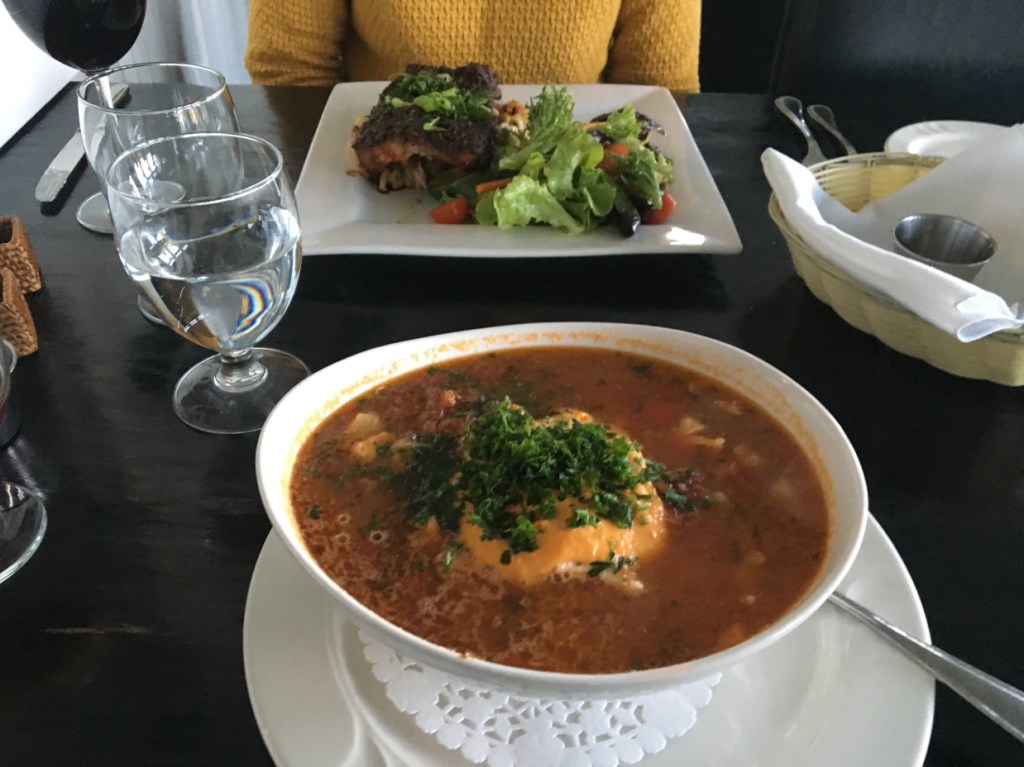
   “Anyway, I can taste bay leaves and thyme, and there might be some oregano in it. It’s loaded with stuff. She must have hit the motherload at the fish market. There are mussels, halibut, lobster, a chuck of salmon, and shrimp.”

   “Emily probably uses whatever she has on hand,” Vera said.

   “On top there’s a red pepper rouille, almost like a pesto, which gives it a kick.”   

   “Are you going to be able to finish it?”

   “I’m going to give it my best shot.”

   Halfway through their meal, when Vera spotted a plate of maple mousse walking by, she said to Frank, “That’s what I want to try for dessert tonight. It’s frozen mousse, like ice cream. I thought it might not be good for sharing, but that thing is more than big enough.”

   “All right,” said Frank, “since that Anna kid is a wizard. First, we eat well, then we face tomorrow, no matter what happens.”

   The Mill was almost vacated evacuated when they paid their bill of fare and left.

   “You wouldn’t know a hurricane is blowing in,” Frank said to Vera as they lingered in the front lot after dinner, leaning against the back hatch of their Hyundai, watching the no traffic on the quiet road, the starry northern sky inky and still above them.

   When Saturday morning rolled around, it started getting dark, and by noon it started raining. It got windy and windier. The Coastline Cottages and the Doyle houses on the other side of the park road lost power in the late afternoon. Churchill Avenue in town was shut down. The Gulf Shore Parkway east from Brackley was shut down. Roads in all directions were shut down, as utility wires and branches blew away. Fences were flattened, roofs torn off, and hundred-year-old trees toppled.

   The damage to the Cavendish Campground, seven-some miles away from where Frank and Vera were staying, was so bad it was closed for the rest of the year. An arc from Cavendish to Kensington to Summerside was walloped. Islanders tarped their roofs, sawed up tree limbs, and hauled away debris for days afterwards. On Sunday morning all the trails administered by Parks Canada everywhere on PEI were shut down until they could be assessed.

   After their cottage lost power, Frank and Vera packed for their drive home the next day and tidied up while there was still some light. “At least we know the mondo bridge is as sturdy as it gets,” said Vera. When it got dark, 19th century-style dark, they popped open the remains of a bottle of red wine and spent the rest of the night riding out the lashing all-out rain and gusting big ass wind.

Ed Staskus posts monthly on 147 Stanley Street http://www.147stanleystreet.com, Made in Cleveland http://www.clevelandohiodaybook.com, Atlantic Canada http://www.redroadpei.com, and Lithuanian Journal http://www.lithuanianjournal.com

A New Maritime Thriller by Ed Staskus

“Ebb Tide”

“Small book, big story.” Barron Cannon, Adventure Books

“A Down East crime mystery, wildlife and all.” Sam Winchell, Beyond Fiction

Available on Amazon: https://www.amazon.com/dp/B0CVDP8B58

Atlantic Canada, 1989. A town on the Gulf of St. Lawrence. A satchel of stolen counterfeit money. Two contract killers from Montreal. A gravel road cop stands in their way.

Finding the Coastline

By Ed Staskus

   “Remember what the dormouse said, feed your head, feed your head.”  Grace Slick, Jefferson Airplane

   There are no dormice on Prince Edward Island but there are plenty of mice. There are house mice, field mice, and meadow jumping mice. There are rats, too. There is the Norway rat, otherwise known as the brown rat. There are so many of them the wide world over, next to human beings, they are the most successful mammal on the planet.

   Mice are little bundles of energy and love to chow down. They eat fruits, seeds, and grains. They are omnivorous, which means they eat plants and meat. They eat just about anything they can find, always on the prowl. The trouble with the rat race is, win or lose, you are still in the rat race.

   Every day is a field day for them on Prince Edward Island. The state of the island is that its land mass is 1.4 million acres and almost half of it is cleared for agricultural use. Back in the day swarms of vermin would show up out of nowhere and eat everything in the fields. In the 19th century, the years 1813 to 1815 were known as “The Years of the Mouse.”

   We had a mouse in our cottage a couple of years ago. We heard something at night scratching around in the kitchen. The next morning, my wife Vanessa found droppings.” She tucked all the food away and told Kelly Doyle, the proprietor of Coastline Cottages, which are five cottages up a sloping lawn from the eponymous Doyle’s Cove in North Rustico. He found a tiny hole at the back of the cottage the mouse had chewed to get in, plugged it up, and set a trap under the sink.

   “That’s the end of that mouse,” I said.

   “You know what they say,” Vanessa said.

   “No, what?”

   “It’s the second mouse that gets the cheese.” The second mouse never showed up, though, staying away in the barley field behind the cottages.

   The first farmers at Souris, near the northeastern tip of the island, suffered many infestations. Vermin can and will lay waste to croplands. The first of a dozen plagues of mice in the 18th century happened in 1724. When the time came to give the town a name, the townsfolk called it Souris, which is French for mouse. Even though they are not welcome, the town’s mascot is a mouse.

   Integrated pest management systems have gone a long way controlling infestations in the 21st century. It doesn’t mean complete eradication of them, but rather bringing their numbers down to where losses are below economic injury levels. It’s about not throwing the baby out with the bath water, but rather ensuring crop protection while reducing human health risks and environmental damage.

   Mice have since gone That’s Entertainment! on Prince Edward Island. In 2010 small bronze statues of them were hidden around Charlottetown. They were based on Eckhart the Mouse, who is a character from PEI author David Weale’s book “The True Meaning of Crumbfest.” The around town game was about downloading clues and trying to find the hidden in plain sight little urchins.

   Mice in the wild live a year or two. The bronze rodents are still in Charlottetown. They’ve been living on their charm and good looks.

   Wherever there are mice there are foxes, and since there are a lot of foxes in the National Park between Cavendish and North Rustico, there are consequently a lot of mice. Foxes are omnivores and eat seeds, berries, worms, eggs, birds, frogs, and fungi. They are a lot like the mice they chase and snatch up. They eat everything. In the winter they eat lots of rabbits.

   We saw red foxes the first time we drove up to the north side of the island. They sat on the side of the road eyeing us. We were on a car trip across Nova Scotia, our second in as many years, when somebody mentioned Prince Edward Island. “What’s that?” Vanessa asked. I was born in Sudbury, Ontario, and was still a Canadian citizen, but couldn’t answer her question. I had never heard of the place.

  We took the Northumberland Ferry at Caribou to the island the next morning. The best dressed person on board in the brisk wind was a Chow Chow. We stayed at the Sunny King Motel in Cornwall. The next day we had lunch sitting at the bar inside Churchill Arms in Charlottetown. Vanessa had a Havarti and vegetable sandwich, and I had a clubhouse.

   “How long are you here?” asked the bartender.

   “Just a day or two. We need to be back to work on Monday.”

   “Where are you from?”

   “Northern Ohio, west of Cleveland, on Lake Erie.”

   “Eerie as in scary and strange?”

   “No, it was named after the Erie tribe of Indians.”

   “You mean Native Americans?”

   “Right, the Indians. The Iroquois called them Erie, which means long tail, because they wore bobcat fur hats with the tail on the back.”

   “Don’t bobcats have short stubby tails?” asked the bartender.

   “That’s the part that stumps everybody.”

   “We had never even heard of Prince Edward Island before,” Vanessa said.

   “I’ve seen some Canadian maps where we aren’t even there,” said the bartender, refilling our coffee cups. “There’s New Brunswick and Nova Scotia and the next thing is Newfoundland, which is not even really Canadian.”

   “I’m originally from Sudbury and I had an idea there was something here, but I couldn’t have told you what it was.”

   The bartender gave us a Visitor’s Guide.

   “You might try the north coastal side of the island, Rustico, Cavendish, Brackley Beach, up around there.”

   We took Route 7 to North Milton and Oyster Bed Bridge, took a left to North Rustico, and kept going to Cavendish. We saw a Visitor Center, turned right, and drove to the National Park. It was mid-September, and the toll booths were closed. There were no boom barriers. We drove onto the Gulf Shore Parkway. The road followed the curve of the ocean, the Gulf of St. Lawrence, the landscape rolling.

   We stopped at MacNeill’s Brook and took a walk on the beach. The freshwater outflow comes from the brook, part of David and Margaret MacNeill’s farm and house a hundred years ago, when they were cousins and neighbors of Lucy Maud Montgomery, who wrote “Anne of Green Gables.”

   We stopped at MacKenzie’s Brook and walked up to a grassy bluff. The brook passes underneath the parkway through two culverts. There was a long beach to the west and red sandstone cliffs to the east. One enormous rock in the cliff face had an enormous hole in it. We lay on our backs on the grass and looked up into the sky. The sun was warm on our faces and the breeze was cool.

   We stopped at Orby Head, parked in the gravel lot, and walked to the edge of the cliff. Cormorants was nesting in the cliffs. Some of them were fishing off the shore, others were drifting, their heavy bodies low in the water, while others were chilling in the sunshine on a ledge. They are large water birds with small heads on long necks. Their thin hooked bills are about the length of their heads. The birds are dark, brownish black with a small patch of yellow-orange skin on their face. They look pre-historic up close.

   “Oh, man, this is where we should come next year,” I said, getting back into our car.

   “I am with you,” my wife said.

   Before we could pull out, a red fox ran diagonally across the parking lot and jumped into the brush, hellbent after something running for its life.

   We passed Cape Turner and a minute later the road dipped down to Doyle’s Cove. On our left were two older frame houses, one green and the other one white. The white house had a sign on it that said, “Andy’s Surfside Inn.” On our right, up a grassy slope, were some cottages. The sign at the front of the drive read “Coastline Cottages.” We drove up to the office and parked in front of a neon OPEN sign in the window.

   A Japanese woman carrying a blue plastic bucket came out of one of the cottages. She told us her name was Katsue and that the owner was away, but she could show us one of the cottages, the one she had just finished cleaning. By the time we left, our names were on the paper schedule board for a cottage the next September, right after Labor Day.

   A year later, driving up and down Route 6 between North Rustico and Cavendish in the dark, after twelve hours in the car, having lost all sense of where exactly the park road and the cottages were, we finally found the Visitor Center on Cawnpore Lane. It was closed, but we heard voices across the street at Shining Waters. One of the cottages was still lit up and four men were talking laughing drinking beer on the deck.

   None of them knew the Coastline Cottages, but all of them knew where the shore road was.

   “That’s a step in the right direction,” Vanessa said, shooting me a vexed relieved look. “Maybe we won’t have to sleep in the car after all.”

   In the event, we almost fell asleep on the deck of our cottage after we found it, wrapped in blankets, looking up at the wide expanse of stars in the inky sky, stars we never saw at home, where the lights of the city obscured the heavens.

   “Keep your feet on the ground and your eyes on the stars,” I said.

   “I know you just said that, but who said that?” asked Vanessa.

   “Teddy Roosevelt, in the biography about him I’m reading.”

   “We are all stars, and we all deserve to twinkle.”

   “Who said that?”

   “Marilyn Monroe.”

   I read more books than watched movies and my wife watched more movies than read books. I was a by-the-book man, and she had her head in the stars.

   The next morning, the day clear brisk breezy, we unpacked and went for breakfast at Lorne’s Snack Shop in town. We both ordered the special, sausage eggs hash fries and toast at the kitchen hole at the back of the front room. There was a mixed bag of potato chip bags on wire racks attached to a wall where we stood.

   “We got a couple gut founded,” we heard the woman at the counter say to the other woman at the stove. “Fire up a scoff.”

   We sat down on worn chairs at a worn table. Everything was in apple-pie order but worn. There were scattered card tables in a back room and shelves on two walls full of VCR tapes for rent. Three rough and ready men talking low threw us a glance.

   When the front counter woman brought me my plate, I asked, “Is that for both of us?

   “No, that’s your, we’re just doin’ the other toast.”

   “It’s a good thing we haven’t eaten since yesterday afternoon.”

   “Where yah longs to?”

   “What’s that?” I asked.

   “Where yah from?”

   “The States,” said Frank. “What country are you from?”

   “Here in Canada, man, from Newfoundland.”

   “Oh.”

   Twenty years Lorne’s Snack Shop is gone, their poutine a strike-it-rich memory. The Co Op is gone, and although the food market across the street isn’t any bigger, it’s better. Amanda’s and their wood-fired pizza pies is gone, taken over by Pedro’s Island Eatery, big plates of fish on a new deck. The hard scrabble park road has been replaced, flanked by an all-purpose walking running biking path. The toll booths at the entrances to the National Park have been torn down and rebuilt.

   “This is swank,” I said. “What do you call these things, anyway?” I asked a teenager in a green shirt in the toll booth.

   “The guardhouse,” the teenager said, leaning out the window of the air-conditioned guardhouse.

   The town is bigger than it used to be. A trove of big ass houses has been raised in the triangle formed by Harbourview Drive, Church Hill Avenue, and the North Rustico beach. When winter comes most of the occupation army leaves and the houses sit empty. A brick-faced line of condos has been built on Route 6 between Co Op Lane and Autumn Lane.

   One summer evening we threw our beach chairs in the back of our Hyundai, popped open a bottle of wine, and drove to Orby Head to see the sun set. We unfolded our chairs at the edge of the cliff, poured ourselves wine in plastic water cups, and settled down, the orange red orb of the sun sinking over Cavendish. A sweet-tempered breeze drifted through the stunted trees.

   A minute later we were running back to our SUV, our wine splashing, the cork God knows where, swatting at the lynch mob of mosquitos coming after us. “What the hell,” I said as we stepped into the cottage. “You try to enjoy some out of doors and see what it gets you, a swarm of biters.”

   “The out of doors gets you a lot, but not just strong legs and a suntan,” Vanessa said. “Sometimes it’s best keeping the outdoors outdoors.”

   “Some people say the mosquito is the official bird of PEI,” Kelly Doyle said. “The sunset is when you’re most likely to feel them. If you were to stop at a certain place, like Orby Head, and get surprised by the little buggers, just move on. So long as it’s not sunset, they won’t follow.”

   It’s the price you pay to feed your head.

   A Stanford University study found that students who walked in a green park for an hour-and-a-half exhibited quieter brains than those who walked next to a rip-roaring highway. They manifested less activity in the prefrontal cortex, a part of the brain associated with depression. Walking in a natural setting was shown to improve frame of mind. It also avoids clouds of carbon monoxide soaking into the lining of your lungs.

   A study at the University of Exeter in En­gland found that people who moved from concrete spaces to green spaces experienced a clear-cut improvement in their mental health. The boost was long-lasting, mental distress over all lessened even three years post-move. An analysis in 2018 of more than a hundred studies on green spaces found that the benefits included upgraded heart rate and blood pressure, lowering of cholesterol levels, and better sleep duration. There were discernable reductions in type II diabetes, cardiovascular mortality, as well as overall mortality.

   Nobody needs to wash down the ‘Drink Me’ potion Alice did to get perspective, or slip away on Grace Slick’s Orange Sunshine, to have the zero cool red cliffs make your head spin. Just go there and see for yourself. Don’t stand too near the edge, though. Don’t go at sunset, either.

   “Maybe about fifty feet of our land has fallen away since I was a boy,” said Kelly. “It might be climate change, but the storms have gotten more intense, for sure. This island is made of sandstone. We’re like a BIC lighter, not meant to last. There’s no stopping that. It’s just our geology.”

   There is no granite or hard rock to keep the breaking waves away. “Everybody knows it,” said Adam Fenech, director of UPEI’s Climate Lab, echoing Kelly Doyle. He meant everybody on the island, like the Doyle’s, who have been there going on two hundred years. But nothing lasts forever, not mice, not red sandstone, not even hard rock. In the meantime, put on your walking running biking shoes, get out into outer space, never minding the bugs or what’s in the cards.

   Feed your head while you can is where it’s at.

Ed Staskus posts monthly on 147 Stanley Street http://www.147stanleystreet.com, Made in Cleveland http://www.clevelandohiodaybook.com, Atlantic Canada http://www.redroadpei.com, and Lithuanian Journal http://www.lithuanianjournal.com

A New Maritime Thriller by Ed Staskus

“Ebb Tide”

“Small book, big story.” Barron Cannon, Adventure Books

“A Down East crime mystery, wildlife and all.” Sam Winchell, Beyond Fiction

Available on Amazon: https://www.amazon.com/dp/B0CVDP8B58

Atlantic Canada, 1989. A town on the Gulf of St. Lawrence. A satchel of stolen counterfeit money. Two contract killers from Montreal. A gravel road cop stands in their way.

Down the Bay Boys

By Ed Staskus

“I’m going up the country, babe, don’t you wanna go…”  Canned Heat

“We’re always around here,” said Denver McCabe, casting a glance over the chairs and tables on the deck on the sparkling summer water.

Carr’s Oyster Bar is on the New London Bay, in Stanley Bridge, on Prince Edward Island, the Atlantic Canada province where Canada happened about 150 years ago. Opened in 1999, from the deck, kicking back with a pint on a warm day, you can see the wharf across the bay where oysters are landed.

They’re shucked when you order them, served with a fresh lemon slice, or you can order clams mussels quahogs. Last year the restaurant won the Restaurants Canada Shellfish Excellence Award. “I’m happy to showcase the best shellfish in the world,” said Phyllis Carr.

Whenever she slides a sharp knife into an oyster and pries it apart at the hinge “it’s the best one ever.”

“He was a bold man that first ate an oyster,” said Jonathan Swift.

Life is too short to not have oysters. But, they are best eaten with friends family anybody somebody else. Although oysters keep themselves to themselves, they’re a weird thing to eat by yourself.

Native North Americans harvested them for thousands of years. In the 19th century New York City was filled with oyster saloons. Today no oysters anywhere taste as good as those found on the north shore of PEI.

Denver McCabe and Brenden Carr are ten-year-old boys born and bred on Prince Edward Island. Until recently both lived in Stanley Bridge, a small town of fewer than 300 on the north central coast of the island on the Gulf of St. Lawrence.

“He swarms me when I come home from Edmonton,” said Denver. “I go to his house every day.”

They have spent all of their summers on the bay, along the Stanley River, and making the scene daily on the deck of Carr’s Oyster Bar. ”We grew up together,” said Brenden. “He’s my best friend.”

You can’t Madison Avenue anybody to be your best friend. Denver and Brenden have known each other since they were anklebiters. What do you do with your best friend when you’re both ten-years-old? A good time doing a whole lot of nothing, eyeing and gabbing about everything, cruising doing me, making fish faces, making mischief, making your summer jump, and jumping rocks.

“Most of the time we go on the rocks,” said Denver. “That’s how I get my energy up.”

The riverbank and along the shoreline are protected by piled rocks, riprap revetments.

“We go to my house and play on the trampoline, too,” said Brenden.

“I do flips,” said Denver. “I know how.”

“On the rocks we do hard core technical stuff. We jump rock to rock. He challenges me,” said Brenden.

“Sometimes I jump from one rock to the third one,” said Denver.

“So do I. I never fall down.”

“Me neither,” said Denver. “The other day I fell. Did I fall?”

“Unless you were faking me,” said Brenden.

Even though they aren’t yet preteens, they talk like old friends, the same as thinking out loud, their thoughts like toppings that can’t always be fathomed into a pizza.

“I fell once or twice, probably. It was because I jumped from one rock to a far, far one. I just got back up.”

Many people do all their playing when they’re children, all their working when they’re grown up, and all their retiring when they reach old age. When you play, no matter how old you are, you can be a kid as long as you want. Just watch out for the rocks.

“He jumps off the bridge,” said Brenden.

The Route 6 main street bridge crosses the Stanley River at the New London Bay. On one side of the bridge is Carr’s Oyster Bar and on the other side of the bridge is the Race Trac gas station and Sterling Women’s Institute community hall. Jumping off the bridge thirty feet into the bay is summertime chill in Stanley Bridge.

“We go to the bridge and tell them to jump, hurry up, don’t be scared,” said Denver. “I did it when I was eight. They’re teenagers, but they’re scared.”

“They never jump when we tell them,” said Brenden.

“I jump with my crush, Jess,” said Denver. “She’s a waitress here at Carr’s.”

“She’s my crush, too.”

“I got engaged to her,” said Denver.

“Me, too,” said Brenden.

“Whenever we tap our cheeks she has to come over and give us a kiss on the cheek.”

They tapped with their index fingers, the both of them. They’re not shy on their home turf on the Stanley River. They believe in their flyness.

Jessica Gillis, twice their age and more than a foot taller than the boys, walked over to where they were warming seats at a table on the deck on the bay eating nachos and sipping from childproof Shirley Temples.

They looked up. “Oh, my God, now what?” said Jessica, looking down at them. It was like ‘The Attack of the 50 Foot Woman’.

They tapped their cheeks again.

“No,” she said.

Even though both boys are in love with Jess, they don’t actually hang out with her. It’s not complicated. Most boys don’t like girls hanging around when they’re doing their own boy things.

“I never jump the bridge,” said Brenden. “I can’t swim.”

“I learned when I was four,” said Denver.

“I took lessons for a year,” said Brenden. “But, I don’t like people bossing me around.”

“It’s kind of weird because he lives right beside the water,” said Denver.

“I almost floated away one day,” said Brenden.

“It was a windy day and it blew his splash meter away,” said Denver. “He was trying to get it back, but the wind blew him away, too.”

“I floated to where it was just to my cheeks.”

“He needed my help, but I couldn’t swim fast because there were oyster traps everywhere.”

“My brother and dad were there, but then they went on their boat,” said Brenden.

“He stayed in the water and it became fine,” said Denver.

Brenden’s father David Carr is an oysterman. “He has his own boat,” said Brenden. “He catches eels, too. When he goes eel fishing he goes with his brother Stan.”

Eels are nocturnal, hiding during the day. Fishermen hunt them at night. Few fish put up the fight that a good-sized eel does. An eel held by the tail is not necessarily caught, yet. They can swim backwards as well as forwards.

“We went to the sand and I got a bad, bad sunburn,” said Brenden.

“Same with me, on the same day.”

“Yeah, but mine was worse.”

“That’s why you didn’t catch Jacob.”

“He’s sketchy,” said Brenden, making a face.

“He said my friends run away because of my ugly face. That pissed me off. I ran after him and pushed him. He ran to the park where there were booths being set up for Canada Day and got under one. I couldn’t bend down because my back was burnt from the sunburn. I would have given him a big one.”

After his sunburn got better Brenden had an airbrush tattoo of a barcode stencilled across his chest. It was at the Canada Day parade festivities concert fireworks day in nearby North Rustico. “It’s because I’m funny talented a good actor good singer good dancer and handsome and beautiful.”

Denver had a red maple leaf tattooed on his cheek. “I’m hot,” he said, looking out from under the brim of his bright orange Bass Pro Shop baseball cap.

“When I walk into a sauna I make it even hotter.”

“Dreams, Denver, dreams,” said Brenden.

Trying to tag along with the stream of consciousness of ten-year-olds can be like trying to play putt putt during an earthquake.

Lucy Maud Montgomery, who grew up on PEI and wrote “Anne of Green Gables” a hundred-or-so years ago, wrote that Stanley Bridge “used to seem quite a town to my childish eyes. It was the hub of the universe then – or of our solar system at the very least.”

“Brenden and I are cousins,” said Denver.

“My great-uncle, Granny Phyllis’s husband, is his grandfather,” said Brenden. “Phyllis was my cousin before she married, so I’m related to Denver both ways.”

“My grandpa is a Carr and Granny Gallant was a Doiron before she changed to Gallant,” said Denver. “Everybody in Granny’s family was a Gallant. My grandfather was Tommy Gallant. He found the Marco Polo. He’s famous on the island. He’s famous in heaven now.”

“He’s my great-uncle,” said Brenden, “I took dancing from him.”

Given enough time and left to their own genealogical devices they would likely conjure everyone on the island a cousin in the 9th degree, and discover a common ancestor in steerage on the St. Jehan, one of the first passenger ships sailing to the New World back in the 1630s.

“We’re from here,” said Suzanne McCabe, Denver’s mother.

“Cory, my husband, is from Rustico. We moved to Edmonton for the work. My grandmother and Brenden’s grandmother are sisters and my dad and his grandfather are brothers.”

The first explorers to land on PEI were the French, who called it Isle St. Jean. They fished for cod and traded for furs. The first settlers were Acadians. After the Seven Years War it was re-named Prince Edward Island. Scots, English, and Irish emigrants sailed to the British colony and built their own close-knit communities. Doirin and Gallant are Acadian surnames. McCabe and Carr are English Irish Scottish surnames.

Most Acadians are bilingual, but nowadays some speak English with a French accent, even though, for one reason or another, they no longer speak French.

“When I wake up I go on my phone, track what time it is, eat breakfast, and brush my teeth,” said Denver.

“I don’t have a phone. Sometimes I have your phone in my pocket,” said Brenden.

“It’s dead,” said Denver.

“I was cranky this morning. My brother woke me up early. I usually get up at six, but there’s no school anymore,” said Brenden.

Denver and Brenden help out at Carr’s Oyster Bar peeling potatoes and washing windows.

“I do everything,” said Denver.

“I help my father get fish,” said Brenden.

“Me and Brenden used to go to the sand dunes and collect hermit crabs,” said Denver. “But, he hasn’t come to his job, the last time was a year ago.”

“Me?”

The most freedom most people ever have is when they misspend most of their free time as children.

“More than a year ago, actually.”

“I don’t know about that,” said Brenden.

“You’ve never come since you handed out menus and got no money.”

“I got paid five dollars and I got another five dollars when you won the 50/50.”

“Oh, yeah,” said Denver. “My aunt is religious and prayed to win the 50/50. When she did she gave me some of it and I gave some to him.”

“Do you remember when I peeled the carrots in the shed?” asked Brenden.

“Look at my muscles,” said Denver, flexing a bicep.

“You don’t have any.”

“I definitely feel something on my arm. What do you think this is?” said Denver, pointing.

“Is that like a pimple?” asked Brenden.

Denver McCabe is an aspiring hockey player in Edmonton, Alberta, playing for the Mellwood Icebreakers. “I might go to Double A soon,” he said. “It depends on how good I am. My team wasn’t good. They wouldn’t pass the puck, so I was the one who had to pass the most.”

Brendan Carr has studied judo and plays ball hockey. “On my own time, not with a team,” he said. “I played soccer, too, once.”

The kicking heading game is beyond the pale for some. They believe if God had wanted boys to play soccer he wouldn’t have made them with arms. Brenden is a step dancer, like soccer got done sans hands.

Step dance is a dance style in which footwork is by far the most important part of the performance. At ceilidhs in community halls across Prince Edward Island it is accompanied by toe-tapping fiddle tunes. Children often learn it at an early age.

“Tommy Gallant taught me,” said Brenden.

“But, I mostly taught myself. I was in a class for a year and then I watched and followed Robbie, who’s my uncle. I dance at all of my Uncle Leon’s music shows at the hall. I don’t dance at every one of his concerts, just every one when I’m there. I’ve never been to one since I was four-years-old that I haven’t danced up on stage.”

“I never get called up on stage,” said Denver.

“That’s because you never ask,” said Brenden.

“I asked Leon once, he said yes, but he didn’t even call me up.”

When they’re not jumping rocks, step dancing, or trying to cadge kisses from waitresses, they spend some of the summer at summer camps. Denver goes to a Bible camp in Malpeque and Brenden goes to a rock-n-roll camp in Charlottetown.

“My first son slept in a surplus Canadian Army tent,” said Suzanne McCabe. “He never went back to camp ever again.”

“Denver doesn’t like rock-n-roll,” said Brenden.

“We were all at the beach, everybody had matching towels, somebody went under a dock, and there they saw a rock, it wasn’t a rock, it was a rock lobster, rock lobster, rock lobster…”

“I only like pop and country,” said Denver.

“Ain’t much an old country boy like me can’t hack, it’s early to rise, early in the sack, thank God I’m a country boy…”

Brenden probably wouldn’t mind being the lead guitarist in a wildly successful band. He has a guitar. But, he doesn’t play it. He sings. “I do like to sing,” he said. “I only get nervous when I have to sing in front of my friends.”

“KISS is the worst band ever,” said Denver.

“I listen to KISS a lot,” said Brenden.

When Canada Day finally got dark on July 1st and they craned their necks to watch fireworks exploding over the North Rustico harbor, Denver and Brenden still had nearly two more months of summer to spend in Stanley Bridge before going back to school.

It’s only when you’re still a kid and the long summer is stretching out in front of you that doing practically nothing all day becomes respectable.

“Are you going to the barbeque?” Brenden asked the next day.

“I’ll probably go with you,” said Denver. “Where is it?”

“It’s right here. Stanley Bridge is a wonderful place. I can see trees and the church from our kitchen window,” said Brenden.

Right here is the hub of the universe, re-mixed.

“I like the water. I like walking in it. Everyone should come to Carr’s Oyster Bar, where we are, sometimes, when we’re around here, if you live close,” said Denver. “It’s beside the main road.”

Water is always trying to get back to where it came from.

“Believe it, have fun and love life,” said Brenden, with a chuck of the head over his black sleeveless t-shirted shoulder, as he and Denver ran off opening the flyness throttle keeping their energy up jumping rocks, dashing off plans for the rest of the summer. 

Ed Staskus posts monthly on 147 Stanley Street http://www.147stanleystreet.com, Made in Cleveland http://www.clevelandohiodaybook.com, Atlantic Canada http://www.redroadpei.com, and Lithuanian Journal http://www.lithuanianjournal.com

A New Maritime Thriller by Ed Staskus

“Ebb Tide”

“Small book, big story.” Barron Cannon, Adventure Books

“A Down East crime mystery, wildlife and all.” Sam Winchell, Beyond Fiction

Available on Amazon: https://www.amazon.com/dp/B0CVDP8B58

Atlantic Canada, 1989. A town on the Gulf of St. Lawrence. A satchel of stolen counterfeit money. Two contract killers from Montreal. A gravel road cop stands in their way.

Near and Far

By Ed Staskus

Prince Edward Island, the smallest Canadian province, is off the Atlantic Canada coast in the Gulf of St. Lawrence, east of New Brunswick and north of Nova Scotia. Its land mass is less than 2200 square miles. Victoria, a village on the southern edge of the island on the Northumberland Straight, isn’t measured in square miles. It is measured in square feet.

Six months of the year, from about the middle of spring to the about the middle of autumn, Olivier Sauve, who was born and bred and lives and works in Victoria, spends almost all of his time inside those square feet.

“I don’t go far,” he said. “I might go to the liquor store once a week, do a pick-up, and if Doug and Rachel need a day off, I’ll do the food run.” Rachel is his sister and Doug is her boyfriend. The pick-ups and runs for food and drink are for the family business.

“I’m working 14 hours a day, 7 days a week. I go from the house to the restaurant and from there back to the house. Sometimes I go to the post office.”

Olivier’s parents, Julia, a Manhattanite, and Eugene, a Quebecois, met and married on PEI, opening the Landmark Café catty-corner to the Victoria Theatre 28 years ago, when he was six.

“I grew up in Victoria, played ball hockey, jumped off the wharf, ate dirt all summer. We’ve got everything here, friends, neighbors, home.”

The other six months of the year Olivier goes globetrotting. The earth is 197 million square miles, which is too many square feet to try counting. Over the past 15 years the 34-year-old Olivier Sauve has bussed boated walked the length and breadth of 52 countries. “I know because I can name them all,“ he said.

“I’m a good counter, too.”

In 2015 he hiked from southern to northern Spain and then pivoted west to Portugal. He walked almost a thousand miles in 40 days, averaging close to the equivalent of a marathon every day.

“I’m into walking, hiking, being outside,” he said. “I’ve hiked the Andes, the Himalayas, Adam’s Peak in Sri Lanka.”

He stopped in San Lorenzo in central Spain for the hot springs and dinner.

“The thermal spring baths in the middle of the town have been flowing out of a mountain for 2000 years,” he said. ”There was a pizzeria around the corner from my hostel. After walking 20, 25 miles, there’s nothing like a big pizza.”

“It’s the way you ride the trail that counts,” said the singing cowgirl Dale Evans.

Although at home Olivier’s days and nights are framed by village life and work, travel is in his blood. “We moved to Montreal when I was two, but then my parents bought a house here when I was three. Every winter we would visit mom’s family in New York City and dad’s family in Vancouver.”

The family went Canadian winters to Florida or Jamaica, too. “I made sure we went somewhere,” said Eugene Sauve.

“We’re not like some PEI families that have a thousand cousins in a 10 mile radius, said Olivier. “It’s just us, no cousins, aunts, or uncles on the island.”

Traveling is getting past what’s in plain sight, becoming alert to the secret strange out-of-the-way parade of the rest of the world. It’s going somewhere else that you find out that nearsightedness isn’t the great again agenda it’s cracked up to be.

“There’s one thing about traveling,” said Olivier. ”You don’t want to give people too much advice. Everybody’s got to make their own trip, their own experiences. You don’t want to go on somebody else’s trip.”

One traditional way of traveling is to make sure you see what you have gone to see. The other way is to see whatever it is you are seeing. The sightseers who circle around journey’s end often see the most because they’re always on the way. It’s not necessarily about stockpiling souvenirs, but about keeping watch, sea to shining sea.

“My parents continually traveled. My father has been all over the world. I remember laying around in Costa Rica when I was ten-years-old, saying to myself, I can’t wait until I turn 18 and can get that little book that says Canada Passport.”

After his parents separated Olivier’s mother moved to New Hampshire with the children. He went to five different schools in five years. “You don’t get to know people well, but you get to know yourself well,” he said. When they moved back to Prince Edward Island they moved back to Victoria. He started working at the Landmark Café no sooner than reaching thirteen.

“He’d get a bench, get up to the sink, and wash dishes,” said Eugene Sauve. “He wanted to do it.”

Like father, like son.

Eugene Sauve left home when he was 16, moving from Montreal to Vancouver “My first job was at a Greek restaurant, washing dishes. The owner was a macho man, always wore a brown jumpsuit and a Santa Claus belt, wife in a fur coat, dripping with jewelry.”

“Washing dishes should be a perquisite for life,” said Olivier. “If you were in a sweaty dish pit, everybody screaming and throwing greasy pans, that would suck. But, here, we have music playing, JR’s hair is blue this week, and everybody helps out.”

It isn’t possible for anyone to help everyone. At the Landmark Café everyone helps someone. The homegrown menu, meat pies, pasta, salad, down to the salad dressing, has long been recommended by ‘Where to Eat in Canada’.

“The restaurant business is awesome. It’s high-paced, fun, frustrating. It isn’t for everyone, not if you can’t multi-task, aren’t sociable, and don’t appreciate food. Food can be anything. If you’re going to make a cheeseburger, get some awesome meat, throw in some salt and pepper, and make an awesome cheeseburger.”

When he turned 19 Olivier Sauve flew overseas by himself for the first time.

“I took off for six months. Eugene met me in Bangkok, We went down to Vietnam and Cambodia together for a few weeks.” After they separated Eugene Sauve planned on going to Africa. But, a week later, Olivier was crossing a street in Ho Chi Minh City when a man crossing in his direction called out.

“Ollie!” he said.

“Dad!” said Olivier.

“After that dad went to Africa and I spent the next five months running around Thailand, Indonesia, and Malaysia.”

The next winter, back on Prince Edward Island, Olivier enrolled at UPEI. “I was in for a couple of weeks, but I said, no, I don’t want to do this.” He and a friend began planning a trip to the far end of South America. Itinerant, rambling, backpacking, over the course of six months they traversed North and Central America.

While crossing the forest and swampland of the Darien Gap between Panama and Colombia on foot an army patrol stopped them and sent them both back to Panama. They boarded an old boat. “It took us 18 days to make 150 kilometers.” Back on dry land on foot again they were picked up by an army patrol again, who this time escorted them over a mountain range into Colombia, warning them about rebel FARC forces.

“We had no problem,” said Olivier. “We don’t know if we saw any FARC. We don’t think we did, but if we did, they were the people giving us crackers and coconuts while we walked.” They made it as far as Ecuador.

Four years later Olivier flew back to Ecuador, to the same spot where he had stopped four years earlier, and bussed and backpacked to Tierra de Fuego. “When you take off like that,” he said, “every single day is brand new. I used to run away when I was a kid, for fun, knowing I’d be coming back, just to get lost.”

It’s an unfailing good idea to see more than you can remember.

Setting foot outside your house, even going to the grocery, is always at the crossroads of promise and peril. Anything can happen. You might find something yummy. You might stub your toe on the stairs. Going halfway around the world, suspecting what might and often does happen, some people go right back home.

Other people don’t worry about the potholes in the road. They cut the string on the tin can telephone, kicking the can down the street.

“For me, it’s a mosh pit. I’m going to jump,” said Olivier.

“I’ve been close to being robbed, been in accidents, been in an earthquake. I was taking pictures in Morocco when an old man made a fuss, got all his friends involved, and it turned into a big ordeal. The cops came, threw me into a no window unmarked van and took me to a no window concrete building.”

The police went through his camera. “They asked me my story ten times and finally just laughed it off. They let me go. I didn’t know where I was, so when I asked, they dropped me off at the beach. I’m good with orientation whenever I’m in a city on the water.”

When he started taking pictures he wasn’t a good photographer. “I’m still not the best photographer,” he said. What he is, camera-in-hand, is a good street photographer. Street photographers shoot unmediated encounters in public places. Olivier Sauve’s pictures are clean clear straightforward. He specializes in on-the-spot portraits.

“I get right up in there, so I can get the right shot, no holds barred, from prostitutes on a shitty side of town to someone’s face after they’ve just burnt the body of their husband and now want to jump in the fire with him.”

After photographing a festival in Kathmandu, Nepal, back on Prince Edward Island he had large-scale reproductions printed on canvas and installed a show at Victoria’s Lobster Barn. “It’s a big open room and they had all the wall space. It became a gallery. We sold some pictures.”

Many of his photographs have been assembled in a self-published book. “So many people I’ve known for years, they stop at the Landmark to eat, and ask me about my winter, where I went.” But, in the meantime, he has six or seven tables he is waiting, letting everyone know what the specials are, making sure the soup stays hot, mixing Mohito cocktails and tossing Caesar salads.

On top of that something might need to be suddenly washed, JR is doing something else, and the show at the Victoria Theatre across the street starts in an hour. “The book helps. Here’s where I did this, take a look through it.”

Flipping through his pictures of the Kumbh Mela, India’s festival of faith, where he mixed for a week with tens of millions of pilgrims, for whom a colossal temporary city of tents roads hospitals toilets police stations is constructed, diners soon find their drinks and seafood specials delivered and their questions answered.

One of Olivier’s favorite countries in the world is Spain. One of his favorite areas in Spain is northwestern Spain. His favorite aspect of northwestern Spain is the Camino de Santiago, or the Way of St. James, the pilgrimage routes that lead to the Cathedral of Santiago de Compostela. He has hiked the Caminos a half-dozen times over the course of a half-dozen years.

“It’s religious, although some people do it for exercise, to just prove they can do it, or because they’re at a crossroads. It’s a beautiful walk. I make sure to pack light, but I’m still packing smarter than my last time.”

Two years ago a teacher from PEI’s Holland College, where Olivier graduated in 2008, contacted him about the Camino de Santiago. “We’re going on a study tour to Spain. I’d like to pick your brain,” he said. In the end Olivier became the group’s guide translator chaperone. He booked the busses, the hotels, and planned the route. Four teachers and he led a group of thirty students for two weeks from Madrid to Barcelona to Pamplona, and finally on to the Camino.

“No one got into trouble and no one got sick,” he said.

Olivier Sauve has made himself into an expert on the trails, hostels, and eateries of Spain. “I know where to find a chunk of bread, fish, dessert, a bottle of wine, and where to get to sleep by 9 o’clock.” He speaks the language and his two cents are worth their weight in Euros.

He has since started making plans to lead other groups on the Camino, but groups on a smaller scale, four five six people. One of his game plans is corporate team-building, bird-dogging businesspeople on an adventure travel trek. Another is path-finding youth-at-risk. “Kids who are screwed up, getting expelled from school, whose parents are done,” he said. “I would take them for a month and bring them back different, better.”

No matter where he has gone global-wide he has come back to Victoria. “I travel all over the world, where no one knows me, but I live in a tight-knit community where everybody knows me. This is home, our own little bubble.”

Olivier Sauve isn’t somebody who sits at home, but home is where everybody feels most at home.

He bought a lot in town last year and plans on building his own house in the next couple of years. “I’m a Victoria villager, finally, after thirty years.” After being by-passed by the Tran-Canada Highway in the 1980s, and slowly but surely downsizing, the community is again growing. “All my friends live here, they’re all having kids, young families.” Although his plans also include starting a family, he admits he has an inherent underlying literal problem.

“I don’t have a girlfriend, not yet, not right now,” he said. “I’m looking, sending out surveys, and it’s going to happen.

“You never know what’s going to walk into your life.”

Ed Staskus posts monthly on 147 Stanley Street http://www.147stanleystreet.com, Made in Cleveland http://www.clevelandohiodaybook.com, Atlantic Canada http://www.redroadpei.com, and Lithuanian Journal http://www.lithuanianjournal.com

A New Maritime Thriller by Ed Staskus

“Ebb Tide”

“Small book, big story.” Barron Cannon, Adventure Books

“A Down East crime mystery, wildlife and all.” Sam Winchell, Beyond Fiction

Available on Amazon: https://www.amazon.com/dp/B0CVDP8B58

Atlantic Canada, 1989. A town on the Gulf of St. Lawrence. A satchel of stolen counterfeit money. Two contract killers from Montreal. A gravel road cop stands in their way.

Born Again (Yellow House)

By Ed Staskus

The Yellow House on the south side of North Rustico on Prince Edward Island isn’t any different than most houses. It has a front door and back door, two stories, two gables, two chimneys, plenty of windows, and a latter-day addition The only difference is that it’s on a fishing harbor on the ocean, has its own parking lot, and isn’t strictly a family house anymore.

It’s a family restaurant, takeout, and catering house.

On sunny days the Yellow House looks like it is painted in sunlight. On its open to close days, if it’s overcast on the Gulf of St. Lawrence, light streams out of the windows brightening the gloom. On catering days it buzzes with energy and deadlines.

When Marie “Patsy” Gallant died in 2009, the home she had lived in on Harbourview Drive, next to Barry Doucette’s Deep Sea Fishing, went empty and dark.

“She let the town buy the house, but they didn’t have any money to renovate or turn it anything,” said Mike Levy. “They wanted a restaurant, something that would service the community.” Six years later he and his wife, Jennifer, recently become residents on the north-central shore of PEI, decided to give it their best shot.

“We had to fix it up so we started looking for funding. We couldn’t find any. Nobody wants to risk a restaurant, even though we had worked in finance and banking and worked in the food and beverage industry, been servers bartenders cooks managers.”

Between them they had two university degrees, two degrees from the Culinary Institute of Canada at Holland College, and had already gotten a business, the Green Island Catering Company, off the ground. They had been catering the Prince Edward Island Legislature’s “Speaker’s Tartan Tea” for three years.

“It’s easier to get a loan for a food truck, since the truck is an asset,” said Mike.

Lenders are understandably skittish, given that 60% of eatery start-ups go out of business within a year and 80% within five years. Even though many entrepreneurs believe failure isn’t an option so long as their determination to succeed is strong enough, it is more often the case, as Winston Churchill said, “Success consists of going from failure to failure without loss of enthusiasm.”

No matter what your best shot is, doing almost anything worthwhile carries with it some kind of risk. It’s only when you don’t try, on the other hand, when you don’t play ball with failure as a possibility, you don’t take any risks. But, since Mike Levy getting to the Yellow House was, in the first place, only made possible by playing poker, he stepped up to the plate.

“Some friends and I were playing poker on-line,” he said. “I had written a paper in university about gambling sites. I loved poker because there is a way to play that isn’t just pure luck.”

A native of Unionville, a once-farmland suburb of Toronto, Mike was living and working in Calgary, Alberta, after graduating from nearby Lethbridge College. “The money we won that night didn’t split evenly, so I let my buddies have it so long as they let me have the ticket to get into the next tournament.”

He couldn’t lose.

“I knew enough to know it wasn’t skill. No matter what I did it didn’t matter. I made it up to twenty grand. Anybody tells you gambling isn’t an addiction is full of it. I could feel myself itching to go back to the computer and play more. The only thing that saved me was the thought, in the back of my mind, Jen will kill me.”

Jennifer Johnston, his wife-to-be, was finishing her degree at Leftbridge College. Mike was working at the Dockside Bar & Grill. A meat packing plant squatted next door to the restaurant. Working behind the bar, some of his tips were in lieu of cash.

“I’d come home with a box of steaks.”

After dinner – after watching “After the Sunset” – a movie about a master thief who retires to the archipelago following his last big score, Mike popped the question one night. “There was a song in the movie, the pineapple song, and I couldn’t get it out of my head. I finally said, Jen, do you want to try the Caribbean?”

“What? Where?” Jennifer asked.

“I figured she was going to ask.” He had done his research beforehand. “The Grand Cayman Islands fit all of our requirements. The history was British, the laws were similar to what we were used to, and the currency was stable. It was safe and everyone spoke English.”

They parlayed their winnings into moving lock stock and barrel three thousand miles southeast of the Canadian Rockies, from where high temperatures in summer in Cowtown meant the mid-70s, to where low temperatures never fall below the mid-70s, summer or winter.

Grand Cayman is the largest of the three islands. Hundreds of offshore banks and tourism drive the economy. Orchids, mahogany and palm trees, and many kinds of fruit trees dot the landscape, as do turtles and racer snakes. They are known as racer snakes because they tend to race away when encountered.

After living in town they found lodgings on the seashore. “A doctor who owned a beach house needed somebody to look after the property,” he said. They lived in the caretaker’s apartment. “It was only rented twice a year, by a nun who was a writer, very active politically. She drank me under the table twice a year.”

Jennifer found work immediately as a server at the Royal Palms on Seven Mile Beach. “She’s a cute blonde girl, she got hired in ten seconds.” The Royal Palms is the closest beach bar to the cruise ship port. She later worked as one of the managers at the Dolphin Swim Club, where tourists paid to swim with fish.  “I’d visit her and a dolphin would go flying by her office window.”

It took Mike a few weeks, but he finally found a job as a junior bartender at the Westin. “You get all the bad shifts at first,” he said. “You get screwed. You make no money. I put in my dues. After a few months I got better shifts.”

Mike and Jennifer worked in Grand Cayman for almost three years. “It’s a very stratified economy,” said Mike. “You’re either very rich or very poor. But it was semi-affordable for us.” On off days they rode their Vespa around the island, taking martial arts and yoga classes on the beach. “Afterwards we’d swim in the ocean, go out for brunch.”

He learned to get along with his boss. “He had been down there for more than thirty years, from Saskatchewan. He was a bald-headed, serious-looking, aggressive-looking guy. Everybody called him Bitter Bob. When I found out why, I felt bad.”

Thirty-or-so years earlier, with his island sweetheart, visiting Miami where he planned to propose, she was killed in an accident in the street, run down by a city bus. He went back to Grand Cayman and never talked about what happened.

Many years later, shortly before Mike and Jennifer’s leave-taking of Grand Cayman, Bitter Bob and his friend Fabio Carletti came out on top.

“Fabio grew up in rural Italy, flamboyantly gay, and his village chased him out,” said Mike. “He and Bob bought a nothing-special plot of land on the west end of the island, except it turned out their little acre had the only deep-water well in the area. They sold it for millions.”

Fabio went back to Italy and bought his mother a car. He bought her a big house. He told off all the villagers, as well.

“Bob sorted himself out, was getting happy, but when I told him we were leaving he held a grudge for months. You get attached to people down there.”

The couple returned to Toronto to get married in order that both of their Ontario families could celebrate the nuptials. It was just in time for Mike’s grandfather to make it to the wedding, too. “He passed away a few months later on the only golf course he ever got a hole-in-one in his entire life.”

He suffered a heart attack walking up the hill to the green of that same hole.

Mike’s family has long been entrepreneurs and business people. They broke ground for Mastermind Toys, a 300-square-foot store, in 1984 in Toronto. It became a chain of toy stores that became Canada’s largest specialty toy and children’s books retailer. “I picked up our first shipment of Beanie Babies,” said Mike Levy, who was then a teenager. “I remember thinking, this is the stupidest thing ever.” By the mid-1990s Beanie Babies had become a craze. In 2010 Andy and Jon Levy collaborated with Birch Hill Equity Partners, masterminding the company’s national expansion.

After high school Mike joined the army. He was 18-years-old when he was sent on his first out-of-country mission. “They sent us to Fort Benning to train with the Rangers.”  The US Army Rangers describe themselves as an agile, flexible, and lethal force. One of their beliefs is “complete the mission, though I be the lone survivor.“

The only thing they’re afraid of, it turns out, are snow snakes.

Fort Benning is named after a Civil War-era Confederate States general and is ‘Home of the Infantry’ in the United States. The Canadians marched in the woods all day carrying nearly a hundred pounds of gear and rucksack. They went on simulated search-and-destroy exercises at night. They set up bivouacs in the dark, exhausted, in the middle of nowhere.

When they befriended a troop of American counterparts being posted to the far north, they warned them about Canada’s deadly snow snakes. “Heading up north, eh? The snow snakes are bad this year.” They were met with blank stares.

“What’s a snow snake?”

“They tunnel through the snow. They’ve got long fangs and can bite right through your boots.”

“My God! Are they poisonous?”

“You know the two-step? With those things, they bite you, it’s more like one step.”

The entrepreneurial Canadians offered the Americans their own down-home antidote. It looked like a can of tuna fish with a label that said “Arctic Snow Snake Bite Kit”. The reason it looked like a can of tuna fish was because it was a can of tuna fish with an improvised label the Canadians had designed and printed and stuck on the can.

They sold the antidote like hot cakes for ten dollars a can until they were caught. “Some moron had done it the year before, so they caught us in about twenty minutes.”

“Don’t be idiots,” their commanding officer said.

“They let us go even though they were mad.”

When Mike Levy boarded the plane back to Canada the following month he was told to never come back to Fort Benning. “I’m not sure if the ban is still in place,” he said. In any event, he was leaving the army. “I went off to university the next year.”

After getting married Mike and Jennifer flew to Prince Edward Island for their honeymoon. They stayed at the Inn at St. Peters. “We loved it.” They went to the Provincial Plowing Match and Agricultural Fair in nearby Dundas. Jennifer entered the Wife Hollering Contest.

“You literally had to call your husband to dinner,” said Mike. “I was wandering around a field when I heard my name shrieked out. I stood at attention. The guys around me, I could see them thinking, the poor bastard, I wonder what he did.”

Jennifer Levy won first prize.

“Many of the Canadians we knew in Grand Cayman were from Prince Edward Island,” said Mike. “They always said PEI had good people, good food, and was a great place. That is where you want to go.”

In 2011 the Levy’s moved to PEI and enrolled in the two-year program at the Culinary Institute. In the meantime they cut their teeth working in the kitchen at the Inn at St. Peters, the Orange Lunch Box, the province’s first food truck, and the Delta Hotel in downtown Charlottetown. On his first shift his first day at the Delta, the chef, Javier Alarco, asked him if he had ever shucked a lobster.

“A couple, at school,” said Mike.

“Oh, good. There is a dinner party for the Liberal party tonight. We’ve got 600 lobsters. The kitchen’s got three hours to shuck them.”

Shucking a lobster means twisting off the large claws, separating the tail from the body, breaking off the tail flippers, opening the body, and extracting all the meat. “My first thought was, that’s not going to happen. But, we got it done.” The next day a hundred pounds of potatoes, a hundred pounds of carrots, a hundred pounds of celery, and a hundred pounds of turnips were delivered to his work surface.

“Small dice, three hours, go,” said Chef Alarco.

“That hurt!” said Mike.

The politicians wining and dining in the ballroom at the Delta might have wondered, how hard can it be to boil a lobster? The work in a commercial professional kitchen is hard, hard keeping track of all the sharp knives and sharp edges of stainless steel, hard on your arms and shoulders and back from lifting all during your shift, hard on your legs from being on them all the time. There is nothing that requires a chair for the doing. There isn’t any time to sit, anyway.

There isn’t any time for explaining and complaining.

After finishing culinary school the Levy’s had a plan. Their plan was to work on privately owned yachts plying the high seas. “We were going to find a billionaire who wanted a private chef,” said Mike. “We had the connections from working in Grand Cayman. The pay is outrageous.”

Most super-yachts spend winters in the Caribbean and summers in the Mediterranean. Sometimes they are chartered and other times they are anchored in quiet spots with their owner. Produce has to be bought in port towns, but fishermen often deliver fresh catch to the boat. Although chefs are disconnected from their family and friends for weeks and months, they accrue their wages since there is nowhere to spend it.

“When you’re done they give you a check and away you go,” said Mike. “I thought that was brilliant. That’s what we were preparing to do.” But, sometimes your way of life happens to you, not the other way around, or as John Lennon said, “Life is what happens while you’re busy making other plans.”

Before Mike and Jennifer could sail away they got a phone call from Ontario’s Child Protective Services. Jennifer’s sister, beset by problems with drugs and drink, and the mother of two children, emotionally neglected and in-and-out of care, was on the threshold of losing her children.

“We are going to adopt the children out, unless you, as eligible family members, take them, and agree to make PEI their home,” they were told.

“You have to declare your intent within 24 hours, yes or no.”

The children, Jacob and Madeline, were 7 and 12-years-old. “They had been moving from shelter to shelter, living in crappy apartments. They weren’t living, just surviving, no opportunities. It’s not that I love kids so much, but it was take it or leave it. I could never say no,” said Mike.

“No cruise, two kids, it was a hell of a change.”

They stayed on Prince Edward Island, buying a house in Rusticoviille, where the North Rustico Harbour meets the Hunter River. “My family strongly supported us, they helped us get our house, and a small allowance to take care of the kids, so that we wouldn’t just be scraping by, so they could lead a normal life.”

The Levy household turned on the lights.

“The kids were a stabilizing factor in our lives, too, even though they cost me years of idyllic luxury.”

Not only had they lost the life of Riley, now they had to support their newfound children. Their fledgling catering company was growing, but it wasn’t enough. “We needed a more solid income,” said Mike. When they found the vacant Yellow House, Jennifer Levy was dead set on getting it. “Ten years from now people are going to look back, how did you get so lucky and find a nice spot like this,” she said.

They still needed funding to bring it to life. They got it when they put the problem on the doorstep of Anne Kirk, the mayor of North Rustico. “She was so pissed, so incensed,” said Mike. “I’ve got three or four businesses like yourself and nobody’s helping them,” she said. “Come back in few days.”

The mayor went to Charlottetown, the capital of the province. “She lambasted everybody about helping small businesses in rural areas,” said Mike. “Sure enough, we got our funding.” They got some from the non-profit Futurepreneur, a loan from the Bank of Canada, and kicked in the balance themselves. They opened in July 2016.

The Yellow House is not a halfway house on the way to a sandwich.

“We had Lester the Lobster Roll for lunch,” said a man with his hands full of a lobster roll. “A wonderful taste of lemon zest on a fresh and flaky roll, yummy.”

“The best ever cod burger with homemade tartar sauce,” said a woman eating a cod burger.

It’s not duck soup, either.

“The service is limited, the menu is limited, but we would go back in a heartbeat,” said a man finishing a bowl of chowder. “The food is outstanding.”

The first year their menu was take-out only. “We didn’t have any indoor seating or a public access washroom,” said Mike. They fried with a small portable unit and lived without a commercial fume hood. Mike and Jennifer did all the work. Mike was the boss and Jennifer was the decision-maker. “We cooked all the food from scratch. It was exhausting.”

The second year they renovated their washroom, added indoor and outdoor seating, and added staff. “Jen and I still do a good chunk of the cooking, but we hired a young guy, Jake, who has the right temperament to work in a hot stressful environment with lots of people yelling around you. He’s ambidextrous, too. When he’s chopping vegetables and his hand gets tired, he flips his knife into the other hand.”

Their adopted family helps out, likewise. “Maddie does a great job maintaining the garden and cleaning up after us.”

They fill their larder locally as much as possible. “We’ve got an intense island focus,” said Mike. They procure garlic from nearby Eureka Garlic. It has a deep earthy sweet flavor. Their gouda cheese comes from nearby Glasgow Glen Farm. Their cured meats come from nearby Mt. Stewart. “They smoke them like they would have a hundred years ago.”

Moving into their third year, the Levy’s continue to cater, working out of the Yellow House, servicing weddings, meet-and-greets, and Buddhist retreats.

Even though fewer than a few hundred natives of the province identify themselves as Buddhists, there are two large religious communities on the southeastern end of Prince Edward Island. The Great Enlightenment Buddhist Institute Society is for monks and the Great Wisdom Buddhist Institute is for nuns. Monks and nuns typically study for fourteen years.

“They were having a retreat and Molly Chang, the coordinator, reached out to us. We had no idea about Buddhists. When I asked her how many people would be there, she said, oh, maybe five hundred.”

There was a pause. Mike Levy tried to downplay the numbers. “Oh, we do those all the time, no problem.”

”It’s got to be vegan.”

“Sure, no problem,” repeated Mike.

The problem was how to plan prepare lick into shape that much food in the limited space of the Yellow House, transport it an hour-and-a half away, keeping the hot food hot and the chilled food chilled, get it ready to be served on time, and then serve it. “There was a lot of fear and anxiety,” said Mike. “But they were great. When you watch TV and see the super wise calm thing Buddhists do, the first nun we met did that, and it all went well.”

At the end of the event the organizers showed their gratitude to the vendors and suppliers on hand by asking them to step up on stage and take a bow. “We had taken Jacob, our eleven-year-old, with us, and after the applause, leaving the auditorium, I looked around, where’s Jacob? I looked back to the stage. There he was center stage, alone, bowing to all the Chinese people, thinking he might be the next Buddha.”

He wasn’t the next Buddha, just that day’s Buddha.

“The nuns thought he was cute as anything.”

Buddhists take as gospel that we existed before we were born and we will have another life after we die. They believe the cycle of life and death continues endlessly, or at least until one achieves enlightenment, or liberation, losing the attachment to existence in the first place.

In the meantime, no matter how many times you’re born again, they believe in being mindful of what you say and do, mindful in your livelihood, and having care and concern in your heart for others so you can, in the end, understand yourself.

Once Jacob was coaxed off stage, however, it was back to work, loading up for the road back to North Rustico.

If kitchens are the heart of all houses, the Yellow House is all heart.

Ed Staskus posts monthly on 147 Stanley Street http://www.147stanleystreet.com, Made in Cleveland http://www.clevelandohiodaybook.com, Atlantic Canada http://www.redroadpei.com, and Lithuanian Journal http://www.lithuanianjournal.com

A New Maritime Thriller by Ed Staskus

“Ebb Tide”

“Small book, big story.” Barron Cannon, Adventure Books

“A Down East crime mystery, wildlife and all.” Sam Winchell, Beyond Fiction

Available on Amazon: https://www.amazon.com/dp/B0CVDP8B58

Atlantic Canada, 1989. A town on the Gulf of St. Lawrence. A satchel of stolen counterfeit money. Two contract killers from Montreal. A gravel road cop stands in their way.