Tag Archives: Atlantic Canada

Back in Action

By Ed Staskus

  “Oy, where is that you are coming from?” Kieran Foyle asked the kitten going on tomcat at his feet. The half-pint was looking up at him. He had been on board the ferry when Prince Albert’s gunman shot Tom Spate dead. As the ferryman was spitting out his last breath, the kitten jumped off his perch and scurried to the side. He watched Kieran roll, push, and kick the dead Englishman into the Stanley River. He floated face down into the New London Bay. The Kulloo flying overhead didn’t bother glancing down at the end of Tom Spate.

   That was the end of Queen Victoria’s would-be killer, at least until he sank. When he did bottom feeders like eels would eat whatever was left of his decomposing body. The kitten had seen plenty of eels in his short time on Prince Edward Island. He knew what they were up to. It was why he never snacked on them.

   The kitten was striped and gray, still small but on the stocky side. “The only true animal is a cat, and the only true cat is a gray cat,” Lucy Maud Montgomery said. The Green Gables author had two of them. “When people ask me why I want to keep two cats I tell them I keep them to do my resting for me.”

   Snapper was a Scottish half-breed from Rear Settlement, on the west side of Settlement Rd. beside a tributary of the Montague River. Everything had gone wrong a month before when Ann Beaton, the woman who had given him his name and kept him fed, dry, and warm, was murdered when somebody smashed the back of her head with a grubbing hoe.

   Ann was 41 years old and a spinster. She was lonely but had a one-year-old daughter to keep her company. Nobody knew who had gotten Ann pregnant. She had a lot of explaining to do but kept it a secret. She had called the bun in the oven her snapper. When she found the kitten, who had wandered away from his litter, she called him Snapper. She lived with her brother Murdoch and his family. The night she was killed was the day she went visiting her neighbor who was weaving some cloth for her. They had tea and raisin pie after dinner and Ann started for home when it was near to sunset.

   “What do you say, it’s getting awful dark, maybe you should stay overnight,” her neighbor suggested.

   Ann said she knew the way back like the back of her hand and besides, she enjoyed walking in the dark. Her brother was away and one of his children was watching her girl. She wanted to get back to her young one. Ann was found dead the next day in a ditch at the back of her brother’s farm. She was lying in blood day-old dry and caked.

   She was laid out in the barn. She had been stamped on and violated. Her body and dress were marked with the prints of a shod foot. Everybody from the community filing past the viewing laid a hand on her. There was a Scottish belief that if a murderer touched the body of his victim, blood would gush forth. At the end of the viewing everybody was in the clear. There had not been any gushers. The killer was never found.

   Snapper stayed alert as Kieran walked back to North Rustico. He bounced up and down in the man’s coat pocket. The island’s pioneer days weren’t over, except where they were. Most still farmed and fished, but not all of them. Some made and sold farming implements while some worked in shipyards. Everybody needed lumber and many men worked at lumbering. There were sawmills and shingle mills. There were schools, churches, and post offices. There were some inns and hotels. There were plenty of distilleries.

   Ann Beaton’s funeral was presided over by the Reverend Donald McDonald, a minister of the Church of Scotland. He had a large following of “kickers” and “jumpers.” They were known that way for the religious frenzy they fell into while being “under the works.” The clergyman had emigrated from Scotland to Cape Breton and finally to Prince Edward Island. Everybody knew he drank too much when he was still a Scotsman. When he became a Canadian, he tried to stay on the wagon. “Prince Edward Island is a dubious haven for a man fleeing demon rum,” one of his kinsmen said. There was plenty of strong drink on the island. 

   A year before her death Ann attended several prayer meetings and while under the works had knocked a Bible and a candle from Reverend McDonald’s hands. She invertedly kicked the Bible, too. She purposely blew out the candle. “They are both under her feet now and mark the end of that girl,” the clergyman said by way of a sour eulogy.

   Snapper watched country folk going to Cavendish by horse and buggy to buy tea, salt, and sugar. If they had something extra in their pockets, they bought molasses and tobacco. They only bought clothes they couldn’t make themselves. They didn’t buy food as a rule. They grew and processed it themselves, picking and preserving berries, milking cows and churning cream for butter, and curing beef and pork after slaughtering the animals.

​   The grubbing hoe that killed Ann Beaton belonged to Archibald Matheson. He lived nearby on the Settlement Rd. with his wife and son. The three of them were arrested on suspicion of the crime. Some local women reported being molested by the farmer. But bad feelings among neighbors weren’t facts. He and his family were soon released. He may have had a bad reputation, but so did Ann. There were rumors she had been killed by a jealous wife. A smutty ballad was composed describing her as “light in her way.” 

   After the funeral she was buried in the Pioneer Graveyard. Her brother moved away nobody knew where. Nobody knew what happened to her baby, either. Nobody wanted to know. By the time Snapper was on his way to North Rustico everybody had done their best to forget all about it.

   The kitten had been sleeping in the back of a wagon one day almost a month after Ann’s death. He was sick and tired of nobody feeding him. Before he knew it the wagon was on its way. When he looked back, he didn’t see anything worth going back to. He made himself comfortable and went with the flow. The flow went towards the northwest. The wagon stopped overnight at Saint Andrews and the next night at Covehead before getting to the Stanley River, where it rang for the ferry. Once they were across, and the wagoner was stretching his legs, Snapper stretched his legs, too. When he was done the wagon was long gone. Unlike wagoner’s hauling freight, the kitten wasn’t on a schedule. He was go-as-you-please footloose.

   Tom Spate’s young wife took him in, poured him a bowl of milk, and fed him scraps of white fish. He bulked up and stayed agile by staying out of Tom Spate’s way. The ferryman had a bad temper and wasn’t above hitting his wife or trying to kick the kitten. Snapper was fast and none of the ferryman’s kicks ever landed. Tom Spate’s wife wasn’t fast enough and had the bruises to prove it.

   Snapper wasn’t overly distressed to see the dead as a doornail Tom Spate floating away. Kieran was his kind of man, irascible but not mean-hearted. I have never known anyone worth a damn who wasn’t irascible, the kitten thought. Snapper stayed where he was, not jumping ship. Besides, he had already spotted foxes along the coastline. He would deal with them once he was grown up and ready for bear, but for the moment he kept his eyes open and his nose on high alert.

   He saw a lighthouse in the distance. It was weather-beaten. He was farsighted but saw well enough so long as it was a few feet past his nose. He made good use of his nose and ears for everything closer. They walked past a house where it was wash day. Behind the house was a field of sunlit rapeseed. A woman was raising water from a well with a bucket and washing clothes on a washboard with home-made laundry soap. She pressed what clothes needed to be pressed using an iron she heated on her kitchen stove. Snapper didn’t own or wear clothes and thought it was a lot of bother.

   A traveling tailor was walking up the path to a nearby house. He was going to stay for several days, maybe even a week, making wool coats for everybody. The lady of the house had already spun, dyed, and woven the cloth. What Snapper didn’t know was winters on the island were long and cold. He was going to find out soon enough. When he did, he was every day going to sniff out wool so he could curl up into it.

   When they got to North Rustico there was still plenty of daylight left in the day. Snapper ran behind the boarding house where Kieran was staying and started pawing at a beetle. He batted it one way and another way. The beetle looked for a tree to scurry up. The only beetles Snapper never messed with were lady bugs. He liked the way they went about their business as they hunted for aphids. They were deadly killers of the pests. Snapper never killed lady bugs. It would have brought bad luck. Everybody knew that.

   Snapper slept on Kieran’s bed that night. He made himself small and pressed himself into the man’s ribs. The Irishman didn’t toss and turn, which suited the kitten. He didn’t have to catnap with one eye open, ready to jump at any minute. He slept better that night than he had in many nights. By the morning he had forgotten all about Tom Spate.

Excerpted from the book “Ebb Tide.”

Ed Staskus posts monthly on 147 Stanley Street at http://www.147stanleystreet.com, Made in Cleveland at http://www.clevelandohiodaybook.com, Atlantic Canada at http://www.redroadpei.com, and Lithuanian Journal at http://www.lithuanianjournal.com. To get the site’s monthly feature in your in-box click on “Follow.”

“Ebb Tide” by Ed Staskus

“A thriller in the Maritimes, out of the past, a double cross, and a fight to the finish.” Sam Winchell, Beyond Books

Available at Amazon: https://www.amazon.com/dp/B0CV9MRG55

Summer, 1989. A small town on Prince Edward Island. Mob money on the move gone missing. Two hired guns from Montreal. A constable working the back roads stands in the way.

A Crying of Lot 49 Publication

Swamp Thing

By Ed Staskus

   “There is no Bayfield,” Oliver’s father said as he, his wife, and two children stood next to a sign on the side of the road saying “Bayfield.” The four of them looked in all four directions. They looked at the sign again. It was a bright sunny day. There wasn’t a cross road and there were no buildings. There was no town. Oliver’s father looked at his son,  who was looking at a road map.

   “Are you sure this is where the Swamp Lady is supposed to be?”

   Oliver was the Monster Hunter of Lake County. The county was in Ohio, just east of Cleveland. The family was on Prince Edward island enjoying a two week vacation. Emma was Oliver’s sister. She was 12 years old, two years older than Oliver. She was his right-hand man when it came to monster hunting.

   “This is the place, dad,” Oliver said.

   Bayfield is on the east end of Prince Edward Island, just west of North Lake. It is named after Admiral Henry Bayfield, who surveyed the coast of the island for the British Admiralty between 1842 and 1845. He spent long days tramping through woodlands to get to coastlines.

   “What I’m trying to say, Ollie, is that when it comes to this place, there is no place here.”

   Oliver was looking for the Swamp Lady. She roamed the road between Bayfield and Glencorradale. There is a large marsh along that stretch of road, hundreds of acres of it, mostly covered over by woods. The first sighting of the Swamp Lady was by Little Johnny MacDonald. It happened long ago. Little Johnny had a farmhouse and a plot of land near Bayfield. He was going home after a kitchen party one night in his horse and buggy, One minute he was looking at the rear end of his horse and the next minute he had a feeling that somebody was close by. He looked over his shoulder and saw a queer woman beside him. 

   She was sitting silently and staring straight ahead. Little Johhny didn’t know what to say and so stayed the course, letting the horse find its way. When he looked again the woman was no longer beside him. He stopped his horse and jumped out of the buggy. The Swamp Lady was nowhere to be seen. 

   “Why is she called the Swamp Lady?” Emma asked.

   “Her clothes are always wet,” Oliver said. “Her eyes, lips, and hair are black. Her dress is in tatters. Her feet are bare and dark with mud. She carries a lantern, even though it’s always unlit. When she talks her voice sounds like bubbles. But mostly, she’s called that because she lives in a swamp.”

   “All right, smarty pants,” Emma said.

   When Josephine Miller was a girl living on Priest Pond northeast of Bayfield, one early spring day she and her family hitched up the horse and went to visit relations who lived on the edge of what she called “the big bog.” They were visiting because there had been  a death in the family. On the way they saw the Swamp Lady behind a tree on one side of the road and then behind another tree on the other side of the road. 

   “Don’t mind that,” her father said. The closer they got to their relation’s farm the farther it appeared they had to go. They seemed to be moving but were stuck in the same place. The big horse pulling their wagon was walking, but no matter how much the horse walked it didn’t seem to be getting anywhere. 

   The horse and wagon finally came to a standstill. Josephine’s mother reached into the basket beside her and pulled out one of the raisin pies in it. She hopped off her seat and put the pie on the side of the road. As soon as she was back in her seat the horse and wagon began to move for real. When they looked back the Swamp Lady had the pie in her hands and was walking back into the forest.

   Raisin pie was often served in those days to family and friends at a wake following a funeral.  It was commonplace to take a gift of food to pay your last respects. Most homes had dried raisins on hand. The pie was a favorite because the ingredients were always available and the pie kept well.  That meant it could be made weeks before whatever funeral needed a pie.

   Don MacGregor grew up in nearby East Baltic but lived in Bayfield. He married his wife Elaine in the late 1970’s. One summer night he decided to join his wife at a friend’s house in Rock Barra for a card game. The friend lived on the other side of the swamp. His wife had taken the car, so he started walking. The walk was going to be twenty-or-so minutes. Half way there he caught sight of a haggard woman standing on the road. She was wearing a white wet dress. She was the Swamp Lady. She watched him silently as he approached. He walked slowly past her, tipping his hat as he did. The woman’s face were blank as an owl’s eyes. As soon as he passed her he started running. He didn’t stop until he got to the front door of the house where the card game was going on.

   “What’s the matter with you?” his wife asked. “You’re pale as a ghost” 

   “I think I’ve just seen one,” he said.

   “It was probably the Swamp Lady,” his wife said, declaring the total value of her unmatched cards and saying “Knock.” They were playing Gin.

   “The who and what did I see?” he asked.

   “The Legend of the Northside,” one of the other card players said nonchalantly while handing Don a stiff drink.

   “Come on, Ollie, it’s getting dark,” Oliver’s father said. ”It’s time we get back to North Rustico.” They were staying at the Coastline Cottages on the seashore just off the town’s harbor. Everybody piled into their Jeep Cherokee and they drove away.

   The Swamp Lady watched them drive away. “I’ll have to talk to that wee boy if he ever comes back by himself” she said to herself before taking a bite of the slice of raisin pie she had in her hand. She only talked to those who believed in her existence. She never said a word to those who doubted her. She didn’t doubt that Oliver believed in her. 

   She would wait for the boy. She had all the time in the world. The swamp was here to stay. Neither it nor she were going anywhere.

Ed Staskus posts monthly on 147 Stanley Street http://www.147stanleystreet.com, Made in Cleveland http://www.clevelandohiodaybook.com, Down East http://www.redroadpei.com, and Lithuanian Journal http://www.lithuanianjournal.com. To get the site’s monthly feature in your in-box click on “Follow.”

“Ebb Tide” by Ed Staskus

“A thriller in the Maritimes, magic realism, a double cross, and a memory.” Sam Winchell, Beyond Books

Available at Amazon: https://www.amazon.com/dp/B0CV9MRG55

Summer, 1989. A small town on Prince Edward Island. Mob money on the move gone missing. Two hired guns from Montreal. A peace officer working the back roads stands in the way.

A Crying of Lot 49 Publication

The Well Gone Dry

By Ed Staskus

   Cavendish is an unincorporated community on the central north coast of Prince Edward Island, a half hour drive from Charlottetown, the capital of the province. The population is less than 200, although in the summer it swells to more than 8,000, who sleep in tents, campers, motels, cottages, and resorts. In the dead of winter it is a ghost-of-a-place with only a red fox or a white hare crossing Route 6.

   The place was founded in 1790 and named after Lord Cavendish, Colonel of the 34th Regiment of Foot. In 1893 the world-record holding clipper ship Marco Polo got caught in a storm, grounded, and broke apart on its coastline. Lucy Maud Montgomery, the author of “Anne of Green Gables,” grew up there. She is buried in the Cavendish Community Cemetery. It was largely a quiet whistle-stop through the first half of the 20th century

   In the second half of the 20th century campgrounds, amusement parks, restaurants, and bars were built. The PEI National Park was created along 40 miles of the Gulf of St. Lawrence. Some of the province’s best beaches are in the park, including Cavendish Beach. There are four championship golf courses, each one only a few minutes from the others.

   Cavendish caters to family vacations, romantic getaways, and golfers. It wasn’t always like that. It was once more like Dodge City and Thirsty’s Roadhouse was where to be and be seen. “Cavendish was the place to be on Prince Edward Island,” said Rob Gibson, who was the long-time general manager of the roadhouse. “And Thirsty’s was the place to be in Cavendish, bringing in up to seven hundred people on a Saturday.”

   My wife and I first discovered Cavendish the second summer we went to Prince Edward Island. We had been on an improvised road trip around Nova Scotia three years earlier when somebody we met in Halifax suggested we take the ferry to Prince Edward Island for a look-see. 

   “What is Prince Edward Island?” I asked.

   “It’s a big island on the other side of the Northumberland Strait. It’s one of Canada’s original provinces. Mapmakers sometimes forget to include it on their maps. I shouldn’t say so, I suppose, but it’s even nicer than Nova Scotia.”

   “I’ve never heard of it and I’m from Canada.” I said. 

   I was born in Sudbury, Ontario. My parents were refugees from the Baltics, which they fled after World War Two and before the Iron Curtain came down. My father worked in the nickel mines of the Sudbury Basin for almost ten years. My mother worked as a nanny for thirteen children until she began having children of her own. They left for a better life in the United States once they had saved enough money to make the move. Even though I lived in the United States ever after, I had dual citizenship, which meant I could say I was a compatriot whenever I went to Canada. That and some loose change meant I could get a cup of coffee at Tim Horton’s.

   We took the ferry to Prince Edward Island. We had a Rand McNally road atlas but no idea where to go. We ended up in Cornwall. When it started to get dark we started looking for a place to sleep. We found the Sunny King Motel, which was clean and affordable. We stayed there three nights. We spent two days roaming around the island. It was on the second day, the day before we had to go home and get back to work, that we stopped in North Rustico to get a bite to eat. It was late morning. There was an unassuming place called Lorne’s Snack Shop on the side of the road. They had a fisherman’s breakfast that amounted to an all-you-can-eat plate. The plate was full of fried eggs, a slab of bacon, sausage, grilled tomatoes, chunky home fries, and thick toast with jam. There was a side of baked beans. We took a pass on dinner that night.

   A woman speaking a dialect of English we had to pay very close attention to suggested we take a drive along the coast on the Gulf Shore Parkway. We found out later she was from Newfoundland. We also found out later about poutine at Lorne’s Snack Shop. It wouldn’t be long before we started dashing in for the French fries topped with cheese curds and gravy. We took a drive along the coast and discovered the landscape was pretty as a postcard. 

   We decided to come back the next summer for a two week in one place vacation. There were several groupings of cottages on the Gulf Shore Parkway between North Rustico and Cavendish. One was across the street from MacNeills Brook, but it was too expensive. One was on a hillside overlooking North Rustico Beach, but it wasn’t to our liking. We stopped at the Coastline Cottages across from Doyle’s Cove. It was just right. We made a reservation for the next year.

   Thirsty’s opened the summer of 1984, except it wasn’t Thirsty’s at first. It was G. J.’s North. Phil Manovilli, who was part owner of Gentleman Jim’s in Charlottetown, created the near-to-the-beach bar. He changed the name the next year. It became one of the two most popular watering holes in Cavendish. The other one was the Cavendish Arms, which later became Chevy’s. A sign behind the bar at Thirsty’s said “Hangovers Installed and Serviced Here.”

   Loose-knit groups of the young trekked across the street from nearby campgrounds for drinking, dancing, local bands, high-spirited conversation, and Silly Olympics. The dancing was haphazard, but if you can dance you’ve got a chance. When the night was done there was no need for designated drivers. Everybody walked back to their  campgrounds. There was plenty of grass to cushion face-first encounters.

   The next summer, after miscalculating our ability to drive 1,236 miles from Cleveland, Ohio to North Rustico in one-and-a-half days, we got to the intersection of Cavendish Lane and Route 6 at two o’clock in the morning. When we did we realized we had little idea of where the Coastline Cottages actually was. Everything looked different in the dark a year later. We pulled off onto the shoulder of the road in front of Shining Waters. We were standing outside of our car looking at everything with no lights on anywhere when we heard talking and laughing. Four men were sitting by the light of an electric lantern on the front deck of one of the Shining Waters cottages drinking beer. We explained out predicament.

   “From the States, are you?” one of them asked.

   “Yes, but I’m originally from Canada.”

   “Ah, then,” he said. “Just go that way to the ocean, follow the road to the right, and you’ll come to the Coastline Cottages soon enough. If you get to North Rustico, you’ve gone too far.”

   We found our beds without any trouble and fell into them without unpacking. We woke up to a bad-tempered rainstorm that cleared up by noon and became a sunny day. We were at the top on a long gradually sloping  lawn that ended at the Gulf of St. Lawrence. Every so often a flock of cormorants flew past.

   Now and then Thirsty’s was cited for something or other. Overcrowding was one of the things they were cited for. “The Prince Edward Island Liquor Control Commission has suspended the lounge operation as well as the liquor service in the dining-room of the licensed premises known as ‘Thirsty’s Roadhouse’ located in Cavendish, PEI, for a three day period. The violations of the Liquor Control Act Regulations are ‘A Licensee shall not admit more persons in his licensed premise than the capacity established and posted by the Fire Marshal’s Office’ and ‘A licensed premise shall comply with the Fire Prevention Act.’”

   We stopped in a few times, although we never stopped in on happening weekend nights when there was barely enough room to stand or turn around, much less find a table or a bar stool. The drinks were abundant, the food was fair, redeemed by its agricultural island roots, but the music was mostly unremarkable, cover bands skilled at a few chords and not much else. We did see Mis-B-Haven there, who were three guys and two gals who knew what they about and were fine to listen to.

   “I still have the note my mother wrote allowing me to perform at Thirsty’s when I was under age,” said Janet Boulter, who was one of the gals. “Man, did we have fun!”

   We discovered the roots music of the Maritimes and started going to a Women’s Institute in Stanley Bridge,  a Lion’s  Club in Cymbria, and a community hall in Brackley Beach to hear it. The music is based on Scottish and Irish and Acadian traditions. We especially liked Acadian fiddle music. We went to the Agricultural Fair in Abram-Village to hear Eddie Arsenault and to Charlottetown to hear Barachois. We went to the Piping College in Summerside to hear everything else, including a bagpipe marching band.

   Somebody once said a gentleman is a man who knows how to play the bagpipes but doesn’t. There were no gentlemen in the marching band. You could hear them a mile away.

   Thirsty’s closed at the end of the Labor Day weekend in 2010. “The 1980s and after the bridge opened in 2000 were good to Thirsty’s but the downward spiral began in 2005,” Phil Manovilli said. “Part of it is my fault, our fault. I’m 52 years old now. When I started I was 28. I’m out of that loop,” He was sitting at a table near the dance floor. “Successful bars need to be in touch with their age groups. I’m just so far removed from that now. Kids here now could be my kids.” He watched his two growing children playing on top of a pool table.

   “Cavendish has been changing over the last 10 or 12 years,” said Donald McKearney, the Chairman of the Cavendish Resort Municipality. He said it wasn’t going after the party crowd any longer. “We don’t want the party people. They bring some money to the economy but basically they’ll pitch a tent, 25 people will be there, and they just drink, fight among themselves, and generally carry on. That’s not what we’re looking for.” He said the Victoria Day weekend in Cavendish had gotten to be nothing but a boisterous party weekend on the north shore.

   All good things come to an end. That’s not necessarily a bad thing. It usually means something else is about to begin. The goal of a song isn’t to get to the end but if it doesn’t get there it doesn’t reach its goal. “Thirsty’s holds a special place in people’s hearts and I think they’ll remember it fondly,” Rob Gibson said after the roadhouse’s closing day, standing behind the bar in front of shopworn signs for Alpine and Moosehead beer.

   Yesterday is always just a memory. It’s what is left when the past doesn’t completely unhappen.

Ed Staskus posts monthly on 147 Stanley Street http://www.147stanleystreet.com, Made in Cleveland http://www.clevelandohiodaybook.com, Down East http://www.redroadpei.com, and Lithuanian Journal http://www.lithuanianjournal.com. To get the site’s monthly feature in your in-box click on “Follow.”

“Ebb Tide” by Ed Staskus

“A thriller in the Maritimes, magic realism, a double cross, and a memory.” Sam Winchell, Beyond Books

Available at Amazon: https://www.amazon.com/dp/B0CV9MRG55

Summer, 1989. A small town on Prince Edward Island. Mob money on the move gone missing. Two hired guns from Montreal. A peace officer working the back roads stands in the way.

A Crying of Lot 49 Publication

Beyond the Haunted Motel

By Ed Staskus

   The Adventure Zone in Cavendish on Prince Edward Island’s north coast is three attractions. One of them is the River of Adventure Mini Golf Course. The second one is the Hangar Laser Tag Arena. The last one is the Route 6 Haunted Motel. Neither Oliver nor Emma planned on playing golf until they were senior citizens. They couldn’t play laser tag because their parents didn’t want their children playing with guns, even if the gunplay was called laser tag. What Oliver and Emma were mainly interested in was the Haunted Motel.

   They had a professional interest in it. Oliver was the Monster Hunter of Lake County and Emma was his right- hand man They were from Ohio. They were on the island with their parents on a two-week vacation.

   They were standing in front of the Haunted Motel, sizing it up, when two children walked out of the Hangar Laser Tag Arena. One of them was a big boy wearing a pink sweatshirt. The other one was a black-haired girl wearing baggy Sinbad pants.

   “When we went one-on-one, I totally destroyed you,” Big Pink said.

   “Sure, but when we played that family, I dominated,” Baggy Pants said.

   “You were super good at sneaking around, getting behind them, and shooting, shooting, shooting,” Big Pink said. “You would just surprise run up and shoot them in the back the whole time.”

   “Sneak attacks are the best,” Baggy Pants said.

   A pack of  tweens came out of the Haunted Motel while Oliver and Emma were wondering whether to try it out.

   “That was twice as scary as the Haunted Mansion in Kensington,” one of them declared.

   “I know why they say ‘No Money Back’ if you leave early,” another one said.

   “Did you see that moon faced boy crying?” 

   “Yeah, he looked all freaked out.”

   “How about that mom who ran out? She went in with six kids and she was the only one who bailed.”

   That sealed it for Oliver and Emma. They paid the admission charge. They stepped into the Haunted Motel.

   Afterwards, even though it had been loud and claustrophobic, and they thought it was fun, they wondered what was so scary about it. In their time they had gone up against Destoroyah, the Green Goblin, and Long Tall Sally, the Loch Ness Monster’s sister. They weren’t babes in the woods when it came to scary. 

   They spent most of their time in the Haunted Motel in total darkness. There were small red lights that were markers signaling when and where to turn. The floors were uneven and they had to bend and twist to make their way. They found out later every third or fourth person, young and old, didn’t make it through from beginning to end. 

   “That boy behind you, who kept clutching at you, he was scared out of his wits,” Emma said.

   “I finally held his hand and he made it all the way through,” Oliver said.

  “What about that girl, who as soon as the lights went out, she curled up into a ball on the floor and wouldn’t get up?”

   “If that want scary, you should visit the Midgell River Motel in St. Peters Bay, which may or may not still be there,” a voice behind them said.

   When they turned around to find out more, the voice wasn’t there anymore. There wasn’t anything other than a shadow behind them, which shape-shifted into smoke that the wind blew away. They looked down at the gravel at their feet and saw hobnail boot footprints.

   As it happened, their father had planned a day trip to St. Peters Bay and two days later, early in the morning, they were on the way there the 40-some miles along the north coast. When they got there they drove just beyond it to the Greenwich Interpretation Centre. They studied the Time Line exhibit, which depicts 10,000 years of life on Prince Edward Island, and tested their naturalist skills with the Shell Game, Shorebird Challenge, and the Dune Plant Quiz. Being city folk, they came in last place.

   They went for a walk on a boardwalk through the biggest sand dunes on the island, including parabolic dunes, which are unusually large and mobile dunes with rare counter ridges called Gegenwälle. Some people call them blowouts because their center sometimes blows out leaving just a rim. When they drove back to St. Peters Bay they stopped at Rick’s Fish ‘N’ Chips and had fish and chips. 

   They had just started on their way back to the Coastline Cottages when Oliver spotted a sign for Midgell River.

   “Dad, can you turn up that way?” he asked.

   They turned that way. When Oliver saw the Midgell River Motel he asked his father to stop. Emma and he jumped out of the Jeep Cherokee and surveyed the dilapidated house that had once been a boarding house and later a motel. It looked deserted and unhappy.

   “What are you up to Ollie?”

   “We heard a story about it, so we want to look around.”

   “Was it a spooky story?”

   “Yes.”

   “All right then, but your mother and I are going to tilt the seats back and take a nap here in the car. Wake us up when you’re done.”

   “OK, dad.”

   They surveyed the house, which looked like it was at the tail end of one hundred years of solitude. It had been built in three parts, each part higher than the other. The first room they went into was a front bedroom. A door creaked and a young girl walked in. She made eye contact with them even though she didn’t have eyes. She started opening the drawers of a dresser and throwing out clothes that vanished in thin air before hitting the floor.

   When they heard somebody clomping up and down the stairs they went into the lobby and looked, but there wasn’t anybody on the stairs, even though they continued hearing the clomping. A hangman’s noose was neatly coiled on the landing, its fibers bristling with menace.

   “This is creepy,” Emma said.

   When they went upstairs they saw a man in a bathroom combing his hair in the mirror and the reflection of another man standing behind him. Every time the man combing his hair looked behind him, the other man wasn’t there anymore. A flock of blackbirds flew through the hallway and out an open window. Oliver and Emma went downstairs.

   “This is getting creepier,” Oliver said.

    A card game was going on in the parlor. Four men were playing five-card draw. One of them slapped down a dead man’s hand, a pair of black aces and black eights, and swept the pot off the table. One of the other men reached for a gun, convinced there had been cheating, but a third man slapped it away 

   “Not here, not now,” he said. “We’ll settle this later.”

   The fourth man, unnoticed, slipped all the jacks up his sleeve.

   Stepping into the kitchen they saw a man wearing hobnailed boots. Dishes flew out of the cupboard and smashed themselves to pieces at his feet. Three Norwegian rats peeked out from the rust-stained sink.

   “Don’t mind the dishes,” Hobnail Man said. “It happens all the time.”

   “Who are you?” Oliver asked.

   “I’m the caretaker,” Hobnail Man said. “Can’t you tell? After all, you’re the monster hunter.”

   “I was just double-checking,” Olver said. He knew full well who Hobnail Man was and what he was up to.

   “Do you know, this place was burned down years ago by order of the local priest, who said Satan’s work was being done here.”

   “I was wondering what that smell was,” Oliver said.

   “Now I burn it down every night.”

   “I thought you might,” Oliver said.

   Hobnail Man raised his hand and said, “I’ve got to lock all the doors now and do my work.”

   “Before you do, we have got to go,” Oliver said.

   “You can’t go anywhere,” Hobnail Man said. “There must be an offering.”

   But before he could take a step, Oliver dug into his pockets which he had stuffed with packets of salt from Rick’s Fish ‘N’ Chips, and ripping them open sprinkled Emma and himself with salt. Evil spirits hate salt. He threw a handful of it in Hobnail Man’s face, who stumbled backwards, trying to get a grip on the floorboards with his boots. 

   He  cried out, “I can’t see, I can’t see!”

   Oliver and Emma ran out of the Midgell River Motel fast as jack rabbits and back to where their parents were napping. They woke them up, piled into the Jeep Cherokee, and a minute later were on their way.

   When Oliver looked over back his shoulder he saw the Midgell River Motel going up in flames.

Ed Staskus posts monthly on 147 Stanley Street http://www.147stanleystreet.com, Made in Cleveland http://www.clevelandohiodaybook.com, Atlantic Canada http://www.redroadpei.com, and Lithuanian Journal http://www.lithuanianjournal.com

“Ebb Tide” by Ed Staskus

“A thriller in the Maritimes, magic realism, a double cross, and a memory.” Sam Winchell, Beyond Books

Available at Amazon: https://www.amazon.com/dp/B0CV9MRG55

Summer, 1989. A small town on Prince Edward Island. Mob money on the move gone missing. Two hired guns from Montreal. A peace officer working the back roads stands in the way.

A Crying of Lot 49 Publication

Lay of the Land

By Ed Staskus

   When Oliver’s father steered their Jeep Cherokee off the Confederation Bridge and past the Gateway Factory Outlet, he turned on his GPS. He hadn’t told his family, but since entering Canada he had been steering by the stars, by the compass on his dashboard display, not using a map or GPS. The digital compass was up to date snazzy  but old-fashioned like every other compass. He was an electrical engineer attuned to high tech, but sometimes he ditched it. 

   When they had crossed into New Brunswick from Maine, he thought, the island is due east of us, so I’ll just drive due east until we get to it. Other than having to navigate a rotary in the middle of nowhere, the family got to Prince Edward Island with no problem.

   After crossing New Brunswick, he continued on to PEI’s Route 13 through Crapaud, Kellys Cross, Hunter River, and New Glasgow. The family was on its way to the Coastline Cottages in North Rustico for two weeks.

   “Dad,” Oliver asked his father, “how come there are no billboards on the roads here like at home?”

   “That’s a good question, Ollie, but I don’t know.”

   There are nearly 20,000 highway billboard signs in Ohio. There are many more of them dotting the state’s towns and cities. Advertising is legalized lying. Billboards are big and bold about it.

   “I know why, “ Emma said. “Most billboards are banned.”

    “How do you know that?” Oliver asked.

   “Because I did my research, not like some people I know,” she said.

   Oliver was the Monster Hunter of Lake County. He was ten years old. Emma was his older sister by two years. They lived in Perry, Ohio. After the pinching and pushing in the back seat was over, Emma told her family what she knew.

   “No billboards are allowed on most of the roads on PEI, which is what everybody calls the island. It was named after Prince Edward, who became the father of Queen Victoria. He never set foot on ground here. He was like a ghost. The lion on top of the PEI flag is an English lion. The official bird is the Blue Jay. The official animal is the Red Fox. The official boss is called the Premier. Every fifth potato grown in Canada comes from here, which is why some people call it Spud Island.”

   “Anything else, clever clogs?” Oliver asked.

   “No more fighting,” their mother immediately commanded from the front seat.

    That night, after finding the Coastline Cottages and unpacking, they sat in an array of Adirondack chairs on the wide slopping lawn that dead-ended at the Gulf of St. Lawrence, and scanned the dark sky for stars and constellations. Light pollution where they lived in northeast Ohio obscures most of the stars most of the time. From their chairs on the lawn, the family saw many more than they had ever seen.

   “That’s a boatload of stars,” Oliver said.

   “That’s only some of them,” his father said. “There are more stars in the sky than all the grains of sand on all the world’s beaches.”

   “Oh, wow! Who counted them all? Did you, dad?”

   “Not me, Carl Sagan did.”

   A fox chased a zigzagging rabbit in the dark field behind them. There were no streetlights anywhere. The stars twinkled in the inky sky.

   The next day they drove the Gulf Shore Parkway to Stanhope Main, a beach just east of Brackley Beach in the National Park. There was a mile-or-more of sand and dunes. The water was shallow and there were sandbars. It had been a local hotspot during Prince Edward Island’s rum-running days, both for landing booze and having a party.

   Oliver and Emma built inukshuks on the beach, which Emma had also researched. She taught Oliver the mechanics of making them. Inukshuks are human-like figures made of piled stones. They are central to Inuit culture in the Arctic. A red inuksuk is on the flag of their land called Nunavut. The word itself means “to act in the capacity of a human.” They are sometimes used as guideposts showing the way.

   “Dad always says you can learn more from a guide in one day than you can in three months of fishing alone,” Emma said.

   “But dad doesn’t fish,” Oliver said.

   “Oh, you’re right,’ Emma said.

   The tide came in as the afternoon wore on. They packed up and walked back to the parking lot. Oliver found a scrap of paper sticking out of the Marram grass bordering the path. It said, “If you disbelieve in spirits and have faith that you will die in your bed, you may care to watch at Holland Cove at night at the hour when the tide is high.” 

   “Dad, do you know where Holland Cove is?” Oliver asked his father. 

   “No, but I can look it up on my phone.” He found it on his cell phone.

   “It’s near Charlottetown.”

   “When are we going to see ‘Anne of Green Gables’ in Charlottetown?”

   “Tomorrow night,” his father said. “Why?”

   “Can we stop and see Holland Cove after the show?” 

   “Is there something there you want to see?”

   “Yes.”

   “OK, we’ll swing by afterwords.”

   They saw the song and dance stage show the next night at the Confederation Centre, buzzing about it afterwards as they walked back to their car.

   “That girl playing Anne had some Broadway belt in her voice,” their father said.

   “She was almost pure energy,” their mother said. “The show was wonderful. I’m glad we could take the kids.”

   “I was so sad when Matthew died,” Emma said.

   “Me too, sis,” Oliver said.

   It didn’t take them long to get to Holland Cove after the musical show. They parked near the shore. Oliver said they would have to wait for whatever was going to happen to happen.

   Samuel Holland had been the Surveyor-General for the northern half of North America in the mid-18thcentury. He was responsible for the partitioning of Prince Edward Island into 67 lots back in the day. He had come to the island in 1764. His wife Racine came with him. She was tall, pretty, and French. One of Samuel Holland’s surveying trips took him longer than he planned. Racine was anxious about his absence. She bundled up and went out on the ice on the cove to see if she could spot him. The ice was thinner then she expected. She fell through it and drowned a day before her husband returned.

   After her body washed ashore and Samuel Holland buried her, he started seeing her apparition. She always brought a flagon of water with her and called for him. More than two centuries later her voice is still heard along the shoreline of Holland Cove calling for her husband. She has long black hair and is dressed in a white robe. She comes out of the surf, prowls the beach, and returns to the cove disappointed. Many believe that those who see her will themselves soon drown.

   When she came out of the surf only Oliver and Emma could see her. Their parents couldn’t see the apparition. They didn’t believe such a thing was possible. Oliver and Emma met her on the beach. Oliver meant to explain to Racine that she was dead and gone. They introduced themselves. Racine’s face was obscured by mist.

   “Where is Samuel?” she asked them.

   “He died some years after you died, so long ago nobody can remember what either of you ever looked like,” Oliver said. 

   “Oh, no one told me,” she said.

   Sometimes ghosts are muddled and don’t even know they have died. When they find out they are bemused.

   “Do you know you are dead?” Emma asked.

   “No, I didn’t know.”

   “Do you know there are those who believe they will themselves soon drown if they see you?”

   “That’s terrible,” she said. She knew firsthand how terrible it was.

   “Would you like to move on?”

    “Yes, but how do I do that?” 

   “When you are back in the ocean tap the heels of your shoes together and say three times, ‘I do believe in Heaven and Hell.’”

   “I will do that,” Racine said. She turned and strode into the surf, never to be seen again. Oliver and Emma ran back to where their parents were waiting for them.

   “Did you see what you came to see?” their father asked.

   “Yes, but what we saw has moved on to another place,” Oliver said.

Ed Staskus posts monthly on 147 Stanley Street http://www.147stanleystreet.com, Made in Cleveland http://www.clevelandohiodaybook.com, Down East http://www.redroadpei.com, and Lithuanian Journal http://www.lithuanianjournal.com. To get the site’s monthly feature in your in-box click on “Follow.”

“Ebb Tide” by Ed Staskus

“A thriller in the Maritimes, magic realism, a double cross, and a memory.” Sam Winchell, Beyond Books

Available at Amazon: https://www.amazon.com/dp/B0CV9MRG55

Summer, 1989. A small town on Prince Edward Island. Mob money on the move gone missing. Two hired guns from Montreal. A peace officer working the back roads stands in the way.

A Crying of Lot 49 Publication

Rise and Shine

 By Ed Staskus

  “I got started in theatre when my mom was looking for what I might be interested in,” Hayden Lysecki said. “She put me into all these random things, from dodgeball to martial arts, but the thing that stuck was theatre.” Born and bred in Whitby, Ontario, Hayden was 12 years old when he got cracking. He put his dodgeball sweatbands away and retired his gi fighting suit. He planted himself on the stage.

   “I think it stuck because I love being a part of telling stories and I love attention.”

   One of the first productions he appeared in was “Oliver!” It is a musical from 1960 based on an 1838 book by Charles Dickens. Oliver Twist is an orphan navigating London’s underworld while searching for a family and a home. He falls in with a gang of pickpockets led by the cunning Fagin.

    “The director Geoff Couler saw something in me and gave me the part of Fagin,” Hayden said. He was the youngest member of the cast. “There was a sense of great excitement and utmost fear in me. I found out thriving on that is what theatre is all about. It’s like riding a roller coaster. It’s a positive fear, since it’s such a fun experience.” He belted out “You’ve Got to Pick a Pocket or Two.” The applause lit him up.

   “The year of ‘Oliver’ changed my life. The majority of what I’ve done since then are musicals. You get to act, sing, and dance, instead of just talking at an audience.” Musicals are about characters who feel so deeply about something that they are compelled to break out into song. “I love plays, but some of them are stinkers, like when there are two guys in one room and they spend all their time talking to each other.”

   Hayden majored in performing arts at Oshawa High School and O’Neill CVI High School. He participated in a Broadway Student Summit studying “Hamilton” and “Chicago.”  He secured a Music Performance diploma from Holland College and is currently a Bachelor of Music student at the University of Prince Edward Island. 

   “Choral music was pushed in our high school, which suited me since it is one of my passions,” Hayden said. “Our chamber choir was invited to sing at Carnegie Hall for Eric Whitacre.” The bus ride to New York City took most of a day. Eric Whitacre is an American composer and conductor best known for his choral music. “There were lots of choirs who were part of that show. It was mind-blowing.”

   During Hayden’s high school years he participated in several tailored workshops. “Most of the workshops ended with the advice, if you can do anything else, please do it. The mindset I learned to keep is, what’s destined for you will come to you, while what’s not for you, you will be rejected for it. It will suck but you will move on. The only thing you can do is accentuate what you do well, and that way you’ll get the roles you’re going to shine in.”

   His parents were all in, even though neither of them were performers. His father, however, had once played in a  band in high school. It was a four bass guitar band called Lake of Bass. There was a steady beat but the melody had to be worked out  by the listeners. 

   “My family made the commitment to driving me to rehearsals multiple times a week until it became an in school thing in high school.”  All youngsters need some help as well as the confidence of the help they are being given. Parents helping their children is fruitful for everybody. It enriches the children and benefits the neighborhood by keeping parents off the streets.

   “I was a bit of a black sheep trying a new thing,” Hayden said. “The way my parents supported me came in all the ways parents have to do it behind the scenes, driving me everywhere, making sure I was fed before rehearsals, and coming to all my shows. I think they realized it could be a reinforcing thing for a kid who wants to figure out who they are in life, who wants to grow into their own.”

   Hayden graduated from high school as the Covid-19 pandemic picked up steam. “I didn’t get to go to prom, a graduation ceremony, or perform in our year-end show. I was supposed to be Joseph in ‘Joseph and the Amazing Technicolor Dreamcoat.’ I couldn’t go anywhere. I went nocturnal for a couple of months. Not being able to perform, your soul just dies.”

   Hayden’s father was the Chief Technology Officer of a software company. Mike Lysecki moved his family from Ontario to Prince Edward island in the summer of 2021. His firm had  leased office space in Charlottetown, the capital of the province, intended to house 50 employees, and wanted somebody up the chain of command to run the operation. Hayden’s father was that man. 

   “Prince Edward Island and Charlottetown are growing areas for top talent across Canada and the province’s proximity to universities and its passionate workforce makes it the perfect place for our expansion,” he said.

   “My father had been thinking of retirement and thought Prince Edward Island would be a wonderful place to settle down when he eventually stopped working. It was the fastest process ever for our family. He told us about it in June and we were on the island in August. It was a whirlwind. Things were crazy for me for a while but as soon as I came here I could see there was a vibrant music and theatre community on the island.”

   The family moved to the bay at West Covehead, up the street from the Brackley Beach Drive-in. Hayden started knocking on doors. “Since then, I’ve been living and doing shows here. I started by working at the Watermark Theatre in North Rustico as an intern, doing all kinds of things, props, painting sets, being their office manager. I was a part of the ‘Munshables’ at the Confederation Centre last year and this year I have been in ‘Rent’ and ‘Anne & Gilbert’ at the Florence Simmons Theatre.”

   “Rent” became a big hit as soon as it premiered on Broadway in the 1990s, winning the Pulitzer Prize for Drama and the Tony Award for Best Musical. The story revolves around Mark and his friends in the arts struggling to make a living in New York City. Hayden played Mark in the musical, embracing the character’s dual roles as narrator and documentarian of his circle’s experiences. “Mark wants to shed light on not just his friends, but the entire community that he’s immersed himself in. And that’s such an inspiring journey.”

   It’s also a challenging journey. “One of the most challenging aspects of the musical is all the genres Mark performs in. Rock is the main medium in the story, but Mark performs in a myriad of musical styles from powerful duet ballads to dancing the tango. It’s almost entirely sung through, like an opera, so there is very little downtime onstage. Mark and I are very similar in our abilities to connect with people and read their emotions to properly perceive a situation. We also both have a passionate fire inside of us that translates to our physicality. Rallying a crowd and leading a group number feels like second nature.”

   “Anne & Gilbert” was where he learned to act fast. The actors had only two and a half weeks of rehearsals. They had to get the ball rolling. “They needed to learn 17 musical numbers in a short rehearsal time, and the quality of their singing was exceptional,” Wade Lynch, the director of the show, said.

   It was also where Hayden sussed out the merits of authenticity. “You lose authenticity when you chase it, when you set your performance around trying to get an audience to react to you. Your job is to do your part in the narrative. In musicals the actors on stage are gaining a lot of their energy and passion based on what the audience is giving back to them. If you can get an authentic reaction from the audience, then you’ve got something great going.”

   He had something great going when he played Fagin in “Oliver.” In the second act he sang a song called ‘Reviewing the Situation.’  It starts by asking, “Can a fellow be a villain all his life? I’d be the first to say that I wasn’t a saint.” It ends by declaring, “I’m a bad ‘un and a bad ‘un I shall stay.” Reviewing a situation usually means identifying issues for improvement and making changes. Not so for Fagin in that song. 

   “It’s got four verses with a ton of words,” Hayden said. “I was stressed out about forgetting the words on opening night but I got in a groove and it just flowed. When I hit the end of the song, the audience loved it. It felt incredibly validating. It makes you feel invincible. From then on I knew that was the feeling  I was after.”

   Obstacles are what you see when you take your eyes off the goal. Nothing can stop a man with a purposeful frame of mind. Nothing can help a man with an aimless frame of mind. Hayden is staying focused on the bullseye.

   “One of the main reasons I enjoy performing is because of the connections you make with people, not just within your troupe, but with the audience, too,” he said. “Audiences come and go but they can and do remember you.”

   Being in the acting business can be enriching in more ways than one. “Some people look at acting like it’s just messing around and not work, not exactly a way of making a living,” Hayden said. “I try to surround myself with creative individuals and theatre people who enjoy the craft, so I hear a lot less of the negative voices. For me, acting fluctuates between being a business and the favorite thing I like doing. If you’ve got the grit, if you’re marketing yourself, if you are accepting opportunities, it is one of the most rewarding jobs on the planet.”

   All jobs require a measure of stamina, staying aware of the whys and wherefores, and putting in the effort. “My next few years are committed to studying my craft at the University of Prince Edward Island, so I’m sticking around here,” Hayden Lysecki said. He is committed to rise and shine.

Ed Staskus posts monthly on 147 Stanley Street at http://www.147stanleystreet.com, Made in Cleveland http://www.clevelandohiodaybook.com, Down East http://www.redroadpei.com, and Lithuanian Journal http://www.lithuanianjournal.com. To get the site’s monthly feature in your in-box click on “Follow.”

“Ebb Tide” by Ed Staskus

“A thriller in the Maritimes, the deep blue sea, magic realism, and a memory.” Sam Winchell, Beyond Books

Available at Amazon: https://www.amazon.com/dp/B0CV9MRG55

Summer, 1989. A small town on Prince Edward Island. Mob money on the move gone missing. Two hired guns from Montreal. A peace officer working the back roads stands in the way.

A Crying of Lot 49 Publication

Making It Happen

By Ed Staskus

   “I’ve been immersed in the world of performing arts for as long as I can remember, from singing songs from Cinderella with my mom as soon as I could speak, to studying performing arts at Sheridan College,” Charlee Whitty said. Cinderella is the story of a hardworking underdog who doesn’t have much but knows what she wants when she sees it. “When you’re driving through the moonlight, breathless with wild anticipation of adventure and excitement,” Julie Andrews sang in the 1956 Rogers and Hammerstein movie musical.

   It was the middle of summer on Prince Edward Island. Charlee was taking a break from serving coffee and sandwiches at Tide & Tales Bistro in North Rustico, where she was working part time for the season. Behind the eatery an osprey flew in from the ocean to its nest perched on top of a utility pole. There was a fish in its beak. The sea life was for its hatchlings.

   Charlee is a 26-year-old performer and choreographer from Newmarket, Ontario, now making a home in New Glasgow, Prince Edward Island with her husband Ryan. They got married in 2022 and straight away moved to Atlantic Canada. She graduated from the Huron Heights Secondary School arts program with majors in dance, drama, and vocals. She moved on to  Sheridan College’s performing arts program, where she honed her craft before relocating to the eastern seaboard. Some of her theatrical roles include Dorothy in ‘The Wizard of Oz,’ Little Red in ‘Into the Woods,’ and Frank-N-Furter in ‘The Rocky Horror Show.’  

   “My husband and I moved because we were going to get a small apartment in Ontario after we got married, but my dad advised us not to,” Charlee said. “What he said was, ‘You’re not going to get anywhere starting out in Ontario, it’s so cutthroat finding work.’ There is a crazy rat race mentality in the province. We had been talking about moving to Prince Edward Island where there is a lot of opportunity in theater. Both of my parents pushed for that, saying we could better make a name for ourselves in a smaller community.”

    Everything in life is competitive. It can be a good thing. It forces us to do our best. The theater business is especially scrappy. “Getting a role can literally come down to you and one other person. You could be perfect but maybe you don’t have the exact look the creative team is looking for. It’s not about talent at that point. Its cutthroat although it’s not personal. It’s a rewarding job. You get to be like a child again, exploring things, but you have to keep auditioning and auditioning. One rejection after another can be taxing on your mental health.”

   When Charlee got to Prince Edward Island she started looking for doors to get her foot into. “I didn’t know a single soul on the island. I was nervous. It was daunting, but I knew I wanted to get into choreography. When I got the opportunity to do that in ‘Rent’ it kick-started everything. I have made some friends since then who have become best friends.”

   ‘Rent’ is a rock musical based on Puccini’s opera ‘La Boheme.’  It tells the story of young artists and musicians struggling to survive in New York City in the days when the East Village was bohemian and not yet gentrified and bland. More than anything it is about finding your voice. It scored four Tony Awards and is one of the top 10 longest-running musicals on Broadway. “It’s about a community celebrating life,” said Jonathan Larson, who created the show.

   “I’m thrilled to be part of its debut on the island this summer,” Charlee said. “It resonates with me for many reasons, but a huge one is because it encapsulates the essence of love. I think we can all empathize with the characters in ‘Rent,’ such as how we cherish the bonds of friendship, how we navigate self-worth, and understanding that you must find love in everything you do because life is so precious. I strive to infuse every aspect of my own life with that same spirit.”

   She has lately added ‘Anne and Gilbert: The Musical’  to her resume. She got to spread her wings, playing four roles, which are Ruby, Mrs. Pye. Christie Stuart, and Marilla Cuthbert. The actor who has no immediacy has no wings.

   Acting isn’t for everybody. The competition is never-ending. Everybody wants it as bad as everybody else. It can amount to years of dispiriting turndowns. The travel takes you away from your family and friends. Equity pay is more terrible than phenomenal. “Almost 100% of everybody I talked to growing up said don’t go into acting,” Charlee said. “They said, if you can do something else, do something else.”

   What they were saying is, do something normal. What they weren’t saying is, normal is only one cycle on a washing machine. There are other cycles. Cut-and-dried isn’t always the be-all and end-all to aspire to. It can be overrated. Sometimes the aspiration to move into a new frame of mind is what brings into being a new normal.

   Lee Strasberg, the preeminent exponent of method acting, said, “Acting isn’t something you do. Instead of doing, it occurs. You can have conscious preparation but If you’re going to start with logic, you might as well give up.”

   “It’s mostly people who aren’t in theater telling you to give up, go do something else, get a real job,” Charlee said. “Everybody in theater, they tell you making it is hard, but they never tell you not to do it. Nobody in the theater world tries to discourage you. Surrounding yourself with the right people is absolutely imperative.” The right people are the people actors need in their lives to make it happen.

   “It’s vulnerable being an actor. You find out things about yourself that you didn’t know. You grow so much, but you’re not doing it by yourself. Many people in theater have shaped who I am. The reason I love it, every show you do, you become like a family. It’s special, the community you create. It’s a great feeling, so bonding.”

   Acting can be scary. It is a form of public speaking in a world where many people think speaking in public is akin to dying. “The first time I had a lead role was when I played Dorothy in ‘The Wizard of Oz,’” Charlee said. “I was excited but terrified.”

   She was even more terrified playing Frank-N-Furter in the ‘The Rocky Horror Picture Show.’ Frank-N-Furter is a cross-dressing mad scientist. His mission in life is to create Rocky, the perfect man. In his own words, Frank-N-Furter is a “sweet transvestite from Transylvania.” The show is a mash-up of sci-fi and horror B-movies, campy slapstick, and rock ‘n roll.

   “I was scared to do the show because it is so demanding vocally and because it’s supposed to be a man doing the role,” Charlee said. “I had never done anything like it, being usually typecast as a princess or the girl next door. I had to play a transvestite wearing a jock strap, fishnets, and my hair colored bright orange. He’s a very out there character. My friends were there. My parents were there. I walked out on stage and everybody lost their minds. I got crazy laughs and it fueled me for the whole show. I needed it so bad because I was so nervous.”

   Not every audience breaks out into laughs and applause. Every one of them is different. “Sometimes you get an audience that doesn’t react while others react too much, like talking at the stage,” Charlee said. Sometimes acting is the art of keeping a large group of people from hemming and hawing. “An audience can be drab and all you can do then is get through the show. Other times they hype you up, although you definitely need to find a line. You can go over the top, like if it’s a comedy show, you try too hard, and then it’s not funny anymore. You don’t want to chase it.”

   The acting business is a freelance business. You never stop having to prove yourself and promote your work. It’s also a business which is conducive to pivoting in new directions. Charlee has pivoted in the direction of choreography. “One of the challenges I face as a choreographer is navigating the diverse skill levels of actors. I tend to create relatively intricate choreography, which I know can be intimidating, but I do my best to break it down piece by piece so that everyone becomes comfortable and knows what they’re doing. Dancing can be daunting and doesn’t come naturally, so my goal is to lift everyone up and give them the confidence to have fun, own the stage, and help them enhance the story with movement and dance. It is rewarding to watch and experience them gaining confidence and doing things they never thought they could do.”

   Besides acting, stagecraft, and choreography, Charlee teaches at Revolution Dance Studio and works with the Queensville Players, among other things. “Ryan and I have started our own business called Little Wonders Character Entertainment,” she said. “We will bring a princess to your party, like having a clown or a magician.” The Whitty’s need to pay the rent like all young actors and artists. Paying the rent by making somebody’s magic day more magical is as good a way to do it as any.

   “My first acting job was being a Disney princess at parties when I was 16 years old. We have hired a few of my friends to do the performing. I stay in the background, coordinating it all, which I love doing. That’s the direction I am going in for a career. I love being on stage, but I totally love being behind the scenes.” 

   Charlee and her husband Ryan, who also studied performing arts at Sheridan College, are planning on starting a musical theater program. “He and I will be tag-teaming the program,” she said. “Life is about finding a clear path. Don’t try to fit into somebody else’s box. If you ignore the clear path you will miss opportunities. Stay on the path and the opportunities will present themselves. Connections are huge, you have to be strategic, you have to be able to pick and choose, but staying on the path is essential. Things are falling into place. We’ll be here next year making a name for ourselves.”

   Making it happen is a process. It is a direction, not necessarily a destination. What you achieve fleshing out dreams is what you make of your direction.

Ed Staskus posts monthly on 147 Stanley Street at http://www.147stanleystreet.com, Made in Cleveland http://www.clevelandohiodaybook.com, Down East http://www.redroadpei.com, and Lithuanian Journal http://www.lithuanianjournal.com. To get the site’s monthly feature in your in-box click on “Follow.”

“Ebb Tide” by Ed Staskus

“A thriller in the Maritimes, the deep blue sea, magic realism, and a memory..” Sam Winchell, Beyond Books

Available at Amazon: https://www.amazon.com/dp/B0CV9MRG55

Summer, 1989. A small town on Prince Edward Island. Mob money on the move gone missing. Two hired guns from Montreal. A peace officer working the back roads stands in the way.

A Crying of Lot 49 Publication

Pit Stop

By Ed Staskus

  Clyde Ferguson walked into the Queen Elizabeth Hospital mortuary room like he was seeing it for the first time, even though he had been the provincial pathologist for 11 years. “Damn, that hurts,” he said under his breath. His eyes were tearing up. He waited for the sharp stab in his left hip to go away. He felt unsteady. He steadied himself with one hand on the doorjamb. He was all right after a moment, as far as it went. His left heel wouldn’t flatten down to the floor. That leg had gotten slightly shorter the past five years. He put his arms at his sides and breathed evenly.

   The hospital was still in its infancy. It was practically new. He was getting older by the minute, which bothered him. “Getting old is no problem,” is what Groucho Marx said. “You just have to live long enough.” But sometimes he didn’t feel like he was only getting old. He felt like he was getting old and getting crippled to boot. His daughter was already telling her friends, “Don’t ever get old if you know what’s good for you.”

   His hip hurt like hell and worse. He knew exactly what the matter was. It had finally gotten to be bone on bone. The day had always been coming. Walking and yoga and strong drink had forestalled the inevitable. But he had walked too much the past several days. When the weather had gotten better, he drove to Brackley Beach, and walked two miles back and forth three days in a row. That was a mistake. It wasn’t the same as his treadmill, which had arm rails he could support himself on. He had three months left before his retirement became official. When it was signed, sealed, and delivered, he was getting an after-market hip the next day, going back to Tracadie, and staying there. He would break it in over the next year and in the evenings cut up fillets rather than the dead.

   He blinked in the fluorescent light, wondering why there were two tables set up for him. When he remembered the arm, he remembered he was going to have to do two post-mortems, one on the arm and one on the young woman who the arm had once belonged to. That arm looks like it’s been chewed on, he thought, looking at it. 

   Her death was being treated as the result of criminal activity. If it had been some place bigger than Charlottetown the post-mortem would have been performed by a forensic pathologist. They investigate deaths where there are legal implications, like a suspected murder. But it wasn’t some other place. It was Charlottetown, the smallest capital city of the smallest province in Canada. It would have to do and he would have to do it.

   After he was suited up, Clyde stood over the dead woman and blinked his fly-belly blue eyes. She was on her back on a stainless-steel cadaver table. It was a body-sized slanted tray with raised edges to keep fluids from flowing onto the floor. There was running water to wash away the blood released during the procedure. The blood went down a drain.

   She hadn’t been shot or stabbed. Her face was a mess, though. It took him a minute to see what it was that had killed her. Her skull was fractured. Parts of the broken head had pressed into the brain. It swelled and cut off access to blood by squeezing shut the arteries and blood vessels that supply it. As the brain swelled it grew larger than the skull that held it and begin to press outside of it into the nasal cavity, out of the ears, and through the fracture. After a minute it began to die. After five minutes, if she hadn’t called it a day, she would have suffered irreversible brain damage. One way or the other it was the end of her.

   He got down to his work, making a long incision down the front of the body to remove the internal organs and examine them. A single incision across the back of the head allowed the top of her skull to be removed so the brain could be examined. He saw what he expected to see. He examined everything carefully with the naked eye. If dissection had been necessary to look for any abnormalities, such as blood clots or tumors, he would have done it, but what was the point?

   After the examination he returned the organs and brain to the body. He sewed her back up. When he turned his attention to the arm, he saw clearly enough it had been chopped off clean as a whistle. The axe, or whatever it was, must have been newer than not. In any case, it was as sharp as could be. Her hand was clenched in a fist. He had to break her fingers to loosen it. When he did, he found a Loonie in her palm. It was Canada’s one-dollar coin introduced two years earlier to replace paper dollar bills, which had become too expensive to print. Everybody called them loonies after the bird on the reverse side.

   Clyde looked at the new coin smeared with old blood and older dirt. He put it in a plastic bag and labelled it. He recorded everything on a body diagram and verbally on a cassette tape. He put the Loonie, diagram, and tape in a pouch and labelled it. When he was done, he washed up and decided to go eat. After that he would call it a day. The work had warmed him up and he wasn’t limping as much as he had earlier. He tested his hip, lifting his leg at the knee and rotating it. His hip felt reasonably ready to go. He would go to Chubby’s Roadhouse for lunch. They had the best burgers on the island.

   The phone rang. It was Pete Lambert, the Commanding Officer of the RCMP Queens detachment.

   “What have you found out, Clyde.”

   “I’m on my way out for a bite to eat. Meet me at Chubby’s. So long as the force pays, I’ll tell you everything I know.”

   Chubby’s was 15 minutes from the Queen Elizabeth Hospital and 20 minutes from the RCMP station. While he was driving Clyde thanked God it was 1989 and metallic hip replacements were as good as they had ever been. The first hips dated back a hundred years to when ivory implants were used to replace the femoral head. Elephant tusks were cheap at the time and were thought to possess good biomechanical properties. That proved to not be the case. Men and women died right and left from dislocations and infections.

   Fifty years later an American surgeon performed the first metallic hip replacement. He designed a prosthesis with a head made of something he called Vitallium. The implant was 12 inches in length and attached with bolts to the end of the femoral shaft. It worked like a charm. That same prosthesis is what he would be getting, except it was better and the implant would be inserted within the canal of the femur, where bone growth would lead to more permanent attachment. So long as he could wake up and walk upright in the morning, instead of staggering and grabbing for support, he would be a happy man.

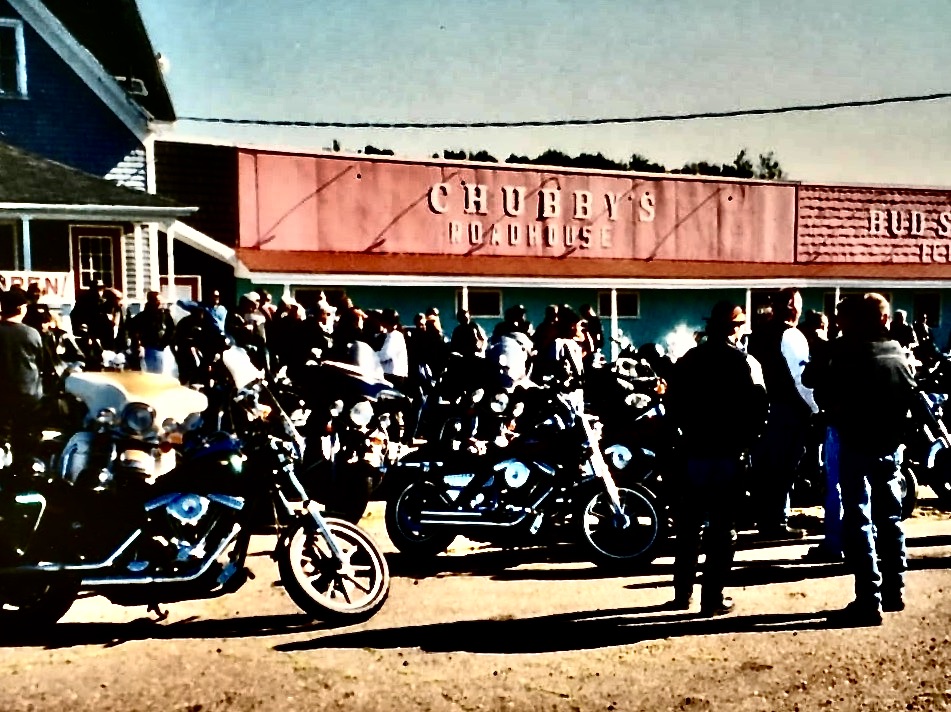
   Chubby’s Roadhouse and Bud’s Diner were side by side in a pink and blue building on St. Peters Road in Dunstaffnage. They did a brisk business. It was a popular pit stop for bikers on poker runs. It was why Pete Lambert had lunch or dinner there once a week, getting to know the riders. He kept his enemies close.

   “We serve burgers and fries and shakes and fish and chips and clams and all that stuff,” Clarence Foster said. “But I think as far as the burger goes, the best, the one that everybody seems to like is called the Bud Burger.” Clarence was both Chubby and  Bud.  “We have wedding receptions and things like that,” he said. He told the bikers about them in advance, so that nobody ended up stepping on anybody else’s toes.

   The Spoke Wheel Car Museum was next door. Clarence and his father Ray shared an appreciation for old cars. They both liked to smoke cigarettes but loved cars more. They gave up fags to save money. Instead of going up in smoke their savings went toward buying broken down heaps nobody else wanted and restoring them. They offered to buy Bernie Doiron’s VW Beetle, but he said, “It ain’t no antique.” By 1969, they had 13 cars, including a 1930 Ford Model A Coach that Clarence drove for show. It was how the roadhouse and diner came into being. 

   “People were coming to the museum and looking for a place to eat,” Clarence said. “Since my dad was a cook in the army, we decided to build a little canteen and it just kept on growing.” 

   Clyde and Pete met at the bar and ate at a back table. It wasn’t the warmest spring day, although it was sunny. They had cold pints and Bud Burgers.. There were a handful pf people having late lunches.

   “How’s the hip?” Pete asked.

   “Hellzapoppin,” Clyde said.

   “Is that the official diagnosis?”

   “It’s how I feel. I’ve got two months and 29 days from today circled on my calendar.”

   They ate and talked small. “Find anything out?” Pete finally asked, finishing his burger and hand-cut fries. The food was good because the beef and potatoes came from the island, not from away. It would be a trifecta once islanders opened up their own breweries.

   “It will be in my report tomorrow, but since you’re interested, I’ll summarize it. She died of a fractured skull. There was tissue not hers on her face and in her hair. I want to say she was hit by a fist that got scuffed up doing it. She had alfalfa on and in her clothes. More than a brush of silage, enough to make me think she was on a dairy farm long enough to roll around in it. She wasn’t killed on that field, although her arm was probably cut off there. The last field cutting there was in late August, so she was put in the ground sometime between then and no later than the end of October.”

   Thousands of acres of potatoes on the island the last fall had been left in the ground. Heavy rain and cold temperatures put a damper on the harvest. There had been too much rain and cold, freezing and thawing, day after day, and it led to a deep frost.

   “Her arm was probably cut off by an axe, sharp as can be. Whoever did it is a strong enough man, or a man driven to extremes. I don’t believe a woman did it, although I can’t tell you why. Why it was cut off, since she was already dead when it happened, is for you to find out. She had a Loonie clenched in her missing hand. It was a 1988 issue. No prints other than hers on it.”

   “Are her prints in the report?”

   “Yes, what we could get, which wasn’t much of anything, but they will do.” It was shop talk. Pete knew everything he needed and a batch of photographs would be part of the report.     

   “She wasn’t molested or abused. I don’t think she had eaten for several days. There wasn’t anything remarkable about her teeth, none missing, one filling. She was in her early twenties, five foot five, 118 pounds, green eyes, light brown hair, no moles, birthmarks, or tattoos. She was healthy as a horse.”

   “Anything else?”

   “One more thing. I think she might have poked somebody in the eye. There was retinal fluid under the fingernails of the first two fingers on the cut-off arm. Her nails were 7 mm long and almond shaped, perfect for poking. It wasn’t her fluid, either.”

   Blunt trauma to the eye can cause the retina to tear. It can lead to retinal detachment. It can require urgent surgery. The alternative is blindness. That alternative means living in the dark forever.

   “If that happened, where would the eye have been treated?” Pete asked.

   “At a hospital or a large eye clinic.”

   “What happens if it’s not treated?”

   “Kiss goodbye to that eye.”

   “I see,” Pete said, paying the bill when the waitress stopped at their table. What crowd there had been had cleared out. It was the middle of the afternoon. When the two men went out to their cars, they were the only two cars in the front lot. Pete was driving an unmarked police car, although it was clearly an official car. Clyde was driving a Buick Electra station wagon. He could lay a corpse out in the back if he had to. They shook hands and went their separate ways.

   Later that evening a biker riding a red motorcycle approached the roadhouse, swerving to avoid a fox. There was always more roadkill in the spring and fall. Skunks and raccoons were the most common, although foxes weren’t always as quick and slippery as their reputation. He pulled up, parked, and went inside. He left the key in the ignition. His Kawasaki Ninja had an inline four cylinder, 16 valve, liquid cooled engine with a top speed above 240 KPH. He had already made that speed and more. He knew nobody was going to mess with his bike because nobody stole wheels at Chubby’s Roadhouse. It would have been a heresy. At the bar he ordered a Bud Burger and a cold pint.

   “How’s the eye?” the bartender asked. “It looks good. At least, no more pirate’s patch.”

   “Yeah, but I waited too long to get it fixed,” the biker said. “The doc says I’ll probably be more blind than not in that eye from here on. It don’t matter, I can still see enough out of the other one to take care of my business.”

   He ate fast and downed his beer. When he left, he paid cash with a new one-hundred-dollar bill.

   “Where do you keep finding these?” the bartender asked.

   “Pennies from heaven, my man,” the biker said, leaving him a tip of two new Loonies. Getting on his glam motorcycle in the gloom of dusk he thought, I got to be more careful about that.

Excerpted from the book “Ebb Tide.”

Ed Staskus posts monthly on 147 Stanley Street at http://www.147stanleystreet.com, Made in Cleveland at http://www.clevelandohiodaybook.com, Atlantic Canada at http://www.redroadpei.com, and Lithuanian Journal at http://www.lithuanianjournal.com. To get the site’s monthly feature in your in-box click on “Follow.”

“Ebb Tide” by Ed Staskus

“A thriller in the Maritimes, out of the past, a double cross, and a fight to the finish.” Sam Winchell, Beyond Books

Available at Amazon: https://www.amazon.com/dp/B0CV9MRG55

Summer, 1989. A small town on Prince Edward Island. Mob money on the move gone missing. Two hired guns from Montreal. A constable working the back roads stands in the way.

A Crying of Lot 49 Publication
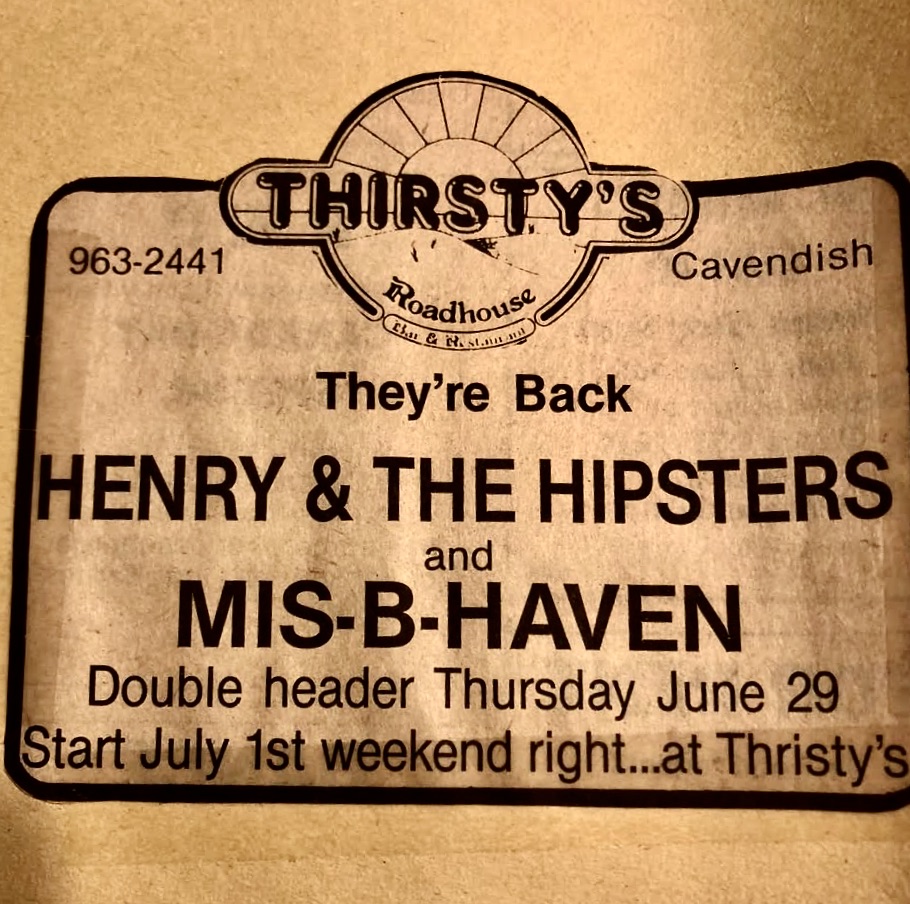
Behind Bulletproof Glass

By Ed Staskus

   I should have known better when I told the young woman on the other side of the Walgreen’s bulletproof drive-thru window that I needed the kind of coronavirus test that would get my wife and me into Canada and she breezily said, “For sure, this is it.” She was a trained pharmacy technician, but made up her harebrained reply, assuring me all was well even though she didn’t know what she was talking about. We found out three days later trying to cross the border at Houlton, Maine into Woodstock, New Brunswick.

   Getting a straight answer from the young can sometimes be like trying to give fish a bath. They often have a quippy answer for everything. Their answers are in earnest no matter what they’re asked and no matter their wealth or lack of knowledge. Whenever they are fazed by anything they say, “Oh, whatever.” 

   They say whatever they want when they are behind bulletproof glass.

   My wife and I were going to Prince Edward Island, where we didn’t go the summer before because of the 19 virus. Canada closed itself up tight as a clam in March of that year and didn’t reopen for Americans until early August of this year. Once we heard the opening was going ahead, we got in touch with the folks who operate Coastline Cottages in the town of North Rustico on PEI and let them know we were coming on August 21st and staying for three weeks.

   The cottages are on a hillside, on land that has been in the Doyle family going on two hundred years. A park road cut through their farm when it was built in the 1970s, but unlike other landowners they didn’t sell their remaining acreage to the state, so it sits snug inside the National Park. There are several homes on the bluff side of the eponymous Doyle’s Cove, some old and some brand new. In one way or another every one of them houses a homegrown north shore family, except for Kelly Doyle, who has lived on the cove the longest and lives alone.

   It takes two and half days to drive from Lakewood, Ohio to Prince Edward Island. At least it did every other year we had driven to the island. This year it took us six and half days.

   When we got to the Canadian border the black uniform in the booth asked for our passports. We forked them over to the tall trim guard, forearms tattooed, a Beretta 9mm on his hip. He was young and just old enough to be on this side of Gen Z. He looked our documents over and asked where we were from and where we were going.

   “Cleveland, Ohio,” I said. Although we live in Lakewood, an inner ring suburb, we always tell red tape we live in Cleveland. No one has heard of Lakewood. Everybody has heard of Cleveland, for good or bad. At least nobody calls it “The Mistake on the Lake” anymore. 

   I almost preferred the insult. “It keeps the riff raff rich away,” I explained to my wife. “There is no need for Cleveland to become the next new thing. They will just use up all the air and water and our real estate taxes will go ballistic. On top of that, we would end up knee deep in smarmy techies with their cheery solutions to all the world’s problems.”

   We handed our ArriveCAN documents over. We handed our virus inoculation cards over. We had both gotten Moderna shots. We handed our virus tests over, proving we had both tested negative.

   “You are cutting it close,” the border guard sniffed, shuffling everything in his hands like a deck of cards. I was hoping he wouldn’t turn a Joker up.

   The negative test had to be presented at the border within 72 hours of taking it. We were there with an hour to spare, although it would have been two hours if we hadn’t had to wait in line in our car for an hour. We had driven a thousand miles. It was tiresome but waiting in an idling car wasn’t any more skin off our noses.

   It started to smell bad when a second border guard stepped into the booth and the two guards put their heads together.

   “The antigen tests you took aren’t accepted in Canada,” the Joker said. “It has to be a molecular test. You can go ahead, since you’re from Canada, but your wife has to go back.”

   I was born in Sudbury, Ontario, and have dual citizenship, although I only carry an American passport. I couldn’t tell if he was being serious, so I asked him to repeat what he said. He repeated what he said and gave us a turn-around document to return to the USA when I told him I wasn’t ready to abandon my wife.

   We went back the way we had come, just like two of the six cars ahead of us, although we had to wait in line at the American crossing for an hour. Once we returned to Maine, we found out we could get the molecular test, but it would be a week-or more before we got the results. Nobody we talked to, not even the Gods of Google, was any help. A friendly truck driver mentioned New Hampshire was faster, only taking a day or two.

   The truck driver was stout, bowlegged, wearing a Red Sox baseball cap, a two-or-three-day growth of beard on his face, with a small shaggy dog to keep him company on the road. He wasn’t a Gen Z man. It was hard to tell what generation he belonged to, other than the changeless working-class generation.

   We drove six hours the wrong way to Campton, New Hampshire and checked into the Colonel Spencer Inn. It was Saturday night. We got on-line and made test appointments for noon at a CVS in Manchester, an hour away. We streamed “Castle of Sand” on our laptop. It was a 1970s Japanese crime thriller movie and kept us up past our bedtime.

   Over breakfast the next morning our innkeeper told us to go early since the traffic leaving New Hampshire for home on Sunday mornings was heavy. We gave ourselves an hour and a half to drive the 55 miles and barely made it. Luckily, we hadn’t made appointments for an hour later. We never would have made it. The traffic on I-93 going south was a snarl of stop and go by the time we started north back to Campton.

   We got our test tubes and swabs and stuck the swabs up our noses. I spilled some of the liquid in my tube and asked the Gen Z pharmacy technician behind the bulletproof glass if I should start over with a new kit.

   “You’re fine, it doesn’t matter,” she said, lazy as a bag of baloney. She couldn’t have been more wrong, which we discovered soon enough.

   Gen Z is self-centered and self-sacrificing both at the same time. “My goals are to travel the world and become the founder of an organization to help people.” They want to stand out. “Our generation is on the rise. We aren’t just Millennials.” They say they are the new dawn of a new age. “We are an unprecedented group of innovation and entrepreneurship.”

   Welcome to the future, just don’t take the future’s word for it.

   We spent the night at the Colonel Spencer. It was built in 1764, a year after the end of the French and Indian War. During the war the British, allied with American colonists, weaponized smallpox, trading infected blankets to Indians. The virus inflicts disfiguring scars, blindness, and death.

   “Could it not be contrived to send the smallpox among those disaffected tribes of Indians? We must on this occasion, use every stratagem in our power to reduce them,” the British commander Sir Jeffrey Amherst wrote to his subordinates.

   The results were what the continent’s newest immigrants from the Old World expected.

   “They burned with the heat of the pox, and they died to feed the monster. And so, the village was deserted, and never again would the Indians live on that spot,” is how one of the natives described the deadly epidemic.

   We had dinner at Panorama Six82, not far from our inn. The hostess seated us outside on the patio which looked out over a valley and a series of cascading White Mountain hilltops. The sun went down behind one of them and we finished our dessert in the dark.

   Our server was a middle-aged man from Colombia wearing jeans, a Panorama Six82 signature shirt, and a Sonoma-style straw hat. He went back to the homeland every year to visit relatives.

    “They always want money, so I don’t bring too much of it,” Fernando said. “It’s not as dangerous as most Americans think it is. I avoid some neighborhoods, sure, and I avoid riding in cabs. The rebels are in the hills, not the cities, and besides, they don’t do much anymore. The Venezuelans are a problem, all of them leaving their god-forsaken country. But they do a lot of the dirty work for us these days.”

   We drove back to Houlton on I-95. The speed limit north of Bangor is 75 MPH. I set the cruise to 85 MPH and kept my eyes peeled for moose. The fleabags lumber onto the roadway, sometimes standing astride one lane or another. Hitting a moose is a bad idea. A full-grown bull moose stands six to seven feet tall and tips the scales at 1500 pounds. It isn’t certain that the collision will kill the beast, but it will kill your car, and maybe you. They do most of their roaming around after nightfall. We made sure we got to our motel before dusk.

   In the morning my wife was winding down a business meeting on Zoom when there was a knock on our door. It was the housekeeper. She wore a black uniform and black hair pulled back in a bun. She was young. She was part of the Z crowd.

   “We’ll be out in about a half-hour,” I said.

   “Can I replace the towels and empty the trash?”

   “Sure.”

   “Weren’t you here a few days ago?”

   “Yes,” I said, and told her about trying and failing to get across the border and our search for a fast 19 test.

   It turned out the explanation for the motel being sold-out was because of the same problem. Every other person lodging there had been turned around for one reason or another.

   “You should go to the Katahdin Valley Medical Center,” she said. “A friend of mine went there, they did the test, she got it back the next day, and went to Nova Scotia.”

   “Thanks,” I said. We packed and followed Apple Maps to the medical center. The receptionist didn’t know anything about a fast molecular test. She sent us to Jesse, the man upstairs, who was the man in charge.

   “We test on Mondays, Wednesdays, and Fridays,” he said. “It takes about a week to get the results back from the lab.” It was Tuesday. We were already three days late. I started looking over my shoulder for Chevy Chase.

   “Not the next day?”

   “No.”

   We left Houlton and drove to Presque Isle, had lunch, messed around, my wife went running on the town’s all-purpose trail, and we drove to the Caribou Inn in the next town north. While the receptionist checked her computer for our reservation, we heard a wolf whistle through the open door of the office behind the front desk. A minute later we heard it again.

   “That’s just Ducky,” the receptionist said. “She belongs to the manager.”

   “Does she do that often, whistle, I mean?” I asked.

   “Whenever she sees a pretty girl.”

   Another wolf whistle came my wife’s way.

   I must have looked cross, because the receptionist said, “Ducky is a parrot.”

   Ducky was a parrot in a tall white cage just inside the door of the office. Her plumage was green with some red and yellow mixed in. She was a saucy character.

   “She’s twenty years old,” the receptionist said.

   “How long has she been here?”

   “Twenty years.”

   Ducky was spending all her Gen Z years locked up at the Caribou Inn, where flocks came and went. The only lasting relationship she had was with Betty, the hotel’s manager, and the bird’s keeper.

   “I didn’t know parrots lived that long.”

   “They can live to be seventy, eighty years old,” Betty said.

   “Ducky wolf whistles women?”

    “And men. We thought she was a he until she started laying eggs not long ago.”

   The parrot was going to outlive most of us, the 19 or no 19. They sometimes play dead in response to threats. They can also look dead when they are asleep. But if a parrot is lying still and not breathing, looking lifeless, you can assume it is dead.

   We had a non-smoking room, although every hallway that led to our room was lined with smoking rooms. The hallways smelled sad and stale. We were settling in with a bottle of wine and a movie when we got a phone call. It was the lab in New Hampshire that was doing our 19 molecular tests. They had good news and bad news. My wife tested negative, but my test was discarded. 

   “There wasn’t enough liquid in the test vial to maintain the sample,” the lab technician said. “Did you happen to spill some of it?”

   I didn’t bother trying to explain. I got on-line and filled out another ArriveCAN form. When we got to the border my wife had no problem. The only problem I had wasn’t make or break, since they couldn’t deny me entry, test or no test. A health officer gave me a self-test kit and told me to make sure I performed it within four days. She was in her early 30s. I had no reason to be skeptical. She was just out of Gen Z range. I should have been leery since she was wrong. She wasn’t as far out of the field of friendly fire as I thought.

   Four days later, when I went on-line and followed the directions for the self-test, the Indian-looking Indian-sounding woman on the other side of screen was nonplussed when I apologized for waiting to the last minute.

   “I don’t understand.” she said. “You are four days early. You are supposed to test after eight days of self-quarantine.”

   When I started to spell out what had happened, she wasn’t in the mood, and said she would schedule Purolator to pick my test up the next day. Purolator sent me an e-mail saying they would pick up between nine and noon. The truck pulled up just before five. I was grilling dogs and corn on the front deck. The next day I got an e-mail informing me my test came back negative. I had been tested four times in ten days and was finally officially virus-free.

   No matter the generation, Prince Edward Island was the only place and people who got it right. When we arrived late Wednesday afternoon and crossed the nine-mile-long bridge to the province, we waited in one of the many lines edging towards checkpoints. It didn’t take long. A young woman took our vitals while an older man in a spacesuit swabbed our noses.

   “If we don’t call you within two hours you tested negative,” he said.

   We drove to the Coastline Cottages. “Welcome to Canada,” our hosts said. “You made it.” 

   No one from Health PEI called us. We unpacked, watching the day get dark over the Atlantic Ocean, and fell into bed. I drifted off thanking God somebody on our part of the planet knew what the 19 score was, not some mumbo jumbo they dreamed up because they neglected to check the scoreboard.

Ed Staskus posts monthly on 147 Stanley Street at http://www.147stanleystreet.com, Made in Cleveland at http://www.clevelandohiodaybook.com, Atlantic Canada at http://www.redroadpei.com, and Lithuanian Journal at http://www.lithuanianjournal.com. To get the site’s monthly feature in your in-box click on “Follow.”

“Ebb Tide” by Ed Staskus

“A thriller in the Maritimes, the deep blue sea, magic realism, and a family saga.” Sam Winchell, Beyond Books

Available at Amazon: https://www.amazon.com/dp/B0CV9MRG55

Summer, 1989. A small town on Prince Edward Island. Mob money on the move gone missing. Two hired guns from Montreal. An RCMP constable working the back roads stands in the way.

A Crying of Lot 49 Publication

Down to Sea Level

   By Ed Staskus

   There was a window seat midway back in the Boeing 737. JT Markunas parked himself there. The plane looked old but smelled clean. It had been built in 1969 with an expected lifespan of 20 years. It was 20 years old in 1989 on the day JT buckled his seat belt. He was on the one daily Canadian Airlines flight from Ottawa, the capital of Canada, to Charlottetown, the capital of Prince Edward Island. Crossing over the eastern end of New Brunswick, he looked up from his Car and Driver magazine. He took a look through the porthole window at the crescent-shaped island in the distance. The land wasn’t small, but it wasn’t big, either. It was blanketed by snow. He had been told his new posting was mostly farm country. He wondered what it looked like from outer space.

   Seen from outer space Prince Edward Island can barely be seen. The solar system is a speck in the galaxy. The earth is a speck in the solar system. Prince Edward Island is a speck on the earth. When the sky is clear and the sun is shining it is a green and red speck under a dome of blue. When it is cloudy and stormy everything gets wet and gray until the sun comes back. It is the Gulf of St. Lawrence. Where he came from, which was Sudbury, Ontario, the sky was always either getting cloudy or it was already cloudy.

   The lay of the land formed hundreds of millions of years ago. Creeks and rivers deposited gravel, sand, and silt into what is the Gulf of Saint Lawrence. Before the last ice age, Prince Edward Island was part of the mainland. After the glaciers melted it wasn’t a part of it anymore. The Northumberland Strait became what separates it from the rest of Canada.

   The province is one of Canada’s Maritime provinces, the others being New Brunswick and Nova Scotia. Newfoundland and Labrador are nearby but more on their own than not, which is the way they want it. There are 225 kilometers from one end of the island to the other. It is 3 kilometers at its most narrow and 65 kilometers at its most wide. It is twice as far as the Kulloo flies from the island to Walt Disney World in Florida as it is to the Arctic Circle. Walt Disney World is far away and for pretend. The Arctic Circle is nearby and for real.

  There are farms from stem to stern of Prince Edward Island. There are so many of them the province is called the “Million-Acre Farm.” Jacques Cartier discovered it in 1534 and Samuel Champlain claimed it for France in 1603. The French explorers called it Île Saint-Jean. When they landed the native Mi’kmaq’s tried to explain they had been there for thousands of years, but all they got for their trouble was wasting their breath. They switched gears and tried singing some of their Top 10 songs. They sang “The Eagle Song” and “The Honor Song” and “The Gathering Song.” They accompanied themselves on rattles and hand drums.

   “Try singing a different tune,” Samuel Champlain finally said. “I’ll teach you the words.” He meant for them to sing “The Giveaway Song.” The Mi’kmaq glared and reached for their bows and arrows. The French strapped on armor and reached for their swords. They were more savage than the savages and knew how to prove it. The natives grumbled to themselves and drifted away. They thought they could make it right later. They were wrong about later.

   Kulloo could have set them straight, but he didn’t. He spoke in riddles, anyway. Hardly anybody ever understood his riddles. Over the centuries it had gotten so he held his tongue more often than not. He didn’t believe in explaining himself, anyway. He believed, being terse, say it once, why say it again? No matter what the  Mi’kmaq’s thought he was, or meant to them, he was a lone wolf. He was big enough to hook a grown man with his talons and carry him away. If push came to shove, and the man couldn’t explain himself, Kulloo was strong and predatory enough to eat him. Men were his least favorite meal, being bitter and hidebound, bur he was never going to shortchange himself dinner.

   He was at least a millennium old. Nobody knew how old he really was, not even Kulloo himself. The day he saw Jacques Cartier’s two ships come from France in 1534 he didn’t know what century it was. He lived by the seasons and the rotation of the stars. The ships and their crewmen piqued his interest. The Mi’kmaq had small boats that hugged the coastline. The big sailing boats had come from the other world, from the other side of the ocean. Kulloo had gotten word about that world long ago, but had never seen it. He suspected the Old World was intent on making the New World their world. He thought it  best to take a closer look to see where he stood.

   When the British took control of Canada East they changed the name of the island from what the French had called it to St. John’s, then changed it to New Ireland, and again on the eve of the 19th century to Prince Edward Island. It was named after Prince Edward, who later became the father of Queen Victoria. He was beguiled by the island, even though he proposed transferring sovereignty of it to Nova Scotia. He visited his namesake five times. The journey took almost a month to sail one way. 

   It became a separate colony in 1769 and the seventh province of Canada in 1873. Charlottetown was named after the wife of King George III. Queen Charlotte barely spoke a word of English and never visited the capital city. She stayed home in Buckingham House and played her harpsichord. She liked chartbusters like Bach’s “Concerto in the Italian Style in F Major” and Handel’s “Keyboard Suite No. 5.”

   “She ain’t no beauty, but she is amiable,” King George said about his wife. Queen Charlotte smiled slyly. She played “By the Light of the Moon” on her harpsichord for the man of the house.  It was a lullaby. King George took a nap in his queen’s lap.

   The province is the smallest and most densely populated Canadian province, although outside of Charlottetown and Summerside, where half of everybody lives, the habitants and their communities are spread far and wide. Most of everything is in the way of out of the way. Forests once covered the island. Trees still covered half of it. The red oak is the provincial tree. There are pine, beech, and spruce. There are no deer, moose, or black bears. There are rabbits and skunks, muskrats, and plenty of foxes. The red fox is the provincial poster boy. In early summer pink and purple lupins, weeds that are an invasive species, line fields and ditches. The Lady Slipper, an out-of-the-way orchid that grows in shady woodlands, is the provincial flower.

   JT was looking out the porthole window when he saw Kulloo. The bird was bigger than an albatross and more stern-looking than an eagle. If it was sowing the wind it was going to reap a whirlwind. The plane was cruising like it had been for the last hour-and-a-half. The big bird was keeping pace with the plane off the tip of the wing. JT rubbed his eyes and looked again. It was still there, soaring. He scanned the aircraft cabin. Some passengers were reading while others napped. Nobody was looking out at the wide blue yonder. When JT blinked the bird was gone. When he blinked again it was back.

   Farming is the number one way of life on the island, followed by the enterprises of fishing and fish mongering. There are a wealth of fields full of potatoes, grains, and fruits. There are cows everywhere, their snouts in the turf, waiting to be milked or slaughtered. There are boatloads of mussels, oysters, and lobsters to be had. Cod had been overfished to near extinction. There was talk of importing it from Iceland.

   Tourism was growing and Liam Foyle and his Japanese girlfriend Mariko were building cottages on family land in North Rustico to get in on the summer trade. In the meantime, they stayed at Sandy’s Surfside Inn most of the time. It was on the Gulf Shore Parkway. It was on the park road but not in the National Park. They had never sold their land. His brother Conor was his only neighbor. Liam and Conor were Kieran Foyle’s descendants, more than a hundred years after the Irish triggerman from the Old World landed in the New World, his Beaumont-Adams revolver tucked into a sailor’s bag. 

   In 1989 the pickings were good for the Liberals. They swept the elections. Andrew, the new Duke of York, and Fergie, his wife and Duchess, visited, flying in on a Canadian Armed Forces jetliner. George Proud, one of the new Liberal members of the province’s parliament, stood on a bench for a better view of the royals as they were driven up University Ave. “We’re the commoners, and they’re royalty, and I think people in a strange way must secretly like that,” he said. 

   “It’s a great day,” declared John Ready, the mayor of Charlottetown. Not everybody agreed. A woman in the crowd groused, “I was talking to a friend this morning who said, ‘I don’t know why we should have to curtsy to a person who a few years ago was living with a race-car driver.’” During the parade the Duchess climbed over a rope barrier to talk to a group of senior citizens. “What are these ropes for?” she asked. “I can’t believe you’re penned in.” The senior citizens were polite but baffled.

   Scouts Canada held their annual jamboree on the island that summer, honing their outdoor skills and running riot in the woods. The TV series “Road to Avonlea” went into production. The last train on Prince Edward Island made its last run, coming to a dead stop in living time. The tip-to-tip railway had been operating for one hundred years. The minute the clock struck the century mark it was done for good.

   Poison’s “Every Rose Has Its Thorn” was the top song on the radio. Malcolm “Monk” Kennedy was a thorn on the island that year, but nobody knew it until the Boy Scouts had all gone home. They were always prepared, it being the scouting motto, but nobody was prepared for Monk. Nobody was prepared for Jules Gagnon and Louise Barboza, either. They were hired guns from Montreal who came to the island looking for Monk and two million missing dollars.

   Jules and Louise were good as gold at what they did, but didn’t know they were going to end up paddling upstream to get their work done. Monk didn’t know two million dollars was going to be so hard to spend. They didn’t like the stumbling blocks in their way, but by then they had picked their poison. The Hunter River was going to flow through North Rustico and out to the ocean, no matter what. They were going to have to find that out for themselves. They weren’t prisoners of fate. They were prisoners of their own minds. Monk couldn’t change his mind, no matter what. Jules and Louise wouldn’t change their minds, no matter what.

   Kulloo peeled away from the Boeing 737 and swooped landward. He saw Louie the Large near the coastline. Hunkered down on a rock shelf not far from shore, the big shellfish was sizing up Monk, Jules, and Louise. Monk was scrawny. He was off the dinner table unless there was a famine. Jules looked better. He had some meat on his bones. Louise looked the best. He wouldn’t mind getting his claws into her, not at all. They shared a name. He liked that. He would like it even better if they shared some flesh and blood.

   Louie the Large loved the ocean, deep and blue, the tides rising and falling. It was where all life came from. He understood the primal fear men and women had of it, which he encouraged with every click clack of his crusher claws. He knew Kulloo was laying low overhead. He kept one eye open for him. He knew all about the bird. He was dangerous as a switchblade. He knew the creature never slept and woke up every morning dangerous as ever. Everything on land and sea was fair game to him.

   JT looked out the porthole window again, as the plane started its approach to the Charlottetown Airport, and saw that the bird was gone. He didn’t think he had imagined it. He wasn’t a fanciful man. He prided himself on thinking straight. He wasn’t especially impulsive or emotional, although he had been in love once and knew he could be as irrational and emotional as anybody. He didn’t believe any bird could be that big and that fast. It must have been a mirage of some kind, like in the movies. 

   He checked his seat belt to make sure it was snug. He looked down at the sea level he was going down to. Five minutes later he was landing on the Atlantic Canada land that was going to be his new RCMP posting.

Excerpted from “Ebb Tide.”

Ed Staskus posts monthly on 147 Stanley Street at http://www.147stanleystreet.com, Made in Cleveland at http://www.clevelandohiodaybook.com, Atlantic Canada at http://www.redroadpei.com, and Lithuanian Journal at http://www.lithuanianjournal.com. To get the site’s monthly feature in your in-box click on “Follow.”

“Ebb Tide” by Ed Staskus

“A thriller in the Maritimes, out of the past, a double cross, and a fight to the finish.” Sam Winchell, Beyond Books

Available at Amazon: https://www.amazon.com/dp/B0CV9MRG55

Summer, 1989. A small town on Prince Edward Island. Mob money on the move gone missing. Two hired guns from Montreal. A constable working the back roads stands in the way.

A Crying of Lot 49 Publication