Making Tracks to Prince Edward Island

By Ed Staskus

   “Hustle it up, kids,” Oliver and Emma’s father said. Oliver was 10  years old. Emma  was 12 years old. Oliver was the Monster Hunter of Lake County. Emma was his sister. She considered herself Oliver’s right-hand man and the brains behind their monster hunting. The family was on their way to Prince Edward Island, which was 1228 miles away from Perry, Ohio, which was where they lived. They were going by car. Their car was a Jeep Cherokee.

   They stopped at a Sheetz at the entrance to I-90, filled up the gas tank, and headed east. They got to Erie in no time and kept going. They drove past Buffalo and Rochester but got off the interstate when they got to the Finger Lakes. They stopped in Waterloo and had a New York Pickle pizza at Ciccino’s Pizzeria.

   “Are we going to the quilt farm after we finish eating?” Emma asked.

   “Yes,” her mother said.

   The farm was on Seneca Lake near Pen Yan. On the way they passed several black and yellow road signs depicting a horse and buggy.

   “Mom, what are those signs?” Emma asked.

   “There are hundreds of Mennonite families up and down these lakes. Some of them get around with horses and buggies.”

   “Who are Mennonites.”

   “They’re cousins to the Amish.”

   The Amish and Mennonites trace their roots to the Anabaptist movement of the early 16th century. Anabaptist is a nickname that means they are rebaptizers. They came from Switzerland and Germany. Both denominations believe modern advances are helpful but only if they  support a simple and humble life.

   “Why don’t they drive cars like us?”

   “The Amish stick to a strict interpretation of the Bible, which means they usually don’t use modern technology in their daily lives. Some Mennonites are old order, so they have horse-and-buggy transportation. Other Mennonites drive cars and wear clothes like us. It just depends.”

   Pauline Weaver and her Mennonite quilters have been making quilts at Weaver View Farm for thirty years. Their prize-winning bedspreads have been featured in Smithsonian Magazine. Dozens of quilts hang from the rafters of their restored 19th century dairy barn.

   “What’s the difference between Amish and Mennonite quilts?” Pauline said. “Not much. Maybe Amish just rolls off the tongue easier than Mennonite.”

   Emma’s mother was looking for a Lone Star pieced quilt.

   “Is it true Mennonite quilters always make an intentional mistake to show humility before God” she asked.

    “I don’t know how that one got started,” Pauline said. “As for me, I make enough mistakes as it is.”

   After they put in their order for the design they wanted on a quilt that would be shipped to them in a couple of months, and were preparing to leave, Emma’s mom asked if quilting bees were still common.

   “Quilting bees really aren’t all that common anymore,” Pauline said. “Sometimes a family will suffer a catastrophe and we’ll do a quilting bee to raise money. A quilting bee is a little like a barn raising. A quilt is completed in a single day. It’s not so hard to do with a large group of women, but the quilters do end up working very quickly.”

   They got back on Rt. 14S and were soon back on I-90. They drove past Albany, the Berkshires, skirted Boston, and stopped in Portland across the border in Maine for the night. They were staying the night near the waterfront. After walking up and down Commercial St. they stopped at Gilbert’s Chowder House and had chowder. Afterwards they walked down the Custom House Wharf. 

   “Dad, Is it OK if we talk to that man writing on that thing,” Oliver asked. A man was sitting on a lawn chair beside the Coastal Bait Shop. He was hunched over tapping at a mint green typewriter. The typewriter was on a red milk crate which was on a block of concrete.

   “Yes, but stay right there until we come back,” his father said. “ We’re going to walk to the end of the wharf and then come back.”

   “Hi mister,” Oliver said, Emma at his side.

   “Hi kids,” the man said.

   “What is that thing?” Oliver asked.

   “It’s a typewriter, a portable Royal, like a laptop.”

   “Where did you get it?”

   “I got it at a rummage sale. Everything works except the letter W.”

   “Why doesn’t it work?” 

   “The rods here hold the letters that hit the paper. When I strike a key a rod swings up and hits this ink-coated tape which transfers the letter to the page, except the W, which is missing.” 

   “Oh.”

   “I’m writing my life story.”

   “Oh.”

   “My name is William.”

   “I’m Oliver and this is my sister Emma.”

   “Where are your parents?”

   “Down there by the water.”

   “Good,” William said. “I’m not up for two orphans.”

   William was wearing a Panama hat on top of a head of dreadlocks, a sleeveless ribbed undershirt, baggy blue pajama pants, and orange Crocs. He was smoking a Calabash pipe, the kind Sherlock Holmes used to smoke.

   “Who’s Sherlock Holmes?” Oliver asked.

   “A detective from long ago.”

   “Are you making a book about your life?”

   “Yes and no,” William said. “I write a chapter every day but at the end of the day I throw whatever I’ve written into that trash can over there.” He pointed at a trash can.

   “Why do you do that?”

   “Life isn’t about finding yourself. It’s about creating yourself. That’s what it’s all about, in the wink of an eye.”

   Neither Oliver nor Emma knew what to say, so they said, “Here come our parents.”

   “It’s been nice talking to you kids,” William said. “Do you want to hear a secret?”

   “Sure.”

   “Everything depends on a 6-inch layer of topsoil and the fact that it rains.”

   “Oh, OK, thanks for the secret.”

   The next day they got up early, had an early breakfast, and got going north on I-95. The highway starts in Miami in Florida and ends in Houlton in Maine. Every few miles they saw a sign saying “Beware Moose Crossing.”

   “We have to be careful about moose coming on to the road,” their father said, “although they mostly come out at dawn and dusk and in between at night. We’ll be on Prince Edward Island before it gets dark though.”

   “Moose are really big,” Emma said.

   “They are about a thousand pounds.”

   “What would happen if we hit one?”

   “We’re not going to hit one.”

   When they got to Houlton they filled up their gas tank at an Irving’s and drove the couple of miles to the Canadian border. They had to wait in line. When they got to the guard booth a dark man in a blue uniform wearing a turban leaned out towards them. His name tag said he was Gagan Singh. He asked them for their passports. The family had NEXUS cards and handed them over.

   “Are all of you American citizens?”

   “Yes.”

   “Where are you from?”

   They told him they were from Perry, Ohio.

   “What is your destination?”

   “Prince Edward Island.”

   “What is the purpose of your trip?”

   “Vacation.”

   “Have a good trip,” the border guard said.

   They drove into the province of New Brunswick, which they would have to cross the length of to get to Prince Edward Island.

   “Dad, that man, he asked us if we were citizens, but he didn’t look like a citizen,” Oliver said.

  “He was probably an immigrant who became a citizen. I think he is a Sikh.”

   “What’s that’s?”

   ”It’s a religion, like being Catholic They’re from India.”

   “Why don’t they stay in India? Why are they in Canada?”

   “Probably for the same reason there are immigrants everywhere.”

   “What’s the reason?”

   “There are different reasons. Most of time it’s to go somewhere where they can find a better life. Maybe there were no jobs where they lived, or the climate was getting bad, or there was a war going on.”

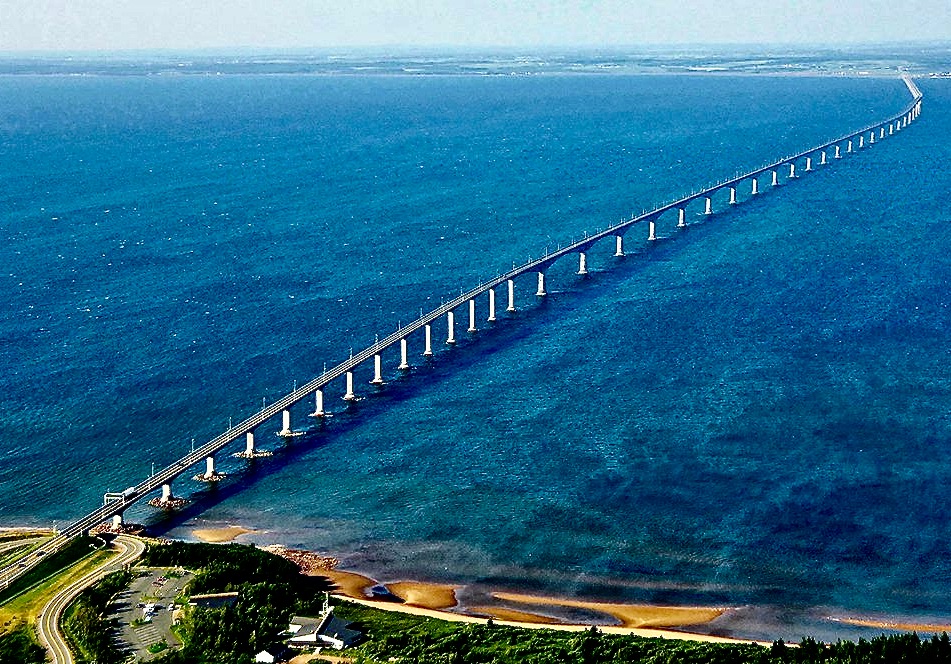
   They drove east past Woodstock, Frederickton, and Moncton. When they got to Sackville they stopped for a bite to eat at the Cackling Goose Market. An hour later they were at the Confederation Bridge. Before 1993 the only way to get to and leave the island was by car ferry. After 1993 there was the bridge. It is a nearly 8-mile long box girder bridge carrying the Trans-Canada Highway across the Abegweit Passage of the Northumberland Strait, linking Prince Edward Island with the mainland. It is the same length as 117 football fields. It weighs almost 8 billion pounds. The average person weighs about 150 pounds so the bridge equals 50,000,000 people.

   “That’s a mighty big bridge!” Emma said.

   “And long, too,” Oliver said.

   They got to North Rustico on the north side of the island before dusk. They were going to stay in one of the cottages at the Coastline Cottages just outside of town on the coast of the Gulf of St. Lawrence. When they drove up the long drive they passed a kidney-shaped salt water pool.

   “You didn’t tell us they had a swimming pool!” Oliver and Emma exclaimed at the same time. 

   “They do and it’s open every day it doesn’t rain.”

   “Does it rain much?”

   “Not too much.”

   “Woohoo!”

Ed Staskus posts monthly on 147 Stanley Street at http://www.147stanleystreet.com, Made in Cleveland http://www.clevelandohiodaybook.com, Down East http://www.redroadpei.com, and Lithuanian Journal http://www.lithuanianjournal.com. To get the site’s monthly feature in your in-box click on “Follow.”

“Ebb Tide” by Ed Staskus

“A thriller in the Maritimes, magic realism, a double cross, and a memory.” Sam Winchell, Beyond Books

Available at Amazon: https://www.amazon.com/dp/B0CV9MRG55

Summer, 1989. A small town on Prince Edward Island. Mob money on the move gone missing. Two hired guns from Montreal. A peace officer working the back roads stands in the way.

A Crying of Lot 49 Publication

Rise and Shine

 By Ed Staskus

  “I got started in theatre when my mom was looking for what I might be interested in,” Hayden Lysecki said. “She put me into all these random things, from dodgeball to martial arts, but the thing that stuck was theatre.” Born and bred in Whitby, Ontario, Hayden was 12 years old when he got cracking. He put his dodgeball sweatbands away and retired his gi fighting suit. He planted himself on the stage.

   “I think it stuck because I love being a part of telling stories and I love attention.”

   One of the first productions he appeared in was “Oliver!” It is a musical from 1960 based on an 1838 book by Charles Dickens. Oliver Twist is an orphan navigating London’s underworld while searching for a family and a home. He falls in with a gang of pickpockets led by the cunning Fagin.

    “The director Geoff Couler saw something in me and gave me the part of Fagin,” Hayden said. He was the youngest member of the cast. “There was a sense of great excitement and utmost fear in me. I found out thriving on that is what theatre is all about. It’s like riding a roller coaster. It’s a positive fear, since it’s such a fun experience.” He belted out “You’ve Got to Pick a Pocket or Two.” The applause lit him up.

   “The year of ‘Oliver’ changed my life. The majority of what I’ve done since then are musicals. You get to act, sing, and dance, instead of just talking at an audience.” Musicals are about characters who feel so deeply about something that they are compelled to break out into song. “I love plays, but some of them are stinkers, like when there are two guys in one room and they spend all their time talking to each other.”

   Hayden majored in performing arts at Oshawa High School and O’Neill CVI High School. He participated in a Broadway Student Summit studying “Hamilton” and “Chicago.”  He secured a Music Performance diploma from Holland College and is currently a Bachelor of Music student at the University of Prince Edward Island. 

   “Choral music was pushed in our high school, which suited me since it is one of my passions,” Hayden said. “Our chamber choir was invited to sing at Carnegie Hall for Eric Whitacre.” The bus ride to New York City took most of a day. Eric Whitacre is an American composer and conductor best known for his choral music. “There were lots of choirs who were part of that show. It was mind-blowing.”

   During Hayden’s high school years he participated in several tailored workshops. “Most of the workshops ended with the advice, if you can do anything else, please do it. The mindset I learned to keep is, what’s destined for you will come to you, while what’s not for you, you will be rejected for it. It will suck but you will move on. The only thing you can do is accentuate what you do well, and that way you’ll get the roles you’re going to shine in.”

   His parents were all in, even though neither of them were performers. His father, however, had once played in a  band in high school. It was a four bass guitar band called Lake of Bass. There was a steady beat but the melody had to be worked out  by the listeners. 

   “My family made the commitment to driving me to rehearsals multiple times a week until it became an in school thing in high school.”  All youngsters need some help as well as the confidence of the help they are being given. Parents helping their children is fruitful for everybody. It enriches the children and benefits the neighborhood by keeping parents off the streets.

   “I was a bit of a black sheep trying a new thing,” Hayden said. “The way my parents supported me came in all the ways parents have to do it behind the scenes, driving me everywhere, making sure I was fed before rehearsals, and coming to all my shows. I think they realized it could be a reinforcing thing for a kid who wants to figure out who they are in life, who wants to grow into their own.”

   Hayden graduated from high school as the Covid-19 pandemic picked up steam. “I didn’t get to go to prom, a graduation ceremony, or perform in our year-end show. I was supposed to be Joseph in ‘Joseph and the Amazing Technicolor Dreamcoat.’ I couldn’t go anywhere. I went nocturnal for a couple of months. Not being able to perform, your soul just dies.”

   Hayden’s father was the Chief Technology Officer of a software company. Mike Lysecki moved his family from Ontario to Prince Edward island in the summer of 2021. His firm had  leased office space in Charlottetown, the capital of the province, intended to house 50 employees, and wanted somebody up the chain of command to run the operation. Hayden’s father was that man. 

   “Prince Edward Island and Charlottetown are growing areas for top talent across Canada and the province’s proximity to universities and its passionate workforce makes it the perfect place for our expansion,” he said.

   “My father had been thinking of retirement and thought Prince Edward Island would be a wonderful place to settle down when he eventually stopped working. It was the fastest process ever for our family. He told us about it in June and we were on the island in August. It was a whirlwind. Things were crazy for me for a while but as soon as I came here I could see there was a vibrant music and theatre community on the island.”

   The family moved to the bay at West Covehead, up the street from the Brackley Beach Drive-in. Hayden started knocking on doors. “Since then, I’ve been living and doing shows here. I started by working at the Watermark Theatre in North Rustico as an intern, doing all kinds of things, props, painting sets, being their office manager. I was a part of the ‘Munshables’ at the Confederation Centre last year and this year I have been in ‘Rent’ and ‘Anne & Gilbert’ at the Florence Simmons Theatre.”

   “Rent” became a big hit as soon as it premiered on Broadway in the 1990s, winning the Pulitzer Prize for Drama and the Tony Award for Best Musical. The story revolves around Mark and his friends in the arts struggling to make a living in New York City. Hayden played Mark in the musical, embracing the character’s dual roles as narrator and documentarian of his circle’s experiences. “Mark wants to shed light on not just his friends, but the entire community that he’s immersed himself in. And that’s such an inspiring journey.”

   It’s also a challenging journey. “One of the most challenging aspects of the musical is all the genres Mark performs in. Rock is the main medium in the story, but Mark performs in a myriad of musical styles from powerful duet ballads to dancing the tango. It’s almost entirely sung through, like an opera, so there is very little downtime onstage. Mark and I are very similar in our abilities to connect with people and read their emotions to properly perceive a situation. We also both have a passionate fire inside of us that translates to our physicality. Rallying a crowd and leading a group number feels like second nature.”

   “Anne & Gilbert” was where he learned to act fast. The actors had only two and a half weeks of rehearsals. They had to get the ball rolling. “They needed to learn 17 musical numbers in a short rehearsal time, and the quality of their singing was exceptional,” Wade Lynch, the director of the show, said.

   It was also where Hayden sussed out the merits of authenticity. “You lose authenticity when you chase it, when you set your performance around trying to get an audience to react to you. Your job is to do your part in the narrative. In musicals the actors on stage are gaining a lot of their energy and passion based on what the audience is giving back to them. If you can get an authentic reaction from the audience, then you’ve got something great going.”

   He had something great going when he played Fagin in “Oliver.” In the second act he sang a song called ‘Reviewing the Situation.’  It starts by asking, “Can a fellow be a villain all his life? I’d be the first to say that I wasn’t a saint.” It ends by declaring, “I’m a bad ‘un and a bad ‘un I shall stay.” Reviewing a situation usually means identifying issues for improvement and making changes. Not so for Fagin in that song. 

   “It’s got four verses with a ton of words,” Hayden said. “I was stressed out about forgetting the words on opening night but I got in a groove and it just flowed. When I hit the end of the song, the audience loved it. It felt incredibly validating. It makes you feel invincible. From then on I knew that was the feeling  I was after.”

   Obstacles are what you see when you take your eyes off the goal. Nothing can stop a man with a purposeful frame of mind. Nothing can help a man with an aimless frame of mind. Hayden is staying focused on the bullseye.

   “One of the main reasons I enjoy performing is because of the connections you make with people, not just within your troupe, but with the audience, too,” he said. “Audiences come and go but they can and do remember you.”

   Being in the acting business can be enriching in more ways than one. “Some people look at acting like it’s just messing around and not work, not exactly a way of making a living,” Hayden said. “I try to surround myself with creative individuals and theatre people who enjoy the craft, so I hear a lot less of the negative voices. For me, acting fluctuates between being a business and the favorite thing I like doing. If you’ve got the grit, if you’re marketing yourself, if you are accepting opportunities, it is one of the most rewarding jobs on the planet.”

   All jobs require a measure of stamina, staying aware of the whys and wherefores, and putting in the effort. “My next few years are committed to studying my craft at the University of Prince Edward Island, so I’m sticking around here,” Hayden Lysecki said. He is committed to rise and shine.

Ed Staskus posts monthly on 147 Stanley Street at http://www.147stanleystreet.com, Made in Cleveland http://www.clevelandohiodaybook.com, Down East http://www.redroadpei.com, and Lithuanian Journal http://www.lithuanianjournal.com. To get the site’s monthly feature in your in-box click on “Follow.”

“Ebb Tide” by Ed Staskus

“A thriller in the Maritimes, the deep blue sea, magic realism, and a memory.” Sam Winchell, Beyond Books

Available at Amazon: https://www.amazon.com/dp/B0CV9MRG55

Summer, 1989. A small town on Prince Edward Island. Mob money on the move gone missing. Two hired guns from Montreal. A peace officer working the back roads stands in the way.

A Crying of Lot 49 Publication

Shock Wave

By Ed Staskus

   “When Britain is at war, Canada is at war,” Prime Minister Wilfrid Laurier said in 1910. “There is no distinction.” Four years later when Britain entered World War One, Canada signed on, too.  In August 1914 the Governor-General of Canada vowed that “if unhappily war should ensue, the Canadian people will be united in a common resolve to put forth every effort and to make every sacrifice necessary to ensure the integrity and maintain the honor of our Empire”

   Empires are made by plundering and slaughtering. They are always sure of the rightness of their cause. They never go down without a fight. It doesn’t matter if there’s any honor in the fighting, or not. They plow straight ahead.

   The country had no air force, a navy fit for a bathtub, and an army of 3,000-some men.  By the end of the war more than 600,000 Canadians had enlisted in the Canadian Expeditionary Force to fight for King and Country and more than 400,000 of them served in Europe, out of a population of fewer than 8 million nationwide.

   “The Empire Needs MEN” is what the posters said. “All answer the CALL! Helped by the YOUNG LIONS the OLD LION defies his foes. ENLIST NOW!”

   Everybody wanted in on the fight because everybody thought it would be over by Christmas. Canadians lined up to support the British Empire and collect steady pay of $1.10 a day. The harvest that year was bad, and unemployment was soaring. But machine guns fired ten times as many bullets a minute as they were paid pennies a day. Hundreds of thousands on all sides were slaughtered week by month by year by the rapid-firing weapons on the Western Front.

   At the beginning of the war, it was better to be killed than wounded. The wounded were taken off battlefields in horse-drawn wagons or on mules with baskets on their sides, the baskets soaked and dripping with men bleeding to death. There wasn’t any such thing as a dressing. If they made it to a train station, they were transported to hospitals. “One of those trains dumped about 500 badly wounded men and left them lying between the tracks in the rain, with no cover whatsoever,” said Harvey Cushing, the head of the Harvard Unit of volunteer doctors at the American Ambulance Hospital of Paris.

   Nearly 60,000 Canadians were killed, most of them the result of enemy action, and more than 170,000 of them were wounded. Almost 3.500 men and one woman had at least one arm or leg amputated. Private Curley Christian lost all four limbs but survived.

   During the Battle of Vimy Ridge he was unloading cargo from trucks when an artillery shell hit next to where he was, trapping him under debris for several days. When stretcher bearers tried to reach him, they were killed by more artillery. When he was finally rescued, he was transported to a military hospital and from there to London. His arms and legs had gone gangrenous and all four were sawed off.

   When he got back to Canada he was fitted with prosthetic limbs and married Cleopatra McPherson. He deigned his own prosthesis for writing. Cleo and he had a son who twenty years later served in World War Two.

   More than 7,000 Prince Edward Islander’s enlisted. Five hundred of them were killed and more than a 1,000 wounded. Tommy Murphy went overseas with a siege battery in 1915. Before he went, he got married to Freya O’Sullivan and got her pregnant. He got word of his son Danny’s birth by telegram while taking a break in an ankle-deep puddle of water sheltering in a trench during the Third Battle of Artois. 

   He had spent eight days at the front and was due for four days in a reserve trench and then four more days at a rest camp. When the bloodletting went on and on and the ranks thinned out, he never made it to the reserve trench much less the rest camp. It was that kind of a war. The Allied and Central Powers fought the same battles over and over.

   The British French and Canadians assembled seventeen infantry and two cavalry divisions for the offensive at Artois, backed by 630 field guns and 420 heavy artillery guns. During the fighting the field artillery fired 1.5 million rounds and the heavy artillery 250,000 rounds at the Germans defenses. Tommy Murphy barely slept for days. Whenever he took a break, he felt like his arms were going to fall off after loading shells until there weren’t any more to load. He knew he had sent his share of Germans to Hell even though he never saw one of them die.

   When the Allies tried to advance, they suffered 40% casualties. The battle went on from late September to mid-October when it ground to a halt in the middle of a never-ending autumn rainstorm and mutual exhaustion. By that time both sides were conserving ammunition because they were running out of it. They spent the rest of the month burying their dead, tending to their wounded, and withdrawing.

   Tommy was a cannon man because he was taller than five feet seven inches and burly enough to do the heavy work of feeding artillery. He didn’t have flat feet or bad eyesight, He didn’t have the greatest teeth, but explained he was enlisting to fight Germans, not bite them. He could have begged off the war because he was married, but he was patriotic and wanted to do his fair share. Money from the Canadian Patriotic Fund helped his wife keep the home fire burning.

   His battery had a lance corporal scout sniper attached to it. Francis “Peggy” Pegahmagabow was an Aboriginal who could split a bullseye nobody else could even see. He had more than 300 kills to his name. He roamed No Man’s Land at night for them, seeking out enemy snipers and forward spotters. He always came back in the morning. The other side never made it back to their side.

   He wore moccasins instead of army boots, chewed dead twigs whenever he sensed danger, and always carried a medicine bag. “When I was at training camp on Lake Superior in 1914, some of us landed from our vessel to gather blueberries near an Ojibwa settlement,” he said. “An old Indian recognized me and gave me a tiny medicine bag to protect me, saying I would shortly go into great danger. The bag was of skin tightly bound with a leather throng. Sometimes it seemed to be hard as a rock, at other times it appeared to contain nothing. What was inside of the bag I do not know.”

   Tommy had signed up for short service and when 1915 was over and done and it was April 1916, he was done with his one year on the Canadian Expeditionary Force. His commanding officer tried to convince him to re-enlist, but he had a wife, a child, and a farm that needed him. He didn’t need to kill anymore Germans. He was sick of the butchery. Three men from North Rustico were already dead. He didn’t want to be next. He knew if he re-enlisted it was only a matter of time before he went home in a box to be buried on Church Hill Rd.

   He got out when the going was good. The next year enlistments dried up as men near and far began to realize the toll the new style combat on the Western Front was taking. Machine gun fire and shell fire was murderous. On top of that there was poison gas. The dead were left where they fell. They were left for the rats. In May 1917 the government announced conscription through the Military Service Act. The rats stood up and cheered.

   It was easier getting into the army than it was getting out. He finally found a ride on a troop transport from Calais to Dover, took a train to London, and spent the night at a whore house with a razzle dazzle girl. He took a steam bath the next morning and had lunch at a corner fish and chip shop eating cod with a splash of vinegar and a full pint at his elbow. He followed the first pint with a second pint and was happy for it. He had a ticket for passage to Halifax in his wallet, but it was a week away. His grandfather had come from Ireland, or so the family story went, and done something big for the Crown, who rewarded him with 400 acres of PEI shoreline. He unfolded a map and located Dublin. It was directly across the Irish Sea from Liverpool.

   He bought a train ticket to Liverpool and the next morning landed in Dublin. It was Easter Monday. The Easter Rising had happened yesterday. The Easter Rising was happening today. 

   After landing at the Dublin Port, he followed the River Liffey, making for Dublin Castle and St. Patrick’s Cathedral. His plan was to find a room for a few days and have dinner. He would explore the rest of the city after a good night’s sleep. He was wearing his Canadian Army uniform over a pair of Spring Needle underwear and carrying a rucksack. He had his toiletries, four pairs of clean socks, his rolled up military wool overcoat, and a paper bag full of Huntley & Palmer biscuits in it. The biscuits were so hard they would crack a man’s teeth at the first bite if not soaked in tea beforehand.

   His papers and money were in a travel wallet attached to his belt. He had his Colt New Service revolver on his belt, too, for what it was worth now that his war was over. An hour later he was glad he had it, after he got it back, although he wasn’t sure if he was going to need it to protect himself from the Irish or the British.

   Dublin Castle was in the middle of the old part of the city. The city got its name from the Black Pool, the ‘Dubh Linn,’ where the rivers Liffey and Poddle met. It was where the castle was. It had been a Gaelic ring fort in the beginning, a long time ago. Later, after the Vikings showed up, it was a Viking fort. For the past 700 years it had been a British fort, the seat of their rule in Ireland. 

   Tommy didn’t have anything against the British, but after a year of serving in their army, he thought the Irish might be better served ruling themselves. They couldn’t do worse. During the year he served on the Western Front three quarters of a million Jacks and John Bulls were killed. It made him sick to think of the men he had seen obeying orders to attack barbed wire and machines guns across open fields. Another few million men went wounded and missing. The broken might survive, but he didn’t think the missing were coming back anytime soon.

   He was glad to be out of it. It hadn’t ended by Christmas of 1914. It still wasn’t over by Christmas of 1915. The next Christmas was in eight months and the talk was it would take a half-dozen more holidays to either win or lose the war. He meant to say a prayer in St. Patrick’s Cathedral before dinner. 

   He didn’t get a chance to say a prayer, find a room, or have dinner. He lost his chance when he came across the bridge leading to Trinity College, turned the corner towards Dublin Castle, and found himself face to face with a Mauser semi-automatic pistol. He knew exactly what it was. He stood stock still exactly where he was. The hand on the firearm was a woman’s hand. She was wearing an old military hat and a yellow armband.

   “Hand’s up and on the wall, boyo,” she said, a second woman coming up behind him. The second woman was wearing a bandolier laden with a half dozen hand grenades. She had a revolver. It looked like it came from the Middle Ages. He did what she said. She patted him down and took his Colt.

   “Who are you and what are you doing here?” she asked.

   “Tommy Murphy, Canadian Army, from Prince Edward Island by way of a year in France,” he said. “I’m here to take in the sights before going home. Now that we’re talking, I thought Ireland was sitting the war out.”

   “We ask the questions,” the woman wearing the bandolier spit out.

   “Come on,” the woman with the Mauser said, poking him in the small of the back with the barrel of the gun.

   The streets leading to the city center were barricaded. When they got to the General Post Office, he saw there were two green flags flying in place of the Union Jack. They said “Irish Republic” in gold letters. He knew there was no such thing as an Irish Republic. 

   “What’s going on?”  

   “We’re rocking the casbah,” the grenade girl said.

   There was a man outside the post office reading from a broadsheet. It was the “Proclamation of the Irish Republic.” There were copies of it pasted on walls. Newsboys were handing them out to anybody who wanted one. Not everybody wanted one. Most of them didn’t understand what was happening. The grenade girl handed him a copy. “Read this,” she said. There were men with rifles and shotguns on the roofs of buildings overlooking bridges.

   “Who’s this?” said a man wearing a scrap of paper pinned to his breast. It said “Citizen Army.”

   “We found him down the street, Sean.”

   Sean was Sean Mac Duiarmada, one of Commander-in-Chief Patrick Pearce’s right-hand men.

   “He’s Canadian,” Sean said pointing to Tommy’s regimental badge and the “CANADA” title at the end of his shoulder straps.

   “We thought he was a Brit.”

   “They’ll be here soon enough,” Sean said.

   There were 1,200 rebels waiting for 20,000 British troops to arrive.

   A shot rang out in the distance and Margaret Keogh fell down dead. She was a 19-year-old nurse tending to a wounded Citizen Army man. She was the first person to die during the Rising of Easter Week.

   A team of Volunteers trotted past on their way to the Magazine Fort in Phoenix Park. They took all the weapons and ammunition they could carry and blew up the rest. When the son of the fort’s commander tried to raise the alarm, he was shot dead. He was the second person to die.

   “You’re free to go,” Sean said to Tommy. “Best you leave Dublin all together.”

   “What about my sidearm?”

   Sean nodded to the grenade girl, and she handed Tommy’s Colt back to him.

   When a contingent of the Citizen’s Army approached Dublin Castle, the police sentry James O’Brien ordered them to halt. He was shot dead even though he was unarmed. He was the third person to die. When British troops showed up the rebels retreated to City Hall, stormed up to the roof, and fired down on the troops in the street. The man commanding the rebel contingent, Sean Connolly, was shot dead by a sniper, the first rebel and fourth person killed.

   Tommy carefully made his way back to the docklands and the port. He boarded the same boat he had come on. An hour later the boat was steaming into Dublin Bay on its way back to Liverpool. Eight hours later he was asleep in a room of a boarding house on the waterfront, not far from the Three Graces.

   The next morning was cold and damp. Women were out in the streets with their long-handled push brooms. They were called Sweepers. Others were in homes cleaning and scrubbing. They were called Dailies. Many more were at work in munitions factories. They were called Munitionettes. Liverpool’s men were on the Royal Navy’s battleships and in the King’s Liverpool Regiment. They were called Cannon Fodder.

   Tommy found a greasy spoon near the port and ordered breakfast, eggs back bacon sausage baked beans a fried tomato fried mushrooms fried bread and black pudding. The Liverpool Daily Post headline screamed “REBELLION!” There was no need for him to read about it. He thought he might have this same breakfast at midday and tonight. Somebody once said, “To eat well in England you should have breakfast three times a day.”

   He put the newspaper aside. Pushing himself away from the table, he checked his ticket for Canada. He tucked it securely away with his service revolver. Tommy Murphy was going to keep himself safe and sound until his boat sailed for home. Once he was out of the frying pan that was burning and smoking on another man’s stove, he was going to stay out of it.

Excerpted from “Ebb Tide.”

Ed Staskus posts monthly on 147 Stanley Street at http://www.147stanleystreet.com, Made in Cleveland http://www.clevelandohiodaybook.com, Down East http://www.redroadpei.com, and Lithuanian Journal http://www.lithuanianjournal.com. To get the site’s monthly feature in your in-box click on “Follow.”

“Ebb Tide” by Ed Staskus

“A thriller in the Maritimes, out of the past, a double cross, and a fight to the finish.” Sam Winchell, Beyond Books

Available at Amazon: https://www.amazon.com/dp/B0CV9MRG55

Summer, 1989. A small town on Prince Edward Island. Mob money on the move gone missing. Two hired guns from Montreal. A constable working the back roads stands in the way.

A Crying of Lot 49 Publication

Making It Happen

By Ed Staskus

   “I’ve been immersed in the world of performing arts for as long as I can remember, from singing songs from Cinderella with my mom as soon as I could speak, to studying performing arts at Sheridan College,” Charlee Whitty said. Cinderella is the story of a hardworking underdog who doesn’t have much but knows what she wants when she sees it. “When you’re driving through the moonlight, breathless with wild anticipation of adventure and excitement,” Julie Andrews sang in the 1956 Rogers and Hammerstein movie musical.

   It was the middle of summer on Prince Edward Island. Charlee was taking a break from serving coffee and sandwiches at Tide & Tales Bistro in North Rustico, where she was working part time for the season. Behind the eatery an osprey flew in from the ocean to its nest perched on top of a utility pole. There was a fish in its beak. The sea life was for its hatchlings.

   Charlee is a 26-year-old performer and choreographer from Newmarket, Ontario, now making a home in New Glasgow, Prince Edward Island with her husband Ryan. They got married in 2022 and straight away moved to Atlantic Canada. She graduated from the Huron Heights Secondary School arts program with majors in dance, drama, and vocals. She moved on to  Sheridan College’s performing arts program, where she honed her craft before relocating to the eastern seaboard. Some of her theatrical roles include Dorothy in ‘The Wizard of Oz,’ Little Red in ‘Into the Woods,’ and Frank-N-Furter in ‘The Rocky Horror Show.’  

   “My husband and I moved because we were going to get a small apartment in Ontario after we got married, but my dad advised us not to,” Charlee said. “What he said was, ‘You’re not going to get anywhere starting out in Ontario, it’s so cutthroat finding work.’ There is a crazy rat race mentality in the province. We had been talking about moving to Prince Edward Island where there is a lot of opportunity in theater. Both of my parents pushed for that, saying we could better make a name for ourselves in a smaller community.”

    Everything in life is competitive. It can be a good thing. It forces us to do our best. The theater business is especially scrappy. “Getting a role can literally come down to you and one other person. You could be perfect but maybe you don’t have the exact look the creative team is looking for. It’s not about talent at that point. Its cutthroat although it’s not personal. It’s a rewarding job. You get to be like a child again, exploring things, but you have to keep auditioning and auditioning. One rejection after another can be taxing on your mental health.”

   When Charlee got to Prince Edward Island she started looking for doors to get her foot into. “I didn’t know a single soul on the island. I was nervous. It was daunting, but I knew I wanted to get into choreography. When I got the opportunity to do that in ‘Rent’ it kick-started everything. I have made some friends since then who have become best friends.”

   ‘Rent’ is a rock musical based on Puccini’s opera ‘La Boheme.’  It tells the story of young artists and musicians struggling to survive in New York City in the days when the East Village was bohemian and not yet gentrified and bland. More than anything it is about finding your voice. It scored four Tony Awards and is one of the top 10 longest-running musicals on Broadway. “It’s about a community celebrating life,” said Jonathan Larson, who created the show.

   “I’m thrilled to be part of its debut on the island this summer,” Charlee said. “It resonates with me for many reasons, but a huge one is because it encapsulates the essence of love. I think we can all empathize with the characters in ‘Rent,’ such as how we cherish the bonds of friendship, how we navigate self-worth, and understanding that you must find love in everything you do because life is so precious. I strive to infuse every aspect of my own life with that same spirit.”

   She has lately added ‘Anne and Gilbert: The Musical’  to her resume. She got to spread her wings, playing four roles, which are Ruby, Mrs. Pye. Christie Stuart, and Marilla Cuthbert. The actor who has no immediacy has no wings.

   Acting isn’t for everybody. The competition is never-ending. Everybody wants it as bad as everybody else. It can amount to years of dispiriting turndowns. The travel takes you away from your family and friends. Equity pay is more terrible than phenomenal. “Almost 100% of everybody I talked to growing up said don’t go into acting,” Charlee said. “They said, if you can do something else, do something else.”

   What they were saying is, do something normal. What they weren’t saying is, normal is only one cycle on a washing machine. There are other cycles. Cut-and-dried isn’t always the be-all and end-all to aspire to. It can be overrated. Sometimes the aspiration to move into a new frame of mind is what brings into being a new normal.

   Lee Strasberg, the preeminent exponent of method acting, said, “Acting isn’t something you do. Instead of doing, it occurs. You can have conscious preparation but If you’re going to start with logic, you might as well give up.”

   “It’s mostly people who aren’t in theater telling you to give up, go do something else, get a real job,” Charlee said. “Everybody in theater, they tell you making it is hard, but they never tell you not to do it. Nobody in the theater world tries to discourage you. Surrounding yourself with the right people is absolutely imperative.” The right people are the people actors need in their lives to make it happen.

   “It’s vulnerable being an actor. You find out things about yourself that you didn’t know. You grow so much, but you’re not doing it by yourself. Many people in theater have shaped who I am. The reason I love it, every show you do, you become like a family. It’s special, the community you create. It’s a great feeling, so bonding.”

   Acting can be scary. It is a form of public speaking in a world where many people think speaking in public is akin to dying. “The first time I had a lead role was when I played Dorothy in ‘The Wizard of Oz,’” Charlee said. “I was excited but terrified.”

   She was even more terrified playing Frank-N-Furter in the ‘The Rocky Horror Picture Show.’ Frank-N-Furter is a cross-dressing mad scientist. His mission in life is to create Rocky, the perfect man. In his own words, Frank-N-Furter is a “sweet transvestite from Transylvania.” The show is a mash-up of sci-fi and horror B-movies, campy slapstick, and rock ‘n roll.

   “I was scared to do the show because it is so demanding vocally and because it’s supposed to be a man doing the role,” Charlee said. “I had never done anything like it, being usually typecast as a princess or the girl next door. I had to play a transvestite wearing a jock strap, fishnets, and my hair colored bright orange. He’s a very out there character. My friends were there. My parents were there. I walked out on stage and everybody lost their minds. I got crazy laughs and it fueled me for the whole show. I needed it so bad because I was so nervous.”

   Not every audience breaks out into laughs and applause. Every one of them is different. “Sometimes you get an audience that doesn’t react while others react too much, like talking at the stage,” Charlee said. Sometimes acting is the art of keeping a large group of people from hemming and hawing. “An audience can be drab and all you can do then is get through the show. Other times they hype you up, although you definitely need to find a line. You can go over the top, like if it’s a comedy show, you try too hard, and then it’s not funny anymore. You don’t want to chase it.”

   The acting business is a freelance business. You never stop having to prove yourself and promote your work. It’s also a business which is conducive to pivoting in new directions. Charlee has pivoted in the direction of choreography. “One of the challenges I face as a choreographer is navigating the diverse skill levels of actors. I tend to create relatively intricate choreography, which I know can be intimidating, but I do my best to break it down piece by piece so that everyone becomes comfortable and knows what they’re doing. Dancing can be daunting and doesn’t come naturally, so my goal is to lift everyone up and give them the confidence to have fun, own the stage, and help them enhance the story with movement and dance. It is rewarding to watch and experience them gaining confidence and doing things they never thought they could do.”

   Besides acting, stagecraft, and choreography, Charlee teaches at Revolution Dance Studio and works with the Queensville Players, among other things. “Ryan and I have started our own business called Little Wonders Character Entertainment,” she said. “We will bring a princess to your party, like having a clown or a magician.” The Whitty’s need to pay the rent like all young actors and artists. Paying the rent by making somebody’s magic day more magical is as good a way to do it as any.

   “My first acting job was being a Disney princess at parties when I was 16 years old. We have hired a few of my friends to do the performing. I stay in the background, coordinating it all, which I love doing. That’s the direction I am going in for a career. I love being on stage, but I totally love being behind the scenes.” 

   Charlee and her husband Ryan, who also studied performing arts at Sheridan College, are planning on starting a musical theater program. “He and I will be tag-teaming the program,” she said. “Life is about finding a clear path. Don’t try to fit into somebody else’s box. If you ignore the clear path you will miss opportunities. Stay on the path and the opportunities will present themselves. Connections are huge, you have to be strategic, you have to be able to pick and choose, but staying on the path is essential. Things are falling into place. We’ll be here next year making a name for ourselves.”

   Making it happen is a process. It is a direction, not necessarily a destination. What you achieve fleshing out dreams is what you make of your direction.

Ed Staskus posts monthly on 147 Stanley Street at http://www.147stanleystreet.com, Made in Cleveland http://www.clevelandohiodaybook.com, Down East http://www.redroadpei.com, and Lithuanian Journal http://www.lithuanianjournal.com. To get the site’s monthly feature in your in-box click on “Follow.”

“Ebb Tide” by Ed Staskus

“A thriller in the Maritimes, the deep blue sea, magic realism, and a memory..” Sam Winchell, Beyond Books

Available at Amazon: https://www.amazon.com/dp/B0CV9MRG55

Summer, 1989. A small town on Prince Edward Island. Mob money on the move gone missing. Two hired guns from Montreal. A peace officer working the back roads stands in the way.

A Crying of Lot 49 Publication

Island Hopping

By Ed Staskus

   It is roughly seven hundred miles from Montreal, Quebec, an island at the confluence of the Ottawa and Saint Lawrence rivers, to Prince Edward Island, on the Gulf of Saint Lawrence. The way most people get off Montreal is by bridge or tunnel. There are twenty-five bridges and three tunnels.  The Victoria Bridge at a mile-and-a-quarter was the longest bridge in the world when it opened in 1860.

   Most transit gets to Prince Edward Island by way of the Confederation Bridge, the only bridge that connects the island to the rest of Canada. Until the span was built, coming and going was largely by boat or ferry. When the Northumberland Strait froze solid you could strap chains onto your tires and drive across it. After four years of construction the bridge opened in 1997. It is the lengthiest overpass ever built traversing ice-covered water. The concrete arc sans the approaches is 8 miles long. It is illegal to stop on the bridge and there is a curve to it whose only purpose is to keep motorists alert.

   “It’s weird, it’s long, you’re on it for 5 minutes, at least,” Tanner Patterson said .

   “It’s more of a 12-minute trip,” Amanda Patterson pointed out, fine-tuning his observation. “I did a project on it at school, actually, although I didn’t have any choice. My teacher told me you’re doing the Confederation Bridge. There was a referendum about building it. The vote was really close because lots of people wanted the island to stay secluded.” There were even some who preferred a moat.

   “Local workers built it and it’s super sturdy. It’s probably never going to fall down,” Amanda added, putting the moat idea to rest.

   More than a million-and-a-quarter people travel to PEI every year for a week-or-two in the summer, almost nine times as many people as live on the island. Some of them cross by ferry, some of them fly into Charlottetown, but almost all of them drive over on the bridge.

   “It’s very impressive,” Cathy Patterson said.

   “Crossing it is anti-climactic, though, because of the concrete parapet,” said Mark Patterson, Tanner’s uncle, Amanda’s father, and Cathy’s husband. “You can’t see anything. But there’s a church you can pull into after you cross, up the approach towards Victoria, and from the parking lot you can see the bridge going all the way back into New Brunswick. It’s an incredible view.”

   The Patterson’s live in the West Island, on the west side of Montreal, a laidback green space small town feel in the big city kind of neighborhood. One of Montreal’s last large remaining spots of wilderness is in West Island. The region was a summer retreat well into the 20th century but city folk now go elsewhere.

   Cathy Patterson first visited Prince Edward Island with a group of fellow potters in 2014. “We did the circuit of the pottery studios,” she said. Throwing, firing, and glazing mud and clay is a cottage industry on the island. “Several teachers showed us their methods.”

   The small troop of ceramic artists stayed in the town of North Rustico, at the Coastline Cottages, on the seashore. “Kelly Doyle opened a cabin for us. It was very nice, but it was brisk.” By the end of March 2014 more snow had fallen that winter than had in more than 40 years. Blizzards swept the island. The sun stayed away. “The landscape was stunning, but it was cold. We all had three layers on.”

   “I was here when I was a kid, thirty-five years ago,” Mark said. “We went to Nova Scotia, did the Cabot Trail, and then came here. I saw ‘Anne of Green Gables’ at the Confederation Centre. My mom told me we stayed near North Rustico.”

   One afternoon when his nephew, daughter, and wife had gone deep-sea fishing, he went for a drive, exploring the north-central coast. At the intersection of Route 6 and South Rustico he spotted an old-school roadhouse. He pulled the car over. “It was the original motel with green paint,” he said. “That’s where we stayed.”

   The Patterson’s piled into their car on a Saturday at 6 o’clock in the morning in late June and left West Island for the eastern seaboard. The drive is circuitous, north to Quebec City, south to Fredericton, east to Monkton, and finally across the bridge. It takes about 12 hours of steady driving.

   “We played the letter game in the car,” Cathy said.. The alphabet game is played on long car rides. The players try to find the letters of the alphabet on license plates, road signs, and nearby buildings, in order, starting with “A.” If any player spots a graveyard on the side of the road and declares it, the other players have to go back to the beginning. There is a shout out for the winner after they have reached “Z” if they can remember all the different things for each letter of the alphabet.

   When he wasn’t playing the letter game, Tanner was downloading podcasts on his phone. “They saved my life,” he said. “’Our Fake History’ and ‘Night Vale’ are good ones.” 

   ‘Night Vale’ is about a small desert town, mysterious lights in the night sky, and dark hooded figures with dark unknowable powers. Tanner had bags under his eyes by the time he was finished.

   “I like to sleep,” Amanda said. “When I get bored, I start rambling, talking nonsense.”

   “It’s annoying,” Tanner groused about Amanda bunking in the back seat, who didn’t lose any sleep over it. “I can’t sleep in cars. She’s out for at least half the trip.”

   “I drive,” Mark said. “I’m no good being a passenger.”

   “I can drive all day long or I can sleep,” said Cathy. “Put me in the passenger seat and I’m out like a light.”

   Three years after Cathy stayed on to Prince Edward Island, bundled up against the cold, the family was on its way there in the summertime. They were in shorts and t-shirts because Sue Cameron, a fellow potter, had booked two weeks at Coastline Cottages for herself earlier in the year. Cathy got wind of the vacation while at lunch with her friend in Montreal.

   “Is there another cabin?” Cathy asked.

   “I don’t know, we can find out,” Sue said.

   “I called Kelly, he had an open cottage, I said fine, and booked it on the spot,” Cathy said.

   “Our first week we went to beaches five days in a row,” said Mark said.

   There are hundreds of miles of PEI coastline, cliffs, sand dunes, and long sandy beaches. There are about 90 beaches. Most of them are located in provincial or national parks. The beaches on the north coast are white sand while those on the south coast are red sand. The sand at Basin Head is called singing sand because it squeaks when you walk on it.

   “I was so excited for the beaches,” Tanner said. “We went all over, to Cavendish, Brackley, and Thunder Cove.”

   “He just sits there listening to music,” Amanda said.

   “Or I listen to podcasts,” Tanner said. “Then I go in the water.”

   “Thunder Cove is our secret beach,” Amanda said.

   “The kids took a walk to the Teacup,” Cathy said.

   “The way the rock there has eroded you can walk underneath it,” Mark explained.

   “It’s a cliff, so you can be on the beach and behind you the water flows into the cliff, and you can go inside it,” Tanner said

   “It was cool,” Amanda said. “But there were little crabs that bite your feet, especially this one part where they keep snapping at you.”

   The day Mark went solo exploring was the same day the rest of the family boarded Papa’s Gem, one of two 45-foot Aiden’s Deep Sea Fishing boats sailing out of the North Rustico harbor. The fishing charter supplies rods, tackle, and bait, cleans the cod and mackerel you’ve caught, and you get to take it all back to your cottage with you.

   Aiden Doiron started fishing when he was 15 years old, started his own deep-sea fishing excursions in 1957, and started Doiron’s Fish Market on the near side of the harbor. His family still operates the charter and the fish market.

   “I caught one cod and two mackerel,” said Tanner.

   “I caught two cod and mom got sick,” said Amanda.

    “This guy on board was smoking a cigarette,” said Cathy.

   “You’re not supposed to smoke,” Amanda said. “The captain got mad when he found out.”

   “It was the way the wind came up and the smoke hit me full throttle,” Cathy said. “I had to sit down, but when the engines started up and we started moving, going back, it was too much. The next minute I was feeding the fish. It was quite embarrassing.”

   Mark fired up the grill at Coastline Cottages the next day for a fish dinner.

   “I had never had mackerel,” he said. “We didn’t have any spices, no nothing, maybe a little parsley, but Tanner and I pan-fried the fish, and it might have been our best meal on the island.”

   “No, dad, it was ice cream at Cows,” Amanda said.

   Dinner at the New Glasgow Lobster Suppers was a big hit. “It was a high point for me,” Tanner said. The restaurant, on the Hunter River, not far from North Rustico, got its start in 1957 when the New Glasgow and District Junior Farmers Organization, looking for a permanent meeting place, bought and moved a canteen to the eatery’s current location. The first lobster supper, priced at $1.50, was served on improvised plank tables as a fundraiser in 1958. The dinner was followed by a dance.

   Today the all-you-can-eat feast starts with fresh rolls seafood chowder coleslaw salad and Island Blue mussels. The main course is lobster. Dessert is buffet-style. The restaurant is still owned by the Nicholson’s and MacRae’s, two of the original founding families. It was showcased on TV’s Food Network in 2012, on a program called “You Gotta Eat Here”.

   “You sit at a long picnic-style table. It’s like clockwork, so well run,” said Cathy.

   “Tanner and I ate a whole bucket of mussels,” said Mark.

   “You can have one, two, three buckets, all you want,” said Cathy.

   “I ate them all,” Tanner said proudly, his pink sweatshirt swelling.

   “I never had fresh mussels like that,” Mark said.

   PEI mussels, sweet and tender, are widely available at seafood counters in many countries, and are often considered the best in the world. Some gourmands say the best mussels are harvested on lonely rocky outcrops along cold-water tidal inlets, but since few people haul themselves, their rubber boots and gloves, and 5-gallon plastic pails to isolated shorelines, the island’s rope-grown mussels are the next best. They are tasty, nutritious, and sustainable. They even help purify water by clearing nitrogen. Nothing beats sitting down to PEI mussels on PEI.

   “Amanda tried a mussel, but she wasn’t crazy about it,” Tanner said .

   “Hey, I ate a lot of them!” she protested.

   After a week of lolling on beaches the Patterson’s got into their car and went touring. The Tip-to-Tip Tour is about driving the length of the province on the rolling coastal roads. It’s a way to see the meeting of the tides at one end of the island at East Point and North America’s longest natural rock reef at the other end at North Cape.

   “You go to one side, they give you a ribbon, and when you get to the other side, and show them the ribbon, they give you a certificate,” said Mark. “It’s a long drive. We were all tired by the time we got to North Cape.”

   When they pulled into Tignish, a small town on the far northwestern tip of the island, they were ready for their daily bread. When they asked, someone recommended the Very Best Restaurant, which turned out to be part of the Tignish Co-op. A small sit-down, it has a big name for its Acadian meat pies.

   “At first I thought they were bragging,” Mark said. “But it’s got to be good if they say that. When we got there, there were all kinds of different tables and chairs.”

   “It looked pretty sketchy,” Amanda said.

“After we sat down, we could tell it was going to be good because all the local farmers and fishermen were there, in work clothes and Chevy caps,” Mark said. “We fed the whole family for thirty-five dollars.”

   “It’s like a PEI secret place,” Tanner said.

   “The name comes from living in the north,” Amanda said. “If you ask anybody how their day has been, they always say, the very best day.”

   Closer to home, one day Cathy told the 12-year-old Tanner and the 13-year-old Amanda that the next day would be their day. They could pick whatever activity they wanted to do.

   “We got one day, no, one morning, out of two weeks,” Tanner said.

   “No, we went to all those beaches,” Cathy said.

   “Oh, yeah,” Tanner said

   The next morning, they went to Cavendish. The resort town is the next town over from North Rustico, known for its numerous cottages and campgrounds, Green Gables attractions, golf courses, boardwalk, and amusement parks. The first place they went to was Adventure Zone. First they went to the Route 6 Motel, a haunted house nestled in a spruce grove, crawling, walking, and running through the winding corridors where bad dreams lurked.

   “It was great, but I couldn’t,” Amanda said. “I was fine, but I don’t like getting squished. When they yelled to get ready for the airbags, I hate that. I told them I needed to check out and they opened a side door for me.”

   Tanner had already checked out. He sat down on the grass beside the road under the OPEN flag, next to a black cat who was watching the traffic.

   “I’m good at scary movies,” he said. “I can predict everything. I just use my brains, but haunted houses, I don’t like it when it’s super dark and super loud.”

   Cathy was waiting outside, catching some fresh air, reading a paperback. A young mother walked out of the haunted house with a 7-year-old in hand. The boy was crying.

   “Is he OK?” Cathy asked.

   “The haunted house did him in,” said the woman.

   “I’m waiting for my kids,” Cathy said.

   “Is one of them wearing a pink sweatshirt?”

   “Yes.”

   “They’re out already.”

   Cathy found Big Pink and PJ standing at the side of the Route 6 Motel.

   “Sure enough, neither of them finished the haunted house.”

   Tanner was known as Big Pink, since he was a large boy and wore his favorite pink sweatshirt whenever he could, and Amanda was known as PJ for wearing her pajamas over her bathing suit going to and from the Coastline Cottage’s saltwater pool overlooking the ocean.

   Their next stop was the Hangar, a black-lit, fog-filled, state-of-the-art laser tag arena. Strapped into special vests, Tanner and Amanda were released into the 3000-square-foot space, firing infrared beams with Uzi-style ray guns.

   “When we went one-on-one, I totally destroyed her,” Tanner said

   “Sure, but when we played that other family, I dominated,” Amanda said.

   “She was super good at sneaking around, getting behind you, and shooting, shooting, shooting,” Tanner said. “She would just surprise run up and shoot you in the back the whole time.”

   After two weeks on the island, going home to Montreal wasn’t easy, except for leaving the pillows behind. “The beds are comfortable in the cottage, but the pillows aren’t,” Amanda said.

  “Bring your own pillow next time,” Cathy said.

   “We all went to see ‘Anne of Green Gables’ in Charlottetown,” Mark said. “When Matthew dies at the end, I was, oh, crap, I had forgotten that part. That got me.”

   “The island is beautiful,” he added. “I liked that I wasn’t working for two weeks.” Island hopping is being able to do nothing much and having all day to do it before you have to go back to whatever made you go on vacation in the first place.

   “I liked getting up in the morning, taking my cup of tea down to the ocean, sitting on my log down there,” Cathy said.

   “The beaches,” Big Pink said. His favorite place was anyplace by the ocean. “Eating mussels and Canada Day were awesome, too.”

   When he heard there was pole climbing, rubber boot throwing, lobster eating contests, and a cow bingo, guessing where the cow will do its business at the end of the afternoon, every year at the Agricultural Exhibition and Acadian Festival, he said, “We’re coming back!”

   “I’m not chasing pigs!” Amanda declared.

   When the Pattersons piled into their car for the return trip to Montreal, they drove from North Rustico to New Glasgow to Hunter River to Kelly’s Cross to Crapaud onto Highway 1 to Borden-Carleton and onto the Confederation Bridge.

   By a twist of the turnstile, there’s no cost to cross the bridge to the red island, no ticket takers and no tolls. But, when you pull up to the tollbooth to go home, it costs fifty-some dollars to leave. It’s like the candles costing more than the cake. That’s when you might as well make plans to go back, since the 12-minute drive from the mainland on the Confederation Bridge over the wide coastal waters to Prince Edward Island is always for the asking.

Ed Staskus posts monthly on 147 Stanley Street at http://www.147stanleystreet.com, Made in Cleveland http://www.clevelandohiodaybook.com, Down East http://www.redroadpei.com, and Lithuanian Journal http://www.lithuanianjournal.com. To get the site’s monthly feature in your in-box click on “Follow.”

“Ebb Tide” by Ed Staskus

“A thriller in the Maritimes, magic realism, a double cross, and a family’s fortunes.” Sam Winchell, Beyond Books

Available at Amazon: https://www.amazon.com/dp/B0CV9MRG55

Summer, 1989. A small town on Prince Edward Island. Mob money on the move gone missing. Two hired guns from Montreal. An RCMP constable working the back roads stands in the way.

A Crying of Lot 49 Publication

Pit Stop

By Ed Staskus

   Clyde Ferguson stumbled into the Queen Elizabeth Hospital mortuary room like he was seeing it for the first time, even though he had been the provincial pathologist for 11 years. He waited for the sharp stab in his left hip to go away. He felt unsteady. He steadied himself with one hand on the doorjamb. He was all right after a moment, as far as it went. His left heel wouldn’t flatten down to the floor. That leg had gotten shorter the past five years. He put his arms at his sides and breathed evenly.

   The hospital was practically new. It was still in its infancy. He was getting older by the minute, which bothered him. “Getting old is no problem,” is what Groucho Marx said. “You just have to live long enough.” But sometimes he didn’t feel like he was just getting old. He felt like he was getting old and getting crippled to boot.

   His hip hurt like hell and worse. He knew exactly what the matter was. It had finally gotten to be bone on bone. The day had always been coming. Walking and yoga and strong drink had forestalled the inevitable. But he had walked too much the past several days. When the weather had gotten better, he drove to Brackley Beach, and walked two miles back and forth three days in a row. That was a mistake. It wasn’t the same as his treadmill, which had arm rails he could support himself on. He had three months left before his retirement became official. When it was signed and sealed, he was getting an after-market hip the next day, going back to Tracadie, and staying there. He would break it in and in the evening cut up fillets rather than dead folks.

   He blinked in the fluorescent light, wondering why there were two tables set up for him. When he remembered the arm, he remembered he was going to have to do two post-mortems, one on the arm and one on the young woman who the arm belonged to.

   Her death was being treated as the result of criminal activity. If it was some place bigger than Charlottetown the post-mortem would have been performed by a forensic pathologist. They investigate deaths where there are legal implications, like a suspected murder. But it wasn’t some other place. It was Charlottetown, the smallest capital city of the smallest province in Canada. It would have to do, and he would have to do it.

   When he was suited up, Clyde stood over the dead woman and blinked his fly-belly blue eyes. She was on her back on a stainless-steel cadaver table. It was essentially a a body-sized slanted tray with raised edges to keep fluids from flowing onto the floor. There was running water to wash away the blood that is released during the procedure. The blood went down a drain.

   She hadn’t been shot or stabbed. Her face was a mess, though. It took him a minute to see what it was that had killed her. Her skull was fractured. Parts of the broken skull had pressed into the brain. It swelled and cut off access to blood by squeezing shut the arteries and blood vessels that supply it. As the brain swelled it grew larger than the skull that held it and begin to press outside of it into the nasal cavity, out of the ears, and through the fracture. After a minute it began to die. After five minutes, if she hadn’t called it a day, she would have suffered irreversible brain damage. One way or the other it was the end of her.

   He got down to the rest of his work, making a long incision down the front of the body to remove the internal organs and examine them. A single incision across the back of the head allowed the top of her skull to be removed so the brain could be examined. He saw what he expected to see. He examined everything carefully with the naked eye. If dissection had been necessary to look for any abnormalities, such as blood clots or tumors, he would have done it, but what was the point?

   After the examination he returned the organs and brain to the body. He sewed her back up. When he turned his attention to the arm, he saw clearly enough it had been chopped off with one clean blow. The axe, or whatever it was, must have been new or even newer. In any case, it was as sharp as could be. Her hand was clenched in a fist. He had to break her fingers to loosen it. When he did, he found a loonie in her palm. It was Canada’s one-dollar coin introduced two years earlier to replace paper dollar bills, which had become too expensive to print. Everybody called them loonies after the loon on the reverse side.

   Clyde looked at the spanking new coin smeared with old blood and older dirt. He put it in a plastic bag and labelled it. He recorded everything on a body diagram and verbally on a cassette tape. He put the loonie, diagram, and tape in a pouch and labelled it. When he was done, he washed up and decided to go eat. After that he would call it a day. The work had warmed him up and he wasn’t limping as much as he had earlier. He tested his hip, lifting his leg at the knee and rotating it. It felt reasonably ready to go. He would go to Chubby’s Roadhouse for lunch. They had the best burgers on the island.

   The phone rang. It was Pete Lambert, the Commanding Officer of the RCMP Queens detachment.

   “What have you found out, Clyde.”

   “I’m on my way out for a bite to eat. Meet me at Chubby’s. So long as the force pays, I’ll tell you everything I know.”

   “I’ll meet you there in twenty minutes.” Chubby’s was 15 minutes from the Queen Elizabeth Hospital and 20 minutes from the RCMP station. While he was driving Clyde thanked God it was 1989 and metallic hip replacements were as good as they had ever been. The first hip replacements dated back a hundred years to when ivory implants were used to replace the femoral head. Elephant tusks were cheap at the time and were thought to possess good biomechanical properties. That proved to not be the case. Men and women died right and left from infections and dislocations.

   Fifty years later an American surgeon performed the first metallic hip replacement. He designed a prosthesis with a large head made of something he called Vitallium. The implant was 12 inches in length and attached with bolts to the end of the femoral shaft. It worked like a charm. That same prosthesis is what he would be getting, except it was better and the implant would be inserted within the canal of the femur, where bone growth would lead to more permanent attachment. So long as he could wake up and walk upright first thing in the morning, instead of staggering and grabbing for support, he would be a happy man.

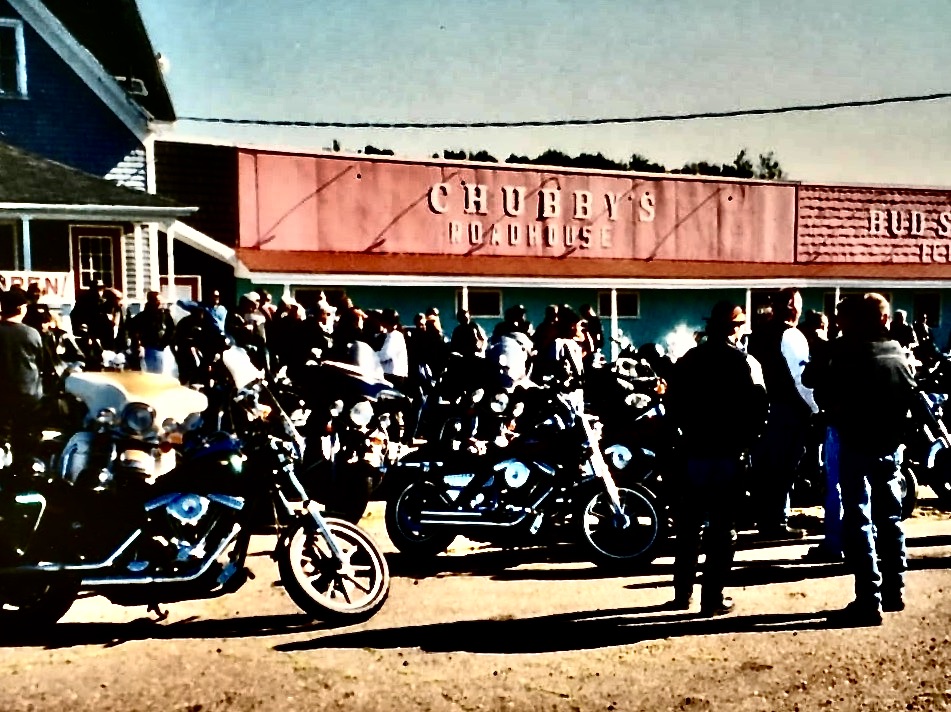
   Chubby’s Roadhouse and Bud’s Diner were next to each other in a pink and blue building on St. Peters Road in Dunstaffnage. They did brisk business. It was a popular pit stop for bikers on poker runs. It was why Pete Lambert had lunch or dinner there once a week, getting to know the riders. He kept his enemies close.

   “We serve burgers and fries and shakes, and fish and chips and clams and all that stuff,” Clarence Foster said. “But I think as far as the burger goes, the best, the one that everybody seems to like is called the Bud Burger.” Clarence was both the Chubby and the Bud.

   Dances were held in the back of the building with local bands. Haywire was a summer favorite. Teenagers with ice cream cones gathered around the pinball machines at the front. Drinkers stayed at the bar, drinking. The bikers ate their Bud Burgers outside during the day and drank inside during the night.

   “We have wedding receptions and things like that,” Clarence said. He told the bikers about them in advance, so that nobody ended up stepping on anybody else’s toes.

   The Spoke Wheel Car Museum was next door. Clarence and his father, Ray, shared an appreciation for old cars. They both liked to smoke but loved cars more. They gave up cigarettes to save money. Instead of going up in smoke their savings went toward buying heaps nobody else wanted and restoring them. They offered to buy Bernie Doiron’s VW Beetle, but he said, “It ain’t no antique.” By 1969, they had 13 cars, including a 1930 Ford Model A Coach that Clarence drove. It was how the roadhouse and diner came into being. 

   “People were coming to the museum and looking for a place to eat,” he said. “Since my dad was a cook in the army, we decided to build a little canteen and it just kept on growing.” 

   Clyde and Pete ate inside at a back table. It wasn’t the warmest day, although it was sunny. They had Bud Burgers and cold pints. There were only a handful pf people having a late lunch.

   “How’s the hip?” Pete asked.

   “Hellzapoppin’,” Clyde said.

   “Is that the official word?”

   “It’s how I feel. I’ve got two months and 29 days from now circled on my calendar.”

   They ate and small talked. “Find anything out?” Pete asked, finishing his burger and hand-cut fries. The food was good because the beef and potatoes came from the island. It would be a trifecta once islanders started up their own breweries.

   “It will be in my report tomorrow, but since you’re interested, I’ll summarize it. She died of a fractured skull. There was tissue not hers on her face and in her hair. I want to say she was hit by a fist that got scuffed up doing it. She had alfalfa on and in her clothes. More than a brush of silage, enough to make me think she was on a dairy farm long enough to roll around in it. She wasn’t killed on that field, although her arm was probably cut off there. The last cut there was in late August, so she was put in the ground sometime between then and no later than the end of October.”

   Thousands of acres of potatoes on the island the last fall were left in the ground. Heavy rain and cold temperatures put a damper on the harvest. There was too much rain and cold, freezing and thawing day after day, and it led to a deep frost.

   “Her arm was probably cut off by an axe, sharp as hell, clean as a whistle. Whoever did it, like the fist, is a strong man or woman. Why it was cut off, since she was already dead when it happened, is for you to find out. She had a loonie clenched in her missing hand. It was a 1988 issue. No prints other than hers on it.”

   “Are her prints in the report?”

   “Yes, what we could get, which wasn’t much of anything, but they will do.”

   It was shop talk. Pete knew everything and a batch of photographs would be part of the report.     

   “She wasn’t molested or abused. I don’t think she had eaten for several days. There wasn’t anything remarkable about her teeth, none missing, one filling. She was in her early twenties, five foot five, 118 pounds, green eyes, light brown hair, no moles, birthmarks, or tattoos. She was healthy as a horse.”

   “Anything else?”

   “One more thing. I think she might have poked somebody in the eye. There was retinal fluid and blood under the fingernails of the first two fingers on the cut-off arm. Her nails were 7 mm long and almond shaped, perfect for poking. It wasn’t her blood, either.”

   Blunt trauma to the eye can cause the retina to tear. It can lead to retinal detachment. It can require urgent surgery. The alternative is blindness.

   “If that happened, where would the eye have been treated?” Pete asked.

   “At a hospital or a large eye clinic.”

   “What happens if it’s not treated?”

   “Kiss goodbye to that eye.”

   “I see,” the police officer said, paying the bill when the waitress stopped at their table. What thin crowd there had been had cleared out. It was the middle of the afternoon. When the two men went out to their cars, they were the only two cars in the front lot. Pete was driving an unmarked police car, although it was clearly an official car. Clyde was driving a Buick Electra station wagon. He could lay a corpse out in the back if he had to. They shook hands and went their separate ways.

   Five hours later a biker riding a red motorcycle approached the roadhouse, swerving to avoid a fox. There was always more roadkill in the spring and fall. Skunks and raccoons were the most common, although foxes weren’t always as quick and slippery as their reputation. He pulled up, parked, and went inside. He left the key in the ignition. His Kawasaki Ninja had an inline four cylinder, 16 valve, liquid cooled engine with a top speed above 240 KPH. He had already made that speed and more. He knew nobody was going to mess with his bike because everybody at Chubby’s knew whose motorcycle it was. At the bar he ordered a Bud Burger and a cold pint.

   “How’s the eye?” the bartender asked. “It looks good. At least, no more pirate’s patch.”

   “Yeah, but I waited too long to get it fixed,” the biker said. “The doc says I’ll probably be more blind than not in that eye from here on. It doesn’t matter, I can still see enough out of the other one to take care of my business.”

   He ate fast and downed his beer. When he left, he paid cash with a new one-hundred-dollar bill.

   “Where do you keep finding these?” the bartender asked.

   “Pennies from heaven, my man, pennies from the main man” the biker said, leaving him a tip of a half dozen shiny loonies.

   Getting on his glam motorcycle in the dusk he thought, I’ve got to be more careful about that.

Excerpted from “Ebb Tide.”

Ed Staskus posts monthly on 147 Stanley Street at http://www.147stanleystreet.com, Made in Cleveland at http://www.clevelandohiodaybook.com, Atlantic Canada at http://www.redroadpei.com, and Lithuanian Journal at http://www.lithuanianjournal.com. To get the site’s monthly feature in your in-box click on “Follow.”

“Ebb Tide” by Ed Staskus

“A thriller in the Maritimes, out of the past, a double cross, and a fight to the finish.” Sam Winchell, Beyond Books

Available at Amazon: https://www.amazon.com/dp/B0CV9MRG55

Summer, 1989. A small town on Prince Edward Island. Mob money on the move gone missing. Two hired guns from Montreal. A constable working the back roads stands in the way.

A Crying of Lot 49 Publication

Behind Bulletproof Glass

By Ed Staskus

   I should have known better when I told the young woman on the other side of the Walgreen’s bulletproof drive-thru window that I needed the kind of coronavirus test that would get my wife and me into Canada and she breezily said, “For sure, this is it.” She was a trained pharmacy technician, but made up her harebrained reply, assuring me all was well even though she didn’t know what she was talking about. We found out three days later trying to cross the border at Houlton, Maine into Woodstock, New Brunswick.

   Getting a straight answer from the young can sometimes be like trying to give fish a bath. They often have a quippy answer for everything. Their answers are in earnest no matter what they’re asked and no matter their wealth or lack of knowledge. Whenever they are fazed by anything they say, “Oh, whatever.” 

   They say whatever they want when they are behind bulletproof glass.

   My wife and I were going to Prince Edward Island, where we didn’t go the summer before because of the 19 virus. Canada closed itself up tight as a clam in March of that year and didn’t reopen for Americans until early August of this year. Once we heard the opening was going ahead, we got in touch with the folks who operate Coastline Cottages in the town of North Rustico on PEI and let them know we were coming on August 21st and staying for three weeks.

   The cottages are on a hillside, on land that has been in the Doyle family going on two hundred years. A park road cut through their farm when it was built in the 1970s, but unlike other landowners they didn’t sell their remaining acreage to the state, so it sits snug inside the National Park. There are several homes on the bluff side of the eponymous Doyle’s Cove, some old and some brand new. In one way or another every one of them houses a homegrown north shore family, except for Kelly Doyle, who has lived on the cove the longest and lives alone.

   It takes two and half days to drive from Lakewood, Ohio to Prince Edward Island. At least it did every other year we had driven to the island. This year it took us six and half days.

   When we got to the Canadian border the black uniform in the booth asked for our passports. We forked them over to the tall trim guard, forearms tattooed, a Beretta 9mm on his hip. He was young and just old enough to be on this side of Gen Z. He looked our documents over and asked where we were from and where we were going.

   “Cleveland, Ohio,” I said. Although we live in Lakewood, an inner ring suburb, we always tell red tape we live in Cleveland. No one has heard of Lakewood. Everybody has heard of Cleveland, for good or bad. At least nobody calls it “The Mistake on the Lake” anymore. 

   I almost preferred the insult. “It keeps the riff raff rich away,” I explained to my wife. “There is no need for Cleveland to become the next new thing. They will just use up all the air and water and our real estate taxes will go ballistic. On top of that, we would end up knee deep in smarmy techies with their cheery solutions to all the world’s problems.”

   We handed our ArriveCAN documents over. We handed our virus inoculation cards over. We had both gotten Moderna shots. We handed our virus tests over, proving we had both tested negative.

   “You are cutting it close,” the border guard sniffed, shuffling everything in his hands like a deck of cards. I was hoping he wouldn’t turn a Joker up.

   The negative test had to be presented at the border within 72 hours of taking it. We were there with an hour to spare, although it would have been two hours if we hadn’t had to wait in line in our car for an hour. We had driven a thousand miles. It was tiresome but waiting in an idling car wasn’t any more skin off our noses.

   It started to smell bad when a second border guard stepped into the booth and the two guards put their heads together.

   “The antigen tests you took aren’t accepted in Canada,” the Joker said. “It has to be a molecular test. You can go ahead, since you’re from Canada, but your wife has to go back.”

   I was born in Sudbury, Ontario, and have dual citizenship, although I only carry an American passport. I couldn’t tell if he was being serious, so I asked him to repeat what he said. He repeated what he said and gave us a turn-around document to return to the USA when I told him I wasn’t ready to abandon my wife.

   We went back the way we had come, just like two of the six cars ahead of us, although we had to wait in line at the American crossing for an hour. Once we returned to Maine, we found out we could get the molecular test, but it would be a week-or more before we got the results. Nobody we talked to, not even the Gods of Google, was any help. A friendly truck driver mentioned New Hampshire was faster, only taking a day or two.

   The truck driver was stout, bowlegged, wearing a Red Sox baseball cap, a two-or-three-day growth of beard on his face, with a small shaggy dog to keep him company on the road. He wasn’t a Gen Z man. It was hard to tell what generation he belonged to, other than the changeless working-class generation.

   We drove six hours the wrong way to Campton, New Hampshire and checked into the Colonel Spencer Inn. It was Saturday night. We got on-line and made test appointments for noon at a CVS in Manchester, an hour away. We streamed “Castle of Sand” on our laptop. It was a 1970s Japanese crime thriller movie and kept us up past our bedtime.

   Over breakfast the next morning our innkeeper told us to go early since the traffic leaving New Hampshire for home on Sunday mornings was heavy. We gave ourselves an hour and a half to drive the 55 miles and barely made it. Luckily, we hadn’t made appointments for an hour later. We never would have made it. The traffic on I-93 going south was a snarl of stop and go by the time we started north back to Campton.

   We got our test tubes and swabs and stuck the swabs up our noses. I spilled some of the liquid in my tube and asked the Gen Z pharmacy technician behind the bulletproof glass if I should start over with a new kit.

   “You’re fine, it doesn’t matter,” she said, lazy as a bag of baloney. She couldn’t have been more wrong, which we discovered soon enough.

   Gen Z is self-centered and self-sacrificing both at the same time. “My goals are to travel the world and become the founder of an organization to help people.” They want to stand out. “Our generation is on the rise. We aren’t just Millennials.” They say they are the new dawn of a new age. “We are an unprecedented group of innovation and entrepreneurship.”

   Welcome to the future, just don’t take the future’s word for it.

   We spent the night at the Colonel Spencer. It was built in 1764, a year after the end of the French and Indian War. During the war the British, allied with American colonists, weaponized smallpox, trading infected blankets to Indians. The virus inflicts disfiguring scars, blindness, and death.

   “Could it not be contrived to send the smallpox among those disaffected tribes of Indians? We must on this occasion, use every stratagem in our power to reduce them,” the British commander Sir Jeffrey Amherst wrote to his subordinates.

   The results were what the continent’s newest immigrants from the Old World expected.

   “They burned with the heat of the pox, and they died to feed the monster. And so, the village was deserted, and never again would the Indians live on that spot,” is how one of the natives described the deadly epidemic.

   We had dinner at Panorama Six82, not far from our inn. The hostess seated us outside on the patio which looked out over a valley and a series of cascading White Mountain hilltops. The sun went down behind one of them and we finished our dessert in the dark.

   Our server was a middle-aged man from Colombia wearing jeans, a Panorama Six82 signature shirt, and a Sonoma-style straw hat. He went back to the homeland every year to visit relatives.

    “They always want money, so I don’t bring too much of it,” Fernando said. “It’s not as dangerous as most Americans think it is. I avoid some neighborhoods, sure, and I avoid riding in cabs. The rebels are in the hills, not the cities, and besides, they don’t do much anymore. The Venezuelans are a problem, all of them leaving their god-forsaken country. But they do a lot of the dirty work for us these days.”

   We drove back to Houlton on I-95. The speed limit north of Bangor is 75 MPH. I set the cruise to 85 MPH and kept my eyes peeled for moose. The fleabags lumber onto the roadway, sometimes standing astride one lane or another. Hitting a moose is a bad idea. A full-grown bull moose stands six to seven feet tall and tips the scales at 1500 pounds. It isn’t certain that the collision will kill the beast, but it will kill your car, and maybe you. They do most of their roaming around after nightfall. We made sure we got to our motel before dusk.

   In the morning my wife was winding down a business meeting on Zoom when there was a knock on our door. It was the housekeeper. She wore a black uniform and black hair pulled back in a bun. She was young. She was part of the Z crowd.

   “We’ll be out in about a half-hour,” I said.

   “Can I replace the towels and empty the trash?”

   “Sure.”

   “Weren’t you here a few days ago?”

   “Yes,” I said, and told her about trying and failing to get across the border and our search for a fast 19 test.

   It turned out the explanation for the motel being sold-out was because of the same problem. Every other person lodging there had been turned around for one reason or another.

   “You should go to the Katahdin Valley Medical Center,” she said. “A friend of mine went there, they did the test, she got it back the next day, and went to Nova Scotia.”

   “Thanks,” I said. We packed and followed Apple Maps to the medical center. The receptionist didn’t know anything about a fast molecular test. She sent us to Jesse, the man upstairs, who was the man in charge.

   “We test on Mondays, Wednesdays, and Fridays,” he said. “It takes about a week to get the results back from the lab.” It was Tuesday. We were already three days late. I started looking over my shoulder for Chevy Chase.

   “Not the next day?”

   “No.”

   We left Houlton and drove to Presque Isle, had lunch, messed around, my wife went running on the town’s all-purpose trail, and we drove to the Caribou Inn in the next town north. While the receptionist checked her computer for our reservation, we heard a wolf whistle through the open door of the office behind the front desk. A minute later we heard it again.

   “That’s just Ducky,” the receptionist said. “She belongs to the manager.”

   “Does she do that often, whistle, I mean?” I asked.

   “Whenever she sees a pretty girl.”

   Another wolf whistle came my wife’s way.

   I must have looked cross, because the receptionist said, “Ducky is a parrot.”

   Ducky was a parrot in a tall white cage just inside the door of the office. Her plumage was green with some red and yellow mixed in. She was a saucy character.

   “She’s twenty years old,” the receptionist said.

   “How long has she been here?”

   “Twenty years.”

   Ducky was spending all her Gen Z years locked up at the Caribou Inn, where flocks came and went. The only lasting relationship she had was with Betty, the hotel’s manager, and the bird’s keeper.

   “I didn’t know parrots lived that long.”

   “They can live to be seventy, eighty years old,” Betty said.

   “Ducky wolf whistles women?”

    “And men. We thought she was a he until she started laying eggs not long ago.”

   The parrot was going to outlive most of us, the 19 or no 19. They sometimes play dead in response to threats. They can also look dead when they are asleep. But if a parrot is lying still and not breathing, looking lifeless, you can assume it is dead.

   We had a non-smoking room, although every hallway that led to our room was lined with smoking rooms. The hallways smelled sad and stale. We were settling in with a bottle of wine and a movie when we got a phone call. It was the lab in New Hampshire that was doing our 19 molecular tests. They had good news and bad news. My wife tested negative, but my test was discarded. 

   “There wasn’t enough liquid in the test vial to maintain the sample,” the lab technician said. “Did you happen to spill some of it?”

   I didn’t bother trying to explain. I got on-line and filled out another ArriveCAN form. When we got to the border my wife had no problem. The only problem I had wasn’t make or break, since they couldn’t deny me entry, test or no test. A health officer gave me a self-test kit and told me to make sure I performed it within four days. She was in her early 30s. I had no reason to be skeptical. She was just out of Gen Z range. I should have been leery since she was wrong. She wasn’t as far out of the field of friendly fire as I thought.

   Four days later, when I went on-line and followed the directions for the self-test, the Indian-looking Indian-sounding woman on the other side of screen was nonplussed when I apologized for waiting to the last minute.

   “I don’t understand.” she said. “You are four days early. You are supposed to test after eight days of self-quarantine.”

   When I started to spell out what had happened, she wasn’t in the mood, and said she would schedule Purolator to pick my test up the next day. Purolator sent me an e-mail saying they would pick up between nine and noon. The truck pulled up just before five. I was grilling dogs and corn on the front deck. The next day I got an e-mail informing me my test came back negative. I had been tested four times in ten days and was finally officially virus-free.

   No matter the generation, Prince Edward Island was the only place and people who got it right. When we arrived late Wednesday afternoon and crossed the nine-mile-long bridge to the province, we waited in one of the many lines edging towards checkpoints. It didn’t take long. A young woman took our vitals while an older man in a spacesuit swabbed our noses.

   “If we don’t call you within two hours you tested negative,” he said.

   We drove to the Coastline Cottages. “Welcome to Canada,” our hosts said. “You made it.” 

   No one from Health PEI called us. We unpacked, watching the day get dark over the Atlantic Ocean, and fell into bed. I drifted off thanking God somebody on our part of the planet knew what the 19 score was, not some mumbo jumbo they dreamed up because they neglected to check the scoreboard.

Ed Staskus posts monthly on 147 Stanley Street at http://www.147stanleystreet.com, Made in Cleveland at http://www.clevelandohiodaybook.com, Atlantic Canada at http://www.redroadpei.com, and Lithuanian Journal at http://www.lithuanianjournal.com. To get the site’s monthly feature in your in-box click on “Follow.”

“Ebb Tide” by Ed Staskus

“A thriller in the Maritimes, the deep blue sea, magic realism, and a family saga.” Sam Winchell, Beyond Books

Available at Amazon: https://www.amazon.com/dp/B0CV9MRG55

Summer, 1989. A small town on Prince Edward Island. Mob money on the move gone missing. Two hired guns from Montreal. An RCMP constable working the back roads stands in the way.

A Crying of Lot 49 Publication

Down to Sea Level

   By Ed Staskus

   There was a window seat midway back in the Boeing 737. JT Markunas parked himself there. The plane looked old but smelled clean. It had been built in 1969 with an expected lifespan of 20 years. It was 20 years old in 1989 on the day JT buckled his seat belt. He was on the one daily Canadian Airlines flight from Ottawa, the capital of Canada, to Charlottetown, the capital of Prince Edward Island. Crossing over the eastern end of New Brunswick, he looked up from his Car and Driver magazine. He took a look through the porthole window at the crescent-shaped island in the distance. The land wasn’t small, but it wasn’t big, either. It was blanketed by snow. He had been told his new posting was mostly farm country. He wondered what it looked like from outer space.

   Seen from outer space Prince Edward Island can barely be seen. The solar system is a speck in the galaxy. The earth is a speck in the solar system. Prince Edward Island is a speck on the earth. When the sky is clear and the sun is shining it is a green and red speck under a dome of blue. When it is cloudy and stormy everything gets wet and gray until the sun comes back. It is the Gulf of St. Lawrence. Where he came from, which was Sudbury, Ontario, the sky was always either getting cloudy or it was already cloudy.

   The lay of the land formed hundreds of millions of years ago. Creeks and rivers deposited gravel, sand, and silt into what is the Gulf of Saint Lawrence. Before the last ice age, Prince Edward Island was part of the mainland. After the glaciers melted it wasn’t a part of it anymore. The Northumberland Strait became what separates it from the rest of Canada.

   The province is one of Canada’s Maritime provinces, the others being New Brunswick and Nova Scotia. Newfoundland and Labrador are nearby but more on their own than not, which is the way they want it. There are 225 kilometers from one end of the island to the other. It is 3 kilometers at its most narrow and 65 kilometers at its most wide. It is twice as far as the Kulloo flies from the island to Walt Disney World in Florida as it is to the Arctic Circle. Walt Disney World is far away and for pretend. The Arctic Circle is nearby and for real.

  There are farms from stem to stern of Prince Edward Island. There are so many of them the province is called the “Million-Acre Farm.” Jacques Cartier discovered it in 1534 and Samuel Champlain claimed it for France in 1603. The French explorers called it Île Saint-Jean. When they landed the native Mi’kmaq’s tried to explain they had been there for thousands of years, but all they got for their trouble was wasting their breath. They switched gears and tried singing some of their Top 10 songs. They sang “The Eagle Song” and “The Honor Song” and “The Gathering Song.” They accompanied themselves on rattles and hand drums.

   “Try singing a different tune,” Samuel Champlain finally said. “I’ll teach you the words.” He meant for them to sing “The Giveaway Song.” The Mi’kmaq glared and reached for their bows and arrows. The French strapped on armor and reached for their swords. They were more savage than the savages and knew how to prove it. The natives grumbled to themselves and drifted away. They thought they could make it right later. They were wrong about later.

   Kulloo could have set them straight, but he didn’t. He spoke in riddles, anyway. Hardly anybody ever understood his riddles. Over the centuries it had gotten so he held his tongue more often than not. He didn’t believe in explaining himself, anyway. He believed, being terse, say it once, why say it again? No matter what the  Mi’kmaq’s thought he was, or meant to them, he was a lone wolf. He was big enough to hook a grown man with his talons and carry him away. If push came to shove, and the man couldn’t explain himself, Kulloo was strong and predatory enough to eat him. Men were his least favorite meal, being bitter and hidebound, bur he was never going to shortchange himself dinner.

   He was at least a millennium old. Nobody knew how old he really was, not even Kulloo himself. The day he saw Jacques Cartier’s two ships come from France in 1534 he didn’t know what century it was. He lived by the seasons and the rotation of the stars. The ships and their crewmen piqued his interest. The Mi’kmaq had small boats that hugged the coastline. The big sailing boats had come from the other world, from the other side of the ocean. Kulloo had gotten word about that world long ago, but had never seen it. He suspected the Old World was intent on making the New World their world. He thought it  best to take a closer look to see where he stood.

   When the British took control of Canada East they changed the name of the island from what the French had called it to St. John’s, then changed it to New Ireland, and again on the eve of the 19th century to Prince Edward Island. It was named after Prince Edward, who later became the father of Queen Victoria. He was beguiled by the island, even though he proposed transferring sovereignty of it to Nova Scotia. He visited his namesake five times. The journey took almost a month to sail one way. 

   It became a separate colony in 1769 and the seventh province of Canada in 1873. Charlottetown was named after the wife of King George III. Queen Charlotte barely spoke a word of English and never visited the capital city. She stayed home in Buckingham House and played her harpsichord. She liked chartbusters like Bach’s “Concerto in the Italian Style in F Major” and Handel’s “Keyboard Suite No. 5.”

   “She ain’t no beauty, but she is amiable,” King George said about his wife. Queen Charlotte smiled slyly. She played “By the Light of the Moon” on her harpsichord for the man of the house.  It was a lullaby. King George took a nap in his queen’s lap.

   The province is the smallest and most densely populated Canadian province, although outside of Charlottetown and Summerside, where half of everybody lives, the habitants and their communities are spread far and wide. Most of everything is in the way of out of the way. Forests once covered the island. Trees still covered half of it. The red oak is the provincial tree. There are pine, beech, and spruce. There are no deer, moose, or black bears. There are rabbits and skunks, muskrats, and plenty of foxes. The red fox is the provincial poster boy. In early summer pink and purple lupins, weeds that are an invasive species, line fields and ditches. The Lady Slipper, an out-of-the-way orchid that grows in shady woodlands, is the provincial flower.

   JT was looking out the porthole window when he saw Kulloo. The bird was bigger than an albatross and more stern-looking than an eagle. If it was sowing the wind it was going to reap a whirlwind. The plane was cruising like it had been for the last hour-and-a-half. The big bird was keeping pace with the plane off the tip of the wing. JT rubbed his eyes and looked again. It was still there, soaring. He scanned the aircraft cabin. Some passengers were reading while others napped. Nobody was looking out at the wide blue yonder. When JT blinked the bird was gone. When he blinked again it was back.

   Farming is the number one way of life on the island, followed by the enterprises of fishing and fish mongering. There are a wealth of fields full of potatoes, grains, and fruits. There are cows everywhere, their snouts in the turf, waiting to be milked or slaughtered. There are boatloads of mussels, oysters, and lobsters to be had. Cod had been overfished to near extinction. There was talk of importing it from Iceland.

   Tourism was growing and Liam Foyle and his Japanese girlfriend Mariko were building cottages on family land in North Rustico to get in on the summer trade. In the meantime, they stayed at Sandy’s Surfside Inn most of the time. It was on the Gulf Shore Parkway. It was on the park road but not in the National Park. They had never sold their land. His brother Conor was his only neighbor. Liam and Conor were Kieran Foyle’s descendants, more than a hundred years after the Irish triggerman from the Old World landed in the New World, his Beaumont-Adams revolver tucked into a sailor’s bag. 

   In 1989 the pickings were good for the Liberals. They swept the elections. Andrew, the new Duke of York, and Fergie, his wife and Duchess, visited, flying in on a Canadian Armed Forces jetliner. George Proud, one of the new Liberal members of the province’s parliament, stood on a bench for a better view of the royals as they were driven up University Ave. “We’re the commoners, and they’re royalty, and I think people in a strange way must secretly like that,” he said. 

   “It’s a great day,” declared John Ready, the mayor of Charlottetown. Not everybody agreed. A woman in the crowd groused, “I was talking to a friend this morning who said, ‘I don’t know why we should have to curtsy to a person who a few years ago was living with a race-car driver.’” During the parade the Duchess climbed over a rope barrier to talk to a group of senior citizens. “What are these ropes for?” she asked. “I can’t believe you’re penned in.” The senior citizens were polite but baffled.

   Scouts Canada held their annual jamboree on the island that summer, honing their outdoor skills and running riot in the woods. The TV series “Road to Avonlea” went into production. The last train on Prince Edward Island made its last run, coming to a dead stop in living time. The tip-to-tip railway had been operating for one hundred years. The minute the clock struck the century mark it was done for good.

   Poison’s “Every Rose Has Its Thorn” was the top song on the radio. Malcolm “Monk” Kennedy was a thorn on the island that year, but nobody knew it until the Boy Scouts had all gone home. They were always prepared, it being the scouting motto, but nobody was prepared for Monk. Nobody was prepared for Jules Gagnon and Louise Barboza, either. They were hired guns from Montreal who came to the island looking for Monk and two million missing dollars.

   Jules and Louise were good as gold at what they did, but didn’t know they were going to end up paddling upstream to get their work done. Monk didn’t know two million dollars was going to be so hard to spend. They didn’t like the stumbling blocks in their way, but by then they had picked their poison. The Hunter River was going to flow through North Rustico and out to the ocean, no matter what. They were going to have to find that out for themselves. They weren’t prisoners of fate. They were prisoners of their own minds. Monk couldn’t change his mind, no matter what. Jules and Louise wouldn’t change their minds, no matter what.

   Kulloo peeled away from the Boeing 737 and swooped landward. He saw Louie the Large near the coastline. Hunkered down on a rock shelf not far from shore, the big shellfish was sizing up Monk, Jules, and Louise. Monk was scrawny. He was off the dinner table unless there was a famine. Jules looked better. He had some meat on his bones. Louise looked the best. He wouldn’t mind getting his claws into her, not at all. They shared a name. He liked that. He would like it even better if they shared some flesh and blood.

   Louie the Large loved the ocean, deep and blue, the tides rising and falling. It was where all life came from. He understood the primal fear men and women had of it, which he encouraged with every click clack of his crusher claws. He knew Kulloo was laying low overhead. He kept one eye open for him. He knew all about the bird. He was dangerous as a switchblade. He knew the creature never slept and woke up every morning dangerous as ever. Everything on land and sea was fair game to him.

   JT looked out the porthole window again, as the plane started its approach to the Charlottetown Airport, and saw that the bird was gone. He didn’t think he had imagined it. He wasn’t a fanciful man. He prided himself on thinking straight. He wasn’t especially impulsive or emotional, although he had been in love once and knew he could be as irrational and emotional as anybody. He didn’t believe any bird could be that big and that fast. It must have been a mirage of some kind, like in the movies. 

   He checked his seat belt to make sure it was snug. He looked down at the sea level he was going down to. Five minutes later he was landing on the Atlantic Canada land that was going to be his new RCMP posting.

Excerpted from “Ebb Tide.”

Ed Staskus posts monthly on 147 Stanley Street at http://www.147stanleystreet.com, Made in Cleveland at http://www.clevelandohiodaybook.com, Atlantic Canada at http://www.redroadpei.com, and Lithuanian Journal at http://www.lithuanianjournal.com. To get the site’s monthly feature in your in-box click on “Follow.”

“Ebb Tide” by Ed Staskus

“A thriller in the Maritimes, out of the past, a double cross, and a fight to the finish.” Sam Winchell, Beyond Books

Available at Amazon: https://www.amazon.com/dp/B0CV9MRG55

Summer, 1989. A small town on Prince Edward Island. Mob money on the move gone missing. Two hired guns from Montreal. A constable working the back roads stands in the way.

A Crying of Lot 49 Publication

Seize the Day

By Ed Staskus

   “Just sit right back and you’ll hear a tale, a tale of a fateful trip.” Gilligan’s Island

   “I’ve sailed my whole life,” Michelle Boyce said.

   A native of London, Ontario, where she grew up, where her father worked for the Board of Education, Michelle raised her children in Aylmer, Ontario, a half hour south of London and less than a half hour from the north shore of Lake Erie. There is plenty of sailing from Port Dover to Long Point to the Port Stanley Sailing Squadron. 

   It isn’t Margaritaville, but it’s laid back. In Port Stanley, on the shoreline, making yourself at home with lemonade or a cold beer on GT’s Beach patio, marking time is watching the town’s drawbridge go up and down. Lift bridges can get stuck up, but that’s the only thing stuck up in town.

   “At one time we owned five sailboats,” Michelle said. “The kids and I used to sail across the lake to Cedar Point every summer. My daughter and I are roller coaster fanatics. We would spend a week in the harbor at Cedar Point and then sail back home.” During the day cannons can be heard when pirates attack riverboats at the amusement park.

   Although she still calls her neck of the woods home, where she spends half the year, the other half of the year she now spends on Prince Edward Island. The country’s smallest province, Prince Edward Island is almost a thousand miles east of Canada’s seed corn hinterland.

   “Sailing to PEI, it got really bad before it got really good.”

   It started when Michelle, her kids, and her partner, Monika Chesnut, went to Prince Edward Island in 2008.  They went for a wedding. They liked what they saw. “We fell in love with the island. We felt at home there, so on the way home we tossed around ideas about how we could spend more time on PEI. We’re an entrepreneurial family. We dreamt up the sailing business.”

   The sailing business is Atlantic Sailing PEI, weighing anchor out of North Rustico on the north-central coast of the island. The three-hour cruises start at the dock, boarding the only sailboat in the harbor, turning out to sea, and looking for dolphins and whales. The sunset sails are on the romantic side. It’s OK to bring a bottle of champagne and find cloud nine.

   Two years after first setting foot on Prince Edward Island, Michelle and her daughter Jessica took the first step toward turning their dream into reality. “We knew nothing about the marine industry on PEI, but we went ahead,” said Michelle. A person with a vision is often more single-minded and able-bodied than somebody with all the facts.

   The facts can be helpful, though, sooner or later. “We went on a sailing trip, from Lake Erie, across Lake Ontario, and up to Montreal. We spent a couple of weeks there and went up the river to Ottawa. Near there we stopped at a marina and found a 38-foot boat we fell in love with.” The name of the boat was Folie. It was going to be the boat Atlantic Sailing PEI would sail the starry-eyed to idyllic sunsets on the Gulf of St. Lawrence. It wasn’t meant to be, however, because folie is a French word meaning, more-or-less, delusional.

   “It can also mean crazy mad person,” Michelle said. “The gentleman we bought it from was 90 years old. He had sailed it to the Caribbean and back. He had pictures. I don’t know how he did it without dying. He said he was a little crazy.”

   Folie was a 1960s-era strong as an ox medium-sized cruising yacht capable of offshore passage. It was a serious no-nonsense boat. The first fiberglass sailboat ever built, the Chinook 34, was built in 1956. “Who built the Folie had no idea how thick they had to make the fiberglass,” Michelle said. “They decided they had to make it as thick as wood. The thing was built like a tank.” Since indestructible is what they ended up needing, indestructible ended up standing them in good stead.

   Michelle Boyce knows her ragtops, from stem to stern. She knows what makes them go, and she knows the free enterprise end of them, too. “When Detroit was going down, I used to buy sailboats there, sell them, and sail them all over the Great Lakes to the people who bought them.” The first thing she did to the Folie was replace its engine. “Everything on that boat was end of life.” The engine was a Universal Atomic 4, last manufactured in the early 1980s. The Atomic 4 used to be the Utility Four, used extensively during WW2 to power lifeboats.

   “I found a brand new one in a barn in northern Ontario, still in its shipping crate from the factory,” Michelle said. After the new motor was installed, she and her daughter set off for Prince Edward Island. They planned on the trip taking two weeks, sailing to and around the Gaspe Peninsula, down the New Brunswick coast, and landing at Northport on Prince Edward Island’s west end. They immediately began accepting on-line reservations for summer cruises. 

   They got to Northport seven weeks later.

   Halfway down the channel out of their first harbor their new Atomic 4 started to overheat. “She was red lining on the temperature gauge. There was nothing we could do. I couldn’t stop in the middle of the channel.” They raced the boat out to the St. Lawrence Seaway, shut off the engine, and threw out the anchor.

   “We spent the next five days in the middle of the seaway fixing the boat.”

   The engine was undamaged, but the hoses carrying the coolant to the engine had melted. “The gentleman I bought the boat from had used crappy transparent hosing that you use for fish tanks. Fortunately, I’m anal about repairs, and I had another boat on the boat.” One rule of thumb on the high seas is, whatever it is, if you can’t repair it, it probably shouldn’t be on board in the first place. The other rule is always have spare parts for everything.

   No sooner, however, did they make it through the lock at the Iroquois Canal, when the boat floundered again. This time the impeller melted. “The old gentleman was also anal, and he had left spare parts scattered all around the boat, so every time we broke down, it was a scavenger hunt. We knew he had one on board, but where?”

   They found it, because they had to. In the event, ‘Regulations Governing Minimum Equipment & Accommodations Standards’ state that the owner, or owner’s representative, the captain, “must ensure that all equipment is properly maintained and stowed and that the crew know where it is kept and how it is to be used.” After replacing the water pump, they sailed down the seaway, staying on the cruising side of the buoys, cruising the wide river. They kept the engine quiet, not dousing their sails, keeping them set to the way they were going.

   It was a windy day, the waves like rippled potato chips, leaving the last lock outside of Montreal, when their steering went. “The boat would only turn right. It wouldn’t turn left. We were heading for a sandbar. One of the locals in his boat beside me was screaming, ‘Turn, turn, turn, you’re going to hit ground.’ We hit ground and came to a stop.”

   “Only two sailors, in my experience, have never ran aground,” observed Dan Bamford, a veteran sailor. “One never left port and the other one was an atrocious liar.”

   “A cable fastener broke,” Michelle said “which was a minor happening of all the happenings. We plugged a hand tiller on, but we were still stuck on the sandbar.” She took a low-tech approach to the problem. She had lowered the sails, but now got them back up, and when the wind blew into them it threw the boat over. “The wind in the sails took the boat off the shallow water,” she said.

   “The goal is not to sail the boat, but rather to help the boat sail herself,” John Rousmaniere, one time editor at the magazine Yachting, has pointed out.

   They pulled into a marina, filled their tank, and got started, except they couldn’t get going. “They filled our tank with dirty gas. I got it running off a jerry can, running a hose directly from the carburetor to the can, bypassing the tank on the boat. But then, we weren’t twenty minutes out of the harbor when we picked up a rope on our prop.” She was done with problems for the day. “The wind was going in the right direction, so I just threw up the sails and we sailed from Montreal to Quebec City.”

   When they got there they ended up floating in one spot off for five days. “The wind died and we had no propulsion,” she said. “Our cooler went warm and we were eating dry reserves. We didn’t have any idea the tides were going to be 24 feet. There was either a 10-knot current going this way or a 10-knot current going that way. The current was so wild there was no rowing our dinghy to shore. We couldn’t dive under the boat to get the rope off our prop, either, too much current.”

   When the wind finally picked up slightly they slowly hove into a marina on sail power. They had to work off the rope. “My daughter chickened out, and so even though my holding my breath under water days are long past, I dove in and got the rope off the prop.”

   At the next marina they followed a friendly local in. He had a sailboat similar to theirs. He waved to them. “We’re fine following you,” she shouted across to him. “You’ll be safe,” he shouted back. He got stuck. Then they got stuck. “Fortunately, we were stuck in mud and stayed afloat,” said Michelle. “He ended up on dry land. “

   The next day, having gotten unstuck, back on the St. Lawrence, they fought a following sea all day. “The waves behind you throw your boat this way and that. It’s hard to steer. At the end of the day, I was exhausted.” It might be why she misread her charts.

   “I thought I was in 25 feet of water at low tide. Actually, I was in 25 feet of water at high tide. The water all disappeared in the middle of the night. My daughter and I were sound asleep when, all of a sudden, BANG! We were sideways.” Waking up with a start, she saw their cats, Cali and Pablo, jump from the bed to the wall, which was now the floor. “They were totally confused.”

   Keeping her wits about her, she remembered a story the man they bought the boat from had told them, about the same thing happening to him in the Caribbean. “He just went to sleep when it happened, the water came back, and it was fine. So, that’s what we did. We made a bed on the wall and went to sleep.”

   In the morning the tide came in and the Folie floated up and away. “It was a tough, tough boat,” said Michelle. ”It was OK, I assumed. We had pretty much worked out the bugs by then.” At least, she thought so. “A tale of a fateful trip, aboard this tiny ship, the mate was a mighty sailin’ lad, the skipper brave and sure.” Assumptions, on the other hand, are like termites.

   They picked up Monika, her partner, at Riviere-du-Loup, a town near where boats turn towards Atlantic Canada. One of the best places for whale watching in the world is at the Saguenay-St. Lawrence Marine Park offshore from Riviere-du-Loup. Beyond the small town are scattered even smaller towns hugging the coastline, and lots of forest.

   “Every so often you’ll see a town and a church steeple. There were almost no other boats around, just the three of us on the Folie, when a superfast black Zodiac came on our horizon. He circled me until he got behind me and started coming up my wash.” There were no markings on the Zodiac. There were four men, clad in black, on the boat. Michelle got on her radio.

   “Vessel approaching, please identify yourself.”

   There was no response.

   She tried again. There was no response. She tried the Coast Guard. “I have a vessel of unknown origin approaching me, unknown intent, mayday, mayday.” There was no response. She grabbed her flare gun.

   “He was coming up my tail. Pirates are a real thing,” she said. “Since we’re a floater, our decks were lined with water and gasoline cans. I had a pirate plan, which was open a gas can, throw it at them, and shoot the flare gun, lighting them on fire.” It was when they came within range, the flare gun cocked, that the blue lights on the boat blinked on. It was the police.

  “Slow down,” one of the policemen shouted through a bullhorn.

   “Whatever,” Michelle muttered.

   “Where are you going?”

   “Prince Edward Island.”

   “Where are you putting into next?”

   “There,” she said.

   “Where’s the man on board?”

   “Pardon me?” The man on board was news to her.

   “You guys are by yourselves?”

   Michelle, Monika, and Jessica looked from one end of the boat to the other. They didn’t see any men. “The cops finally left us alone.” The Zodiac sped away and the Folie got back on track. Time was their enemy. “The whole time we had all these bookings in North Rustico. We were booked solid. Every single day I wasn’t on the island I was hitting the refund button.”

   They hadn’t gotten far before their alternator blew up, stuff started to seize, belts got red hot, and smoke filled the boat, which ended up sideways to the waves. “We instantly got into our deal with it mode.” Jessica ran the jib up, Michelle stabilized the boat, the smoke cleared, and they found a spare alternator. They were starting to run out of the other boat on the boat.

   By the time the Folie flooded a few days later she was starting to wonder what the difference is between an adventure and an ordeal. They had dropped Monika off near Dalhousie, New Brunswick, so she could pick up her car and rendezvous later on Prince Edward Island,                                when they noticed with a jolt that the boat was half full of water.

   “It still wasn’t over!” Michelle said.. “One of the grease fittings, a cap at the prop shaft, had popped, and water was shooting into the boat. The bilge pump was pumping like a madman, but it couldn’t keep up.” It was sink or swim.

   She grabbed a length of rubber hose, some clamps, and a broom handle. She stuffed the handle into the rubber and stuffed the works into the hole. “I clamped it tight so water would stop coming into the boat.” They pumped the seawater out, but by then it had gotten into the engine oil. “It turned it into chocolate milk, like a chocolate milkshake.” They sailed to open water, threw the anchor out, and the next day replaced the oil. They could see the oxidized red of Prince Edward Island in the far distance.

   Taking it easy in a bay one morning, having coffee, they watched baby belugas approach the boat. They are sometimes called sea canaries because of their high-pitched twitter. Big whales were blowing in deeper water. A herd of seals slipped in close to the sailboat. “The cats were running around the boat,” Michelle said. “The seals were lined up beside the boat, their noses stuck up, and the cats were on top of the boat with their noses stuck down, trying to figure each other out. It was like first contact.”

   When the Folie once and for all pulled into Northport on the west end of Prince Edward Island, they were beyond a shadow of a doubt on the island. “I’m not a quitter,” Michelle said.

   That is when they found out the harbors they were going to sail in and out of were too shallow for the Folie’s keel. They also found out there wasn’t a crane-lift big enough to lift their boat out of the water. It couldn’t stay where it was. Boats on Prince Edward Island get winterized in the fall and summerized in the spring. Forgetting your pride and joy in the water from December to April is leaving your boat on the hot seat.

   The first thing Michelle did was to channel the Professor, one of castaways marooned on Gilligan’s Island. A science teacher, he could build anything, hammocks and houses, so the castaways could live comfortably. He rigged up washing machines, supplied water, and generated electric power, using nothing but indigenous coconuts and bamboo, although he was never able to repair the Minnow. “The hole on that boat defies all of my advanced knowledge,” he said.

   Michelle built her own 10-ton hydraulic trailer with which to back up, get under the Folie, pick it up, and carry it away.

   “There must have been ten guys standing around there watching and being brutal,” she said.

   “Do you know what you’re doing?”

   “That’s not going to work.”

   “You’re going to kill yourself.”

   “Are you sure that’s going to work?” Monika, who had just joined them, asked.

   When she had the boat on the trailer and the trailer hooked up to her pick-up, and was driving the boat away, to be stored away safe and sound and out of sight in Summerside for the unforeseeable future, none of the bystanders were there anymore.

    “They scattered like flies,” Michelle said. “Not one of them stayed for I told you so.”

   The next thing she did was drive home to Ontario, pick up her 29-foot sailboat, the Calypso, and haul it back to land’s end, across the Confederation Bridge, and to North Rustico. The Calypso became Atlantic Sail PEI’s bread and butter, three cruises a day, private charters, and special events.

   “Awesome experience,” said Donna Burgoyne.

   “Monika and Michelle were fabulous hosts, very knowledgeable,” said Andre Pelletier.

   “Elle nous fait decouvrir la faune marine et les magnifiques paysages de PEI,” said Sabrina Bottega. “Avec Michelle, c’est super capitaine.”

   “The Folie drained us, in more ways than one,” Michelle said. “It almost bankrupted us. We had to refund tens of thousands of dollars, although we ended up doing some tours at the end of the season.”

   Before landing at Northport, they spent the day anchored off West Point. “It’s where all the windmills are,” Michelle said. It’s where ship yards built sailboats long ago. It’s where sightings of a sea serpent still happen. It is where buried treasure is reportedly buried, still a secret.

   Michelle made herself at home on her back in the sun on the deck while Jessica lolled at the stern. “There is nothing like lying flat on your back on the deck, alone except for the helmsman aft at the wheel, silence except for the lapping of the sea against the side of the ship,” the action actor Errol Flynn once said.

   The three-bladed wind turbines on West Point go around and around. There are 55 of them, rock steady as long as the epoxy sails stay full, at the West Cape Wind Farm. Tilting at windmills is quixotic, like running in circles. But if you can stay the course, and square the circle, making your energy make it a go, you might end up where you wanted to be all along. When Michelle Boyce finally stepped off the plank she landed on the sure-footed red sandstone of Prince Edward Island.

Ed Staskus posts monthly on 147 Stanley Street at http://www.147stanleystreet.com, Made in Cleveland at http://www.clevelandohiodaybook.com, Atlantic Canada at http://www.redroadpei.com, and Lithuanian Journal at http://www.lithuanianjournal.com. To get the site’s monthly feature in your in-box click on “Follow.”

“Ebb Tide” by Ed Staskus

“A thriller in the Maritimes, the deep blue sea, magic realism, and a family saga.” Sam Winchell, Beyond Books

Available at Amazon: https://www.amazon.com/dp/B0CV9MRG55

Summer, 1989. A small town on Prince Edward Island. Mob money on the move gone missing. Two hired guns from Montreal. An RCMP constable working the back roads stands in the way.

A Crying of Lot 49 Publication
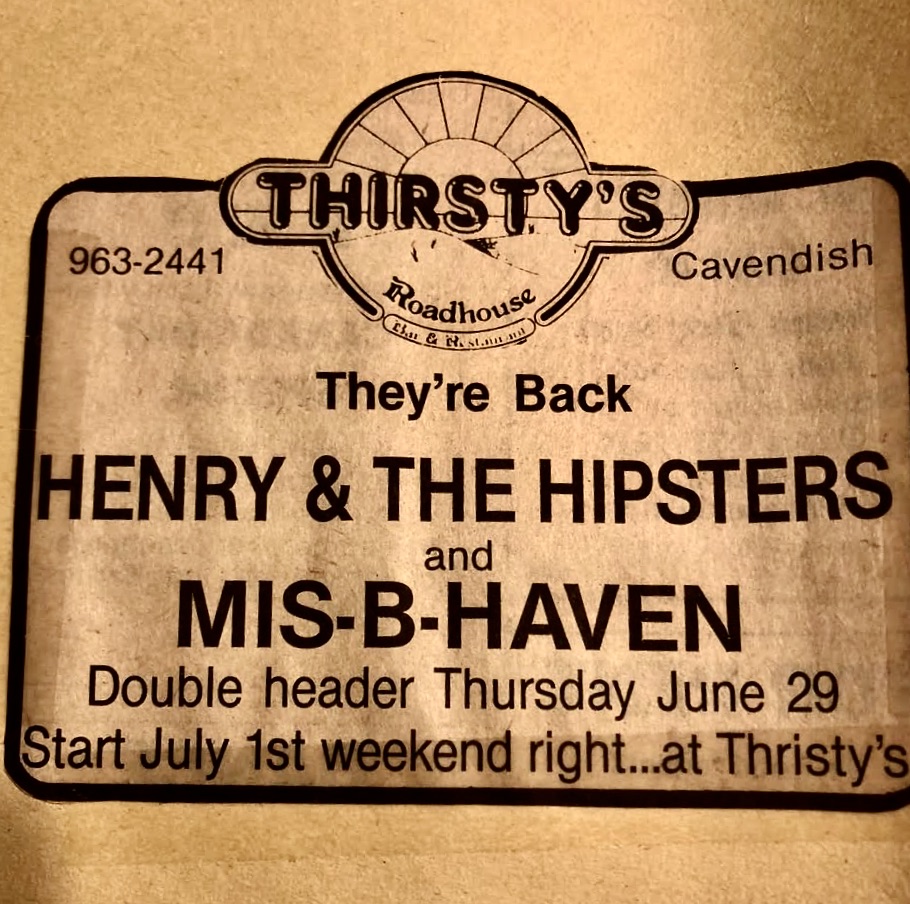
My Aim is True

By Ed Staskus

   “I think all the farmers on the island did it,” Linda Hewitt said. What all the farmers on Prince Edward Island did was squirt a stream of milk in the direction of whatever cat was hightailing it into the barn during milking time. “We used to enjoy watching them line up for their treat.” The ideal of calm may exist in a sitting cat, but when there is milk to be had ideals go out the window.

   Even though it is not ideal for grown-up cats, because it can cause gassiness once they have come of age, squirt milk in the direction of a clowder and they will come running. They drank milk non-stop when they were kittens. When they grow up they remember the familiar smell and taste of it. Their sense of smell is closely linked to memory, more so than their other senses, the same as in people. Straight from the source is their No. 1 comfort food. 

   “Granny Matheson my cousin’s grandmother squirted milk to the cats,” PEI native Anne Fuller said. “They loved it.” Seen from the sky Prince Edward Island lives up to its moniker, which is  “Million Acre Farm.” It is known by several other names, including Spud Island, but is most commonly called PEI. The natives call themselves islanders with a capital “I”.

   Almost all cows nowadays are milked by automatic suction machines. The devices increase the yield of milk and reduce the labor involved. Milking by hand draws about 3-and-a-half liters and takes 15 to 20 minutes.Milking by machine draws about 5 liters of milk and takes between 5 and 7 minutes. The machines go back to the late 1800s. It took decades for them to gain the upper hand. Many cows in North America were still being milked by hand well into the 1940s. Some cows on Prince Edward Island were still being milked by hand even later than that.

   “I did that every day we milked the cows,” PEI native Cecil Wigmore said about the squirting. When you work on a dairy farm, you milk every day because cows don’t take days off. They don’t belong to a union. Dairy farmers wouldn’t mind being in a union and getting a day off, but can’t afford cows going on strike.

   Milking cows on Prince Edward Island in the 21st century is a highly mechanized operation. The total number of cattle on the island is more than 60,000 head. Approximately 14,000 of those are dairy cows and 7,000 are dairy heifers. 170-some farms ship their milk to cooperatives and the volume amounts to 120-some million liters. The milk is known for its good taste and high quality.

   Cows Ice Cream makes some of the world’s best ice cream. They have been making it on the island since 1983 with island milk. They won the award for Canada’s Best Ice Cream in 2015. Their frozen confections were recently named the World’s Best Ice Cream by Tauck World Discovery. 

   “Yes, I sure do remember doing that for cats on visits to my grandfather’s farm,” PEI native Norma MacLean said. “I have many special memories.” Memory is often more about the commands of the heart than the head. The song ‘Memory’ from the musical “Cats” sends shivers up everybody’s spine.

   One of dairy farmer Bloyce Thompson’s cows won the award for Top Holstein in the World in 2011. He is a third-generation farmer in Frenchfort, in the middle of the island, with a sizable herd of purebred cows. He serves as Deputy Premier of Prince Edward Island and has long opposed NAFTA-mandated dairy imports. Why mess with a good thing when you’ve already got the best?

   The dairy business on Prince Edward island is made up of dairy producers, who operate farms and produce raw milk, and dairy processors, who process raw milk into butter, cheese. yogurt, and ice cream. ADL is the major processor, by far. Island cheese is known and celebrated worldwide. Avonlea Clothbound Cheddar won the Super Gold of the World Cheese Awards at the 28th annual BBC Good Food Show in 2015. 

   Milking by hand isn’t rocket science. It is easy enough to do. “I used to do that,” PEI native Tom McSwigan said. While milking a cow he would wait for his cat to rise up on its hind legs and then give it a squirt right from the cow’s udder. “If I missed and hit the cow’s leg she kicked viciously. Not only that, if I got caught doing it I got the heavy hand of justice from my grandaunt, for because I was doing it free of charge.”

   Neolithic farmers in northern Europe were among the first to milk cattle for human consumption. They put hand to teat 6,000 years ago. It was around that same time that the ability of human beings to digest milk was slowly but surely accomplished. It was brought about by the spread of a genetic mutation called lactase persistence. It was what allowed post-weaned human beings to continue to drink and digest milk. 

   Heath McLennan milked cows from his boyhood until his death in 2021.The family farm is in Port Hill on the west end of the island. Heath lived across the street. “He couldn’t wait to get over and that was the highlight of the day,” his son Hilton said. “It was in his blood.” The farm has thirty Holsteins who are milked by machine. “We used to milk them out in the field,” Heath said. “It wasn’t a very excellent job when it was raining. The water would be running off the cows.”

   When asked if he ever milked cows by hand anymore, Heath said he wasn’t sure if it would be a good idea to try milking their cows that way again. “I wouldn’t want to touch them when they’re not used to it now. They might kick the head off you.”

   Hand milking is done one way or the other, by stripping or by full hand. When stripping the teat is held between thumb and forefinger and the hand glides in one smooth motion down the teat while applying pressure to draw the milk out. When employing the full hand method, the teat is held with all the fingers and the teat is pressed against the palm. The full hand method is thought to be the better of the two methods because it applies a more consistent pressure on the teat and simulates the sucking action of a calf.

   “I can still see my father doing it by hand,” PEI native Adele Shea said. “The cats loved it.”

   Before the machine age children played a big part doing what had to be done on the family farm. They gathered eggs, cleaned, fed, and watered the stock, made butter, made lard and soap, weeded the garden, and went berry picking. They helped with planting and harvesting. One thing they did all year round was milk the cows. When they did, sitting on a stool or balancing on their haunches, they made an immediate connection to one of their most important food sources. Kids being kids, they shared the food source with whatever was wandering in for a taste of white.

   “Me when I was younger did it to the cats,” PEI native Ken Macleod said. “I also did it to the dogs.” 

   Even though cows are by nature easygoing creatures, they can sometimes be buttholes. They can be irascible and stubborn. They can even be dangerous. A cow kick can be deadly. It takes the form of a sharp blow. Most cow kicks are brush-offs, but some lead to a trip to the Emergency Room, and a few are fatal. Always move slowly around cows. Always announce yourself when approaching one of them. Never approach a cow from behind. Always be patient. Never flap your arms. Stay a kick away is the way to be. Stay safe getting your glass of milk.

   “Daddy would squirt the barn cats when we were kids,” PEI native Joanne Creamer said. Cats are much faster than cows and even faster when a cow kicks at them. They are rarely overmuch bothered so long as they get their milk. “Me, when I was squirting milk, sometimes I hit the wrong end of the cat,” PEI native Dwight Llewellyn said. “I exactly do remember squirting milk,” PEI native Brian Trainor said. “The cats would sit there waiting while we milked.”

   Fathers milking cows by hand and directing squirts at cats was an island-wide practice back in the day. “Oh, yes, my dad did it all the time!” PEI native Helen Verhulp said. “My dad always done that and sometimes to us, too,” PEI native Caroline MacLean said. “My father did it,” PEI native Joan Coulthard said. “He did it to us kids as well. It was warm sweet milk.”

   Not all parents were as generous. “I always did it until my father caught me,” PEI native Erroll Jon Campbell said. The Scottish are notoriously thrifty. Waste not want not was his father’s motto. The thrifty preach the smart thing to do is be more frugal than not, cats or no cats.

   Milking machines are made of a vacuum pump, a vacuum controller, a pulsation system, a milk transport system, and a milker cluster. The machines apply constant vacuum pressure to the tips of a cow’s udder, mimicking the way milk is naturally drawn. The vacuum tubes are attached to a container where milk is collected. The machines also squeeze the udder periodically so that blood circulation is maintained.

   Milking by hand instead of techno milking is more time-consuming but it is simpler. What’s needed is a milking pail, a wash bowl ,white towel rags, a filter, a funnel, and storage jars. Mason jars are preferred. Glass jars are preferred. Plastic jars are discouraged. They are harder to disinfect. White wash rags are used to clean the udder. Wash bowls are used for cleaning the wash rags. Funnels are used to direct milk from the pail into the storage jar.

   Not all milk ends up where it should. “I remember being sprayed by Shawn and Brian Shea when Granny Trish still had cows,” PEI native Krista Dillon said. “Oh, my God, that was so long ago. I loved that house and farm.”

   Hand milking isn’t coming back anytime soon. Time marches on. Hand milking lives on in the memories of those who made it happen every morning and every afternoon, but there is no squirting anymore. Machine milking is more efficient. Dairy farmers don’t necessarily miss the good old days. The creatures who miss the good old days are the island’s cats. The coming of the Industrial Age meant nothing to them. A stream of warm cow’s milk straight from teat to mouth twice a day is what meant everything to them.

   “Oh my, yes,” PEI native Clara Ross said. “All the barn kitty’s loved it.”

Photograph by Nat Farbman.

Ed Staskus posts monthly on 147 Stanley Street at http://www.147stanleystreet.com, Made in Cleveland at http://www.clevelandohiodaybook.com, Atlantic Canada at http://www.redroadpei.com, and Lithuanian Journal at http://www.lithuanianjournal.com. To get the site’s monthly feature in your in-box click on “Follow.”

“Ebb Tide” by Ed Staskus

“A thriller in the Maritimes, the deep blue sea, magic realism, and a family saga.” Sam Winchell, Beyond Books

Available at Amazon: https://www.amazon.com/dp/B0CV9MRG55

Summer, 1989. A small town on Prince Edward Island. Mob money on the move gone missing. Two hired guns from Montreal. An RCMP constable working the back roads stands in the way.