Tag Archives: Prince Edward Island

Lay of the Land

By Ed Staskus

   When Oliver’s father steered their Jeep Cherokee off the Confederation Bridge and past the Gateway Factory Outlet, he turned on his GPS. He hadn’t told his family, but since entering Canada he had been steering by the stars, by the compass on his dashboard display, not using a map or GPS. The digital compass was up to date snazzy  but old-fashioned like every other compass. He was an electrical engineer attuned to high tech, but sometimes he ditched it. 

   When they had crossed into New Brunswick from Maine, he thought, the island is due east of us, so I’ll just drive due east until we get to it. Other than having to navigate a rotary in the middle of nowhere, the family got to Prince Edward Island with no problem.

   After crossing New Brunswick, he continued on to PEI’s Route 13 through Crapaud, Kellys Cross, Hunter River, and New Glasgow. The family was on its way to the Coastline Cottages in North Rustico for two weeks.

   “Dad,” Oliver asked his father, “how come there are no billboards on the roads here like at home?”

   “That’s a good question, Ollie, but I don’t know.”

   There are nearly 20,000 highway billboard signs in Ohio. There are many more of them dotting the state’s towns and cities. Advertising is legalized lying. Billboards are big and bold about it.

   “I know why, “ Emma said. “Most billboards are banned.”

    “How do you know that?” Oliver asked.

   “Because I did my research, not like some people I know,” she said.

   Oliver was the Monster Hunter of Lake County. He was ten years old. Emma was his older sister by two years. They lived in Perry, Ohio. After the pinching and pushing in the back seat was over, Emma told her family what she knew.

   “No billboards are allowed on most of the roads on PEI, which is what everybody calls the island. It was named after Prince Edward, who became the father of Queen Victoria. He never set foot on ground here. He was like a ghost. The lion on top of the PEI flag is an English lion. The official bird is the Blue Jay. The official animal is the Red Fox. The official boss is called the Premier. Every fifth potato grown in Canada comes from here, which is why some people call it Spud Island.”

   “Anything else, clever clogs?” Oliver asked.

   “No more fighting,” their mother immediately commanded from the front seat.

    That night, after finding the Coastline Cottages and unpacking, they sat in an array of Adirondack chairs on the wide slopping lawn that dead-ended at the Gulf of St. Lawrence, and scanned the dark sky for stars and constellations. Light pollution where they lived in northeast Ohio obscures most of the stars most of the time. From their chairs on the lawn, the family saw many more than they had ever seen.

   “That’s a boatload of stars,” Oliver said.

   “That’s only some of them,” his father said. “There are more stars in the sky than all the grains of sand on all the world’s beaches.”

   “Oh, wow! Who counted them all? Did you, dad?”

   “Not me, Carl Sagan did.”

   A fox chased a zigzagging rabbit in the dark field behind them. There were no streetlights anywhere. The stars twinkled in the inky sky.

   The next day they drove the Gulf Shore Parkway to Stanhope Main, a beach just east of Brackley Beach in the National Park. There was a mile-or-more of sand and dunes. The water was shallow and there were sandbars. It had been a local hotspot during Prince Edward Island’s rum-running days, both for landing booze and having a party.

   Oliver and Emma built inukshuks on the beach, which Emma had also researched. She taught Oliver the mechanics of making them. Inukshuks are human-like figures made of piled stones. They are central to Inuit culture in the Arctic. A red inuksuk is on the flag of their land called Nunavut. The word itself means “to act in the capacity of a human.” They are sometimes used as guideposts showing the way.

   “Dad always says you can learn more from a guide in one day than you can in three months of fishing alone,” Emma said.

   “But dad doesn’t fish,” Oliver said.

   “Oh, you’re right,’ Emma said.

   The tide came in as the afternoon wore on. They packed up and walked back to the parking lot. Oliver found a scrap of paper sticking out of the Marram grass bordering the path. It said, “If you disbelieve in spirits and have faith that you will die in your bed, you may care to watch at Holland Cove at night at the hour when the tide is high.” 

   “Dad, do you know where Holland Cove is?” Oliver asked his father. 

   “No, but I can look it up on my phone.” He found it on his cell phone.

   “It’s near Charlottetown.”

   “When are we going to see ‘Anne of Green Gables’ in Charlottetown?”

   “Tomorrow night,” his father said. “Why?”

   “Can we stop and see Holland Cove after the show?” 

   “Is there something there you want to see?”

   “Yes.”

   “OK, we’ll swing by afterwords.”

   They saw the song and dance stage show the next night at the Confederation Centre, buzzing about it afterwards as they walked back to their car.

   “That girl playing Anne had some Broadway belt in her voice,” their father said.

   “She was almost pure energy,” their mother said. “The show was wonderful. I’m glad we could take the kids.”

   “I was so sad when Matthew died,” Emma said.

   “Me too, sis,” Oliver said.

   It didn’t take them long to get to Holland Cove after the musical show. They parked near the shore. Oliver said they would have to wait for whatever was going to happen to happen.

   Samuel Holland had been the Surveyor-General for the northern half of North America in the mid-18thcentury. He was responsible for the partitioning of Prince Edward Island into 67 lots back in the day. He had come to the island in 1764. His wife Racine came with him. She was tall, pretty, and French. One of Samuel Holland’s surveying trips took him longer than he planned. Racine was anxious about his absence. She bundled up and went out on the ice on the cove to see if she could spot him. The ice was thinner then she expected. She fell through it and drowned a day before her husband returned.

   After her body washed ashore and Samuel Holland buried her, he started seeing her apparition. She always brought a flagon of water with her and called for him. More than two centuries later her voice is still heard along the shoreline of Holland Cove calling for her husband. She has long black hair and is dressed in a white robe. She comes out of the surf, prowls the beach, and returns to the cove disappointed. Many believe that those who see her will themselves soon drown.

   When she came out of the surf only Oliver and Emma could see her. Their parents couldn’t see the apparition. They didn’t believe such a thing was possible. Oliver and Emma met her on the beach. Oliver meant to explain to Racine that she was dead and gone. They introduced themselves. Racine’s face was obscured by mist.

   “Where is Samuel?” she asked them.

   “He died some years after you died, so long ago nobody can remember what either of you ever looked like,” Oliver said. 

   “Oh, no one told me,” she said.

   Sometimes ghosts are muddled and don’t even know they have died. When they find out they are bemused.

   “Do you know you are dead?” Emma asked.

   “No, I didn’t know.”

   “Do you know there are those who believe they will themselves soon drown if they see you?”

   “That’s terrible,” she said. She knew firsthand how terrible it was.

   “Would you like to move on?”

    “Yes, but how do I do that?” 

   “When you are back in the ocean tap the heels of your shoes together and say three times, ‘I do believe in Heaven and Hell.’”

   “I will do that,” Racine said. She turned and strode into the surf, never to be seen again. Oliver and Emma ran back to where their parents were waiting for them.

   “Did you see what you came to see?” their father asked.

   “Yes, but what we saw has moved on to another place,” Oliver said.

Ed Staskus posts monthly on 147 Stanley Street http://www.147stanleystreet.com, Made in Cleveland http://www.clevelandohiodaybook.com, Down East http://www.redroadpei.com, and Lithuanian Journal http://www.lithuanianjournal.com. To get the site’s monthly feature in your in-box click on “Follow.”

“Ebb Tide” by Ed Staskus

“A thriller in the Maritimes, magic realism, a double cross, and a memory.” Sam Winchell, Beyond Books

Available at Amazon: https://www.amazon.com/dp/B0CV9MRG55

Summer, 1989. A small town on Prince Edward Island. Mob money on the move gone missing. Two hired guns from Montreal. A peace officer working the back roads stands in the way.

A Crying of Lot 49 Publication

Making Tracks to Prince Edward Island

By Ed Staskus

   “Hustle it up, kids,” Oliver and Emma’s father said. Oliver was 10  years old. Emma  was 12 years old. Oliver was the Monster Hunter of Lake County. Emma was his sister. She considered herself Oliver’s right-hand man and the brains behind their monster hunting. The family was on their way to Prince Edward Island, which was 1228 miles away from Perry, Ohio, which was where they lived. They were going by car. Their car was a Jeep Cherokee.

   They stopped at a Sheetz at the entrance to I-90, filled up the gas tank, and headed east. They got to Erie in no time and kept going. They drove past Buffalo and Rochester but got off the interstate when they got to the Finger Lakes. They stopped in Waterloo and had a New York Pickle pizza at Ciccino’s Pizzeria.

   “Are we going to the quilt farm after we finish eating?” Emma asked.

   “Yes,” her mother said.

   The farm was on Seneca Lake near Pen Yan. On the way they passed several black and yellow road signs depicting a horse and buggy.

   “Mom, what are those signs?” Emma asked.

   “There are hundreds of Mennonite families up and down these lakes. Some of them get around with horses and buggies.”

   “Who are Mennonites.”

   “They’re cousins to the Amish.”

   The Amish and Mennonites trace their roots to the Anabaptist movement of the early 16th century. Anabaptist is a nickname that means they are rebaptizers. They came from Switzerland and Germany. Both denominations believe modern advances are helpful but only if they  support a simple and humble life.

   “Why don’t they drive cars like us?”

   “The Amish stick to a strict interpretation of the Bible, which means they usually don’t use modern technology in their daily lives. Some Mennonites are old order, so they have horse-and-buggy transportation. Other Mennonites drive cars and wear clothes like us. It just depends.”

   Pauline Weaver and her Mennonite quilters have been making quilts at Weaver View Farm for thirty years. Their prize-winning bedspreads have been featured in Smithsonian Magazine. Dozens of quilts hang from the rafters of their restored 19th century dairy barn.

   “What’s the difference between Amish and Mennonite quilts?” Pauline said. “Not much. Maybe Amish just rolls off the tongue easier than Mennonite.”

   Emma’s mother was looking for a Lone Star pieced quilt.

   “Is it true Mennonite quilters always make an intentional mistake to show humility before God” she asked.

    “I don’t know how that one got started,” Pauline said. “As for me, I make enough mistakes as it is.”

   After they put in their order for the design they wanted on a quilt that would be shipped to them in a couple of months, and were preparing to leave, Emma’s mom asked if quilting bees were still common.

   “Quilting bees really aren’t all that common anymore,” Pauline said. “Sometimes a family will suffer a catastrophe and we’ll do a quilting bee to raise money. A quilting bee is a little like a barn raising. A quilt is completed in a single day. It’s not so hard to do with a large group of women, but the quilters do end up working very quickly.”

   They got back on Rt. 14S and were soon back on I-90. They drove past Albany, the Berkshires, skirted Boston, and stopped in Portland across the border in Maine for the night. They were staying the night near the waterfront. After walking up and down Commercial St. they stopped at Gilbert’s Chowder House and had chowder. Afterwards they walked down the Custom House Wharf. 

   “Dad, Is it OK if we talk to that man writing on that thing,” Oliver asked. A man was sitting on a lawn chair beside the Coastal Bait Shop. He was hunched over tapping at a mint green typewriter. The typewriter was on a red milk crate which was on a block of concrete.

   “Yes, but stay right there until we come back,” his father said. “ We’re going to walk to the end of the wharf and then come back.”

   “Hi mister,” Oliver said, Emma at his side.

   “Hi kids,” the man said.

   “What is that thing?” Oliver asked.

   “It’s a typewriter, a portable Royal, like a laptop.”

   “Where did you get it?”

   “I got it at a rummage sale. Everything works except the letter W.”

   “Why doesn’t it work?” 

   “The rods here hold the letters that hit the paper. When I strike a key a rod swings up and hits this ink-coated tape which transfers the letter to the page, except the W, which is missing.” 

   “Oh.”

   “I’m writing my life story.”

   “Oh.”

   “My name is William.”

   “I’m Oliver and this is my sister Emma.”

   “Where are your parents?”

   “Down there by the water.”

   “Good,” William said. “I’m not up for two orphans.”

   William was wearing a Panama hat on top of a head of dreadlocks, a sleeveless ribbed undershirt, baggy blue pajama pants, and orange Crocs. He was smoking a Calabash pipe, the kind Sherlock Holmes used to smoke.

   “Who’s Sherlock Holmes?” Oliver asked.

   “A detective from long ago.”

   “Are you making a book about your life?”

   “Yes and no,” William said. “I write a chapter every day but at the end of the day I throw whatever I’ve written into that trash can over there.” He pointed at a trash can.

   “Why do you do that?”

   “Life isn’t about finding yourself. It’s about creating yourself. That’s what it’s all about, in the wink of an eye.”

   Neither Oliver nor Emma knew what to say, so they said, “Here come our parents.”

   “It’s been nice talking to you kids,” William said. “Do you want to hear a secret?”

   “Sure.”

   “Everything depends on a 6-inch layer of topsoil and the fact that it rains.”

   “Oh, OK, thanks for the secret.”

   The next day they got up early, had an early breakfast, and got going north on I-95. The highway starts in Miami in Florida and ends in Houlton in Maine. Every few miles they saw a sign saying “Beware Moose Crossing.”

   “We have to be careful about moose coming on to the road,” their father said, “although they mostly come out at dawn and dusk and in between at night. We’ll be on Prince Edward Island before it gets dark though.”

   “Moose are really big,” Emma said.

   “They are about a thousand pounds.”

   “What would happen if we hit one?”

   “We’re not going to hit one.”

   When they got to Houlton they filled up their gas tank at an Irving’s and drove the couple of miles to the Canadian border. They had to wait in line. When they got to the guard booth a dark man in a blue uniform wearing a turban leaned out towards them. His name tag said he was Gagan Singh. He asked them for their passports. The family had NEXUS cards and handed them over.

   “Are all of you American citizens?”

   “Yes.”

   “Where are you from?”

   They told him they were from Perry, Ohio.

   “What is your destination?”

   “Prince Edward Island.”

   “What is the purpose of your trip?”

   “Vacation.”

   “Have a good trip,” the border guard said.

   They drove into the province of New Brunswick, which they would have to cross the length of to get to Prince Edward Island.

   “Dad, that man, he asked us if we were citizens, but he didn’t look like a citizen,” Oliver said.

  “He was probably an immigrant who became a citizen. I think he is a Sikh.”

   “What’s that’s?”

   ”It’s a religion, like being Catholic They’re from India.”

   “Why don’t they stay in India? Why are they in Canada?”

   “Probably for the same reason there are immigrants everywhere.”

   “What’s the reason?”

   “There are different reasons. Most of time it’s to go somewhere where they can find a better life. Maybe there were no jobs where they lived, or the climate was getting bad, or there was a war going on.”

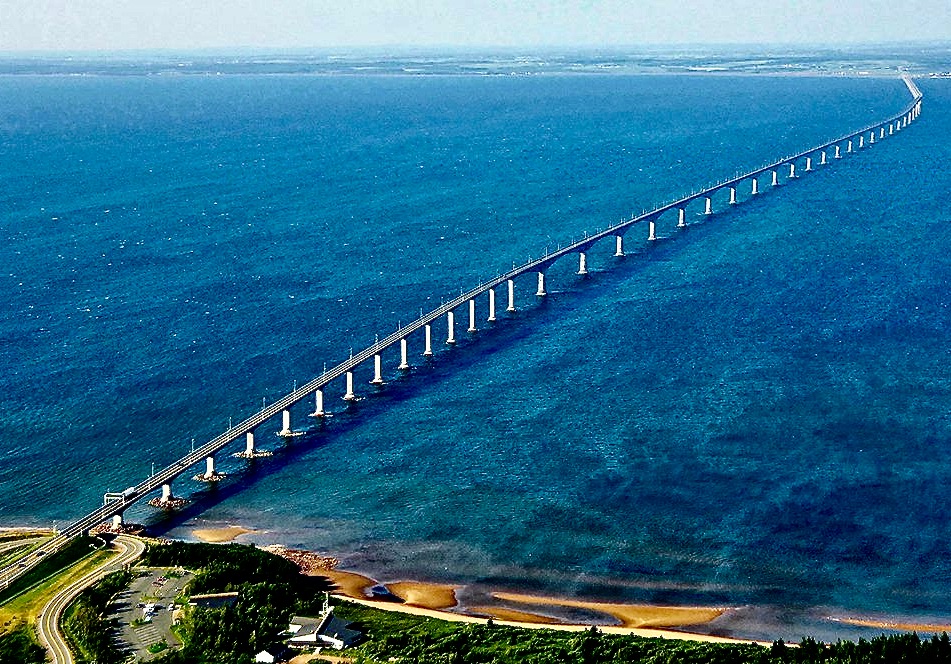
   They drove east past Woodstock, Frederickton, and Moncton. When they got to Sackville they stopped for a bite to eat at the Cackling Goose Market. An hour later they were at the Confederation Bridge. Before 1993 the only way to get to and leave the island was by car ferry. After 1993 there was the bridge. It is a nearly 8-mile long box girder bridge carrying the Trans-Canada Highway across the Abegweit Passage of the Northumberland Strait, linking Prince Edward Island with the mainland. It is the same length as 117 football fields. It weighs almost 8 billion pounds. The average person weighs about 150 pounds so the bridge equals 50,000,000 people.

   “That’s a mighty big bridge!” Emma said.

   “And long, too,” Oliver said.

   They got to North Rustico on the north side of the island before dusk. They were going to stay in one of the cottages at the Coastline Cottages just outside of town on the coast of the Gulf of St. Lawrence. When they drove up the long drive they passed a kidney-shaped salt water pool.

   “You didn’t tell us they had a swimming pool!” Oliver and Emma exclaimed at the same time. 

   “They do and it’s open every day it doesn’t rain.”

   “Does it rain much?”

   “Not too much.”

   “Woohoo!”

Ed Staskus posts monthly on 147 Stanley Street at http://www.147stanleystreet.com, Made in Cleveland http://www.clevelandohiodaybook.com, Down East http://www.redroadpei.com, and Lithuanian Journal http://www.lithuanianjournal.com. To get the site’s monthly feature in your in-box click on “Follow.”

“Ebb Tide” by Ed Staskus

“A thriller in the Maritimes, magic realism, a double cross, and a memory.” Sam Winchell, Beyond Books

Available at Amazon: https://www.amazon.com/dp/B0CV9MRG55

Summer, 1989. A small town on Prince Edward Island. Mob money on the move gone missing. Two hired guns from Montreal. A peace officer working the back roads stands in the way.

A Crying of Lot 49 Publication

Rise and Shine

 By Ed Staskus

  “I got started in theatre when my mom was looking for what I might be interested in,” Hayden Lysecki said. “She put me into all these random things, from dodgeball to martial arts, but the thing that stuck was theatre.” Born and bred in Whitby, Ontario, Hayden was 12 years old when he got cracking. He put his dodgeball sweatbands away and retired his gi fighting suit. He planted himself on the stage.

   “I think it stuck because I love being a part of telling stories and I love attention.”

   One of the first productions he appeared in was “Oliver!” It is a musical from 1960 based on an 1838 book by Charles Dickens. Oliver Twist is an orphan navigating London’s underworld while searching for a family and a home. He falls in with a gang of pickpockets led by the cunning Fagin.

    “The director Geoff Couler saw something in me and gave me the part of Fagin,” Hayden said. He was the youngest member of the cast. “There was a sense of great excitement and utmost fear in me. I found out thriving on that is what theatre is all about. It’s like riding a roller coaster. It’s a positive fear, since it’s such a fun experience.” He belted out “You’ve Got to Pick a Pocket or Two.” The applause lit him up.

   “The year of ‘Oliver’ changed my life. The majority of what I’ve done since then are musicals. You get to act, sing, and dance, instead of just talking at an audience.” Musicals are about characters who feel so deeply about something that they are compelled to break out into song. “I love plays, but some of them are stinkers, like when there are two guys in one room and they spend all their time talking to each other.”

   Hayden majored in performing arts at Oshawa High School and O’Neill CVI High School. He participated in a Broadway Student Summit studying “Hamilton” and “Chicago.”  He secured a Music Performance diploma from Holland College and is currently a Bachelor of Music student at the University of Prince Edward Island. 

   “Choral music was pushed in our high school, which suited me since it is one of my passions,” Hayden said. “Our chamber choir was invited to sing at Carnegie Hall for Eric Whitacre.” The bus ride to New York City took most of a day. Eric Whitacre is an American composer and conductor best known for his choral music. “There were lots of choirs who were part of that show. It was mind-blowing.”

   During Hayden’s high school years he participated in several tailored workshops. “Most of the workshops ended with the advice, if you can do anything else, please do it. The mindset I learned to keep is, what’s destined for you will come to you, while what’s not for you, you will be rejected for it. It will suck but you will move on. The only thing you can do is accentuate what you do well, and that way you’ll get the roles you’re going to shine in.”

   His parents were all in, even though neither of them were performers. His father, however, had once played in a  band in high school. It was a four bass guitar band called Lake of Bass. There was a steady beat but the melody had to be worked out  by the listeners. 

   “My family made the commitment to driving me to rehearsals multiple times a week until it became an in school thing in high school.”  All youngsters need some help as well as the confidence of the help they are being given. Parents helping their children is fruitful for everybody. It enriches the children and benefits the neighborhood by keeping parents off the streets.

   “I was a bit of a black sheep trying a new thing,” Hayden said. “The way my parents supported me came in all the ways parents have to do it behind the scenes, driving me everywhere, making sure I was fed before rehearsals, and coming to all my shows. I think they realized it could be a reinforcing thing for a kid who wants to figure out who they are in life, who wants to grow into their own.”

   Hayden graduated from high school as the Covid-19 pandemic picked up steam. “I didn’t get to go to prom, a graduation ceremony, or perform in our year-end show. I was supposed to be Joseph in ‘Joseph and the Amazing Technicolor Dreamcoat.’ I couldn’t go anywhere. I went nocturnal for a couple of months. Not being able to perform, your soul just dies.”

   Hayden’s father was the Chief Technology Officer of a software company. Mike Lysecki moved his family from Ontario to Prince Edward island in the summer of 2021. His firm had  leased office space in Charlottetown, the capital of the province, intended to house 50 employees, and wanted somebody up the chain of command to run the operation. Hayden’s father was that man. 

   “Prince Edward Island and Charlottetown are growing areas for top talent across Canada and the province’s proximity to universities and its passionate workforce makes it the perfect place for our expansion,” he said.

   “My father had been thinking of retirement and thought Prince Edward Island would be a wonderful place to settle down when he eventually stopped working. It was the fastest process ever for our family. He told us about it in June and we were on the island in August. It was a whirlwind. Things were crazy for me for a while but as soon as I came here I could see there was a vibrant music and theatre community on the island.”

   The family moved to the bay at West Covehead, up the street from the Brackley Beach Drive-in. Hayden started knocking on doors. “Since then, I’ve been living and doing shows here. I started by working at the Watermark Theatre in North Rustico as an intern, doing all kinds of things, props, painting sets, being their office manager. I was a part of the ‘Munshables’ at the Confederation Centre last year and this year I have been in ‘Rent’ and ‘Anne & Gilbert’ at the Florence Simmons Theatre.”

   “Rent” became a big hit as soon as it premiered on Broadway in the 1990s, winning the Pulitzer Prize for Drama and the Tony Award for Best Musical. The story revolves around Mark and his friends in the arts struggling to make a living in New York City. Hayden played Mark in the musical, embracing the character’s dual roles as narrator and documentarian of his circle’s experiences. “Mark wants to shed light on not just his friends, but the entire community that he’s immersed himself in. And that’s such an inspiring journey.”

   It’s also a challenging journey. “One of the most challenging aspects of the musical is all the genres Mark performs in. Rock is the main medium in the story, but Mark performs in a myriad of musical styles from powerful duet ballads to dancing the tango. It’s almost entirely sung through, like an opera, so there is very little downtime onstage. Mark and I are very similar in our abilities to connect with people and read their emotions to properly perceive a situation. We also both have a passionate fire inside of us that translates to our physicality. Rallying a crowd and leading a group number feels like second nature.”

   “Anne & Gilbert” was where he learned to act fast. The actors had only two and a half weeks of rehearsals. They had to get the ball rolling. “They needed to learn 17 musical numbers in a short rehearsal time, and the quality of their singing was exceptional,” Wade Lynch, the director of the show, said.

   It was also where Hayden sussed out the merits of authenticity. “You lose authenticity when you chase it, when you set your performance around trying to get an audience to react to you. Your job is to do your part in the narrative. In musicals the actors on stage are gaining a lot of their energy and passion based on what the audience is giving back to them. If you can get an authentic reaction from the audience, then you’ve got something great going.”

   He had something great going when he played Fagin in “Oliver.” In the second act he sang a song called ‘Reviewing the Situation.’  It starts by asking, “Can a fellow be a villain all his life? I’d be the first to say that I wasn’t a saint.” It ends by declaring, “I’m a bad ‘un and a bad ‘un I shall stay.” Reviewing a situation usually means identifying issues for improvement and making changes. Not so for Fagin in that song. 

   “It’s got four verses with a ton of words,” Hayden said. “I was stressed out about forgetting the words on opening night but I got in a groove and it just flowed. When I hit the end of the song, the audience loved it. It felt incredibly validating. It makes you feel invincible. From then on I knew that was the feeling  I was after.”

   Obstacles are what you see when you take your eyes off the goal. Nothing can stop a man with a purposeful frame of mind. Nothing can help a man with an aimless frame of mind. Hayden is staying focused on the bullseye.

   “One of the main reasons I enjoy performing is because of the connections you make with people, not just within your troupe, but with the audience, too,” he said. “Audiences come and go but they can and do remember you.”

   Being in the acting business can be enriching in more ways than one. “Some people look at acting like it’s just messing around and not work, not exactly a way of making a living,” Hayden said. “I try to surround myself with creative individuals and theatre people who enjoy the craft, so I hear a lot less of the negative voices. For me, acting fluctuates between being a business and the favorite thing I like doing. If you’ve got the grit, if you’re marketing yourself, if you are accepting opportunities, it is one of the most rewarding jobs on the planet.”

   All jobs require a measure of stamina, staying aware of the whys and wherefores, and putting in the effort. “My next few years are committed to studying my craft at the University of Prince Edward Island, so I’m sticking around here,” Hayden Lysecki said. He is committed to rise and shine.

Ed Staskus posts monthly on 147 Stanley Street at http://www.147stanleystreet.com, Made in Cleveland http://www.clevelandohiodaybook.com, Down East http://www.redroadpei.com, and Lithuanian Journal http://www.lithuanianjournal.com. To get the site’s monthly feature in your in-box click on “Follow.”

“Ebb Tide” by Ed Staskus

“A thriller in the Maritimes, the deep blue sea, magic realism, and a memory.” Sam Winchell, Beyond Books

Available at Amazon: https://www.amazon.com/dp/B0CV9MRG55

Summer, 1989. A small town on Prince Edward Island. Mob money on the move gone missing. Two hired guns from Montreal. A peace officer working the back roads stands in the way.

A Crying of Lot 49 Publication
Shock Wave

By Ed Staskus

   “When Britain is at war, Canada is at war,” Prime Minister Wilfrid Laurier said in 1910. “There is no distinction.” Four years later when Britain entered World War One, Canada signed on, too.  In August 1914 the Governor-General of Canada vowed that “if unhappily war should ensue, the Canadian people will be united in a common resolve to put forth every effort and to make every sacrifice necessary to ensure the integrity and maintain the honor of our Empire”

   Empires are made by plundering and slaughtering. They are always sure of the rightness of their cause. They never go down without a fight. It doesn’t matter if there’s any honor in the fighting, or not. They plow straight ahead.

   The country had no air force, a navy fit for a bathtub, and an army of 3,000-some men.  By the end of the war more than 600,000 Canadians had enlisted in the Canadian Expeditionary Force to fight for King and Country and more than 400,000 of them served in Europe, out of a population of fewer than 8 million nationwide.

   “The Empire Needs MEN” is what the posters said. “All answer the CALL! Helped by the YOUNG LIONS the OLD LION defies his foes. ENLIST NOW!”

   Everybody wanted in on the fight because everybody thought it would be over by Christmas. Canadians lined up to support the British Empire and collect steady pay of $1.10 a day. The harvest that year was bad, and unemployment was soaring. But machine guns fired ten times as many bullets a minute as they were paid pennies a day. Hundreds of thousands on all sides were slaughtered week by month by year by the rapid-firing weapons on the Western Front.

   At the beginning of the war, it was better to be killed than wounded. The wounded were taken off battlefields in horse-drawn wagons or on mules with baskets on their sides, the baskets soaked and dripping with men bleeding to death. There wasn’t any such thing as a dressing. If they made it to a train station, they were transported to hospitals. “One of those trains dumped about 500 badly wounded men and left them lying between the tracks in the rain, with no cover whatsoever,” said Harvey Cushing, the head of the Harvard Unit of volunteer doctors at the American Ambulance Hospital of Paris.

   Nearly 60,000 Canadians were killed, most of them the result of enemy action, and more than 170,000 of them were wounded. Almost 3.500 men and one woman had at least one arm or leg amputated. Private Curley Christian lost all four limbs but survived.

   During the Battle of Vimy Ridge he was unloading cargo from trucks when an artillery shell hit next to where he was, trapping him under debris for several days. When stretcher bearers tried to reach him, they were killed by more artillery. When he was finally rescued, he was transported to a military hospital and from there to London. His arms and legs had gone gangrenous and all four were sawed off.

   When he got back to Canada he was fitted with prosthetic limbs and married Cleopatra McPherson. He deigned his own prosthesis for writing. Cleo and he had a son who twenty years later served in World War Two.

   More than 7,000 Prince Edward Islander’s enlisted. Five hundred of them were killed and more than a 1,000 wounded. Tommy Murphy went overseas with a siege battery in 1915. Before he went, he got married to Freya O’Sullivan and got her pregnant. He got word of his son Danny’s birth by telegram while taking a break in an ankle-deep puddle of water sheltering in a trench during the Third Battle of Artois. 

   He had spent eight days at the front and was due for four days in a reserve trench and then four more days at a rest camp. When the bloodletting went on and on and the ranks thinned out, he never made it to the reserve trench much less the rest camp. It was that kind of a war. The Allied and Central Powers fought the same battles over and over.

   The British French and Canadians assembled seventeen infantry and two cavalry divisions for the offensive at Artois, backed by 630 field guns and 420 heavy artillery guns. During the fighting the field artillery fired 1.5 million rounds and the heavy artillery 250,000 rounds at the Germans defenses. Tommy Murphy barely slept for days. Whenever he took a break, he felt like his arms were going to fall off after loading shells until there weren’t any more to load. He knew he had sent his share of Germans to Hell even though he never saw one of them die.

   When the Allies tried to advance, they suffered 40% casualties. The battle went on from late September to mid-October when it ground to a halt in the middle of a never-ending autumn rainstorm and mutual exhaustion. By that time both sides were conserving ammunition because they were running out of it. They spent the rest of the month burying their dead, tending to their wounded, and withdrawing.

   Tommy was a cannon man because he was taller than five feet seven inches and burly enough to do the heavy work of feeding artillery. He didn’t have flat feet or bad eyesight, He didn’t have the greatest teeth, but explained he was enlisting to fight Germans, not bite them. He could have begged off the war because he was married, but he was patriotic and wanted to do his fair share. Money from the Canadian Patriotic Fund helped his wife keep the home fire burning.

   His battery had a lance corporal scout sniper attached to it. Francis “Peggy” Pegahmagabow was an Aboriginal who could split a bullseye nobody else could even see. He had more than 300 kills to his name. He roamed No Man’s Land at night for them, seeking out enemy snipers and forward spotters. He always came back in the morning. The other side never made it back to their side.

   He wore moccasins instead of army boots, chewed dead twigs whenever he sensed danger, and always carried a medicine bag. “When I was at training camp on Lake Superior in 1914, some of us landed from our vessel to gather blueberries near an Ojibwa settlement,” he said. “An old Indian recognized me and gave me a tiny medicine bag to protect me, saying I would shortly go into great danger. The bag was of skin tightly bound with a leather throng. Sometimes it seemed to be hard as a rock, at other times it appeared to contain nothing. What was inside of the bag I do not know.”

   Tommy had signed up for short service and when 1915 was over and done and it was April 1916, he was done with his one year on the Canadian Expeditionary Force. His commanding officer tried to convince him to re-enlist, but he had a wife, a child, and a farm that needed him. He didn’t need to kill anymore Germans. He was sick of the butchery. Three men from North Rustico were already dead. He didn’t want to be next. He knew if he re-enlisted it was only a matter of time before he went home in a box to be buried on Church Hill Rd.

   He got out when the going was good. The next year enlistments dried up as men near and far began to realize the toll the new style combat on the Western Front was taking. Machine gun fire and shell fire was murderous. On top of that there was poison gas. The dead were left where they fell. They were left for the rats. In May 1917 the government announced conscription through the Military Service Act. The rats stood up and cheered.

   It was easier getting into the army than it was getting out. He finally found a ride on a troop transport from Calais to Dover, took a train to London, and spent the night at a whore house with a razzle dazzle girl. He took a steam bath the next morning and had lunch at a corner fish and chip shop eating cod with a splash of vinegar and a full pint at his elbow. He followed the first pint with a second pint and was happy for it. He had a ticket for passage to Halifax in his wallet, but it was a week away. His grandfather had come from Ireland, or so the family story went, and done something big for the Crown, who rewarded him with 400 acres of PEI shoreline. He unfolded a map and located Dublin. It was directly across the Irish Sea from Liverpool.

   He bought a train ticket to Liverpool and the next morning landed in Dublin. It was Easter Monday. The Easter Rising had happened yesterday. The Easter Rising was happening today. 

   After landing at the Dublin Port, he followed the River Liffey, making for Dublin Castle and St. Patrick’s Cathedral. His plan was to find a room for a few days and have dinner. He would explore the rest of the city after a good night’s sleep. He was wearing his Canadian Army uniform over a pair of Spring Needle underwear and carrying a rucksack. He had his toiletries, four pairs of clean socks, his rolled up military wool overcoat, and a paper bag full of Huntley & Palmer biscuits in it. The biscuits were so hard they would crack a man’s teeth at the first bite if not soaked in tea beforehand.

   His papers and money were in a travel wallet attached to his belt. He had his Colt New Service revolver on his belt, too, for what it was worth now that his war was over. An hour later he was glad he had it, after he got it back, although he wasn’t sure if he was going to need it to protect himself from the Irish or the British.

   Dublin Castle was in the middle of the old part of the city. The city got its name from the Black Pool, the ‘Dubh Linn,’ where the rivers Liffey and Poddle met. It was where the castle was. It had been a Gaelic ring fort in the beginning, a long time ago. Later, after the Vikings showed up, it was a Viking fort. For the past 700 years it had been a British fort, the seat of their rule in Ireland. 

   Tommy didn’t have anything against the British, but after a year of serving in their army, he thought the Irish might be better served ruling themselves. They couldn’t do worse. During the year he served on the Western Front three quarters of a million Jacks and John Bulls were killed. It made him sick to think of the men he had seen obeying orders to attack barbed wire and machines guns across open fields. Another few million men went wounded and missing. The broken might survive, but he didn’t think the missing were coming back anytime soon.

   He was glad to be out of it. It hadn’t ended by Christmas of 1914. It still wasn’t over by Christmas of 1915. The next Christmas was in eight months and the talk was it would take a half-dozen more holidays to either win or lose the war. He meant to say a prayer in St. Patrick’s Cathedral before dinner. 

   He didn’t get a chance to say a prayer, find a room, or have dinner. He lost his chance when he came across the bridge leading to Trinity College, turned the corner towards Dublin Castle, and found himself face to face with a Mauser semi-automatic pistol. He knew exactly what it was. He stood stock still exactly where he was. The hand on the firearm was a woman’s hand. She was wearing an old military hat and a yellow armband.

   “Hand’s up and on the wall, boyo,” she said, a second woman coming up behind him. The second woman was wearing a bandolier laden with a half dozen hand grenades. She had a revolver. It looked like it came from the Middle Ages. He did what she said. She patted him down and took his Colt.

   “Who are you and what are you doing here?” she asked.

   “Tommy Murphy, Canadian Army, from Prince Edward Island by way of a year in France,” he said. “I’m here to take in the sights before going home. Now that we’re talking, I thought Ireland was sitting the war out.”

   “We ask the questions,” the woman wearing the bandolier spit out.

   “Come on,” the woman with the Mauser said, poking him in the small of the back with the barrel of the gun.

   The streets leading to the city center were barricaded. When they got to the General Post Office, he saw there were two green flags flying in place of the Union Jack. They said “Irish Republic” in gold letters. He knew there was no such thing as an Irish Republic. 

   “What’s going on?”  

   “We’re rocking the casbah,” the grenade girl said.

   There was a man outside the post office reading from a broadsheet. It was the “Proclamation of the Irish Republic.” There were copies of it pasted on walls. Newsboys were handing them out to anybody who wanted one. Not everybody wanted one. Most of them didn’t understand what was happening. The grenade girl handed him a copy. “Read this,” she said. There were men with rifles and shotguns on the roofs of buildings overlooking bridges.

   “Who’s this?” said a man wearing a scrap of paper pinned to his breast. It said “Citizen Army.”

   “We found him down the street, Sean.”

   Sean was Sean Mac Duiarmada, one of Commander-in-Chief Patrick Pearce’s right-hand men.

   “He’s Canadian,” Sean said pointing to Tommy’s regimental badge and the “CANADA” title at the end of his shoulder straps.

   “We thought he was a Brit.”

   “They’ll be here soon enough,” Sean said.

   There were 1,200 rebels waiting for 20,000 British troops to arrive.

   A shot rang out in the distance and Margaret Keogh fell down dead. She was a 19-year-old nurse tending to a wounded Citizen Army man. She was the first person to die during the Rising of Easter Week.

   A team of Volunteers trotted past on their way to the Magazine Fort in Phoenix Park. They took all the weapons and ammunition they could carry and blew up the rest. When the son of the fort’s commander tried to raise the alarm, he was shot dead. He was the second person to die.

   “You’re free to go,” Sean said to Tommy. “Best you leave Dublin all together.”

   “What about my sidearm?”

   Sean nodded to the grenade girl, and she handed Tommy’s Colt back to him.

   When a contingent of the Citizen’s Army approached Dublin Castle, the police sentry James O’Brien ordered them to halt. He was shot dead even though he was unarmed. He was the third person to die. When British troops showed up the rebels retreated to City Hall, stormed up to the roof, and fired down on the troops in the street. The man commanding the rebel contingent, Sean Connolly, was shot dead by a sniper, the first rebel and fourth person killed.

   Tommy carefully made his way back to the docklands and the port. He boarded the same boat he had come on. An hour later the boat was steaming into Dublin Bay on its way back to Liverpool. Eight hours later he was asleep in a room of a boarding house on the waterfront, not far from the Three Graces.

   The next morning was cold and damp. Women were out in the streets with their long-handled push brooms. They were called Sweepers. Others were in homes cleaning and scrubbing. They were called Dailies. Many more were at work in munitions factories. They were called Munitionettes. Liverpool’s men were on the Royal Navy’s battleships and in the King’s Liverpool Regiment. They were called Cannon Fodder.

   Tommy found a greasy spoon near the port and ordered breakfast, eggs back bacon sausage baked beans a fried tomato fried mushrooms fried bread and black pudding. The Liverpool Daily Post headline screamed “REBELLION!” There was no need for him to read about it. He thought he might have this same breakfast at midday and tonight. Somebody once said, “To eat well in England you should have breakfast three times a day.”

   He put the newspaper aside. Pushing himself away from the table, he checked his ticket for Canada. He tucked it securely away with his service revolver. Tommy Murphy was going to keep himself safe and sound until his boat sailed for home. Once he was out of the frying pan that was burning and smoking on another man’s stove, he was going to stay out of it.

Ed Staskus posts monthly on 147 Stanley Street at http://www.147stanleystreet.com, Made in Cleveland http://www.clevelandohiodaybook.com, Down East http://www.redroadpei.com, and Lithuanian Journal http://www.lithuanianjournal.com. To get the site’s monthly feature in your in-box click on “Follow.”

“Ebb Tide” by Ed Staskus

“A thriller in the Maritimes, out of the past, a double cross, and a fight to the finish.” Sam Winchell, Beyond Books

Available at Amazon: https://www.amazon.com/dp/B0CV9MRG55

Summer, 1989. A small town on Prince Edward Island. Mob money on the move gone missing. Two hired guns from Montreal. A constable working the back roads stands in the way.

A Crying of Lot 49 Publication

Making It Happen

By Ed Staskus

   “I’ve been immersed in the world of performing arts for as long as I can remember, from singing songs from Cinderella with my mom as soon as I could speak, to studying performing arts at Sheridan College,” Charlee Whitty said. Cinderella is the story of a hardworking underdog who doesn’t have much but knows what she wants when she sees it. “When you’re driving through the moonlight, breathless with wild anticipation of adventure and excitement,” Julie Andrews sang in the 1956 Rogers and Hammerstein movie musical.

   It was the middle of summer on Prince Edward Island. Charlee was taking a break from serving coffee and sandwiches at Tide & Tales Bistro in North Rustico, where she was working part time for the season. Behind the eatery an osprey flew in from the ocean to its nest perched on top of a utility pole. There was a fish in its beak. The sea life was for its hatchlings.

   Charlee is a 26-year-old performer and choreographer from Newmarket, Ontario, now making a home in New Glasgow, Prince Edward Island with her husband Ryan. They got married in 2022 and straight away moved to Atlantic Canada. She graduated from the Huron Heights Secondary School arts program with majors in dance, drama, and vocals. She moved on to  Sheridan College’s performing arts program, where she honed her craft before relocating to the eastern seaboard. Some of her theatrical roles include Dorothy in ‘The Wizard of Oz,’ Little Red in ‘Into the Woods,’ and Frank-N-Furter in ‘The Rocky Horror Show.’  

   “My husband and I moved because we were going to get a small apartment in Ontario after we got married, but my dad advised us not to,” Charlee said. “What he said was, ‘You’re not going to get anywhere starting out in Ontario, it’s so cutthroat finding work.’ There is a crazy rat race mentality in the province. We had been talking about moving to Prince Edward Island where there is a lot of opportunity in theater. Both of my parents pushed for that, saying we could better make a name for ourselves in a smaller community.”

    Everything in life is competitive. It can be a good thing. It forces us to do our best. The theater business is especially scrappy. “Getting a role can literally come down to you and one other person. You could be perfect but maybe you don’t have the exact look the creative team is looking for. It’s not about talent at that point. Its cutthroat although it’s not personal. It’s a rewarding job. You get to be like a child again, exploring things, but you have to keep auditioning and auditioning. One rejection after another can be taxing on your mental health.”

   When Charlee got to Prince Edward Island she started looking for doors to get her foot into. “I didn’t know a single soul on the island. I was nervous. It was daunting, but I knew I wanted to get into choreography. When I got the opportunity to do that in ‘Rent’ it kick-started everything. I have made some friends since then who have become best friends.”

   ‘Rent’ is a rock musical based on Puccini’s opera ‘La Boheme.’  It tells the story of young artists and musicians struggling to survive in New York City in the days when the East Village was bohemian and not yet gentrified and bland. More than anything it is about finding your voice. It scored four Tony Awards and is one of the top 10 longest-running musicals on Broadway. “It’s about a community celebrating life,” said Jonathan Larson, who created the show.

   “I’m thrilled to be part of its debut on the island this summer,” Charlee said. “It resonates with me for many reasons, but a huge one is because it encapsulates the essence of love. I think we can all empathize with the characters in ‘Rent,’ such as how we cherish the bonds of friendship, how we navigate self-worth, and understanding that you must find love in everything you do because life is so precious. I strive to infuse every aspect of my own life with that same spirit.”

   She has lately added ‘Anne and Gilbert: The Musical’  to her resume. She got to spread her wings, playing four roles, which are Ruby, Mrs. Pye. Christie Stuart, and Marilla Cuthbert. The actor who has no immediacy has no wings.

   Acting isn’t for everybody. The competition is never-ending. Everybody wants it as bad as everybody else. It can amount to years of dispiriting turndowns. The travel takes you away from your family and friends. Equity pay is more terrible than phenomenal. “Almost 100% of everybody I talked to growing up said don’t go into acting,” Charlee said. “They said, if you can do something else, do something else.”

   What they were saying is, do something normal. What they weren’t saying is, normal is only one cycle on a washing machine. There are other cycles. Cut-and-dried isn’t always the be-all and end-all to aspire to. It can be overrated. Sometimes the aspiration to move into a new frame of mind is what brings into being a new normal.

   Lee Strasberg, the preeminent exponent of method acting, said, “Acting isn’t something you do. Instead of doing, it occurs. You can have conscious preparation but If you’re going to start with logic, you might as well give up.”

   “It’s mostly people who aren’t in theater telling you to give up, go do something else, get a real job,” Charlee said. “Everybody in theater, they tell you making it is hard, but they never tell you not to do it. Nobody in the theater world tries to discourage you. Surrounding yourself with the right people is absolutely imperative.” The right people are the people actors need in their lives to make it happen.

   “It’s vulnerable being an actor. You find out things about yourself that you didn’t know. You grow so much, but you’re not doing it by yourself. Many people in theater have shaped who I am. The reason I love it, every show you do, you become like a family. It’s special, the community you create. It’s a great feeling, so bonding.”

   Acting can be scary. It is a form of public speaking in a world where many people think speaking in public is akin to dying. “The first time I had a lead role was when I played Dorothy in ‘The Wizard of Oz,’” Charlee said. “I was excited but terrified.”

   She was even more terrified playing Frank-N-Furter in the ‘The Rocky Horror Picture Show.’ Frank-N-Furter is a cross-dressing mad scientist. His mission in life is to create Rocky, the perfect man. In his own words, Frank-N-Furter is a “sweet transvestite from Transylvania.” The show is a mash-up of sci-fi and horror B-movies, campy slapstick, and rock ‘n roll.

   “I was scared to do the show because it is so demanding vocally and because it’s supposed to be a man doing the role,” Charlee said. “I had never done anything like it, being usually typecast as a princess or the girl next door. I had to play a transvestite wearing a jock strap, fishnets, and my hair colored bright orange. He’s a very out there character. My friends were there. My parents were there. I walked out on stage and everybody lost their minds. I got crazy laughs and it fueled me for the whole show. I needed it so bad because I was so nervous.”

   Not every audience breaks out into laughs and applause. Every one of them is different. “Sometimes you get an audience that doesn’t react while others react too much, like talking at the stage,” Charlee said. Sometimes acting is the art of keeping a large group of people from hemming and hawing. “An audience can be drab and all you can do then is get through the show. Other times they hype you up, although you definitely need to find a line. You can go over the top, like if it’s a comedy show, you try too hard, and then it’s not funny anymore. You don’t want to chase it.”

   The acting business is a freelance business. You never stop having to prove yourself and promote your work. It’s also a business which is conducive to pivoting in new directions. Charlee has pivoted in the direction of choreography. “One of the challenges I face as a choreographer is navigating the diverse skill levels of actors. I tend to create relatively intricate choreography, which I know can be intimidating, but I do my best to break it down piece by piece so that everyone becomes comfortable and knows what they’re doing. Dancing can be daunting and doesn’t come naturally, so my goal is to lift everyone up and give them the confidence to have fun, own the stage, and help them enhance the story with movement and dance. It is rewarding to watch and experience them gaining confidence and doing things they never thought they could do.”

   Besides acting, stagecraft, and choreography, Charlee teaches at Revolution Dance Studio and works with the Queensville Players, among other things. “Ryan and I have started our own business called Little Wonders Character Entertainment,” she said. “We will bring a princess to your party, like having a clown or a magician.” The Whitty’s need to pay the rent like all young actors and artists. Paying the rent by making somebody’s magic day more magical is as good a way to do it as any.

   “My first acting job was being a Disney princess at parties when I was 16 years old. We have hired a few of my friends to do the performing. I stay in the background, coordinating it all, which I love doing. That’s the direction I am going in for a career. I love being on stage, but I totally love being behind the scenes.” 

   Charlee and her husband Ryan, who also studied performing arts at Sheridan College, are planning on starting a musical theater program. “He and I will be tag-teaming the program,” she said. “Life is about finding a clear path. Don’t try to fit into somebody else’s box. If you ignore the clear path you will miss opportunities. Stay on the path and the opportunities will present themselves. Connections are huge, you have to be strategic, you have to be able to pick and choose, but staying on the path is essential. Things are falling into place. We’ll be here next year making a name for ourselves.”

   Making it happen is a process. It is a direction, not necessarily a destination. What you achieve fleshing out dreams is what you make of your direction.

Ed Staskus posts monthly on 147 Stanley Street at http://www.147stanleystreet.com, Made in Cleveland http://www.clevelandohiodaybook.com, Down East http://www.redroadpei.com, and Lithuanian Journal http://www.lithuanianjournal.com. To get the site’s monthly feature in your in-box click on “Follow.”

“Ebb Tide” by Ed Staskus

“A thriller in the Maritimes, the deep blue sea, magic realism, and a memory..” Sam Winchell, Beyond Books

Available at Amazon: https://www.amazon.com/dp/B0CV9MRG55

Summer, 1989. A small town on Prince Edward Island. Mob money on the move gone missing. Two hired guns from Montreal. A peace officer working the back roads stands in the way.

A Crying of Lot 49 Publication

Pit Stop

By Ed Staskus

  Clyde Ferguson walked into the Queen Elizabeth Hospital mortuary room like he was seeing it for the first time, even though he had been the provincial pathologist for 11 years. “Damn, that hurts,” he said under his breath. His eyes were tearing up. He waited for the sharp stab in his left hip to go away. He felt unsteady. He steadied himself with one hand on the doorjamb. He was all right after a moment, as far as it went. His left heel wouldn’t flatten down to the floor. That leg had gotten slightly shorter the past five years. He put his arms at his sides and breathed evenly.

   The hospital was still in its infancy. It was practically new. He was getting older by the minute, which bothered him. “Getting old is no problem,” is what Groucho Marx said. “You just have to live long enough.” But sometimes he didn’t feel like he was only getting old. He felt like he was getting old and getting crippled to boot. His daughter was already telling her friends, “Don’t ever get old if you know what’s good for you.”

   His hip hurt like hell and worse. He knew exactly what the matter was. It had finally gotten to be bone on bone. The day had always been coming. Walking and yoga and strong drink had forestalled the inevitable. But he had walked too much the past several days. When the weather had gotten better, he drove to Brackley Beach, and walked two miles back and forth three days in a row. That was a mistake. It wasn’t the same as his treadmill, which had arm rails he could support himself on. He had three months left before his retirement became official. When it was signed, sealed, and delivered, he was getting an after-market hip the next day, going back to Tracadie, and staying there. He would break it in over the next year and in the evenings cut up fillets rather than the dead.

   He blinked in the fluorescent light, wondering why there were two tables set up for him. When he remembered the arm, he remembered he was going to have to do two post-mortems, one on the arm and one on the young woman who the arm had once belonged to. That arm looks like it’s been chewed on, he thought, looking at it. 

   Her death was being treated as the result of criminal activity. If it had been some place bigger than Charlottetown the post-mortem would have been performed by a forensic pathologist. They investigate deaths where there are legal implications, like a suspected murder. But it wasn’t some other place. It was Charlottetown, the smallest capital city of the smallest province in Canada. It would have to do and he would have to do it.

   After he was suited up, Clyde stood over the dead woman and blinked his fly-belly blue eyes. She was on her back on a stainless-steel cadaver table. It was a body-sized slanted tray with raised edges to keep fluids from flowing onto the floor. There was running water to wash away the blood released during the procedure. The blood went down a drain.

   She hadn’t been shot or stabbed. Her face was a mess, though. It took him a minute to see what it was that had killed her. Her skull was fractured. Parts of the broken head had pressed into the brain. It swelled and cut off access to blood by squeezing shut the arteries and blood vessels that supply it. As the brain swelled it grew larger than the skull that held it and begin to press outside of it into the nasal cavity, out of the ears, and through the fracture. After a minute it began to die. After five minutes, if she hadn’t called it a day, she would have suffered irreversible brain damage. One way or the other it was the end of her.

   He got down to his work, making a long incision down the front of the body to remove the internal organs and examine them. A single incision across the back of the head allowed the top of her skull to be removed so the brain could be examined. He saw what he expected to see. He examined everything carefully with the naked eye. If dissection had been necessary to look for any abnormalities, such as blood clots or tumors, he would have done it, but what was the point?

   After the examination he returned the organs and brain to the body. He sewed her back up. When he turned his attention to the arm, he saw clearly enough it had been chopped off clean as a whistle. The axe, or whatever it was, must have been newer than not. In any case, it was as sharp as could be. Her hand was clenched in a fist. He had to break her fingers to loosen it. When he did, he found a Loonie in her palm. It was Canada’s one-dollar coin introduced two years earlier to replace paper dollar bills, which had become too expensive to print. Everybody called them loonies after the bird on the reverse side.

   Clyde looked at the new coin smeared with old blood and older dirt. He put it in a plastic bag and labelled it. He recorded everything on a body diagram and verbally on a cassette tape. He put the Loonie, diagram, and tape in a pouch and labelled it. When he was done, he washed up and decided to go eat. After that he would call it a day. The work had warmed him up and he wasn’t limping as much as he had earlier. He tested his hip, lifting his leg at the knee and rotating it. His hip felt reasonably ready to go. He would go to Chubby’s Roadhouse for lunch. They had the best burgers on the island.

   The phone rang. It was Pete Lambert, the Commanding Officer of the RCMP Queens detachment.

   “What have you found out, Clyde.”

   “I’m on my way out for a bite to eat. Meet me at Chubby’s. So long as the force pays, I’ll tell you everything I know.”

   Chubby’s was 15 minutes from the Queen Elizabeth Hospital and 20 minutes from the RCMP station. While he was driving Clyde thanked God it was 1989 and metallic hip replacements were as good as they had ever been. The first hips dated back a hundred years to when ivory implants were used to replace the femoral head. Elephant tusks were cheap at the time and were thought to possess good biomechanical properties. That proved to not be the case. Men and women died right and left from dislocations and infections.

   Fifty years later an American surgeon performed the first metallic hip replacement. He designed a prosthesis with a head made of something he called Vitallium. The implant was 12 inches in length and attached with bolts to the end of the femoral shaft. It worked like a charm. That same prosthesis is what he would be getting, except it was better and the implant would be inserted within the canal of the femur, where bone growth would lead to more permanent attachment. So long as he could wake up and walk upright in the morning, instead of staggering and grabbing for support, he would be a happy man.

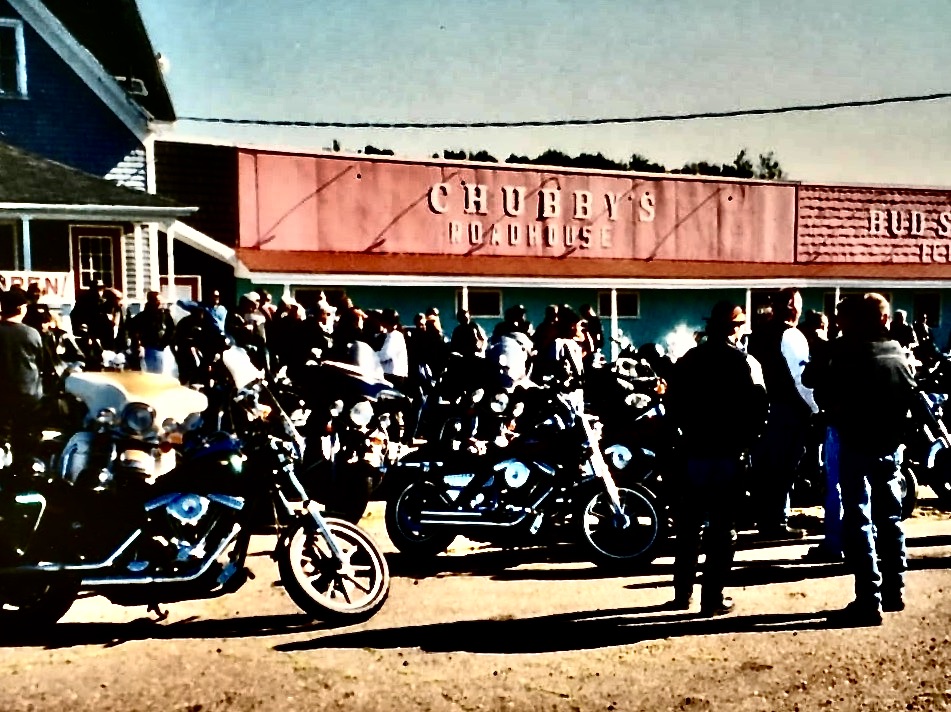
   Chubby’s Roadhouse and Bud’s Diner were side by side in a pink and blue building on St. Peters Road in Dunstaffnage. They did a brisk business. It was a popular pit stop for bikers on poker runs. It was why Pete Lambert had lunch or dinner there once a week, getting to know the riders. He kept his enemies close.

   “We serve burgers and fries and shakes and fish and chips and clams and all that stuff,” Clarence Foster said. “But I think as far as the burger goes, the best, the one that everybody seems to like is called the Bud Burger.” Clarence was both Chubby and  Bud.  “We have wedding receptions and things like that,” he said. He told the bikers about them in advance, so that nobody ended up stepping on anybody else’s toes.

   The Spoke Wheel Car Museum was next door. Clarence and his father Ray shared an appreciation for old cars. They both liked to smoke cigarettes but loved cars more. They gave up fags to save money. Instead of going up in smoke their savings went toward buying broken down heaps nobody else wanted and restoring them. They offered to buy Bernie Doiron’s VW Beetle, but he said, “It ain’t no antique.” By 1969, they had 13 cars, including a 1930 Ford Model A Coach that Clarence drove for show. It was how the roadhouse and diner came into being. 

   “People were coming to the museum and looking for a place to eat,” Clarence said. “Since my dad was a cook in the army, we decided to build a little canteen and it just kept on growing.” 

   Clyde and Pete met at the bar and ate at a back table. It wasn’t the warmest spring day, although it was sunny. They had cold pints and Bud Burgers.. There were a handful pf people having late lunches.

   “How’s the hip?” Pete asked.

   “Hellzapoppin,” Clyde said.

   “Is that the official diagnosis?”

   “It’s how I feel. I’ve got two months and 29 days from today circled on my calendar.”

   They ate and talked small. “Find anything out?” Pete finally asked, finishing his burger and hand-cut fries. The food was good because the beef and potatoes came from the island, not from away. It would be a trifecta once islanders opened up their own breweries.

   “It will be in my report tomorrow, but since you’re interested, I’ll summarize it. She died of a fractured skull. There was tissue not hers on her face and in her hair. I want to say she was hit by a fist that got scuffed up doing it. She had alfalfa on and in her clothes. More than a brush of silage, enough to make me think she was on a dairy farm long enough to roll around in it. She wasn’t killed on that field, although her arm was probably cut off there. The last field cutting there was in late August, so she was put in the ground sometime between then and no later than the end of October.”

   Thousands of acres of potatoes on the island the last fall had been left in the ground. Heavy rain and cold temperatures put a damper on the harvest. There had been too much rain and cold, freezing and thawing, day after day, and it led to a deep frost.

   “Her arm was probably cut off by an axe, sharp as can be. Whoever did it is a strong enough man, or a man driven to extremes. I don’t believe a woman did it, although I can’t tell you why. Why it was cut off, since she was already dead when it happened, is for you to find out. She had a Loonie clenched in her missing hand. It was a 1988 issue. No prints other than hers on it.”

   “Are her prints in the report?”

   “Yes, what we could get, which wasn’t much of anything, but they will do.” It was shop talk. Pete knew everything he needed and a batch of photographs would be part of the report.     

   “She wasn’t molested or abused. I don’t think she had eaten for several days. There wasn’t anything remarkable about her teeth, none missing, one filling. She was in her early twenties, five foot five, 118 pounds, green eyes, light brown hair, no moles, birthmarks, or tattoos. She was healthy as a horse.”

   “Anything else?”

   “One more thing. I think she might have poked somebody in the eye. There was retinal fluid under the fingernails of the first two fingers on the cut-off arm. Her nails were 7 mm long and almond shaped, perfect for poking. It wasn’t her fluid, either.”

   Blunt trauma to the eye can cause the retina to tear. It can lead to retinal detachment. It can require urgent surgery. The alternative is blindness. That alternative means living in the dark forever.

   “If that happened, where would the eye have been treated?” Pete asked.

   “At a hospital or a large eye clinic.”

   “What happens if it’s not treated?”

   “Kiss goodbye to that eye.”

   “I see,” Pete said, paying the bill when the waitress stopped at their table. What crowd there had been had cleared out. It was the middle of the afternoon. When the two men went out to their cars, they were the only two cars in the front lot. Pete was driving an unmarked police car, although it was clearly an official car. Clyde was driving a Buick Electra station wagon. He could lay a corpse out in the back if he had to. They shook hands and went their separate ways.

   Later that evening a biker riding a red motorcycle approached the roadhouse, swerving to avoid a fox. There was always more roadkill in the spring and fall. Skunks and raccoons were the most common, although foxes weren’t always as quick and slippery as their reputation. He pulled up, parked, and went inside. He left the key in the ignition. His Kawasaki Ninja had an inline four cylinder, 16 valve, liquid cooled engine with a top speed above 240 KPH. He had already made that speed and more. He knew nobody was going to mess with his bike because nobody stole wheels at Chubby’s Roadhouse. It would have been a heresy. At the bar he ordered a Bud Burger and a cold pint.

   “How’s the eye?” the bartender asked. “It looks good. At least, no more pirate’s patch.”

   “Yeah, but I waited too long to get it fixed,” the biker said. “The doc says I’ll probably be more blind than not in that eye from here on. It don’t matter, I can still see enough out of the other one to take care of my business.”

   He ate fast and downed his beer. When he left, he paid cash with a new one-hundred-dollar bill.

   “Where do you keep finding these?” the bartender asked.

   “Pennies from heaven, my man,” the biker said, leaving him a tip of two new Loonies. Getting on his glam motorcycle in the gloom of dusk he thought, I got to be more careful about that.

Excerpted from the book “Ebb Tide.”

Ed Staskus posts monthly on 147 Stanley Street at http://www.147stanleystreet.com, Made in Cleveland at http://www.clevelandohiodaybook.com, Atlantic Canada at http://www.redroadpei.com, and Lithuanian Journal at http://www.lithuanianjournal.com. To get the site’s monthly feature in your in-box click on “Follow.”

“Ebb Tide” by Ed Staskus

“A thriller in the Maritimes, out of the past, a double cross, and a fight to the finish.” Sam Winchell, Beyond Books

Available at Amazon: https://www.amazon.com/dp/B0CV9MRG55

Summer, 1989. A small town on Prince Edward Island. Mob money on the move gone missing. Two hired guns from Montreal. A constable working the back roads stands in the way.

A Crying of Lot 49 Publication

My Aim is True

By Ed Staskus

   “I think all the farmers on the island did it,” Linda Hewitt said. What all the farmers on Prince Edward Island did was squirt a stream of milk in the direction of whatever cat was hightailing it into the barn during milking time. “We used to enjoy watching them line up for their treat.” The ideal of calm may exist in a sitting cat, but when there is milk to be had ideals go out the window.

   Even though it is not ideal for grown-up cats, because it can cause gassiness once they have come of age, squirt milk in the direction of a clowder and they will come running. They drank milk non-stop when they were kittens. When they grow up they remember the familiar smell and taste of it. Their sense of smell is closely linked to memory, more so than their other senses, the same as in people. Straight from the source is their No. 1 comfort food. 

   “Granny Matheson my cousin’s grandmother squirted milk to the cats,” PEI native Anne Fuller said. “They loved it.” Seen from the sky Prince Edward Island lives up to its moniker, which is  “Million Acre Farm.” It is known by several other names, including Spud Island, but is most commonly called PEI. The natives call themselves islanders with a capital “I”.

   Almost all cows nowadays are milked by automatic suction machines. The devices increase the yield of milk and reduce the labor involved. Milking by hand draws about 3-and-a-half liters and takes 15 to 20 minutes.Milking by machine draws about 5 liters of milk and takes between 5 and 7 minutes. The machines go back to the late 1800s. It took decades for them to gain the upper hand. Many cows in North America were still being milked by hand well into the 1940s. Some cows on Prince Edward Island were still being milked by hand even later than that.

   “I did that every day we milked the cows,” PEI native Cecil Wigmore said about the squirting. When you work on a dairy farm, you milk every day because cows don’t take days off. They don’t belong to a union. Dairy farmers wouldn’t mind being in a union and getting a day off, but can’t afford cows going on strike.

   Milking cows on Prince Edward Island in the 21st century is a highly mechanized operation. The total number of cattle on the island is more than 60,000 head. Approximately 14,000 of those are dairy cows and 7,000 are dairy heifers. 170-some farms ship their milk to cooperatives and the volume amounts to 120-some million liters. The milk is known for its good taste and high quality.

   Cows Ice Cream makes some of the world’s best ice cream. They have been making it on the island since 1983 with island milk. They won the award for Canada’s Best Ice Cream in 2015. Their frozen confections were recently named the World’s Best Ice Cream by Tauck World Discovery. 

   “Yes, I sure do remember doing that for cats on visits to my grandfather’s farm,” PEI native Norma MacLean said. “I have many special memories.” Memory is often more about the commands of the heart than the head. The song ‘Memory’ from the musical “Cats” sends shivers up everybody’s spine.

   One of dairy farmer Bloyce Thompson’s cows won the award for Top Holstein in the World in 2011. He is a third-generation farmer in Frenchfort, in the middle of the island, with a sizable herd of purebred cows. He serves as Deputy Premier of Prince Edward Island and has long opposed NAFTA-mandated dairy imports. Why mess with a good thing when you’ve already got the best?

   The dairy business on Prince Edward island is made up of dairy producers, who operate farms and produce raw milk, and dairy processors, who process raw milk into butter, cheese. yogurt, and ice cream. ADL is the major processor, by far. Island cheese is known and celebrated worldwide. Avonlea Clothbound Cheddar won the Super Gold of the World Cheese Awards at the 28th annual BBC Good Food Show in 2015. 

   Milking by hand isn’t rocket science. It is easy enough to do. “I used to do that,” PEI native Tom McSwigan said. While milking a cow he would wait for his cat to rise up on its hind legs and then give it a squirt right from the cow’s udder. “If I missed and hit the cow’s leg she kicked viciously. Not only that, if I got caught doing it I got the heavy hand of justice from my grandaunt, for because I was doing it free of charge.”

   Neolithic farmers in northern Europe were among the first to milk cattle for human consumption. They put hand to teat 6,000 years ago. It was around that same time that the ability of human beings to digest milk was slowly but surely accomplished. It was brought about by the spread of a genetic mutation called lactase persistence. It was what allowed post-weaned human beings to continue to drink and digest milk. 

   Heath McLennan milked cows from his boyhood until his death in 2021.The family farm is in Port Hill on the west end of the island. Heath lived across the street. “He couldn’t wait to get over and that was the highlight of the day,” his son Hilton said. “It was in his blood.” The farm has thirty Holsteins who are milked by machine. “We used to milk them out in the field,” Heath said. “It wasn’t a very excellent job when it was raining. The water would be running off the cows.”

   When asked if he ever milked cows by hand anymore, Heath said he wasn’t sure if it would be a good idea to try milking their cows that way again. “I wouldn’t want to touch them when they’re not used to it now. They might kick the head off you.”

   Hand milking is done one way or the other, by stripping or by full hand. When stripping the teat is held between thumb and forefinger and the hand glides in one smooth motion down the teat while applying pressure to draw the milk out. When employing the full hand method, the teat is held with all the fingers and the teat is pressed against the palm. The full hand method is thought to be the better of the two methods because it applies a more consistent pressure on the teat and simulates the sucking action of a calf.

   “I can still see my father doing it by hand,” PEI native Adele Shea said. “The cats loved it.”

   Before the machine age children played a big part doing what had to be done on the family farm. They gathered eggs, cleaned, fed, and watered the stock, made butter, made lard and soap, weeded the garden, and went berry picking. They helped with planting and harvesting. One thing they did all year round was milk the cows. When they did, sitting on a stool or balancing on their haunches, they made an immediate connection to one of their most important food sources. Kids being kids, they shared the food source with whatever was wandering in for a taste of white.

   “Me when I was younger did it to the cats,” PEI native Ken Macleod said. “I also did it to the dogs.” 

   Even though cows are by nature easygoing creatures, they can sometimes be buttholes. They can be irascible and stubborn. They can even be dangerous. A cow kick can be deadly. It takes the form of a sharp blow. Most cow kicks are brush-offs, but some lead to a trip to the Emergency Room, and a few are fatal. Always move slowly around cows. Always announce yourself when approaching one of them. Never approach a cow from behind. Always be patient. Never flap your arms. Stay a kick away is the way to be. Stay safe getting your glass of milk.

   “Daddy would squirt the barn cats when we were kids,” PEI native Joanne Creamer said. Cats are much faster than cows and even faster when a cow kicks at them. They are rarely overmuch bothered so long as they get their milk. “Me, when I was squirting milk, sometimes I hit the wrong end of the cat,” PEI native Dwight Llewellyn said. “I exactly do remember squirting milk,” PEI native Brian Trainor said. “The cats would sit there waiting while we milked.”

   Fathers milking cows by hand and directing squirts at cats was an island-wide practice back in the day. “Oh, yes, my dad did it all the time!” PEI native Helen Verhulp said. “My dad always done that and sometimes to us, too,” PEI native Caroline MacLean said. “My father did it,” PEI native Joan Coulthard said. “He did it to us kids as well. It was warm sweet milk.”

   Not all parents were as generous. “I always did it until my father caught me,” PEI native Erroll Jon Campbell said. The Scottish are notoriously thrifty. Waste not want not was his father’s motto. The thrifty preach the smart thing to do is be more frugal than not, cats or no cats.

   Milking machines are made of a vacuum pump, a vacuum controller, a pulsation system, a milk transport system, and a milker cluster. The machines apply constant vacuum pressure to the tips of a cow’s udder, mimicking the way milk is naturally drawn. The vacuum tubes are attached to a container where milk is collected. The machines also squeeze the udder periodically so that blood circulation is maintained.

   Milking by hand instead of techno milking is more time-consuming but it is simpler. What’s needed is a milking pail, a wash bowl ,white towel rags, a filter, a funnel, and storage jars. Mason jars are preferred. Glass jars are preferred. Plastic jars are discouraged. They are harder to disinfect. White wash rags are used to clean the udder. Wash bowls are used for cleaning the wash rags. Funnels are used to direct milk from the pail into the storage jar.

   Not all milk ends up where it should. “I remember being sprayed by Shawn and Brian Shea when Granny Trish still had cows,” PEI native Krista Dillon said. “Oh, my God, that was so long ago. I loved that house and farm.”

   Hand milking isn’t coming back anytime soon. Time marches on. Hand milking lives on in the memories of those who made it happen every morning and every afternoon, but there is no squirting anymore. Machine milking is more efficient. Dairy farmers don’t necessarily miss the good old days. The creatures who miss the good old days are the island’s cats. The coming of the Industrial Age meant nothing to them. A stream of warm cow’s milk straight from teat to mouth twice a day is what meant everything to them.

   “Oh my, yes,” PEI native Clara Ross said. “All the barn kitty’s loved it.”

Photograph by Nat Farbman.

Ed Staskus posts monthly on 147 Stanley Street at http://www.147stanleystreet.com, Made in Cleveland at http://www.clevelandohiodaybook.com, Atlantic Canada at http://www.redroadpei.com, and Lithuanian Journal at http://www.lithuanianjournal.com. To get the site’s monthly feature in your in-box click on “Follow.”

“Ebb Tide” by Ed Staskus

“A thriller in the Maritimes, the deep blue sea, magic realism, and a family saga.” Sam Winchell, Beyond Books

Available at Amazon: https://www.amazon.com/dp/B0CV9MRG55

Summer, 1989. A small town on Prince Edward Island. Mob money on the move gone missing. Two hired guns from Montreal. An RCMP constable working the back roads stands in the way.

Six Oysters Ahoy

By Ed Staskus

   “I checked the weather report,” Frank Glass said.

   “What did you find out?” Vera Glass asked.

   “It’s going to be the same today as it was yesterday.”

   “Do you mean it’s going to rain all day?” 

   “You don’t need a weatherman to know which way the wind blows, or in this case, rain” Frank said, throwing a glance at the window.

   A steady rain was falling outside the front window of the cottage, down on the long sloping lawn of the Coastline Cottages, on the Gulf Shore Parkway, on the three houses on the other side of the road, and out to the horizon of the Atlantic Ocean as far as they could see. The sky was dark over Doyle’s Cove. Rhino size waves worked up the water. When Frank looked out the northwest-facing back window, the sky, where the weather was coming from, was even darker.

   “What should we do? It rained all day yesterday. I’m getting cabin fever.”

   “We could play cards and talk. Or how about dinner and a show?”

   “That sounds good, especially the part about dinner,” Vera said. “Where do you want to eat?”

   “There’s a show opening tonight at the Victoria Theatre.”

   “All right, but what about dinner?”

   “We could eat at the Landmark, it’s right there, and then go see the show.”

   “I’ve always liked the Landmark,” Vera said. “Eugene is a great cook. They have the best meat pies.”

   “You mean they had the best meat pies,” Frank said. “Somebody told me Eugene sold it and there are new owners.”

   “What? How can that be? Eugene is gone? Did he sell it to his kids, Oliver and Rachel.”

   “I heard they wanted it, but Eugene is all business when it comes to business. He got a better offer.”

   The Sauve family had repurposed an old grocery store in Victoria into a café restaurant in the late 1980s, adding a deck, digging a basement for storage and coolers, and expanding their dining space several times. They were a perennial ‘Best Place to Eat on Prince Edward Island’ in the magazine Canadian Living.

   “It’s now called the Landmark Oyster House,” Frank said.

   “I love oysters,” Vera said. “Let’s go.”

   It was still raining when Frank and Vera drove up Church Hill Road and swung onto Route 6, through North Rustico to Route 13, through Hunter River and Kelly’s Cross. It was still raining when they pulled into the small seaside town of Victoria on the other side of Prince Edward Island, on the Northumberland Straight side, after 45 minutes of wending their way. It rained on them as they hurried into the Landmark Oyster House. There wasn’t a table to be had, but there were two seats at the bar. They took the two seats.

   “Look, we’re right in front of the oysters,” Vera said, as they sat down at the closed end of the bar. “I love this spot.”

   Kieran Goodwin, the bartender, agreed. He was a burly man sporting a trim beard, standing on the other side of the bar, on the other side of a stainless steel bin full of raw oysters on ice. “Best seats in the house,” he said. “They were going to put the bar in the front room, but the dimensions didn’t work out.”

   “Who’s they?” Frank asked.

   Vera looked the chalkboard on the wall up and down. The names of the oysters on ice were written on the board. There were six of them, Valley Pearl, Sand Dune, Shipwreck, Blackberry Point, Lucky Limes, and Dukes. She looked down into the bin. She couldn’t make heads or tails of which were which. She knew raw oysters were alive, more-or-less. That’s all she knew.

   “They are Greg and Marly Anderson,” said Kieran. “They own a wedding venue up the road.” The venue is the Grand Victoria Wedding Events, in a restored former 19th century church. “When this opportunity came up, when Eugene was looking to tone it down a bit, they decided to purchase it.”

   “I worked at the Oyster House in Charlottetown shucking oysters for almost five years,” the new owner Marly said. “We heard that the family wanted to retire because they had been working at this restaurant for 29 years. We already felt a connection to this place and we are friends and neighbors with the family.”

   “They’ve put their roots down in the community, are making their stand here,” Kieran said.

   “It was important that whoever bought the Landmark be somebody who was going to be a part of the community,” Eugene said. “Who was going to open the place and run it and put some effort into it. Greg and Marly are the perfect people.”

   “I like what they’ve done in here, casual but upscale,” Vera said.

   “It looks like the kitchen is more enclosed than it was,” Frank observed.

   “Yeah, they put up a wall,” Kieran said. “Before that, when you used to walk in, you could see right in.”

   “I remember Eugene telling us once he learned all his cooking from his mom. Who does the cooking now?”

   “Kaela Barnett is our chef. She can shuck with the best of them.”

   “We couldn’t do this without her,” Greg said. Somebody has got to have a steady hand on the ladle that stirs the soup. Owners of eateries often spend more time with their chef, keeping the drumbeat rat-tat-tatting, than they do with their loved ones.

   “I’m thinking of doing oysters and a board,” Vera said.

   “That’s a good choice,” Kieran said. “I recommend the large board. You get a bit of everything. I personally like getting some cheese.”

   “Me, too.”

   “Are you oyster connoisseurs?” Kieran asked.

   “Not me,” Frank said. “I can’t remember the last time I ate an oyster, if I ever have.”

   “I wish I was, but I love them,” Vera said. “We were on the island two years ago and went to the Merchantman in Charlottetown with Rachel, Eugene’s daughter, and Doug, her boyfriend. I had oysters and she went through all the ones we ate, explaining them to me.”

   “You know what King James said.”

   “What was that?”

   “He was a very valiant man who first adventured on the eating of oysters.” 

   “Who’s King James?”

   “The guy who wrote the Bible.”

   “No, that was God.”

   “Whoever.”

    “Would you like something from the bar?” Kieran asked.

   “I’ll take the Gahan on tap, the 1772 Pale Ale,” Frank said.

   “What wine goes with oysters?” Vera asked.

   “We have a beautiful California chardonnay,” Kieran said. “It’s great with shellfish. I recommend it.”

   “This is good, fruity,” Vera said, tasting it.

   “We have six oysters,” Kieran said. “You could do one of each.”

   “That’s what I’ll do.”

   “I think I’ll have the seafood chowder and some of the board,” Frank said.

   “Oh, Frank, try one,” Vera said.

   “Lucky Limes are my favorite,” Kieran said. “It’s a good medium oyster.”

   “OK, I’ll try it,” Frank said, shrugging.

   Kieran handed him a Lucky Lime.

   “How do I eat this thing?” Frank asked Vera.

   “Sometimes I chew it, sometimes I don’t,” she said.

   “Some people like putting stuff on it, like horseradish, but it kills the taste,” Kieran said. “Straight up is best. That’s how islanders do it, just shuck it and suck it down.”

   Frank looked at the liquid-filled half shell.

   “From the wide end,” Kieran explained.

   Frank slurped the oyster into his mouth and swallowed it.

   “Now you’re a pro,” Vera said.

   “That wasn’t bad,” Frank said. “How could you tell it was a Lucky Lime? They all look the same to me.”

   “If you look at the chalkboard, it’s one through six. That’s one way.”

   “Can you tell by looking at them?” Vera asked.

   “I can tell by the shell,” Kieran said. “The ones that are more green, that means there’s more saltwater content. So, this is a Sand Dune, quite briny. That one is almost straight salt water.” He pointed to an even darker greener shell.

   “The Shipwreck made me nervous to have it, the name and all, but it was mild,” Vera said.

   “It would be farther up the estuary, closer to fresh water. The Blackberry ones are from Malpeque, which is near Cavendish. The Sand Dune is from Surrey, down east, and the Lucky Limes are from New London Bay. Valley Pearl is from Pine Valley and the Dukes are from Ten Mile Creek.”

   “I thought you were just making all this up,” Frank said.

   “No, it’s like wine,” Kieran said.

   “How did you get into the shellfish racket?” Frank asked.

   “I graduated in business, traveled, lived in New Zealand and Australia, and then came back here, back home, and worked in a bank as a financial advisor for six years, in Summerside and Charlottetown, but then I just got tired of working in a bank, and went back to school.”

   “How did you find your way here, behind the bar?”

   “I date Jamie, who is Marly’s sister.”

   “Are those pickled carrots?” Vera asked, pointing at the charcuterie board in front of her.

   “Yes, and you have raisin jam, too,” Kieran said.

   “Chutney, stop the madness!” Vera exclaimed, spying another glob. “Oh, it’s strawberry jam. It just looks like chutney. It’s delicious.”

   “We had raisin pie at a small diner in Hunter River the other day,” Frank said.

   “The one by the side of the road, up from the Irving gas station?” Kieran asked.

   “That’s the one,” Frank said. “The waitress told us she always thinks of raisin pie as funeral pie, because back in the day, if there was a funeral in the winter, women always had raisin pies for the reception after the memorial service, because raisins keep all year round.”

   “Can I take my oyster shells with me?” Vera asked.

   “Sure,” Kieran said. ”We can get a little bag for you.”

   “You can really taste the sea eating oysters,” Vera said. “Blackberry Point was a little thin and too salty, but once you eat one, and you don’t like it, whoa, what are you going to do? Valley Pearl didn’t have a lot of flavor, but there was some good texture to it. Lucky Lime was very good. My favorite was Sand Dune. It had a strong ocean flavor, briny.”

   “I’ve heard people say oysters are slimy, but the one I had, it didn’t seem that way,” Frank said. “I can see having oysters again.”

   “Don’t people sometimes say the world is your oyster?” Vera said.

   “Do you want dessert?” Kieran asked.

   “Do you have carrot cake?”

   “It’s made here.”

   “We’ll split a slice of that, and two coffees, thanks.”

   As Vera and Frank dug into their carrot cake, there was a bustle at the other end of the bar. Kieran, Jamie, and Marly were huddling over a glowing screen. They looked concerned.

   “Did your electronics go haywire?” Frank asked when Kieran brought them coffee.

   “The microwave in the basement tripped the breaker and knocked out our internet. We hardly ever use the microwave, except to melt butter sometimes. It’s weird, it’s been working until now. We have a thing that magnifies our wi-fi signal. We just found out it’s on the same circuit.”

   “My mother was a pastry chef,” Vera said.” She didn’t use microwaves much, but whenever she did, she always said, ‘Stand back, I’m going to nuke it now!’”

   Frank and Vera used their forks on the last crumbs of their cake and finished their coffee. Frank checked the time on his iPhone. “Time to go, sweetheart,” he said. They paid the bill and stood up to go.

   “Enjoy the show, hope to see you again,” Kieran said as Frank and Vera walked out of the Landmark Oyster House.

   “It’s rainy and sunny at the same time,” Frank said as they darted across the street to the Victoria Theatre, yellow slanting sunlight leading the way through drizzle.

   “That’s Prince Edward Island for you,” Vera said. “By the way, what are we seeing?”

   “Where You Are.”

   “I know where we are,” Vera said.

   “That’s the name of the show,” Frank said.

   “Oh, I see.”

   “Hustle it up, we’re almost late.”

   They went up the steps into the theater, handed over their tickets, got their programs, and sat down. Vera tucked the bag of oyster shells under her seat. “Wherever you are, there you are, boys and girls,” she whispered, making sure they were safe and sound as the lights went down and the show started.

Ed Staskus posts monthly on 147 Stanley Street http://www.147stanleystreet.com, Made in Cleveland http://www.clevelandohiodaybook.com, Atlantic Canada http://www.redroadpei.com, and Lithuanian Journal http://www.lithuanianjournal.com

“Ebb Tide” by Ed Staskus

“A big story in a small town.” Barron Cannon, Adventure Books

“Foul play in the Maritimes, wildlife and all.” Sam Winchell, Beyond Fiction

Available on Amazon: https://www.amazon.com/dp/B0CVDP8B58

Atlantic Canada, 1989. A town on the Gulf of St. Lawrence. A satchel of stolen counterfeit money. Two contract killers from Montreal. A gravel road cop stands in their way.

Swept Away

By Ed Staskus

   Jimmy LaPlante’s neighbors either didn’t know a thing about him or thought he was R. B. Bennett’s double with a nice dog. Since they hardly ever saw Jimmy, they knew for sure he was a recluse. The dog was a Labrador Retriever, young and friendly, ready and able to chase any stick thrown by anybody into the bay. Jimmy didn’t especially like dogs, but he had gotten the black puppy last fall to keep him company and be a first alarm. He wasn’t worried about his neighbors. He was worried about Montreal. He was from Quebec but had lived on St Peter’s Bay the past eleven years, He kept himself to himself for good reason. The reason was Montreal.

   Nobody on Prince Edward Island knew anything about him except his dog and his niece. Now it was only the dog. He had made sure Montreal didn’t know where he was. He had made absolutely sure of it. He was sure they still didn’t know. He was careful talking to them on the pay phone outside the fish and chip shop down the street, never talking for long, always cutting it short. He knew they knew how to trace calls.

   He hadn’t been especially close to his niece, but he didn’t like it when he read in a newspaper that she was dead. At least he now knew something. Until then all he had known was that Becky was gone. She had been found buried in a potato field up around Rustico. What was she doing there? The cops weren’t saying much. The newspapers weren’t reporting much of what they didn’t want to say.

   What the hell happened? She had delivered the hundred grand of good cash from Montreal and long since was supposed to have delivered the two million dollars of bad cash to them, although he knew all winter long she hadn’t. He wasn’t returning his hundred grand, though. He told Montreal that and told them to find the girl themselves. He had done his part. When they found her, they would find their money, he said. They didn’t like it and told him so. He told them to drop dead and hung up. He knew it was the wrong thing to say, but what could he say? 

   He knew somebody would be showing up soon enough, looking for him and their money. The newspapers said Becky had been found with a briefcase but no identification. It didn’t say anything about what was in the briefcase. He knew without thinking about it that it had been empty just like he knew from now on he was going to have to be very careful. That’s the way the Quebecois men were. He didn’t think they would find him but started sleeping with his dog at the foot of the bed and a Colt .38 Super under his pillow.

   Jimmy was 16 years old when he made his first counterfeit bill. By his late teens he was making fake one hundred dollar bills that his friends spent everywhere without any of them bouncing. By his early 20s he was flooding the market with so many of the fakes that many businesses stopped accepting them. The Bank of Canada was forced to change the design to put their currency back on the right track.

   He got good at reproducing security holograms on banknotes and earned the nickname of “Hologram Tom.” His middle name was Tom. When he took a break from forgery, he took up impersonation. He masqueraded as a pilot for Air Canada so he could fly on courtesy passes. Over the next five years he pretended to be a doctor and a lawyer, among other things. One man died and another man was disbarred, but Jimmy left his mistakes behind him. He moved on to bank checks. In the end he went back to hard cash. It was what he knew best.

   What had happened to his niece? It had to be something to do with that biker boyfriend of hers, who he disliked and distrusted the minute he saw him and whose name he never was able to remember. He thought he was probably an islander, although he wasn’t sure. He didn’t know where he lived, but guessed it had to be Summerside or Charlottetown. He didn’t even know what kind of motorcycle the boyfriend rode, although he knew it was red.

   If push came to shove, he might tell the men from Montreal what he knew but make sure he told them from the back of his handgun. He wouldn’t let them get their hands on him. If they did, he stood no chance. He knew that as well as he knew anything. He wasn’t planning on leaving Prince Edward Island. There was no point to it. It would just make them testy and not believe anything he might tell them later on. He would sit tight until if and when they showed up. He had moved to Prince Edward Island to get away from a life of crime, although crime was how he made his living. He knew the everyday risks, which was why he left Quebec for Atlantic Canada. The past years had been peaceful and quiet, the occasional briefcase of phony money traded for real money keeping him in plenty of ready money.

   It had blown up in his face, but he put a brave face on it and took his dog for a walk. He pulled on a pair of rubber boots. His house was just past Bay Shore Rd. where it turned toward Greenwich Rd. The dog and he walked on the thin strip of beach on the bay past some cottages until there weren’t any more cottages.

   St. Peter’s went back to 1720 when the village of Saint Pierre was established. It was one of the most important settlements on the island then because it had a good harbor and good fishing grounds full of clams, oysters, quahogs, lobsters, trout, and schools of salmon. Many of the French considered it to be the commercial capital of Isle St. Jean. When the Fort of Louisbourg on Cape Breton surrendered to the British it was the end of Isle St. Jean. The French were all deported in 1758 and the English helped themselves. The land became Prince Edward Island. St. Pierre became St. Peter’s. 

   The British weren’t overly interested in fish. They were more interested in boats. They turned St. Peter’s into a shipbuilding hub, building 27 big craft between 1841 and 1850. There were three shipyards, all controlled by Martin MacInnis and William Coffin. They couldn’t launch their ships fast enough. The north shore had long been a graveyard for ships. They needed to be replaced.

   Passenger steamers between the mainland and Prince Edward Island sank all the time. When they did new ones had to be built. In 1859 the Fairie Queene from Nova Scotia didn’t make it. The bells of Saint James Church in Charlottetown tolled eight times of their own accord on the morning of the disaster, foretelling the deaths of the eight passengers on board the steamer. “Keen blows the bitter spirit of the north,” is what everybody said.

   The Turret Bell was driven ashore by a violent storm in 1906 at Cable Head. It stayed beached for more than three years and became a tourist attraction. Picnickers sat in the dunes staring at the rotting hulk, eating apples, drinking cold tea, and chatting. Their dogs ran up and down the beach barking up a storm.

   The first sawmill was Leslie’s Mill near Schooner Pond. There were lobster factories on the northside. A starch factory opened in 1880 and stayed open until 1945. A trotter track opened in 1929. It was still there. Jimmy wasn’t a betting man and never went there. He liked horses but disliked racing. If God had meant horses to pull two-wheel carts for sport, he would have created two-wheel carts. If he had gone to the track he wouldn’t have bet real money, anyway, but that was beside the point. 

   Jimmy lit an Export-A and blew smoke out through his nose. He wasn’t interested in the past. He was only interested in what was in front of him. A seagull flew past looking for scraps. He and his dog went as far as Sunrise Ave. and took a break. Sitting on the sand leaning back against a mound he watched the dog run into the water after a stick. Whenever a stick went flying the dog became a creature of habit. 

   He watched a man and a woman coming his way. They were both in shorts. The man had a camera slung around his neck. It bounced on his chest with every step he took. He looked fair and sunburned. The woman was slightly shorter than the man. She was dark skinned. She carried a kind of messenger bag over her shoulder. She could have carried a man over her shoulder if she had a mind to. She was a hefty gal. Tourists, Jimmy thought, and thought about something else.

   They stopped a few yards away and watched the dog lunge out of the water and run up to Jimmy. He shook himself dry, the water spraying on all three of them. The woman reached into her bag. She pulled a Colt .38 Super out of the bag and shot the dog twice. The dog yelped, groaned, staggered backwards, and fell over, shaking uncontrollably until the shaking stopped. The dog’s last thought before giving up the ghost was, “What did I ever do to you?”

   Jimmy tried to get up.

   “Stay where you are. Don’t be the dog.”

   “Jesus Christ, why did you do that?” His ears were ringing from the blasts. He didn’t care about the dog, but was shaken.

   “Dogs are a man’s best friend,” the woman said. “I’m not a man. He wasn’t my best friend.” She threw the gun down at his feet. “That’s yours.”

   In that moment Jimmy understood they were from Montreal. He understood they had found him. He understood his life was in danger. He didn’t reach for the handgun. There was no point in trying. If he tried, he would be as dead as the dog in no time flat.

   “What you need to do, Jimmy, is print another batch of bills for us,” the man said, taking a picture of the counterfeiter with his camera. “If you don’t, what happened to your dog will happen to you. The sooner you print them, the better. In the meantime, we are going to find whoever stole our first batch and take care of that business. When we do, we will be back to get what is ours before we leave. Do you understand?”

   “I understand,” Jimmy said.

   “If anybody asks about the dog, just say he dropped dead,” the woman said. “And put that gun away somewhere safe, so nobody gets hurt on this shitty island.” They walked away, going up the bay the way they had been going. 

   “You’ve had a hell of a bad attitude ever since we got here,” Jules Gagnon said as they walked away. “There was no need to shoot that dog. What is the matter with you?”

   “Shut the fuck up,” Louise Barboza said.

   “And that’s another thing. You’ve been cursing up a storm everywhere we go. You’ve been cursing in Portuguese in your sleep.” Louise was Quebecois, like Jules, but her grandmother was Portuguese. The old woman cursed like a sailor and taught Louise everything she knew. The two killers were sharing a motel room with two queen beds. Jules avoided Louise’s bed the same as if a tarantula was lurking under the covers. “Tone it down. We’ve got to stay low profile.”

   “Yeah, yeah, yeah,” she muttered, sullen and swellheaded.

   Waiting until the man and woman were smudges in the distance, Jimmy stood up and looked down at the dead dog. “Goddamn it,” he said to himself, and turned around to go back the way he had come. When he was gone gulls and crows started nosing around the still warm Lab. A fox crept out of his burrow to investigate. Flies put the word out and were soon gathering. Jimmy came back and waved them away. He pushed the dead dog into the bay. By that night the carcass had floated past Morell and the lighthouse. 

   Kulloo hung in mid-air high in the sky watching over him, watching him sink. When the moon came out the dog was gone out to sea. Kulloo had a bad taste in his mouth. There is going to be blood, he thought.

   The next day Jimmy drove to a farm outside Saint Catherine’s and got a new dog. It was a Pit Bull almost full grown and trained to bite on command. It took a week, but he taught the dog to hate guns. When he was done, the Pit Bull knew full well to bite any hand not Jimmy’s that had a gun in it.

Excerpted from the book “Ebb Tide.”

Ed Staskus posts monthly on 147 Stanley Street at http://www.147stanleystreet.com, Made in Cleveland at http://www.clevelandohiodaybook.com, Atlantic Canada at http://www.redroadpei.com, and Lithuanian Journal at http://www.lithuanianjournal.com. To get the site’s monthly feature in your in-box click on “Follow.”

Rachel Finds a Ring

   By Ed Staskus

   Although it may be the case that there are either no coincidences or everything is a coincidence, it is certainly the case that everyone in some small or large way is shaped by happenstance. One thing doesn’t work out while the other one does.

   “Coincidence is God’s way of remaining anonymous” is how Albert Einstein put it. 

   “I was out with a group of friends,” said Doug McKinney. “Another friend that I played basketball with back in the day texted me he was at Baba’s Lounge. Although I never went there, I went that one time, and connected with Rachel.”

   Baba is a word that comes from Persian. It is a Middle Eastern word of fondness, like darling. It’s like “My Darling Clementine” in a Pahlavi instead of a cowboy hat.

   “Do you mind if I ask you a question, darlin’?”

   “Where I come from, that’s a term of endearment.”

   “We’re on the same page, then,”

   “No, we connected at the game,” said Rachel.

   Doug McKinney was a power forward for the Island Storm of the Canadian National Basketball League for four years, once on the All-Star team, and to this day holds the playoff record for most points scored in the fewest minutes, when he couldn’t miss in the seventh game of the 2014 NBL Finals.

    “I didn’t see you at the game,” said Doug.

   “I thought you were just skipping over me, but I saw you, and I wrote you.”

    “OK, technically we can start there.”

   “I wrote him, I haven’t seen you in years, I hope you’re OK.”

   “When I saw her at Baba’s she gave me a big hug, we hung out for a little bit, and when I left, I couldn’t stop thinking about her afterwards.”

   They had first met more than ten years earlier, when Doug was playing for the University of Prince Edward Panthers, and Rachel was dating one of his teammates, even though Doug was Best Male Athlete of the Year at the school in 2007.

   “I was always a big fan of Doug’s, a great guy, sweet,” said Rachel.

   In the years since Doug had finished his college career, played internationally, and was in his third season with the Island Storm. Rachel had gone to school in Toronto, lived in Hawaii, and moved back to Prince Edward Island. In the meantime, she traveled, to the USA, the Caribbean, and Europe.

   She and her friend Emma, whose family operates the Chocolate Factory across the street from the Landmark Café, in Victoria, their hometown on the south shore of Prince Edward Island, piled into a 1992 Buick with Emma’s nearly 200-pound Newfoundland dog, Rupert, and drove across and back the range of Canada.

   Newfies are black dogs who don’t necessarily eat too much, don’t necessarily need large houses to live in, but do sprawl across back seats, and do, by necessity, often drool. They are dogs who save babies from drowning and need baby wipes.

   “It took months, a crazy road trip, came home, moved to Ontario, came back, did some more traveling, and every summer worked at the Landmark,” said Rachel.

   The popular eatery, featured in the guidebook ‘Where to Eat in Canada,’ is seasonal, opening in May and closing in October. The Landmark Café was her father and mother’s brainchild 29 years ago. Rachel and her brother have worked there nearly every summer since they came of age, and even before that.

   Doug went the length and breadth of Prince Edward Island during his walk of life with the Island Storm.

   “I got to see more of the island on that team than living here my whole life,” he said. “Going to schools, all these little communities, we’re talking to kids, promoting literacy, all kinds of community stuff.” Even though PEI is the smallest of the Canadian provinces, there are more than 70 municipalities spread out over 2200 square miles, most of them separated by big tracts of farmland. There are only two pocket-sized cities on the island. It is mainly a rural landscape.

   It wasn’t long after their chance encounter at Babas’s Lounge that Rachel and Doug became a twosome.

   “I don’t think either of us were looking for a relationship, but we didn’t want to pass it up,” said Rachel.

   “There was something special about our energy together,” said Doug. “I never felt that energy before.”

   The summer after retiring from pro ball he got involved with skills training at several basketball camps. He helped out at the Landmark Café, too. “Doug was finishing up with the Storm and it was time to start work at the restaurant,” said Rachel. He bussed tables, later on learning to serve. Seasonal work on PEI means being busy as a bee.

   “You could have a day off, but you felt guilty because everyone else was there working so hard,” said Rachel.

   “We didn’t see each other a whole lot, but then it just came together,” said Doug. 

   “It evolved into us realizing we worked well with one another,” said Rachel. ”It’s been almost five years working at different things together, and so we’re at a spot where we’re trying to figure out our next life.”

   “Our next play,” said Doug.   

   “Our next thing,” said Rachel.

   “Working side by side,” said Doug.

   “We do well together,” said Rachel. ”We’re very open with each other. Even if I feel embarrassed, I know I can go talk to Doug about anything. When we worked at the restaurant, I was almost his boss. He can take it.”

   There’s no needing to take it when you’re on the same wavelength.

   Getting in sync at the Landmark Café was one thing. Hiking the Camino was another.

   “That definitely brought us closer together,” said Rachel.

  The Camino de Santiago, sometimes known as the Way of Saint James, is a network of paths passages roads in northwestern Spain all leading to the shrine of the saint. In the Middle Ages it was one of the most important Christian pilgrimages. Even today hundreds of thousands of pilgrims make their way to the Cathedral Santiago de Compostela. Some do it for penance or as a spiritual retreat from modern life. Some hikers walk the route for the challenge. The full length of the trek takes about a month.

   If things go haywire there’s always the traditional queimada, which is a local ritual used to fight off evil spirits by drinking a smoking concoction brewed somewhere out of sight, although planning on a day of R & R after the cultural experience is advisable.

   “Doing the 800 kilometers of the Camino brought us closer,” said Doug. “There’s the physical stress, dealing with it, of the two of you walking 30 kilometers a day with backpacks, side by side.”

   It’s one day at a time on the Camino. It can get hot dusty tiresome. Your partner can start getting on your nerves.

   “There are a lot of couples, they say, I can’t imagine working with him,” said Rachel.

   “I can’t imagine going to two separate jobs, being separate forty hours a week,” said Doug.

   “It gives me anxiety,” said Rachel. 

   “I just wouldn’t be comfortable,” said Doug.

   “I definitely feel safe when Doug’s around,” said Rachel. “In many ways, the more the years go on, the more you want to be together. We can look at each other and we know what the look means. It’s just fun to have, if you’re in that fun busy relationship. It can be great.” 

   A fun busy loving relationship may not make the world go around, but it makes the ride worthwhile.

   After three years working elbow-to-elbow at the family restaurant, in the past year they both found a new path, going to work for Fairholm Properties, which operates high-end inns and lodgings in Charlottetown. They rent an apartment downtown in the capitol city, a few minutes from their jobs. “In the wintertime, it’s storming outside, you can walk just about anywhere,” said Doug.

   The next step was walking to the jewelry store. 

   Like Socrates said, “If you find a good wife, you’ll be happy. If not, you’ll become a philosopher.” Who wants to be a down at the mouth philosopher? After all, Socrates ended up drinking hemlock. Better to ask your better half to pop the top of a Ghahan Sir John A’s honey wheat ale. It pours a refreshing golden color with a white head and it’s not poisonous.

   “I know my future is something colorful, something hands-on, something bright, with Doug next to me,” said Rachel. 

   When you’re hands-on you’re a big part of whatever you’re doing, jumping right in, not taking it for granted, seeing it through from beginning to end. It’s taking the present into your own hands, getting your hands dirty, not handing anything off to anybody else. It’s a show of hands.

   Doug showed his hand the October before last.

   “I didn’t know where we were going to get engaged, although I knew it was going to be in St. Andrews,” he said.

   St. Andrews, at the far western end of New Brunswick, is a small town on the southern tip of a triangle-shaped peninsula in the Passamaquoddy Bay. Many of the original buildings from the 18th century have been restored and are still in place. It is a National Historic Site, although whose history is open to question. Many of the homes were dismantled and floated across the border to the town by disgruntled Loyalists from Maine at the end of the American Revolutionary War, where they were reassembled.

   “It’s literally on the USA border,” said Doug.

   Crossing borders was more seat-of-your-pants once upon a time. Nobody asked for your passport. Everybody wasn’t forever talking about another brick in the wall. You could bring your whole house with you, not just your RV.

   “It is beautiful there,” said Rachel. “Whenever we see a botanical garden, we go to it. When we visit family in New York City, we always go.” Although born and reared on PEI, Rachel’s mother is from NYC and her father is from Montreal. 

   They had lunch in the café at the Kingsbrae Garden.

   “The chef happened to be from PEI,” said Rachel. 

   The Kingsbrae Garden is a 27-acre former family estate turned horticultural oasis of nearly three thousand perennials, shrubs, and trees. It is a Certified Audubon Cooperative Sanctuary. There are peacocks, pygmy goats, and ponds, a cedar maze, and a trail through an old-growth forest. Doug and Rachel walked the gardens after lunch.

   They spotted a giant Adirondack chair, the kind of oversized chair that makes grown-ups look like kids. They stopped in front of the great big chair.

   “Oh, yeah,” said Rachel. “Whenever we see one of those big chairs, we get a picture of us sitting on it.” 

   When they slid off the seat, Doug asked her if she had dropped something when she got off the chair.

   “She didn’t actually drop anything,” said Doug. He didn’t tell her it had fallen far. Rather, it was right there. You don’t want to cast your chance too far when you have the chance.

   “It was all just a ploy to get her to turn around.”

   “I looked and looked, and when I looked back at him he was on his knee.” 

   Doug was on his knee next to a giant pumpkin beside the chair on a sunny October afternoon, the day after Columbus Day, proposing a new world, proposing marriage.

   ”It made us at eye level,” said Rachel.   

   “How long do you want to be loved? Is forever enough?” is how the Dixie Chicks sing it.

   She said yes when she saw the ring, the two of them seeing eye-to-eye in the garden.

   “I’m pumped for the rest of our adventures,” said Rachel.

Ed Staskus posts monthly on 147 Stanley Street http://www.147stanleystreet.com, Made in Cleveland http://www.clevelandohiodaybook.com, Atlantic Canada http://www.redroadpei.com, and Lithuanian Journal http://www.lithuanianjournal.com

A New Maritime Thriller by Ed Staskus

“Ebb Tide”

“Small book, big story.” Barron Cannon, Adventure Books

“A Down East crime mystery, wildlife and all.” Sam Winchell, Beyond Fiction

Available on Amazon: https://www.amazon.com/dp/B0CVDP8B58

Atlantic Canada, 1989. A town on the Gulf of St. Lawrence. A satchel of stolen counterfeit money. Two contract killers from Montreal. A gravel road cop stands in their way.