Tag Archives: Prince Edward Island

Making It Happen

By Ed Staskus

   “I’ve been immersed in the world of performing arts for as long as I can remember, from singing songs from Cinderella with my mom as soon as I could speak, to studying performing arts at Sheridan College,” Charlee Whitty said. Cinderella is the story of a hardworking underdog who doesn’t have much but knows what she wants when she sees it. “When you’re driving through the moonlight, breathless with wild anticipation of adventure and excitement,” Julie Andrews sang in the 1956 Rogers and Hammerstein movie musical.

   It was the middle of summer on Prince Edward Island. Charlee was taking a break from serving coffee and sandwiches at Tide & Tales Bistro in North Rustico, where she was working part time for the season. Behind the eatery an osprey flew in from the ocean to its nest perched on top of a utility pole. There was a fish in its beak. The sea life was for its hatchlings.

   Charlee is a 26-year-old performer and choreographer from Newmarket, Ontario, now making a home in New Glasgow, Prince Edward Island with her husband Ryan. They got married in 2022 and straight away moved to Atlantic Canada. She graduated from the Huron Heights Secondary School arts program with majors in dance, drama, and vocals. She moved on to  Sheridan College’s performing arts program, where she honed her craft before relocating to the eastern seaboard. Some of her theatrical roles include Dorothy in ‘The Wizard of Oz,’ Little Red in ‘Into the Woods,’ and Frank-N-Furter in ‘The Rocky Horror Show.’  

   “My husband and I moved because we were going to get a small apartment in Ontario after we got married, but my dad advised us not to,” Charlee said. “What he said was, ‘You’re not going to get anywhere starting out in Ontario, it’s so cutthroat finding work.’ There is a crazy rat race mentality in the province. We had been talking about moving to Prince Edward Island where there is a lot of opportunity in theater. Both of my parents pushed for that, saying we could better make a name for ourselves in a smaller community.”

    Everything in life is competitive. It can be a good thing. It forces us to do our best. The theater business is especially scrappy. “Getting a role can literally come down to you and one other person. You could be perfect but maybe you don’t have the exact look the creative team is looking for. It’s not about talent at that point. Its cutthroat although it’s not personal. It’s a rewarding job. You get to be like a child again, exploring things, but you have to keep auditioning and auditioning. One rejection after another can be taxing on your mental health.”

   When Charlee got to Prince Edward Island she started looking for doors to get her foot into. “I didn’t know a single soul on the island. I was nervous. It was daunting, but I knew I wanted to get into choreography. When I got the opportunity to do that in ‘Rent’ it kick-started everything. I have made some friends since then who have become best friends.”

   ‘Rent’ is a rock musical based on Puccini’s opera ‘La Boheme.’  It tells the story of young artists and musicians struggling to survive in New York City in the days when the East Village was bohemian and not yet gentrified and bland. More than anything it is about finding your voice. It scored four Tony Awards and is one of the top 10 longest-running musicals on Broadway. “It’s about a community celebrating life,” said Jonathan Larson, who created the show.

   “I’m thrilled to be part of its debut on the island this summer,” Charlee said. “It resonates with me for many reasons, but a huge one is because it encapsulates the essence of love. I think we can all empathize with the characters in ‘Rent,’ such as how we cherish the bonds of friendship, how we navigate self-worth, and understanding that you must find love in everything you do because life is so precious. I strive to infuse every aspect of my own life with that same spirit.”

   She has lately added ‘Anne and Gilbert: The Musical’  to her resume. She got to spread her wings, playing four roles, which are Ruby, Mrs. Pye. Christie Stuart, and Marilla Cuthbert. The actor who has no immediacy has no wings.

   Acting isn’t for everybody. The competition is never-ending. Everybody wants it as bad as everybody else. It can amount to years of dispiriting turndowns. The travel takes you away from your family and friends. Equity pay is more terrible than phenomenal. “Almost 100% of everybody I talked to growing up said don’t go into acting,” Charlee said. “They said, if you can do something else, do something else.”

   What they were saying is, do something normal. What they weren’t saying is, normal is only one cycle on a washing machine. There are other cycles. Cut-and-dried isn’t always the be-all and end-all to aspire to. It can be overrated. Sometimes the aspiration to move into a new frame of mind is what brings into being a new normal.

   Lee Strasberg, the preeminent exponent of method acting, said, “Acting isn’t something you do. Instead of doing, it occurs. You can have conscious preparation but If you’re going to start with logic, you might as well give up.”

   “It’s mostly people who aren’t in theater telling you to give up, go do something else, get a real job,” Charlee said. “Everybody in theater, they tell you making it is hard, but they never tell you not to do it. Nobody in the theater world tries to discourage you. Surrounding yourself with the right people is absolutely imperative.” The right people are the people actors need in their lives to make it happen.

   “It’s vulnerable being an actor. You find out things about yourself that you didn’t know. You grow so much, but you’re not doing it by yourself. Many people in theater have shaped who I am. The reason I love it, every show you do, you become like a family. It’s special, the community you create. It’s a great feeling, so bonding.”

   Acting can be scary. It is a form of public speaking in a world where many people think speaking in public is akin to dying. “The first time I had a lead role was when I played Dorothy in ‘The Wizard of Oz,’” Charlee said. “I was excited but terrified.”

   She was even more terrified playing Frank-N-Furter in the ‘The Rocky Horror Picture Show.’ Frank-N-Furter is a cross-dressing mad scientist. His mission in life is to create Rocky, the perfect man. In his own words, Frank-N-Furter is a “sweet transvestite from Transylvania.” The show is a mash-up of sci-fi and horror B-movies, campy slapstick, and rock ‘n roll.

   “I was scared to do the show because it is so demanding vocally and because it’s supposed to be a man doing the role,” Charlee said. “I had never done anything like it, being usually typecast as a princess or the girl next door. I had to play a transvestite wearing a jock strap, fishnets, and my hair colored bright orange. He’s a very out there character. My friends were there. My parents were there. I walked out on stage and everybody lost their minds. I got crazy laughs and it fueled me for the whole show. I needed it so bad because I was so nervous.”

   Not every audience breaks out into laughs and applause. Every one of them is different. “Sometimes you get an audience that doesn’t react while others react too much, like talking at the stage,” Charlee said. Sometimes acting is the art of keeping a large group of people from hemming and hawing. “An audience can be drab and all you can do then is get through the show. Other times they hype you up, although you definitely need to find a line. You can go over the top, like if it’s a comedy show, you try too hard, and then it’s not funny anymore. You don’t want to chase it.”

   The acting business is a freelance business. You never stop having to prove yourself and promote your work. It’s also a business which is conducive to pivoting in new directions. Charlee has pivoted in the direction of choreography. “One of the challenges I face as a choreographer is navigating the diverse skill levels of actors. I tend to create relatively intricate choreography, which I know can be intimidating, but I do my best to break it down piece by piece so that everyone becomes comfortable and knows what they’re doing. Dancing can be daunting and doesn’t come naturally, so my goal is to lift everyone up and give them the confidence to have fun, own the stage, and help them enhance the story with movement and dance. It is rewarding to watch and experience them gaining confidence and doing things they never thought they could do.”

   Besides acting, stagecraft, and choreography, Charlee teaches at Revolution Dance Studio and works with the Queensville Players, among other things. “Ryan and I have started our own business called Little Wonders Character Entertainment,” she said. “We will bring a princess to your party, like having a clown or a magician.” The Whitty’s need to pay the rent like all young actors and artists. Paying the rent by making somebody’s magic day more magical is as good a way to do it as any.

   “My first acting job was being a Disney princess at parties when I was 16 years old. We have hired a few of my friends to do the performing. I stay in the background, coordinating it all, which I love doing. That’s the direction I am going in for a career. I love being on stage, but I totally love being behind the scenes.” 

   Charlee and her husband Ryan, who also studied performing arts at Sheridan College, are planning on starting a musical theater program. “He and I will be tag-teaming the program,” she said. “Life is about finding a clear path. Don’t try to fit into somebody else’s box. If you ignore the clear path you will miss opportunities. Stay on the path and the opportunities will present themselves. Connections are huge, you have to be strategic, you have to be able to pick and choose, but staying on the path is essential. Things are falling into place. We’ll be here next year making a name for ourselves.”

   Making it happen is a process. It is a direction, not necessarily a destination. What you achieve fleshing out dreams is what you make of your direction.

Ed Staskus posts monthly on 147 Stanley Street at http://www.147stanleystreet.com, Made in Cleveland http://www.clevelandohiodaybook.com, Down East http://www.redroadpei.com, and Lithuanian Journal http://www.lithuanianjournal.com. To get the site’s monthly feature in your in-box click on “Follow.”

“Ebb Tide” by Ed Staskus

“A thriller in the Maritimes, the deep blue sea, magic realism, and a memory..” Sam Winchell, Beyond Books

Available at Amazon: https://www.amazon.com/dp/B0CV9MRG55

Summer, 1989. A small town on Prince Edward Island. Mob money on the move gone missing. Two hired guns from Montreal. A peace officer working the back roads stands in the way.

A Crying of Lot 49 Publication

Pit Stop

By Ed Staskus

   Clyde Ferguson stumbled into the Queen Elizabeth Hospital mortuary room like he was seeing it for the first time, even though he had been the provincial pathologist for 11 years. He waited for the sharp stab in his left hip to go away. He felt unsteady. He steadied himself with one hand on the doorjamb. He was all right after a moment, as far as it went. His left heel wouldn’t flatten down to the floor. That leg had gotten shorter the past five years. He put his arms at his sides and breathed evenly.

   The hospital was practically new. It was still in its infancy. He was getting older by the minute, which bothered him. “Getting old is no problem,” is what Groucho Marx said. “You just have to live long enough.” But sometimes he didn’t feel like he was just getting old. He felt like he was getting old and getting crippled to boot.

   His hip hurt like hell and worse. He knew exactly what the matter was. It had finally gotten to be bone on bone. The day had always been coming. Walking and yoga and strong drink had forestalled the inevitable. But he had walked too much the past several days. When the weather had gotten better, he drove to Brackley Beach, and walked two miles back and forth three days in a row. That was a mistake. It wasn’t the same as his treadmill, which had arm rails he could support himself on. He had three months left before his retirement became official. When it was signed and sealed, he was getting an after-market hip the next day, going back to Tracadie, and staying there. He would break it in and in the evening cut up fillets rather than dead folks.

   He blinked in the fluorescent light, wondering why there were two tables set up for him. When he remembered the arm, he remembered he was going to have to do two post-mortems, one on the arm and one on the young woman who the arm belonged to.

   Her death was being treated as the result of criminal activity. If it was some place bigger than Charlottetown the post-mortem would have been performed by a forensic pathologist. They investigate deaths where there are legal implications, like a suspected murder. But it wasn’t some other place. It was Charlottetown, the smallest capital city of the smallest province in Canada. It would have to do, and he would have to do it.

   When he was suited up, Clyde stood over the dead woman and blinked his fly-belly blue eyes. She was on her back on a stainless-steel cadaver table. It was essentially a a body-sized slanted tray with raised edges to keep fluids from flowing onto the floor. There was running water to wash away the blood that is released during the procedure. The blood went down a drain.

   She hadn’t been shot or stabbed. Her face was a mess, though. It took him a minute to see what it was that had killed her. Her skull was fractured. Parts of the broken skull had pressed into the brain. It swelled and cut off access to blood by squeezing shut the arteries and blood vessels that supply it. As the brain swelled it grew larger than the skull that held it and begin to press outside of it into the nasal cavity, out of the ears, and through the fracture. After a minute it began to die. After five minutes, if she hadn’t called it a day, she would have suffered irreversible brain damage. One way or the other it was the end of her.

   He got down to the rest of his work, making a long incision down the front of the body to remove the internal organs and examine them. A single incision across the back of the head allowed the top of her skull to be removed so the brain could be examined. He saw what he expected to see. He examined everything carefully with the naked eye. If dissection had been necessary to look for any abnormalities, such as blood clots or tumors, he would have done it, but what was the point?

   After the examination he returned the organs and brain to the body. He sewed her back up. When he turned his attention to the arm, he saw clearly enough it had been chopped off with one clean blow. The axe, or whatever it was, must have been new or even newer. In any case, it was as sharp as could be. Her hand was clenched in a fist. He had to break her fingers to loosen it. When he did, he found a loonie in her palm. It was Canada’s one-dollar coin introduced two years earlier to replace paper dollar bills, which had become too expensive to print. Everybody called them loonies after the loon on the reverse side.

   Clyde looked at the spanking new coin smeared with old blood and older dirt. He put it in a plastic bag and labelled it. He recorded everything on a body diagram and verbally on a cassette tape. He put the loonie, diagram, and tape in a pouch and labelled it. When he was done, he washed up and decided to go eat. After that he would call it a day. The work had warmed him up and he wasn’t limping as much as he had earlier. He tested his hip, lifting his leg at the knee and rotating it. It felt reasonably ready to go. He would go to Chubby’s Roadhouse for lunch. They had the best burgers on the island.

   The phone rang. It was Pete Lambert, the Commanding Officer of the RCMP Queens detachment.

   “What have you found out, Clyde.”

   “I’m on my way out for a bite to eat. Meet me at Chubby’s. So long as the force pays, I’ll tell you everything I know.”

   “I’ll meet you there in twenty minutes.” Chubby’s was 15 minutes from the Queen Elizabeth Hospital and 20 minutes from the RCMP station. While he was driving Clyde thanked God it was 1989 and metallic hip replacements were as good as they had ever been. The first hip replacements dated back a hundred years to when ivory implants were used to replace the femoral head. Elephant tusks were cheap at the time and were thought to possess good biomechanical properties. That proved to not be the case. Men and women died right and left from infections and dislocations.

   Fifty years later an American surgeon performed the first metallic hip replacement. He designed a prosthesis with a large head made of something he called Vitallium. The implant was 12 inches in length and attached with bolts to the end of the femoral shaft. It worked like a charm. That same prosthesis is what he would be getting, except it was better and the implant would be inserted within the canal of the femur, where bone growth would lead to more permanent attachment. So long as he could wake up and walk upright first thing in the morning, instead of staggering and grabbing for support, he would be a happy man.

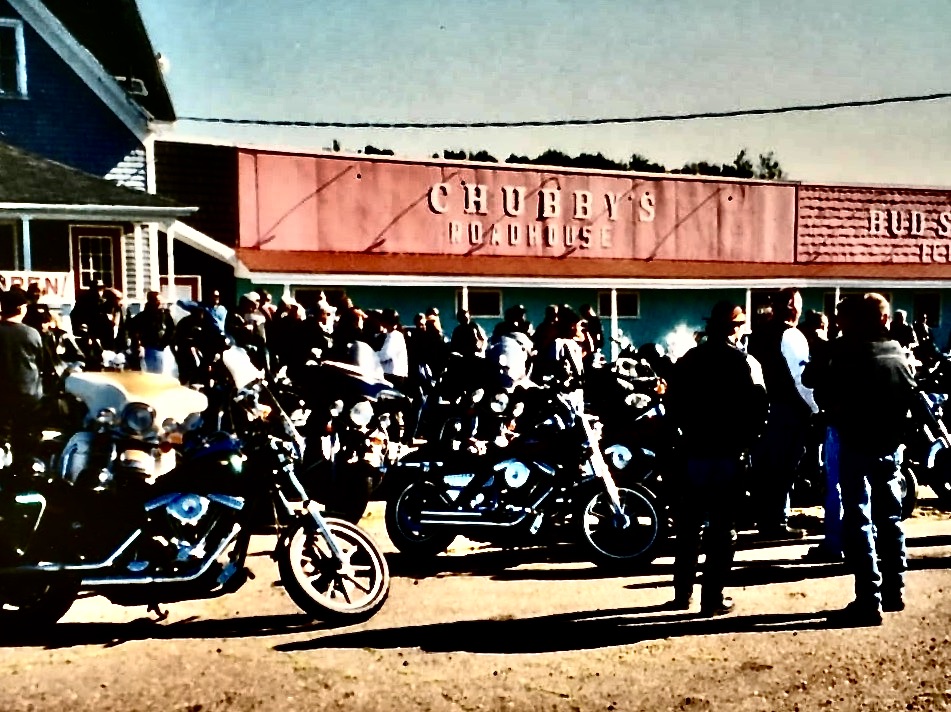
   Chubby’s Roadhouse and Bud’s Diner were next to each other in a pink and blue building on St. Peters Road in Dunstaffnage. They did brisk business. It was a popular pit stop for bikers on poker runs. It was why Pete Lambert had lunch or dinner there once a week, getting to know the riders. He kept his enemies close.

   “We serve burgers and fries and shakes, and fish and chips and clams and all that stuff,” Clarence Foster said. “But I think as far as the burger goes, the best, the one that everybody seems to like is called the Bud Burger.” Clarence was both the Chubby and the Bud.

   Dances were held in the back of the building with local bands. Haywire was a summer favorite. Teenagers with ice cream cones gathered around the pinball machines at the front. Drinkers stayed at the bar, drinking. The bikers ate their Bud Burgers outside during the day and drank inside during the night.

   “We have wedding receptions and things like that,” Clarence said. He told the bikers about them in advance, so that nobody ended up stepping on anybody else’s toes.

   The Spoke Wheel Car Museum was next door. Clarence and his father, Ray, shared an appreciation for old cars. They both liked to smoke but loved cars more. They gave up cigarettes to save money. Instead of going up in smoke their savings went toward buying heaps nobody else wanted and restoring them. They offered to buy Bernie Doiron’s VW Beetle, but he said, “It ain’t no antique.” By 1969, they had 13 cars, including a 1930 Ford Model A Coach that Clarence drove. It was how the roadhouse and diner came into being. 

   “People were coming to the museum and looking for a place to eat,” he said. “Since my dad was a cook in the army, we decided to build a little canteen and it just kept on growing.” 

   Clyde and Pete ate inside at a back table. It wasn’t the warmest day, although it was sunny. They had Bud Burgers and cold pints. There were only a handful pf people having a late lunch.

   “How’s the hip?” Pete asked.

   “Hellzapoppin’,” Clyde said.

   “Is that the official word?”

   “It’s how I feel. I’ve got two months and 29 days from now circled on my calendar.”

   They ate and small talked. “Find anything out?” Pete asked, finishing his burger and hand-cut fries. The food was good because the beef and potatoes came from the island. It would be a trifecta once islanders started up their own breweries.

   “It will be in my report tomorrow, but since you’re interested, I’ll summarize it. She died of a fractured skull. There was tissue not hers on her face and in her hair. I want to say she was hit by a fist that got scuffed up doing it. She had alfalfa on and in her clothes. More than a brush of silage, enough to make me think she was on a dairy farm long enough to roll around in it. She wasn’t killed on that field, although her arm was probably cut off there. The last cut there was in late August, so she was put in the ground sometime between then and no later than the end of October.”

   Thousands of acres of potatoes on the island the last fall were left in the ground. Heavy rain and cold temperatures put a damper on the harvest. There was too much rain and cold, freezing and thawing day after day, and it led to a deep frost.

   “Her arm was probably cut off by an axe, sharp as hell, clean as a whistle. Whoever did it, like the fist, is a strong man or woman. Why it was cut off, since she was already dead when it happened, is for you to find out. She had a loonie clenched in her missing hand. It was a 1988 issue. No prints other than hers on it.”

   “Are her prints in the report?”

   “Yes, what we could get, which wasn’t much of anything, but they will do.”

   It was shop talk. Pete knew everything and a batch of photographs would be part of the report.     

   “She wasn’t molested or abused. I don’t think she had eaten for several days. There wasn’t anything remarkable about her teeth, none missing, one filling. She was in her early twenties, five foot five, 118 pounds, green eyes, light brown hair, no moles, birthmarks, or tattoos. She was healthy as a horse.”

   “Anything else?”

   “One more thing. I think she might have poked somebody in the eye. There was retinal fluid and blood under the fingernails of the first two fingers on the cut-off arm. Her nails were 7 mm long and almond shaped, perfect for poking. It wasn’t her blood, either.”

   Blunt trauma to the eye can cause the retina to tear. It can lead to retinal detachment. It can require urgent surgery. The alternative is blindness.

   “If that happened, where would the eye have been treated?” Pete asked.

   “At a hospital or a large eye clinic.”

   “What happens if it’s not treated?”

   “Kiss goodbye to that eye.”

   “I see,” the police officer said, paying the bill when the waitress stopped at their table. What thin crowd there had been had cleared out. It was the middle of the afternoon. When the two men went out to their cars, they were the only two cars in the front lot. Pete was driving an unmarked police car, although it was clearly an official car. Clyde was driving a Buick Electra station wagon. He could lay a corpse out in the back if he had to. They shook hands and went their separate ways.

   Five hours later a biker riding a red motorcycle approached the roadhouse, swerving to avoid a fox. There was always more roadkill in the spring and fall. Skunks and raccoons were the most common, although foxes weren’t always as quick and slippery as their reputation. He pulled up, parked, and went inside. He left the key in the ignition. His Kawasaki Ninja had an inline four cylinder, 16 valve, liquid cooled engine with a top speed above 240 KPH. He had already made that speed and more. He knew nobody was going to mess with his bike because everybody at Chubby’s knew whose motorcycle it was. At the bar he ordered a Bud Burger and a cold pint.

   “How’s the eye?” the bartender asked. “It looks good. At least, no more pirate’s patch.”

   “Yeah, but I waited too long to get it fixed,” the biker said. “The doc says I’ll probably be more blind than not in that eye from here on. It doesn’t matter, I can still see enough out of the other one to take care of my business.”

   He ate fast and downed his beer. When he left, he paid cash with a new one-hundred-dollar bill.

   “Where do you keep finding these?” the bartender asked.

   “Pennies from heaven, my man, pennies from the main man” the biker said, leaving him a tip of a half dozen shiny loonies.

   Getting on his glam motorcycle in the dusk he thought, I’ve got to be more careful about that.

Excerpted from “Ebb Tide.”

Ed Staskus posts monthly on 147 Stanley Street at http://www.147stanleystreet.com, Made in Cleveland at http://www.clevelandohiodaybook.com, Atlantic Canada at http://www.redroadpei.com, and Lithuanian Journal at http://www.lithuanianjournal.com. To get the site’s monthly feature in your in-box click on “Follow.”

“Ebb Tide” by Ed Staskus

“A thriller in the Maritimes, out of the past, a double cross, and a fight to the finish.” Sam Winchell, Beyond Books

Available at Amazon: https://www.amazon.com/dp/B0CV9MRG55

Summer, 1989. A small town on Prince Edward Island. Mob money on the move gone missing. Two hired guns from Montreal. A constable working the back roads stands in the way.

A Crying of Lot 49 Publication

My Aim is True

By Ed Staskus

   “I think all the farmers on the island did it,” Linda Hewitt said. What all the farmers on Prince Edward Island did was squirt a stream of milk in the direction of whatever cat was hightailing it into the barn during milking time. “We used to enjoy watching them line up for their treat.” The ideal of calm may exist in a sitting cat, but when there is milk to be had ideals go out the window.

   Even though it is not ideal for grown-up cats, because it can cause gassiness once they have come of age, squirt milk in the direction of a clowder and they will come running. They drank milk non-stop when they were kittens. When they grow up they remember the familiar smell and taste of it. Their sense of smell is closely linked to memory, more so than their other senses, the same as in people. Straight from the source is their No. 1 comfort food. 

   “Granny Matheson my cousin’s grandmother squirted milk to the cats,” PEI native Anne Fuller said. “They loved it.” Seen from the sky Prince Edward Island lives up to its moniker, which is  “Million Acre Farm.” It is known by several other names, including Spud Island, but is most commonly called PEI. The natives call themselves islanders with a capital “I”.

   Almost all cows nowadays are milked by automatic suction machines. The devices increase the yield of milk and reduce the labor involved. Milking by hand draws about 3-and-a-half liters and takes 15 to 20 minutes.Milking by machine draws about 5 liters of milk and takes between 5 and 7 minutes. The machines go back to the late 1800s. It took decades for them to gain the upper hand. Many cows in North America were still being milked by hand well into the 1940s. Some cows on Prince Edward Island were still being milked by hand even later than that.

   “I did that every day we milked the cows,” PEI native Cecil Wigmore said about the squirting. When you work on a dairy farm, you milk every day because cows don’t take days off. They don’t belong to a union. Dairy farmers wouldn’t mind being in a union and getting a day off, but can’t afford cows going on strike.

   Milking cows on Prince Edward Island in the 21st century is a highly mechanized operation. The total number of cattle on the island is more than 60,000 head. Approximately 14,000 of those are dairy cows and 7,000 are dairy heifers. 170-some farms ship their milk to cooperatives and the volume amounts to 120-some million liters. The milk is known for its good taste and high quality.

   Cows Ice Cream makes some of the world’s best ice cream. They have been making it on the island since 1983 with island milk. They won the award for Canada’s Best Ice Cream in 2015. Their frozen confections were recently named the World’s Best Ice Cream by Tauck World Discovery. 

   “Yes, I sure do remember doing that for cats on visits to my grandfather’s farm,” PEI native Norma MacLean said. “I have many special memories.” Memory is often more about the commands of the heart than the head. The song ‘Memory’ from the musical “Cats” sends shivers up everybody’s spine.

   One of dairy farmer Bloyce Thompson’s cows won the award for Top Holstein in the World in 2011. He is a third-generation farmer in Frenchfort, in the middle of the island, with a sizable herd of purebred cows. He serves as Deputy Premier of Prince Edward Island and has long opposed NAFTA-mandated dairy imports. Why mess with a good thing when you’ve already got the best?

   The dairy business on Prince Edward island is made up of dairy producers, who operate farms and produce raw milk, and dairy processors, who process raw milk into butter, cheese. yogurt, and ice cream. ADL is the major processor, by far. Island cheese is known and celebrated worldwide. Avonlea Clothbound Cheddar won the Super Gold of the World Cheese Awards at the 28th annual BBC Good Food Show in 2015. 

   Milking by hand isn’t rocket science. It is easy enough to do. “I used to do that,” PEI native Tom McSwigan said. While milking a cow he would wait for his cat to rise up on its hind legs and then give it a squirt right from the cow’s udder. “If I missed and hit the cow’s leg she kicked viciously. Not only that, if I got caught doing it I got the heavy hand of justice from my grandaunt, for because I was doing it free of charge.”

   Neolithic farmers in northern Europe were among the first to milk cattle for human consumption. They put hand to teat 6,000 years ago. It was around that same time that the ability of human beings to digest milk was slowly but surely accomplished. It was brought about by the spread of a genetic mutation called lactase persistence. It was what allowed post-weaned human beings to continue to drink and digest milk. 

   Heath McLennan milked cows from his boyhood until his death in 2021.The family farm is in Port Hill on the west end of the island. Heath lived across the street. “He couldn’t wait to get over and that was the highlight of the day,” his son Hilton said. “It was in his blood.” The farm has thirty Holsteins who are milked by machine. “We used to milk them out in the field,” Heath said. “It wasn’t a very excellent job when it was raining. The water would be running off the cows.”

   When asked if he ever milked cows by hand anymore, Heath said he wasn’t sure if it would be a good idea to try milking their cows that way again. “I wouldn’t want to touch them when they’re not used to it now. They might kick the head off you.”

   Hand milking is done one way or the other, by stripping or by full hand. When stripping the teat is held between thumb and forefinger and the hand glides in one smooth motion down the teat while applying pressure to draw the milk out. When employing the full hand method, the teat is held with all the fingers and the teat is pressed against the palm. The full hand method is thought to be the better of the two methods because it applies a more consistent pressure on the teat and simulates the sucking action of a calf.

   “I can still see my father doing it by hand,” PEI native Adele Shea said. “The cats loved it.”

   Before the machine age children played a big part doing what had to be done on the family farm. They gathered eggs, cleaned, fed, and watered the stock, made butter, made lard and soap, weeded the garden, and went berry picking. They helped with planting and harvesting. One thing they did all year round was milk the cows. When they did, sitting on a stool or balancing on their haunches, they made an immediate connection to one of their most important food sources. Kids being kids, they shared the food source with whatever was wandering in for a taste of white.

   “Me when I was younger did it to the cats,” PEI native Ken Macleod said. “I also did it to the dogs.” 

   Even though cows are by nature easygoing creatures, they can sometimes be buttholes. They can be irascible and stubborn. They can even be dangerous. A cow kick can be deadly. It takes the form of a sharp blow. Most cow kicks are brush-offs, but some lead to a trip to the Emergency Room, and a few are fatal. Always move slowly around cows. Always announce yourself when approaching one of them. Never approach a cow from behind. Always be patient. Never flap your arms. Stay a kick away is the way to be. Stay safe getting your glass of milk.

   “Daddy would squirt the barn cats when we were kids,” PEI native Joanne Creamer said. Cats are much faster than cows and even faster when a cow kicks at them. They are rarely overmuch bothered so long as they get their milk. “Me, when I was squirting milk, sometimes I hit the wrong end of the cat,” PEI native Dwight Llewellyn said. “I exactly do remember squirting milk,” PEI native Brian Trainor said. “The cats would sit there waiting while we milked.”

   Fathers milking cows by hand and directing squirts at cats was an island-wide practice back in the day. “Oh, yes, my dad did it all the time!” PEI native Helen Verhulp said. “My dad always done that and sometimes to us, too,” PEI native Caroline MacLean said. “My father did it,” PEI native Joan Coulthard said. “He did it to us kids as well. It was warm sweet milk.”

   Not all parents were as generous. “I always did it until my father caught me,” PEI native Erroll Jon Campbell said. The Scottish are notoriously thrifty. Waste not want not was his father’s motto. The thrifty preach the smart thing to do is be more frugal than not, cats or no cats.

   Milking machines are made of a vacuum pump, a vacuum controller, a pulsation system, a milk transport system, and a milker cluster. The machines apply constant vacuum pressure to the tips of a cow’s udder, mimicking the way milk is naturally drawn. The vacuum tubes are attached to a container where milk is collected. The machines also squeeze the udder periodically so that blood circulation is maintained.

   Milking by hand instead of techno milking is more time-consuming but it is simpler. What’s needed is a milking pail, a wash bowl ,white towel rags, a filter, a funnel, and storage jars. Mason jars are preferred. Glass jars are preferred. Plastic jars are discouraged. They are harder to disinfect. White wash rags are used to clean the udder. Wash bowls are used for cleaning the wash rags. Funnels are used to direct milk from the pail into the storage jar.

   Not all milk ends up where it should. “I remember being sprayed by Shawn and Brian Shea when Granny Trish still had cows,” PEI native Krista Dillon said. “Oh, my God, that was so long ago. I loved that house and farm.”

   Hand milking isn’t coming back anytime soon. Time marches on. Hand milking lives on in the memories of those who made it happen every morning and every afternoon, but there is no squirting anymore. Machine milking is more efficient. Dairy farmers don’t necessarily miss the good old days. The creatures who miss the good old days are the island’s cats. The coming of the Industrial Age meant nothing to them. A stream of warm cow’s milk straight from teat to mouth twice a day is what meant everything to them.

   “Oh my, yes,” PEI native Clara Ross said. “All the barn kitty’s loved it.”

Photograph by Nat Farbman.

Ed Staskus posts monthly on 147 Stanley Street at http://www.147stanleystreet.com, Made in Cleveland at http://www.clevelandohiodaybook.com, Atlantic Canada at http://www.redroadpei.com, and Lithuanian Journal at http://www.lithuanianjournal.com. To get the site’s monthly feature in your in-box click on “Follow.”

“Ebb Tide” by Ed Staskus

“A thriller in the Maritimes, the deep blue sea, magic realism, and a family saga.” Sam Winchell, Beyond Books

Available at Amazon: https://www.amazon.com/dp/B0CV9MRG55

Summer, 1989. A small town on Prince Edward Island. Mob money on the move gone missing. Two hired guns from Montreal. An RCMP constable working the back roads stands in the way.

Six Oysters Ahoy

By Ed Staskus

   “I checked the weather report,” Frank Glass said.

   “What did you find out?” Vera Glass asked.

   “It’s going to be the same today as it was yesterday.”

   “Do you mean it’s going to rain all day?” 

   “You don’t need a weatherman to know which way the wind blows, or in this case, rain” Frank said, throwing a glance at the window.

   A steady rain was falling outside the front window of the cottage, down on the long sloping lawn of the Coastline Cottages, on the Gulf Shore Parkway, on the three houses on the other side of the road, and out to the horizon of the Atlantic Ocean as far as they could see. The sky was dark over Doyle’s Cove. Rhino size waves worked up the water. When Frank looked out the northwest-facing back window, the sky, where the weather was coming from, was even darker.

   “What should we do? It rained all day yesterday. I’m getting cabin fever.”

   “We could play cards and talk. Or how about dinner and a show?”

   “That sounds good, especially the part about dinner,” Vera said. “Where do you want to eat?”

   “There’s a show opening tonight at the Victoria Theatre.”

   “All right, but what about dinner?”

   “We could eat at the Landmark, it’s right there, and then go see the show.”

   “I’ve always liked the Landmark,” Vera said. “Eugene is a great cook. They have the best meat pies.”

   “You mean they had the best meat pies,” Frank said. “Somebody told me Eugene sold it and there are new owners.”

   “What? How can that be? Eugene is gone? Did he sell it to his kids, Oliver and Rachel.”

   “I heard they wanted it, but Eugene is all business when it comes to business. He got a better offer.”

   The Sauve family had repurposed an old grocery store in Victoria into a café restaurant in the late 1980s, adding a deck, digging a basement for storage and coolers, and expanding their dining space several times. They were a perennial ‘Best Place to Eat on Prince Edward Island’ in the magazine Canadian Living.

   “It’s now called the Landmark Oyster House,” Frank said.

   “I love oysters,” Vera said. “Let’s go.”

   It was still raining when Frank and Vera drove up Church Hill Road and swung onto Route 6, through North Rustico to Route 13, through Hunter River and Kelly’s Cross. It was still raining when they pulled into the small seaside town of Victoria on the other side of Prince Edward Island, on the Northumberland Straight side, after 45 minutes of wending their way. It rained on them as they hurried into the Landmark Oyster House. There wasn’t a table to be had, but there were two seats at the bar. They took the two seats.

   “Look, we’re right in front of the oysters,” Vera said, as they sat down at the closed end of the bar. “I love this spot.”

   Kieran Goodwin, the bartender, agreed. He was a burly man sporting a trim beard, standing on the other side of the bar, on the other side of a stainless steel bin full of raw oysters on ice. “Best seats in the house,” he said. “They were going to put the bar in the front room, but the dimensions didn’t work out.”

   “Who’s they?” Frank asked.

   Vera looked the chalkboard on the wall up and down. The names of the oysters on ice were written on the board. There were six of them, Valley Pearl, Sand Dune, Shipwreck, Blackberry Point, Lucky Limes, and Dukes. She looked down into the bin. She couldn’t make heads or tails of which were which. She knew raw oysters were alive, more-or-less. That’s all she knew.

   “They are Greg and Marly Anderson,” said Kieran. “They own a wedding venue up the road.” The venue is the Grand Victoria Wedding Events, in a restored former 19th century church. “When this opportunity came up, when Eugene was looking to tone it down a bit, they decided to purchase it.”

   “I worked at the Oyster House in Charlottetown shucking oysters for almost five years,” the new owner Marly said. “We heard that the family wanted to retire because they had been working at this restaurant for 29 years. We already felt a connection to this place and we are friends and neighbors with the family.”

   “They’ve put their roots down in the community, are making their stand here,” Kieran said.

   “It was important that whoever bought the Landmark be somebody who was going to be a part of the community,” Eugene said. “Who was going to open the place and run it and put some effort into it. Greg and Marly are the perfect people.”

   “I like what they’ve done in here, casual but upscale,” Vera said.

   “It looks like the kitchen is more enclosed than it was,” Frank observed.

   “Yeah, they put up a wall,” Kieran said. “Before that, when you used to walk in, you could see right in.”

   “I remember Eugene telling us once he learned all his cooking from his mom. Who does the cooking now?”

   “Kaela Barnett is our chef. She can shuck with the best of them.”

   “We couldn’t do this without her,” Greg said. Somebody has got to have a steady hand on the ladle that stirs the soup. Owners of eateries often spend more time with their chef, keeping the drumbeat rat-tat-tatting, than they do with their loved ones.

   “I’m thinking of doing oysters and a board,” Vera said.

   “That’s a good choice,” Kieran said. “I recommend the large board. You get a bit of everything. I personally like getting some cheese.”

   “Me, too.”

   “Are you oyster connoisseurs?” Kieran asked.

   “Not me,” Frank said. “I can’t remember the last time I ate an oyster, if I ever have.”

   “I wish I was, but I love them,” Vera said. “We were on the island two years ago and went to the Merchantman in Charlottetown with Rachel, Eugene’s daughter, and Doug, her boyfriend. I had oysters and she went through all the ones we ate, explaining them to me.”

   “You know what King James said.”

   “What was that?”

   “He was a very valiant man who first adventured on the eating of oysters.” 

   “Who’s King James?”

   “The guy who wrote the Bible.”

   “No, that was God.”

   “Whoever.”

    “Would you like something from the bar?” Kieran asked.

   “I’ll take the Gahan on tap, the 1772 Pale Ale,” Frank said.

   “What wine goes with oysters?” Vera asked.

   “We have a beautiful California chardonnay,” Kieran said. “It’s great with shellfish. I recommend it.”

   “This is good, fruity,” Vera said, tasting it.

   “We have six oysters,” Kieran said. “You could do one of each.”

   “That’s what I’ll do.”

   “I think I’ll have the seafood chowder and some of the board,” Frank said.

   “Oh, Frank, try one,” Vera said.

   “Lucky Limes are my favorite,” Kieran said. “It’s a good medium oyster.”

   “OK, I’ll try it,” Frank said, shrugging.

   Kieran handed him a Lucky Lime.

   “How do I eat this thing?” Frank asked Vera.

   “Sometimes I chew it, sometimes I don’t,” she said.

   “Some people like putting stuff on it, like horseradish, but it kills the taste,” Kieran said. “Straight up is best. That’s how islanders do it, just shuck it and suck it down.”

   Frank looked at the liquid-filled half shell.

   “From the wide end,” Kieran explained.

   Frank slurped the oyster into his mouth and swallowed it.

   “Now you’re a pro,” Vera said.

   “That wasn’t bad,” Frank said. “How could you tell it was a Lucky Lime? They all look the same to me.”

   “If you look at the chalkboard, it’s one through six. That’s one way.”

   “Can you tell by looking at them?” Vera asked.

   “I can tell by the shell,” Kieran said. “The ones that are more green, that means there’s more saltwater content. So, this is a Sand Dune, quite briny. That one is almost straight salt water.” He pointed to an even darker greener shell.

   “The Shipwreck made me nervous to have it, the name and all, but it was mild,” Vera said.

   “It would be farther up the estuary, closer to fresh water. The Blackberry ones are from Malpeque, which is near Cavendish. The Sand Dune is from Surrey, down east, and the Lucky Limes are from New London Bay. Valley Pearl is from Pine Valley and the Dukes are from Ten Mile Creek.”

   “I thought you were just making all this up,” Frank said.

   “No, it’s like wine,” Kieran said.

   “How did you get into the shellfish racket?” Frank asked.

   “I graduated in business, traveled, lived in New Zealand and Australia, and then came back here, back home, and worked in a bank as a financial advisor for six years, in Summerside and Charlottetown, but then I just got tired of working in a bank, and went back to school.”

   “How did you find your way here, behind the bar?”

   “I date Jamie, who is Marly’s sister.”

   “Are those pickled carrots?” Vera asked, pointing at the charcuterie board in front of her.

   “Yes, and you have raisin jam, too,” Kieran said.

   “Chutney, stop the madness!” Vera exclaimed, spying another glob. “Oh, it’s strawberry jam. It just looks like chutney. It’s delicious.”

   “We had raisin pie at a small diner in Hunter River the other day,” Frank said.

   “The one by the side of the road, up from the Irving gas station?” Kieran asked.

   “That’s the one,” Frank said. “The waitress told us she always thinks of raisin pie as funeral pie, because back in the day, if there was a funeral in the winter, women always had raisin pies for the reception after the memorial service, because raisins keep all year round.”

   “Can I take my oyster shells with me?” Vera asked.

   “Sure,” Kieran said. ”We can get a little bag for you.”

   “You can really taste the sea eating oysters,” Vera said. “Blackberry Point was a little thin and too salty, but once you eat one, and you don’t like it, whoa, what are you going to do? Valley Pearl didn’t have a lot of flavor, but there was some good texture to it. Lucky Lime was very good. My favorite was Sand Dune. It had a strong ocean flavor, briny.”

   “I’ve heard people say oysters are slimy, but the one I had, it didn’t seem that way,” Frank said. “I can see having oysters again.”

   “Don’t people sometimes say the world is your oyster?” Vera said.

   “Do you want dessert?” Kieran asked.

   “Do you have carrot cake?”

   “It’s made here.”

   “We’ll split a slice of that, and two coffees, thanks.”

   As Vera and Frank dug into their carrot cake, there was a bustle at the other end of the bar. Kieran, Jamie, and Marly were huddling over a glowing screen. They looked concerned.

   “Did your electronics go haywire?” Frank asked when Kieran brought them coffee.

   “The microwave in the basement tripped the breaker and knocked out our internet. We hardly ever use the microwave, except to melt butter sometimes. It’s weird, it’s been working until now. We have a thing that magnifies our wi-fi signal. We just found out it’s on the same circuit.”

   “My mother was a pastry chef,” Vera said.” She didn’t use microwaves much, but whenever she did, she always said, ‘Stand back, I’m going to nuke it now!’”

   Frank and Vera used their forks on the last crumbs of their cake and finished their coffee. Frank checked the time on his iPhone. “Time to go, sweetheart,” he said. They paid the bill and stood up to go.

   “Enjoy the show, hope to see you again,” Kieran said as Frank and Vera walked out of the Landmark Oyster House.

   “It’s rainy and sunny at the same time,” Frank said as they darted across the street to the Victoria Theatre, yellow slanting sunlight leading the way through drizzle.

   “That’s Prince Edward Island for you,” Vera said. “By the way, what are we seeing?”

   “Where You Are.”

   “I know where we are,” Vera said.

   “That’s the name of the show,” Frank said.

   “Oh, I see.”

   “Hustle it up, we’re almost late.”

   They went up the steps into the theater, handed over their tickets, got their programs, and sat down. Vera tucked the bag of oyster shells under her seat. “Wherever you are, there you are, boys and girls,” she whispered, making sure they were safe and sound as the lights went down and the show started.

Ed Staskus posts monthly on 147 Stanley Street http://www.147stanleystreet.com, Made in Cleveland http://www.clevelandohiodaybook.com, Atlantic Canada http://www.redroadpei.com, and Lithuanian Journal http://www.lithuanianjournal.com

“Ebb Tide” by Ed Staskus

“A big story in a small town.” Barron Cannon, Adventure Books

“Foul play in the Maritimes, wildlife and all.” Sam Winchell, Beyond Fiction

Available on Amazon: https://www.amazon.com/dp/B0CVDP8B58

Atlantic Canada, 1989. A town on the Gulf of St. Lawrence. A satchel of stolen counterfeit money. Two contract killers from Montreal. A gravel road cop stands in their way.

Rat in the Hat

By Ed Staskus

   Aksel was a Norwegian rat, although it would have been a matter of rough-and-tumble if anybody had tried to tell him that. He believed he was a Norman rat since his forebears had come to the New World aboard a French ship that sailed from Bayeaux long ago. The Normans were hardy explorers. Norwegians sat around their fjords moon eyed. It had been more than a hundred generations of his family saga since his ancestors landed on the island. He had never met a Norwegian. He had no idea about any Norwegians. He didn’t even know where Norway was.

   He didn’t know what day week or month it was. He didn’t know it was 1989. He didn’t know he was living in North Rustico on Prince Edward Island, either. He had no clue he was on the North American continent, for that matter, although if he had known it wouldn’t have mattered. He knew where Rollings Pond was. The pond was where he spent most of his nights. During the day he slept in the basement of the Stella Maris Catholic Church. He never went to mass or confession, though. It wasn’t that he was an atheist, not exactly. He simply couldn’t wrap his head around the idea of a Supreme Being who had his best interests in mind. Something was always out to get him. He always had to do everything for himself. He didn’t own anything, not even a fork, knife, or plate, but his bedroom was cozy. He stored some dried food there and had a bed of straw and a small pillow. He kept a handful of loose change he had found at Orby Head under his pillow for a rainy day.

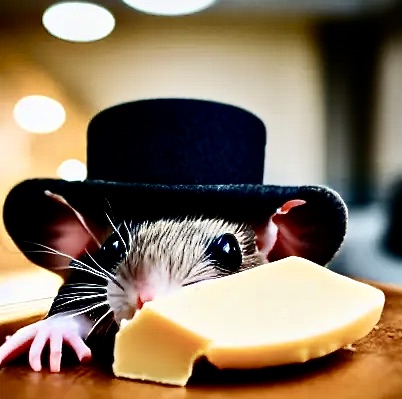
   Aksel was known by the nickname of Left-Hand. How he came to be called Aksel the Left-Hand was beyond him, since he was right-handed. In the event, he didn’t gripe about it. It was better than some of the other rat nicknames he had heard in his neck of the woods, like Seaweed Neck and Foul Fart. He liked to think of himself as a man about town and sometimes wore a bowler hat.

   He wasn’t a farmer. He foraged for food instead of sowing seeds. He gleaned grub far and wide. He ate anything and everything. He thought he had probably eaten hundreds of different foods in his lifetime. He ate any discarded morsels he came across as well as all crops from all fields. He ate all the time, snacking on whatever came his way. Some people said he was a glutton. He didn’t bother disagreeing with them. He preyed on chicks, lizards, and other rodents. He caught fish on Fridays, just in case there was a God.

   His mother let it slip one day that their kind only lived two or three years. He was aghast. There was apparently no time to waste. His eyesight had always been bad. He needed glasses. He was colorblind, too. His other senses, smell, taste, touch, and hearing, were outstanding. He wasn’t especially Olympic Games agile, but he could run, jump, climb, and swim enough to keep danger at bay. He used his face whiskers to feel the world around him. He could wiggle each one of them individually, unlike cats like Snaps, who was from Murphy’s Cove and was always messing with him. He and Snaps were going to have it out one day. The cat was a menace. He was always lying in ambush for him. He had to find a way to cancel out the mouser’s claws, which were razor sharp and deadly. He had the scars to prove it. 

   Except for Snaps, cats rarely bothered Aksel. He was too big for most of them, feral or otherwise. Snaps was a different order of things. He was as big as cats come. The beast was a dangerous son-of-a-gun. The cat and the rat were a stop-and-go dance in the dark. When Aksel stopped, Snaps stopped. When he started up again, the cat was on his heels again, low-down and deadly quiet.

   Islanders didn’t always give Aksel his due. Some called him a street rat, even though he was a field rat. Others with college educations called him a Hanover rat. He tried to explain he was a Norman rat, but couldn’t speak the language of the learned. He didn’t like it whenever he was called a dirty rat. He was fastidiously clean. He washed and groomed himself ten times a day. He was a brown rat with a white underside. He was a big boy, his body length almost a foot long with a tail slightly shorter than a foot. All he had to do was flash his teeth and wiggle his tail at passersby to make them jump and lose their sandwiches.

   He  liked hanging out in the back room of Lorne’s Snack Shop, where out of work fishermen hung around looking for something to talk about. Aksel wore morning dress, a bowler hat, and pantomimed Charlie Chaplin on table tops for handouts.

   One night he met one of his own kind in the dumpster behind the co-op store next to Angie’s Eatery. After giving each other the secret handshake, after which both rats were sure the other one was legit, they chewed the fat and gossiped about local doings. His new-found friend, it turned out, had come off a cruise ship in Charlottetown three weeks ago, gone on a self-guided tour, been late getting back, and was now stranded until another boat rolled in. He had strayed up to North Rustico and was thinking of staying

   “I’m a free agent,” he said. “I can hi-jack myself back onto any boat anytime I want to. You know those round things they attach to mooring lines, what they call rat guards, and how they coat them with grease? First, I puff up my cheeks. Second, I suck up the grease. Third, I spit it out over my shoulder when I go over the rat guard.”

   Cruise ships had been docking in Charlottetown since just after the turn of the century, pulling into port to hearty welcomes. They let loose hundreds sometimes thousands of tourists all at once to stretch their legs, eat, drink, see the sights, and buy “Anne of Green Gables” dolls and effigies. They bought on-the-spur memories to put away in their closets.

   It was after midnight when Aksel and Yeoman Purser, which was what his  friend called himself, went their separate ways. “I know I’m just a rat and a mug, to boot, but I have got to say this seaside place here is something else, just beautiful, and everywhere I look there is food.” The hometown boy twitched one whisker in agreement.

   Aksel was more nocturnal than not, so when Bernie Doiron found something sticking out of the ground when he was plowing on the other side of the hill from Rollings Pond and every nearby cop car, ambulance, and fire truck descended on his stomping grounds, the noise that morning woke him up. He had just rolled over in his straw bed. He coughed and cleared his throat, blinking. He was curious and made his way to the top of the field where it was all happening to see what was happening.

   He had a love hate relationship with members of the human race. On the one hand, he preferred living near them since they were a rat’s number one fast food outlet. On the other hand, they were always trying to kill him. They checked his droppings unceasingly and tracked him by them. They were always putting out traps and bait stations. Whenever they found his nest they gassed it. He had gotten to be as cautious as an accountant. He knew full well what glue boards and snap traps were about. It didn’t matter if they were baited with his favorite fish and cereals. He gave them a wide berth.

   “My mama didn’t raise no fool,” he grumbled to himself.

   He saw what Bernie had seen and what the cops were seeing sticking out of the ground. It was an arm that had been chopped off. He guessed the rest of the body was still in the ground. It looked like they were digging it up, although why was beyond him. He knew they weren’t going to eat the remains, so what was the point? What the human race did day in and day out puzzled him more often than not.

   Aksel quickly lost interest in the unearthing. There wasn’t going to be a free meal in it for him anytime soon unless somebody dropped some crumbs. That was something else that baffled him about men and women. They seemed to never want to pick up food they had dropped, especially the women. In his world no rat did that. They ate everything, no matter what, no matter where it was., and no matter how small it was.

   He ran across the open ground behind him. He could run faster than any man alive. He could run six times his body length in a single second, but he couldn’t keep it up for long. When he got to the tree line and was out of sight, he slowed down and caught his breath. When he got to Church Hill Rd., he looked both ways before crossing to the Stella Maris Catholic Church. There was no sense in being run over on his own doorstep by a four wheel bucket of bolts rolling past.

Excerpted from “Ebb Tide.”

Ed Staskus posts monthly on 147 Stanley Street http://www.147stanleystreet.com, Made in Cleveland http://www.clevelandohiodaybook.com, Atlantic Canada http://www.redroadpei.com, and Lithuanian Journal http://www.lithuanianjournal.com

“Ebb Tide” by Ed Staskus

“A thriller in the Maritimes, out of the past, a double cross, and a fight to the finish.” Sam Winchell, Beyond Books

Available at Amazon: https://www.amazon.com/dp/B0CV9MRG55

Summer, 1989. A small town on Prince Edward Island. Mob money on the move gone missing. Two hired guns from Montreal. A constable working the back roads stands in the way.

A Crying of Lot 49 Publication

Rachel Finds a Ring

   By Ed Staskus

   Although it may be the case that there are either no coincidences or everything is a coincidence, it is certainly the case that everyone in some small or large way is shaped by happenstance. One thing doesn’t work out while the other one does.

   “Coincidence is God’s way of remaining anonymous” is how Albert Einstein put it. 

   “I was out with a group of friends,” said Doug McKinney. “Another friend that I played basketball with back in the day texted me he was at Baba’s Lounge. Although I never went there, I went that one time, and connected with Rachel.”

   Baba is a word that comes from Persian. It is a Middle Eastern word of fondness, like darling. It’s like “My Darling Clementine” in a Pahlavi instead of a cowboy hat.

   “Do you mind if I ask you a question, darlin’?”

   “Where I come from, that’s a term of endearment.”

   “We’re on the same page, then,”

   “No, we connected at the game,” said Rachel.

   Doug McKinney was a power forward for the Island Storm of the Canadian National Basketball League for four years, once on the All-Star team, and to this day holds the playoff record for most points scored in the fewest minutes, when he couldn’t miss in the seventh game of the 2014 NBL Finals.

    “I didn’t see you at the game,” said Doug.

   “I thought you were just skipping over me, but I saw you, and I wrote you.”

    “OK, technically we can start there.”

   “I wrote him, I haven’t seen you in years, I hope you’re OK.”

   “When I saw her at Baba’s she gave me a big hug, we hung out for a little bit, and when I left, I couldn’t stop thinking about her afterwards.”

   They had first met more than ten years earlier, when Doug was playing for the University of Prince Edward Panthers, and Rachel was dating one of his teammates, even though Doug was Best Male Athlete of the Year at the school in 2007.

   “I was always a big fan of Doug’s, a great guy, sweet,” said Rachel.

   In the years since Doug had finished his college career, played internationally, and was in his third season with the Island Storm. Rachel had gone to school in Toronto, lived in Hawaii, and moved back to Prince Edward Island. In the meantime, she traveled, to the USA, the Caribbean, and Europe.

   She and her friend Emma, whose family operates the Chocolate Factory across the street from the Landmark Café, in Victoria, their hometown on the south shore of Prince Edward Island, piled into a 1992 Buick with Emma’s nearly 200-pound Newfoundland dog, Rupert, and drove across and back the range of Canada.

   Newfies are black dogs who don’t necessarily eat too much, don’t necessarily need large houses to live in, but do sprawl across back seats, and do, by necessity, often drool. They are dogs who save babies from drowning and need baby wipes.

   “It took months, a crazy road trip, came home, moved to Ontario, came back, did some more traveling, and every summer worked at the Landmark,” said Rachel.

   The popular eatery, featured in the guidebook ‘Where to Eat in Canada,’ is seasonal, opening in May and closing in October. The Landmark Café was her father and mother’s brainchild 29 years ago. Rachel and her brother have worked there nearly every summer since they came of age, and even before that.

   Doug went the length and breadth of Prince Edward Island during his walk of life with the Island Storm.

   “I got to see more of the island on that team than living here my whole life,” he said. “Going to schools, all these little communities, we’re talking to kids, promoting literacy, all kinds of community stuff.” Even though PEI is the smallest of the Canadian provinces, there are more than 70 municipalities spread out over 2200 square miles, most of them separated by big tracts of farmland. There are only two pocket-sized cities on the island. It is mainly a rural landscape.

   It wasn’t long after their chance encounter at Babas’s Lounge that Rachel and Doug became a twosome.

   “I don’t think either of us were looking for a relationship, but we didn’t want to pass it up,” said Rachel.

   “There was something special about our energy together,” said Doug. “I never felt that energy before.”

   The summer after retiring from pro ball he got involved with skills training at several basketball camps. He helped out at the Landmark Café, too. “Doug was finishing up with the Storm and it was time to start work at the restaurant,” said Rachel. He bussed tables, later on learning to serve. Seasonal work on PEI means being busy as a bee.

   “You could have a day off, but you felt guilty because everyone else was there working so hard,” said Rachel.

   “We didn’t see each other a whole lot, but then it just came together,” said Doug. 

   “It evolved into us realizing we worked well with one another,” said Rachel. ”It’s been almost five years working at different things together, and so we’re at a spot where we’re trying to figure out our next life.”

   “Our next play,” said Doug.   

   “Our next thing,” said Rachel.

   “Working side by side,” said Doug.

   “We do well together,” said Rachel. ”We’re very open with each other. Even if I feel embarrassed, I know I can go talk to Doug about anything. When we worked at the restaurant, I was almost his boss. He can take it.”

   There’s no needing to take it when you’re on the same wavelength.

   Getting in sync at the Landmark Café was one thing. Hiking the Camino was another.

   “That definitely brought us closer together,” said Rachel.

  The Camino de Santiago, sometimes known as the Way of Saint James, is a network of paths passages roads in northwestern Spain all leading to the shrine of the saint. In the Middle Ages it was one of the most important Christian pilgrimages. Even today hundreds of thousands of pilgrims make their way to the Cathedral Santiago de Compostela. Some do it for penance or as a spiritual retreat from modern life. Some hikers walk the route for the challenge. The full length of the trek takes about a month.

   If things go haywire there’s always the traditional queimada, which is a local ritual used to fight off evil spirits by drinking a smoking concoction brewed somewhere out of sight, although planning on a day of R & R after the cultural experience is advisable.

   “Doing the 800 kilometers of the Camino brought us closer,” said Doug. “There’s the physical stress, dealing with it, of the two of you walking 30 kilometers a day with backpacks, side by side.”

   It’s one day at a time on the Camino. It can get hot dusty tiresome. Your partner can start getting on your nerves.

   “There are a lot of couples, they say, I can’t imagine working with him,” said Rachel.

   “I can’t imagine going to two separate jobs, being separate forty hours a week,” said Doug.

   “It gives me anxiety,” said Rachel. 

   “I just wouldn’t be comfortable,” said Doug.

   “I definitely feel safe when Doug’s around,” said Rachel. “In many ways, the more the years go on, the more you want to be together. We can look at each other and we know what the look means. It’s just fun to have, if you’re in that fun busy relationship. It can be great.” 

   A fun busy loving relationship may not make the world go around, but it makes the ride worthwhile.

   After three years working elbow-to-elbow at the family restaurant, in the past year they both found a new path, going to work for Fairholm Properties, which operates high-end inns and lodgings in Charlottetown. They rent an apartment downtown in the capitol city, a few minutes from their jobs. “In the wintertime, it’s storming outside, you can walk just about anywhere,” said Doug.

   The next step was walking to the jewelry store. 

   Like Socrates said, “If you find a good wife, you’ll be happy. If not, you’ll become a philosopher.” Who wants to be a down at the mouth philosopher? After all, Socrates ended up drinking hemlock. Better to ask your better half to pop the top of a Ghahan Sir John A’s honey wheat ale. It pours a refreshing golden color with a white head and it’s not poisonous.

   “I know my future is something colorful, something hands-on, something bright, with Doug next to me,” said Rachel. 

   When you’re hands-on you’re a big part of whatever you’re doing, jumping right in, not taking it for granted, seeing it through from beginning to end. It’s taking the present into your own hands, getting your hands dirty, not handing anything off to anybody else. It’s a show of hands.

   Doug showed his hand the October before last.

   “I didn’t know where we were going to get engaged, although I knew it was going to be in St. Andrews,” he said.

   St. Andrews, at the far western end of New Brunswick, is a small town on the southern tip of a triangle-shaped peninsula in the Passamaquoddy Bay. Many of the original buildings from the 18th century have been restored and are still in place. It is a National Historic Site, although whose history is open to question. Many of the homes were dismantled and floated across the border to the town by disgruntled Loyalists from Maine at the end of the American Revolutionary War, where they were reassembled.

   “It’s literally on the USA border,” said Doug.

   Crossing borders was more seat-of-your-pants once upon a time. Nobody asked for your passport. Everybody wasn’t forever talking about another brick in the wall. You could bring your whole house with you, not just your RV.

   “It is beautiful there,” said Rachel. “Whenever we see a botanical garden, we go to it. When we visit family in New York City, we always go.” Although born and reared on PEI, Rachel’s mother is from NYC and her father is from Montreal. 

   They had lunch in the café at the Kingsbrae Garden.

   “The chef happened to be from PEI,” said Rachel. 

   The Kingsbrae Garden is a 27-acre former family estate turned horticultural oasis of nearly three thousand perennials, shrubs, and trees. It is a Certified Audubon Cooperative Sanctuary. There are peacocks, pygmy goats, and ponds, a cedar maze, and a trail through an old-growth forest. Doug and Rachel walked the gardens after lunch.

   They spotted a giant Adirondack chair, the kind of oversized chair that makes grown-ups look like kids. They stopped in front of the great big chair.

   “Oh, yeah,” said Rachel. “Whenever we see one of those big chairs, we get a picture of us sitting on it.” 

   When they slid off the seat, Doug asked her if she had dropped something when she got off the chair.

   “She didn’t actually drop anything,” said Doug. He didn’t tell her it had fallen far. Rather, it was right there. You don’t want to cast your chance too far when you have the chance.

   “It was all just a ploy to get her to turn around.”

   “I looked and looked, and when I looked back at him he was on his knee.” 

   Doug was on his knee next to a giant pumpkin beside the chair on a sunny October afternoon, the day after Columbus Day, proposing a new world, proposing marriage.

   ”It made us at eye level,” said Rachel.   

   “How long do you want to be loved? Is forever enough?” is how the Dixie Chicks sing it.

   She said yes when she saw the ring, the two of them seeing eye-to-eye in the garden.

   “I’m pumped for the rest of our adventures,” said Rachel.

Ed Staskus posts monthly on 147 Stanley Street http://www.147stanleystreet.com, Made in Cleveland http://www.clevelandohiodaybook.com, Atlantic Canada http://www.redroadpei.com, and Lithuanian Journal http://www.lithuanianjournal.com

A New Maritime Thriller by Ed Staskus

“Ebb Tide”

“Small book, big story.” Barron Cannon, Adventure Books

“A Down East crime mystery, wildlife and all.” Sam Winchell, Beyond Fiction

Available on Amazon: https://www.amazon.com/dp/B0CVDP8B58

Atlantic Canada, 1989. A town on the Gulf of St. Lawrence. A satchel of stolen counterfeit money. Two contract killers from Montreal. A gravel road cop stands in their way.

Lobsterman

By Ed Staskus

“It will bring tears to a grown man’s eyes,” said Kelly Doyle, a lobsterman who works out of the Prince Edward Island harbor of North Rustico. He was talking about lobster claws. The bite force of a large dog in pounds per square inch is about 500 PSI. A good-sized lobster’s crusher claw exerts about 1000 PSI.

   “I had a claw on my hand one morning, he was squeezing my finger, and not letting go. He’s got you and you think, that’s it, he can’t go no more, but then he’ll squeeze some more. My brother Kenny had to take a screwdriver to it. Kenny is a big man, and he had a big screwdriver, but it took him a few minutes to pry it off of my finger.”

   A 27-pound lobster was caught off the coast of Maine in 2012. The claws were so large they would “break a man’s arm,” said Elaine Jones of the Department of Marine Resources.

   “We don’t catch those kinds of monsters,” said Kelly. “The biggest one I ever caught in my traps was maybe 7 pounds, max. But that’s a damn big lobster, a foot-and-a-half long.”

   29 million pounds of lobster were harvested on Prince Edward Island in 2014, much of it during the spring season, which is May and June. It is a limited entry fishery. “1200 lobster fishers land their catches at approximately 42 ports all around the province,” said April Gallant of PEI’s Agriculture and Fisheries. Many of them are pulled up from the north shore, from Malpeque to St Peter’s Bay. The Rustico fisheries are roughly the axis of the lobster world along that shoreline.

   Besides North Rustico, there are the towns of Rustico, Rusticoville, and South Rustico, all named after a fisherman by the name of Rene Racicot, a French Norman who came to PEI in 1724. Racicot became Rustico among the Acadian-French settlers.

   The reason the north shore was settled was fishing. After the deportation of Acadians by the British in 1758, and the eventual return of those who had hidden or survived drowning and shipboard epidemics, fishing was what meant life or death for their families.

   “I’ve been fishing for 30 years,” said Kelly Doyle, “although I took a few years off, which was a little sabbatical.” After leaving PEI for Montreal in his early 20s, he returned in 1983. “I built a cottage, but I couldn’t get a job anywhere. The next spring I got offered a fishing job in North Rustico.”

   Although fishing in North Rustico dates back more than two hundred and fifty years, groundfish stocks contracted in the 20th century. Shellfish and crustaceans, especially lobsters, emerged as the species of choice. Lobster landings almost tripled between 1960 and 1990.

   In the early 1990s a moratorium was enacted limiting the taking of many kinds of groundfish. “We were shut down completely,” said Kelly. “No more white fish. All we were allowed was lobster, although we could still catch our own bait, like mackerel and herring, at that time.”

   Nowadays lobstermen buy their bait. “I come in, pull up to the wharf, and Doiron takes every lobster I’ve got,” said Kelly. “I buy my bait from them, too.”

   North Rustico’s Doiron Fisheries got its start when Aiden Doiron bought his first fishing boat in 1957. One day, when a man asked him for a cooked lobster, he said, “I’ll be right back.” He grabbed a lobster, a pot, and cooked the lobster on the spot. The Doirons still sell fresh fish out of a shanty on the wharf.

   “We cook lobster on the boat sometimes,” said Kelly Doyle. 

   Thirty years ago he often bagged his own bait for lobstering, late at night. “There was a freshwater run about 2 or 3 kilometers down Cavendish Beach, where the gaspereau would come up from the ocean, smell the fresh water, and spawn there. When they came back down we caught them in nets.”

   Alewife is a herring called gaspereau in Atlantic Canada. Catching them meant waiting for them to swim back to the ocean with the tide at midnight. “We would net them by hand, standing in waist-high water. When we got them on shore they’d be flapping around and sand flying everywhere. We’d fill up 40 or 50 boxes and carry them by hand back to our pick-up trucks.“

   Neither motor vehicles nor horses are allowed in the National Park, which is what Cavendish Beach is. “We’d ice them up for the morning, get home by 2, and then back up at 4 o’clock, 6 days a week in the season.”

   There are 37 boats in the harbor at North Rustico. All of them are made of fiberglas, all are equipped with diesel engines, and all carry a trove of electronic gear. Hulls cost upwards of a quarter million dollars. The annual cost to operate Kelly Doyle’s boat, which he co-owns with Paul Doiron, a man he’s known since grade school, is nearly $50,000. “The word boat is actually an acronym,” he said. “It means break out another thousand.”

   Seventy years ago lobster boats were all wood, ran on 6-cylinder gas engines, and most of them didn’t come with a cabin that anyone could stand up inside of. It wasn’t until the 1960s that windshields were added for protection against the elements.

   “In those days in the winter motors were removed and taken home,” said Norman Peters of the Fisheries Museum. “Boats were hauled to a field and turned upside down to keep rain and snow out. I remember playing under the upside boats and finding bits of fishing line to use to fly kites.”

   “Our boat is the Flying Spray,” said Kelly. “It’s hull number177, built in Kensington, so it’s called a Provincial. It’s a great lobster boat, very dependable, although a little on the rocky side. It’s good going into it, but it doesn’t like being turned. It throws you around a bit.

   “Most of my career was in wood. The best thing about fiberglas is it doesn’t leak. Except, not like wood, they don’t float at all. If you put a hole in them they sink pretty well instantly.” 

   Lobstermen start their day early. “He gets up at 4:20 in the morning,” said Kelly Doyle’s girlfriend, Ryoko. “I make his breakfast and lunch and he’s gone before 5. I go back to bed and sleep a little more.” 

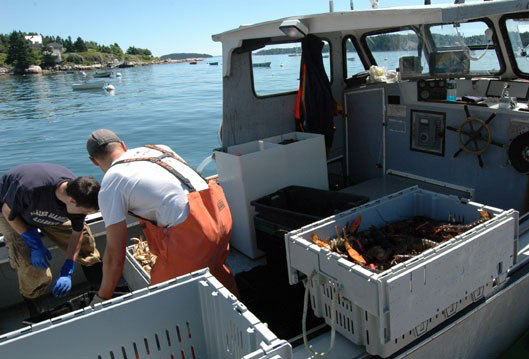
   Paul Doiron captains the Flying Spray and Kelly Doyle is the sternman. Both are in long johns through May and sometimes into June. “On top of those I wear insulated overalls and when I get to the boat I oil up,” said Kelly. “We put on oilskins, a full bib, and a jacket. It’s so you can stand in the rain for hours.”

   After they’ve cleared the North Rustico harbor the first thing Paul Doiron does is turn on his GPS to locate their traps.

   “The first guy I fished with only had a compass,” said Kelly Doyle. “But, it never really worked right for him. They fished by strings back then, by their compasses and landmarks. You would probably find your buoys, but on a dirty morning, no. They’re only so big floating in a big ocean out there.”

   Fishermen on the island are restricted to 300 traps by the Department of Fisheries and Oceans. In the early 19th century lobsters were so abundant they washed up after storms. Islanders used wooden tongs to pick them up, although many were ashamed to be seen eating lobster because it was regarded as a poor man’s dinner. There used to be no rules about harvesting lobster. But, by the 1890s there were problems with declining stock.

   “Many fishermen had from 1200 to 1500 traps,” said Norman Peters. In the latter half of the 20th century the fishing season has been shortened, fishermen must be licensed, and taking spawning lobsters isn’t allowed. “It’s the responsibility of those who are fishing today to conserve our fishery,” said Mr. Peters.

   Once out on the Gulf of St. Lawrence the Flying Spray looks for its traps. “We’ve got 37 bunches of 8 traps and one trap of 4,” said Kelly Doyle. Traps are connected by a line, eight of them along a stringer, and attached to buoys with a unique color for easy identification. “There’s 8 traps between buoys and that’s called a set, or a full trawl. They’re all numbered in our GPS and we pick them up every morning.” 

   The Prince Edward Island gulf coastline is largely ledge and sand. When the frozen shallow waters thaw in April lobsters move in from the deeper ocean. They return to warm shoal water for egg-bearing females to hatch and release in springtime and early summer.   

   “Hard rock is what you want for lobsters, rock that looks like mountains,” said Kelly. “Sometimes they’ll cross sand. Most of the time sand is full of crabs and crabs hate lobsters. When lobsters cross sand they scare the crabs out and you can have a tremendous catch the next day. You’ve got to think like a lobster, about the depth of the water, how warm it is, and when you think they’re going to be there.”

   When the fishing is good he, and often a hired hand, haul one lobster after another out of the traps they’ve pulled, slip rubber bands over the claws of the keepers, loading them into onboard tanks, and re-bait the traps. As the traps are lowered back into the ocean the most important rule for sternmen is to not step on rope, get snagged in the rope, and get dragged overboard. 

   “Lots of guys will get caught for a minute,” said Kelly, “but the last guy who drowned out of this harbor was Jackie Dussett in the 1960s. He got his leg caught and was just gone, overnight. The tide worked him loose the next day.”

   Lobster fishing on Prince Edward Island is not usually unusually dangerous, but it is hard work, in more ways than one. Everything on a boat is hard. “Everything’s hard as steel,” said Kelly. “Or, it is steel. No matter, whatever you hit hurts.”

   Boats bob and toss at sea since the ocean is never steady like dry land. “I’ve been hurt every year I’ve fished, banged up like an old man.” Working on a lobster boat means working on an exposed, slippery, and moving platform in weather that is bad as often as it is good. Tourists drown in small swimming pools. Fishermen are faced with miles of open water.

   Next to logging, commercial fishing is statistically the second deadliest kind of work to be in, deadlier even than police work or firefighting. “Fishing at sea is probably the most dangerous occupation in the world,” according to the Food and Agriculture Organization of the United Nations.

   “I come out of the cabin one morning last year, coming up the three steps, when something came off the sea and literally threw me out of the cab. The momentum of the boat picked my body up like it was weightless. I banged on the bulkhead and just like that you’re on the ground, hurting, black and bruised.”

   Unlike many fishermen on Prince Edward Island, Kelly Doyle doesn’t come from a fishing family. The first Doyle came to the north shore from Ireland in 1847. He was granted land along was is now Doyle’s Cove. They raised thoroughbred horses and later bred black silver foxes for their pelts. When fox furs went out of fashion his grandfather and father mix farmed, growing turnips, barley, and wheat.

   “I have three brothers and they all became fishermen,” said Kelly. “We weren’t fishermen, but I think it was in our blood. We were all at ease on the water. None of us got sick. But, I’m the only one who still fishes. It can be hard on you.”

   In season the Flying Spray sails for lobster every day it can. Some days, like after a storm when the 7 kilometers of line they carry are tangled and need to be untangled, they are out for up to 15 hours. “Gear starts to move. Before you know it it’s all snarled, mine and everybody else’s. You’ve got to pull it up, bind your gear, and that’s rough.”

   Lobster cages weigh about 20 pounds without the 44 pounds of concrete ballast in them. When they are wet they are more than 100 pounds. “Thank you to the man who invented hydraulics!” said Kelly. “Years ago it was all hauled by hand. The forearms of those guys in Rustico back then were like Popeye.”

   Although not born to it, although his business interests have expanded to include Coastline Cottages and PEI Select Tours, and although it is exacting, physical work, Kelly Doyle plans to continue lobstering.

   “I had been out of fishing for a few years, but bought back into it. My first year back I thought I was going to die. It was a tough spring, shitty weather, and I was going to bed at 7 o’clock, just beat up. It’s all about wind, which creates seas, which creates bouncing around like a cork.”

   Seas can be dangerous and storms terrible. But, the lives of commercial fishermen are subsumed by their boats, the waters they sail, and the work they do. “Later part of March, you’ll hear a seagull on the coast, it just seems to draw you back,” said Francis Morrissey, a fifth-generation lobsterman in Tignish, on the northwest tip of the island.

   “This is the best place in the world to be fishing,” said Mike McGeoghegan, past president of the PEI Fisherman’s Association. 

   Oceans are more ancient than anything, including mountains. Men have fished for more than 40,000 years, from about the same time modern humans moved into Europe. 1,100 kilometers of red sandstone shoreline rim Prince Edward Island, some of it sand beaches, some of it cliffs, all surrounded by the wide sea.

   “I’m going to fish this year, at least I will as long as I’m on this side of the sod,” said Kelly Doyle. “To tell you the truth, if and when I die, I hope it’s out there.”

Ed Staskus posts monthly on 147 Stanley Street http://www.147stanleystreet.com, Made in Cleveland http://www.clevelandohiodaybook.com, Atlantic Canada http://www.redroadpei.com, and Lithuanian Journal http://www.lithuanianjournal.com

A New Maritime Thriller by Ed Staskus

“Ebb Tide”

“Small book, big story.” Barron Cannon, Adventure Books

“A Down East crime mystery, wildlife and all.” Sam Winchell, Beyond Fiction

Available on Amazon: https://www.amazon.com/dp/B0CVDP8B58

Atlantic Canada, 1989. A town on the Gulf of St. Lawrence. A satchel of stolen counterfeit money. Two contract killers from Montreal. A gravel road cop stands in their way.

Breathing Room

By Ed Staskus

If you can breathe, then it’s working.” Lemony Snicket

Many actors swear by yoga, from Matthew McConaughey to Naomi Watts to Robert Downey, Jr., because acting is largely a movement art and yoga on the mat is mostly about body awareness. Unless the role is Frankenstein or you’re Vin Diesel, more wooden than a talking tree isn’t usually in the script.

When Russell Brand dedicated himself to Kundalini Yoga he said, “these things are right good for the old spirit.” Gwyneth Paltrow wakes up every morning at 4:30 to practice, according to People Magazine. “It kind of prepares you for everything, honestly,” said Jennifer Aniston.

God knows, Iron Man could use all the yoga he can get.

Rock-n-Roll Hall of Fame superstar dancer singers plug in to the practice, too. Madonna has unrolled her mat down the aisle of jumbo jets. The spectacle of the Queen of Pop in down dog pose is worth the plane fare, given that the average ticket price to one of her shows is upwards of $400.00.

Even though yoga is great for mobility stability control, it doesn’t always work out according to plan. When the singer Rod Stewart was trying a beginner’s balancing pose at home, he lost his balance and fell into a fireplace. “Surely, if God had meant us to do yoga,” he said afterwards, ”he’d have put our heads behind our knees.”

Not many yoga teachers swear by acting. They usually swear about you not being your authentic self, pretending to be somebody else. One of the eight limbs of the practice is all about self-observation. In some respects all of the practice is designed to be an expression of your true self.

Bryde MacLean, a native of Prince Edward Island, an Atlantic Canada province, is an actor and a Moksha Yoga teacher. Two Canadian teachers founded the practice in 2004, focusing on strength, therapeutic flexibility, and calming the mind. It is in the vein of hot yoga, although not as hot as Bikram Yoga, nor as rigid in its sequencing.

“It’s built with the long-term health of your spine in mind,” said Bryde.

Moksha Yoga, which means freedom from the cycle of death and rebirth, is environmentally active, one of its pillars of purpose being ‘Live Green’, and active in its communities, as well. There are more than 70 studios, most of them in Canada. They offer weekly karma classes with all the profits, currently more than $3 million, going to groups supporting human rights and holistic health.

“I was 21-years-old, working in a bar, hanging with my friends, having a lot of anxiety”, said Bryde. “Ryerson University had turned down my application. My sister recommended yoga. I had never taken a class in my life. Tara was dating Ted Grand, and he recommended it, too.” Ted Grand, her future brother-in-law, was at the time creating what became Moksha Yoga.

Bryde MacLean took her first class in the basement of a church in Charlottetown, the capital of Prince Edward Island. “It was myself and a bunch of women who were much older than me, in a definitely not heated space. We did lots of slow breathing and long stretches. It was a powerful experience. I decided I could get behind that.”

When Ted Grand offered her the opportunity to join his team and go to Thailand for yoga teacher training, she made sure she didn’t miss the team bus. “I wanted to travel and I wanted a skill I could travel with. I jumped right into the hot room. I loved it.”

She taught full-time in Toronto for a year before moving to Montreal, where she also taught, as well as attending Concordia University. “I had a full course load, but I wanted to study what I’m passionate about, so I applied to Ryerson again, and got in.”

Ryerson is a public university in Toronto, its downtown urban campus straddled by the Discovery District and Moss Park, focusing on career-oriented education. Bryde Maclean enrolled in the 4-year Performance Acting program. Long before she wanted to be a yoga teacher she had wanted to be an actor. She was scripting performing directing shows from the time she was six.

“We’d haul out Halloween costumes and my parent’s old clothes and dress up. We’d write fantastical stories and use construction paper to build our sets.” She and her friends play acted in garages, attics, and basements. Her parents encouraged her.

“They inspired me.”

Her parents were Sharlene MacLean and Bill McFadden. Her mother was pregnant with Bryde the summer of 1984 at the same time she was stage-managing ‘Blythe Spirit’ at the Confederation Centre in Charlottetown. As an actor Sharlene MacLean has played the maniacal Lady MacBeth in ‘Macbeth’ and the prattling Minnie Pye in ‘Anne of Green Gables’, working on stage and on film, working around the births of her four children.

Her father worked and performed long and often at the Victoria Playhouse. Victoria is a seacoast village on the south shore of Prince Edward Island. “I spent a lot of time in that theater as a little person,” said Bryde “My dad and I lived in the building down the street that is now the Chocolate Factory.”

Her parents played the aging couple in ‘On Golden Pond’ in 2012 at the Victoria Playhouse. They had both starred in ‘The Owl and the Pussycat’ during the theater’s first season in 1982, thirty years earlier. “I had never seen them on stage together, not as an adult,” said Bryde.

By the time she graduated from Ryerson University in 2011 she was teaching other people how to be yoga teachers. “I didn’t know what I was doing when I started, other than enough about teaching classes myself and being a good listener,” said Bryde. She became Manager of Yoga Teacher Trainings for Moksha International for 3 years.

“I dove into that. There’s a big community vibe. It pushed me to learn how to do things I didn’t consider myself capable of.”

2011 was a big year in more ways that one. She graduated with a BFA, got a full-time job, and got married, too. Jeremie Saunders, her boyfriend fiancée husband-to-be, was in the same class in the same program in the same university as her. One thing led to another. After graduation he trained to become a Moksha Yoga teacher.

“So, there we are, we do all the same things,” said Bryde.

They do all the same things, but with a difference. Yoko Ono once said the most important thing in life was, “Just breathe.” When Bryde wakes up in the morning she breathes free and easy. When her husband wakes up in the morning it’s with the thought, at least I’m still breathing.

Born with cystic fibrosis, Jeremie Saunders is in a lifelong fight with the inherited life-threatening disease. It is a genetic disorder that mostly affects the lungs. Infections and inflammation lead to a host of problems. 70 years ago, if you were born with it, you were likely to die within the year.

Even today, while cystic fibrosis has been made livable, there is no cure. No matter exercise regimens treatments antibiotics, median survival is less than 50 years. “I’m living with this terminal illness,” said Jeremie. “I know that my life expectancy is significantly shorter than most people.”

Two years ago he ran an idea for a new podcast by two of his friends. A month later they recorded their first episode of ‘Sickboy’. The podcast is about the day-to- day of living with an illness. Four months later it officially launched and three months after that it was included on iTune’s Best of 2015 list.

Although it is the essence of innovation to fail most of the time, when time is of the essence it’s better to succeed as soon as possible.

“It’s a comedy podcast,” said Bryde. “It’s laughing about the absurdities that happen when you’re sick, all the embarrassing and difficult things people usually don’t talk about.”

“I’ve always been a fan of honesty,” said Jeremie. All good comedy comes from a place of honesty. He doesn’t try to keep the beach ball underwater. “Every time I would talk to someone about being sick, this fog of awkwardness would fall over the conversation. It’s empowering to drop that, let it go, and not feel confined or chained down by your circumstance.”

Living in Halifax, Nova Scotia, teaching Moksha Yoga, co-starring in short films by Tiny Town Media, in early 2015 Bryde spied a last minute casting call for a summer show in Charlottetown. “I was lucky to see that.” She landed the role of the mom in ‘Hockey Mom, Hockey Dad’ in the Studio 1 Theatre at the Confederation Centre. She and the show were a hit. “Sets, characters, director score a hat trick,” wrote The Guardian in its review.

“Bryde MacLean says much with her guarded, often wordless reactions, like a smile tucked into her shoulder.” It was her first professional appearance on stage.

When actors unroll their mats it’s to learn to control movement. It helps them be more aware of where their physical bodies are in space and the dynamics of change in that space. “Yoga helps me get very present with my body and what’s going on with it,” said Jennie Olson Six, who is, like Bryde MacLean, an actor and yoga teacher.

It also helps develop command over one’s breath. But, that kind of command can be a double-edged sword.

“Yoga helps, definitely, as an actor But, I think in some ways, because I did my yoga training before my actor training, it has hindered me.”

Actors practice breath control so that they can manipulate the range, volume, and speed of their speaking. They might breathe in to the count of four, just like in yoga classes, but when they exhale they do it through their teeth with an sssssss sound. When they come back to four they cut the exhale crisply. It’s a way of practicing ending speech on an exact syllable, making it toe the mark.

When it doesn’t, sometimes actors will flap their lips, making a brrrrrrr sound.

“When you breathe in yoga it’s to create a steady, measured breath, focusing on it, calming your nervous system,” said Bryde. “You don’t want that when you’re acting. You want your breath connected to your voice. When you breathe to speak you want your breath to come from a place that’s connected to your impulse. Yoga is about observing your impulses, but not reacting. Acting is reacting.”

In Shakespeare’s day acting was called a performance of deeds. It’s the same today. “Acting is reacting in my book,” said Morgan Freeman. Where actors want to go in their work, even though they’ve walked through it a hundred times, is to express feeling by following an instinct, not by controlling it. Magic on film and stage is created, not by staying in the rehearsal hall, but by being in the moment.

“You need to have a cool head, however, not get caught up in whatever you’re working on, and go off into another dimension and never return,” said Bryde.

“Yoga has been good for me in terms of focus, my ability to concentrate, and be able to handle my anxiety. It keeps my feet on the ground. It rebalances my body, too, which is the only thing I have to work with.”

While at Ryerson University she played King Richard the 2nd in a student production. “He’s a hunchback, crooked. After two hours of him every day I had to balance out that side of me. Maintaining a healthy body is a super important thing for a performer. Otherwise, you end up with injuries.”

She went back to her roots in 2016, appearing in ‘Blythe Spirit’ at the Watermark Theatre on Prince Edward Island. It was her second professional appearance on stage. It was the same show her mother managed on the same island thirty-two years earlier when she was carrying her daughter-to-be. If anyone was ever born to play one of the leads in the Noel Coward play it was Bryde MacLean.

That same summer her husband starred in the comedy ‘The Melville Boys’ at the Victoria Theatre, the theater she had roamed explored left no stone unturned as a tyke. The Watermark Theatre seats about a hundred people. The Victoria Playhouse seats about fifty more than that.

Spectacle sells, splashy musicals, casts driven by stars. But, small gatherings at indie theaters can have a big impact. Little theaters, summer stock, some in your own backyard, often have big talent. “Bryde MacLean has probably the most difficult role to play – the straight woman – and she carries it like a pro,” wrote theater critic Colm Magner. “She has great fun combusting before our eyes later in the play.”

“I love small, intimate performances,” said Bryde. “I like to be right in there with the audience.” It works for her because she often works in film. “I tend to be a little smaller in my performance size. You can do the subtlest things, so subtle, but so real.”

She kept up her practice all summer at a Moksha studio in Charlottetown, taking bar classes, a mixture of ballet, pilates, and yoga. “I love it, but it kicks my butt.”

There are many reasons people take up yoga, among them stress relief, flexibility, and physical fitness. “They come to yoga to get a cute butt, but you can’t escape all the other benefits of it,” said Bryde. “They stay because they get more mindful, awake, in touch a little bit more.” If they stick with it, the reasons for doing yoga change. The focus shifts from the physical body to the subtle body. Almost 70% of people and 85% of teachers say they have a change of heart over time, changing their focus to self-actualization and spirituality.

“Their buns still get really tight,” she added with a teacher’s keen eye.

After ‘Blythe Spirit’ closed Bryde worked on a 5-week shoot of a horror film called ‘But What Are You Really Afraid Of’. She wasn’t an actor in a trailer waiting to be called for her next scene. She was one of the workers who serviced the trailer. “A craft services job takes care of all the food on the set, the crew that does the dirty work,” she said. “It’s not for the faint of heart.”

Although she continues to teach Moksha Yoga in Halifax, and continues acting, on stage and film, she is writing a screenplay for a feature film, producing a play she hopes to get on the road in 2018, and has launched another new podcast with her husband.

‘Turn Me On’ is a show based on sharing the couple’s sex life with others through interviews, candid conversations, and discussions about sexual orientation. “I don’t need crazy shock value to be interested,” said Bryde. In any case, guests on the podcast are free to talk about their sex lives “whether they’re whacky or not.”

“We are definitely having conversations that feel taboo,” said Jeremie Saunders.

Franklin Veaux, an author and sex educator, believes that what Bryde and Jeremie are doing is doing their audience a good service. “Sexual shame undermines people’s happiness and self-esteem, prevents them from being able to understand what they need and advocate for it and hinders intimacy,” he said.

Although ‘Turn Me On’ is not necessarily about heavy breathing, sex has always been a bestseller. It is often more exciting on stage and screen than it is between the sheets, but it is still emotion in motion, and a big part of nature and human nature. “I couldn’t have imagined we’d have over 12,000 listeners so quickly. It’s very cathartic for me.”

If it is about anything, yoga is about slowing down, slowing down your breath, your body, and your brain. It’s been said once you slow down you will connect with your heart. As many irons that Bryde MacLean has in the fire is enough to take your breath away.

“I wrestle with attachment and detachment,” she said.

Although detachment is a linchpin of yoga, nobody ever sincerely does it without a strong feeling of attachment to doing it. Almost everything we do is invented, so that detachment can be a kind of freedom. But, getting on the mat or breathwork or meditation is about involvement. Pattabhi Jois, who created Ashtanga Yoga a generation ago, on which most of today’s yoga is based, once said it is 99% practice and 1% theory. ,

“Lazy people can’t practice yoga,” he pointed out.

The way to get started is to get going get doing, opening doors, working hard at work worth doing. “I’m casting a net out for a bunch of potential opportunities. What matters is doing what you’re passionate about,” said Bryde MacLean.

Not much is ever accomplished without energy and passion, but to get anywhere you have to act it out.

“When you are inspired by some extraordinary project all your thoughts break their bounds and you discover yourself to be a greater person than you ever dreamed yourself to be,” said Pattabhi Jois. “Just do and all is coming.”

Catching your breath will take care of itself.

Ed Staskus posts monthly on 147 Stanley Street http://www.147stanleystreet.com, Made in Cleveland http://www.clevelandohiodaybook.com, Atlantic Canada http://www.redroadpei.com, and Lithuanian Journal http://www.lithuanianjournal.com

A New Maritime Thriller by Ed Staskus

“Ebb Tide”

“Small book, big story.” Barron Cannon, Adventure Books

“A Down East crime mystery, wildlife and all.” Sam Winchell, Beyond Fiction

Available on Amazon: https://www.amazon.com/dp/B0CVDP8B58

Atlantic Canada, 1989. A town on the Gulf of St. Lawrence. A satchel of stolen counterfeit money. Two contract killers from Montreal. A gravel road cop stands in their way.

Searching for the Surfside

By Ed Staskus

“Whenever we leave home, to Ontario or New Brunswick, I always say we are crossing into another world, into a strange world, into Canada,” said Marie Bachand. “I always ask Louie did you bring our passports?” She always asks in French because her partner Louie Painchaund doesn’t speak English.

It was a cumulus cloud high sky day when they went to Prince Edward Island. They didn’t have their passports. Who wants to look like their passport picture on a sunny summer day, anyway?

They live in Saint-Gregorie in Quebec, a community of the city of Becancour, on the south side of the St. Lawrence River. Their house dates to the 1780s, built by refugee Acadians after the French and Indian War. “They came down the St Lawrence River, four hundred families. It was a rough time. They stopped, said OK, looks good, and settled here.”

It is about six hundred miles to Prince Edward Island, up the St. Lawrence, down New Brunswick, and across the Confederation Bridge to PEI. The first time they went they were touring the Maritimes. The island was a spur of the moment runaround. They drove across the Northumberland Straights on the nine-mile-long bridge to the other side.

“We thought we could run over and visit PEI in one or two days,” Marie said. “It’s so small.”

Even though it is pint-sized, the smallest of the ten Canadian provinces at just a little more than two thousand square miles, compared to Quebec’s almost six hundred thousand square miles, it goes over big.

Ten years later, even after Andy’s Surfside Inn is no more, they still go to Prince Edward Island two weeks in the summer, staying at the Coastline Cottages up the hill across the street, riding their bikes all over the place, still finding substantial fresh things to rack up on the to-do list.

The inn was on the ocean side of North Rustico, near the entrance to the harbor, a white clapboard two-story house with a dozen windows, two dormers and three porches on the side facing the water. A broad lawn slopes down to the cliffs. It wasn’t always the Surfside Inn and isn’t the Surfside Inn anymore, having since taken up where it left off, back to being a home.

“The first house was bigger,” said Kelly Doyle.

Kelly’s grandparents, Mike and Loretta Doyle, were visiting and playing cards at a neighbor’s house one winter night in 1929. Their friends lived about a mile away. At the end of the evening, going home in their horse-drawn sled, they crested a frozen hill. A red glow lit up the sky and flared across the flat cove below them.

The house was being swallowed up by fire. The pitch-dark night was blazing. They had left seven children behind in the care of the eldest.

“It was a flue fire,” said Kelly. “It burnt down because of the stove.”

By the time the Doyle’s raced their sled down to the house, and finding all the children safe and sound outside, there wasn’t much they could do. There were no neighbors nearby to help and there was no fire department. Mike Doyle was able to drag some furniture from the first floor out the front door and saved as many fox furs as he could.

The house was rebuilt the next year and finished the following year.

“The foxes my grandfather saved built the new house.” Kelly’s grandfather was a fox farmer. What he sold the pelts for paid for the work of the itinerant immigrant tradesmen who built the house.

Furry garments are made of furry animal hides. Even though it has lately fallen on hard times, fur is one of the oldest forms of clothing. Once we started globe-trotting out of Africa, to where everywhere else was colder, we started wearing furs. Ever since, people have worn beaver racoon sable rabbit coyote wolf chinchilla opossum mink and foxes.

Mountain men wore the bears they shot and killed.

In the 1880s foxes were bred for the first time, accomplished on Prince Edward Island by locals Charlie Dalton and Robert Oulton. Theirs was the original fur farm in 1884. Within several years the rush was on. But the rush didn’t really and truly mushroom until after a pelt sale a few years later when their harvest of 25 skins brought them nearly $35 thousand dollars. It was a boat load of a barn door of money, bearing in mind that the average island farm worker those days made less than $30 dollars a month.

In 1926 nearly nine hundred live silver foxes were shipped from Summerside to the United States. It was the most valuable shipment in the history of Prince Edward Island up to that time and is still called the ‘Million Dollar Train’. Andy Doyle was born the same year, spunky and healthy, although nobody ever called him the ‘Million Dollar Baby’.

By the 1930s the fox farm industry was strong as a bull, raking in multi-millions of dollars. There were hundreds of thousands of foxes being farmed and skinned coast to coast throughout Canada and the United States.

“The furs my grandfather was able to rescue from the fire were worth five thousand. In the end the new house cost five thousand,” said Kelly.

“We stayed at a country inn, at the information center at the bridge they said it was nice, but it was a little room, yuk,” said Marie. She picked up the official PEI tourist book. Where to stay next? She thumbed through the book. She put her finger on Andy’s Surfside Inn. “I say to Louie, what’s that, the north shore? We had already decided to stay three or four more days. We went looking for it.”

Gavan Andrew “Andy” Doyle was 81 years old in 2007 when Marie and Louie went driving up and down the north shore looking for his eponymous inn. Andy had been born in the white house that was the inn. Years later, grown-up a young man, pushing off after World War Two, he landed in Montreal, married, brought up three stepchildren, and years later, when his wife Vivienne died, went back to Prince Edward Island.

His mother died shortly after and he inherited the house on Doyle’s Cove. “My aunt, his sister in Montreal, always had a soft spot for Gavan. She helped him get the place up and running. She bought a bunch of nice furniture for him,” said Kelly Doyle. It was the late 80s. Andy Doyle resurrected the Surfside Inn that had been his mother’s brainchild in the late 40’s.

“When my grandfather died in 1948, my grandmother wanted to make some money with the house and started taking in tourists,” said Kelly. “There was a white picket fence, she had ducks and geese and sheep in a big barnyard, and she kept a garden.” It was a large working garden. “She fed the bed and breakfasts herself.”

As her six girls and two boys grew up and left home, she converted their rooms to guest rooms.

“She filled those rooms all through the 50s and 60s,” said Kelly. “PEI wasn’t like the rest of the world back then. Tourists found the way of life interesting, honest and down-to-earth. There wasn’t much entertainment, but there was always lots to do. They just liked the place.”

When Marie telephoned the Surfside Inn, a Japanese woman answered the call.

“Andy always had Japanese girls, three girls, housekeepers for the season who were exchange students who wanted to learn English. They shared a small bedroom over the kitchen. She told us, yes, we have a room.”

Louie and Marie drove up and down Route 6 between Cavendish and North Rustico searching for the Surfside Inn. When they couldn’t find it, they finally stopped at a National Parks kiosk and got directions. It was in the park, although on private land, Doyle’s Land on Doyle’s Cove. They drove down the Gulf Shore Parkway, past Cape Turner and Orby Head, and down to the coastal inlet.

When they got there, there wasn’t a room. There were four rooms that shared a bath. They were all taken. What Marie and Louie didn’t know was that there was a fifth room on the ground floor, which was Andy’s bedroom with a private bath.

“When we are full, he gives you that room,” explained the young woman.

“We’ll take that,” said Marie. “Where does Andy go to sleep?”

“He sleeps in the boat.”

The Japanese girls did the heavy lifting in return for being able to learn English. “I don’t know where they learned it, but it wasn’t from Andy,” said Marie. “He never talked to them.”

Outside the house was a castaway wooden lobster boat. The hull and forward cabin were worthy enough, although it needed some planks and rib work. it looked like it still had some spirit to it, like it could still make a living at sea.

“It smelled bad, all old stuff papers tools junk a small bed,” said Marie. “It should have been burned long ago.”

The Surfside Inn had a kitchen with several refrigerators. “We thought it was just for breakfast, but we saw other people storing food and making supper.” They started shopping at Doiron’s Fish Market on the harbor road. One suppertime Andy saw them coming into the kitchen with lobsters.

“Let me fix those for you,” he said.

“Oh, my God,” said Marie, “he was good. Tack, tack, tack, all done.”

They started bringing their own wine from home, though.

“I don’t like PEI Liquor wines. We brought Italian and French whites and rose for the fish.”

Coming back from Doiron’s one day, putting away fresh cod wrapped in Kraft paper, Marie noticed small buckets of frozen milk in the freezer.

“There was a Muslim couple staying at Andy’s, the guy was always in the living room, but she was wrapped up, always going to the bedroom. She didn’t talk. At breakfast, no words. She looked at her iPad, that’s all.”

The mother was expressing her breast milk and storing it. She kept it in the back of the freezer, the coldest part of fridges. One day all the milk was gone.

“We never saw the baby, though, maybe it was somewhere else, with a grandma.”

“Tourists in the 50s and 60s weren’t from Monkton or Toronto,” said Kelly. “Some were from the States, but a lot of them were from Europe. We lived next door and ran around the yard, having fun, meeting people. In 1970 my grandmother got a little bit ill and couldn’t keep it going. She lived alone for seven years until my dad moved her into the senior citizen’s home in North Rustico.”

The white house was empty for about ten years, for most of the 80s. It came back to life as the rooms filled up. In summertime it was never vacant.

“You could see the sea right in front of you,” said Marie. “We sat on the porch every day. It was a special place. After a week we would say, let’s stay another day, then another day. Other people, too, were crazy about this place.”

One day Andy asked Louie to help him take an old heavy bicycle out of the lobster boat. “You’re a big guy, you can do it,” said Andy.

When the bike was on the ground Andy straddled it and pedaled to the downhill on the all-purpose path. “He was going down the hill, but Louie told me there were no brakes. Stop! Stop! I yelled but he yelled back, I’ve been riding this bike for thirty years!”

Whenever Andy pulled his four-door sedan out to run errands or go to the grocery, Marie and Louie kept their distance. “I don’t think there were any brakes on his car, either,” she said.

He seemed to own only three short-sleeve shirts. “I have three nice ones,” he said. “I got them for a dollar each at the Salvation Army.” One was yellow, one green and one blue. The blue shirt was his favorite. He dried all his laundry on an outside clothesline, in the sun and ocean breeze.

“All the guests, they were from Canada, the United States, Italy, England, all over. A Chinese couple had a four-year-old who had been born in Quebec, so they named him Denis. Whenever we saw a Chinese child after that we always called the child Denis Wong. There was a couple from Boston, they lived in the harbor on a boat there. He was 80 and she was in her 70s.”

“I didn’t come with my boat. I came with my girlfriend,” he said.

“There is no age,” said Marie. Until you find out your grade school class is running the town city province country.

Aging and its consequences usually happen step-by-step, sometimes without warning. One minute you’re only as old as you feel and the next minute you don’t feel good. It’s like going on a cruise. It can be smooth sailing or a shipwreck. Once you’re on board, though, there’s not much you can do about it.

“There were always many guests, but suddenly a few years ago Andy started getting mixed up. He forgot reservations, there were two Japanese girls instead of three, it wasn’t the same.” What it takes to make an inn work wasn’t getting done. By 2016 it was far more vacant than occupied and Marie and Louie were staying at Kelly Doyle’s Coastline Cottages up the hill across the street.

“Andy introduced us to him,” Marie said.

Like Dorothy said at the end of ‘The Marvelous Land of Oz’, “Everything has to come to an end, sometime.”

In 2018 Andy Doyle moved to the Garden Home in Charlottetown and his nephew Erik Brown took the house over, renovating it and transforming it into his home. In November Andy died. He was 92. It was the end of the Surfside Inn.

“On the ocean was wonderful,” said Marie. “Once we found it, Louie and I loved the Surfside.”

Ed Staskus posts monthly on 147 Stanley Street http://www.147stanleystreet.com, Made in Cleveland http://www.clevelandohiodaybook.com, Atlantic Canada http://www.redroadpei.com, and Lithuanian Journal http://www.lithuanianjournal.com

A New Maritime Thriller by Ed Staskus

“Ebb Tide”

“Small book, big story.” Barron Cannon, Adventure Books

“A Down East crime mystery, wildlife and all.” Sam Winchell, Beyond Fiction

Available on Amazon: https://www.amazon.com/dp/B0CVDP8B58

Atlantic Canada, 1989. A small town on the Gulf of St. Lawrence. A satchel of stolen counterfeit money. Two contract killers from Montreal. A gravel road cop stands in their way.

Rock the Castle

By Ed Staskus

   There isn’t anything to be or not to be about “Kronborg – The Hamlet Rock Musical” as it kicks off the 55th season at The Charlottetown Festival on Prince Edward Island. It’s all about being, being in front and making it happen. There’s nothing indecisive about Hamlet. He’s got Claudius in his crosshairs nearly from the get-go.

   Lawrence Olivier, who directed and starred in an acclaimed movie adaptation of William Shakespeare’s “Hamlet” in 1948, said it is “the story of a man who cannot make up his mind.” The Hamlet of “Kronborg” doesn’t have that problem. His world has been rocked. He has got to make up his mind.

   Hamlet’s first song “That It Should Come To This” – sung by Island-born Aaron Hastelow, in a grim dazzling performance of a determined rather than irresolute prince – is performed right after the Ghost King has made himself known to Marcellus and Horatio, and Claudius and Gertrude have made themselves known to Hamlet. He soon has a good idea of the double-dealing he doesn’t know everything about, yet. From that moment on it is hands on the wheel.

   The singing is brisk and strong throughout, from the leads to the ensemble. Peter McBoyle, the show’s sound designer, has worked on several musicals at the Confederation Centre, including “Jesus Christ Superstar.” The orchestra, led by Craig Fair, leading the way, gets it done down in the pit, always there as the story unfolds.

   Aaron Hastelow gets it done up top up front as Hamlet.

   “From seeing a ten-minute segment of the piece in a review show when I was 13-years-old, to now, it’s surreal,” said Aaron⁣. “I need to acknowledge the tireless work of Craig Fair, giving us all this chance, and Cliff Jones for writing some of the most beautiful and memorable melodies. After 45 years, it’s time to share this show with audiences once again. Let’s rock!”

   The show starts off with a bang, at the end of the story, as the last of all the main characters, save Horatio, fall down dead, and a black-clad dance troupe of post-modern Greek Furies peck at the fallen, pecking out the vengeance of the Ghost King, Hamlet’s father

   “To be or not to be” is never spoken. “Let it be” by The Beatles is invoked. There will be blood is what is on everybody’s lips.

   Lawrence Olivier once also said, “Lead the audience by the nose to the thought.” It’s an unfortunate phrase. Who wants to be led by the nose to anything? It’s far better to smell it out for yourself.

   “Kronborg” propels the audience headlong to its windswept thought on passages of brisk music and stirring song and able-bodied dance and crafty staging, the twisting plot turning high and low. There are barely two lines of dialogue strung together to transition the songs. It is in some senses like an opera, incorporating all the elements of spoken theater, but sung instead of spoken.

   It’s unlike an opera, however, since every word can be understood, it never stands still for long to show off a singer, the songs being embedded in the story, and it is exciting as hell from beginning to end. It bursts with energy.

   “It’s a story of family, power, revenge, and sacrifice,” said Adam Brazier, artistic director at the Confederation Centre of the Arts in Charlottetown, where the show was resurrected on their main stage, the Homburg Theatre, playing in repertory alongside both “Anne of Green Gables” and “Mamma Mia!”

   It is by far the darker, and arguably the more galvanizing, show in town. There’s something both rockin’ and rotten in Denmark.  It’s been said about rock ‘n’ roll that the devil has all the best tunes and the devil is not going anywhere. It’s also been said that shake rattle and roll and three chords are where the truth is. Whatever the truth is, the show is masterminded, exact and sparkling, never slack, always on the go.

   Only the Ghost King takes his time.

   The set by scenic designer Brian Smith is German Expressionist, a kind of Cabinet of Dr. Caligari castle, ramparts, a ramp and movable stairs, and arched entranceways. A forest as bleak as prison bars is lowered several times, the trees jagged and menacing, no escape. The rest of the set is minimalist, from the overhead part medieval part modernist chandelier to Gertrude’s dressing room, more suggestion and more effective because of the suggestion.

   Nothing in the background gets in the way of the song and dance and narrative in the foreground.

   When Honeybelle – Nicola-Dawn Brook in a red beret and man the barricades – and the players of the play within the play belt out the gospel inspired “He Got It In the Ear,” the fulcrum on which the plot rests tilts and everything becomes the gospel truth.

   Hamlet, Claudius, Gertrude, Laertes, and Ophelia pour their hearts out in “I Cannot Turn to Love” at the end of Act One. It ends suddenly. The stage goes dark.

   You can’t wait for intermission to be over.

   The musical was conceived and written in the early 1970s by Cliff Jones, He wrote it while working on the children’s TV show “Mr. Dressup.” A Toronto composer and lyricist, his original “Hamlet: The Musical” has been reprised several times. It played on Broadway in 1976 as “Rockabye Hamlet,” starring the rock star Meat Loaf.

   It came back to PEI in concert form in 2017 in at the Indian River Festival. Cliff Jones was in the audience. Following the production at St. Mary’s Church, another concert was performed at the Confederation Centre. Shortly after that the wheels were set in motion to stage the show again.

   “It’s back where it began and where, in my mind, it’s always belonged,” Cliff Jones said about the production at the Charlottetown Festival.

   “When people on the Island found out that Craig Fair and I were working on “Kronborg” they all had their own story,” said Mary Francis Moore, directing the show.  “Who brought them to the show in 1974? What seat they were sitting in when they heard Cliff’s score. What it was like to work on the first Canadian show to ever make it to Broadway.”

   The musical is more than just a piece of the Charlottetown Festival’s history.

   “We recognize the significance the piece plays. We have dusted off the pages to create a re-envisioned production that has been fully re-orchestrated and re-arranged – new life breathed into this Canadian classic.”

   The composer sat in on some of the rehearsals. “I saw what they were doing with this incredible company and with Craig Fair’s new arrangement and musical direction,” said Cliff Jones. “I’m thrilled. It’s been framing my life for the last 45 years. It’s renewed me.

   “The show has always carried a special combination of being a fun, entertaining experience, but also being faithful to Shakespeare’s story.”

   Kronborg is a 1400s stronghold castle in Helsingor, Denmark, that became Elsinore in Shakespeare’s late 1500s tragedy in five acts. “Kronborg – The Hamlet Rock Musical” is in two acts. Not a moment is wasted, but all the key moments are there, from the Ghost King to setting the scene of Gertrude and Claudius’s marriage, Claudius getting suspicious and Hamlet’s turmoil, the king’s plotting and the play within the play, Hamlet inadvertently killing Polonius, the banishment and the tragic climax.

   There is even some ribald fun along the way, especially when a freshly re-imagined Rosencrantz and Guildenstern make their appearance. They aren’t what you expect. They are nimble and treacherous, like street cats on the prowl.

   Claudius is on the prowl, too, as Act Two starts, aware of the grave threat that Hamlet presents, and he conspires with Rosencrantz and Guildenstern to solve the problem. Gertrude – played by Alana Hibbert – big league but tottering by then, sings the first of her two affecting prophetic solo’s, “Somebody Wrote the Wrong Words,” as fate speeds up.

   Laertes and the full company sing “Eye for an Eye” and the die is cast.

   It all comes down to Claudius and Hamlet.

   Costume designer Jeff Chief doubles the king and his step-son, both men in black, both lean and mean, although Hamlet is largely in wool-like fabric, softening the effect, keeping him on the side of flesh and blood, while Claudius is largely in leather, making him more reptilian. Claudius is Axl Rose meets Johnny Rotten meets villainy most foul.

   The costumes are severe, Edwardian mixed with some Mad Max, while the female leads are often more flowing, leaving trails streaking behind them as they cross the stage. Anachronistic pants are used to good effect, especially when the doomed Ophelia jumps into the lap of the standing Hamlet, straddling him, hanging on for dear life.

   Cameron MacDuffie, a veteran of the Centre who describes himself as a man who “lives out past where the sidewalk ends,” plays Claudius as a man who doesn’t give a damn about sidewalks. He is self-aware, as most of Shakespeare’s wrongdoers are, and not beneath self-pity, but his self is more selfish and slyly arrogant than it is anything else. He is the king and the kingdom is his person. Beyond him, nothing matters.

   It is an astonishing performance.

   When Gertrude sings “No Use Pretending,” which might be one of the best songs of the musical, and is certainly the most moving, near the end of Act Two, she is singing for herself, but for everyone else, too. Polonius and Ophelia are dead. The roof is about to cave in on everyone’s heads.

   Fight director Anita Nittoly stages the penultimate sword fight between Hamlet and Laertes Robin Hood-style, lithe and desperate. It is thrilling and horrible, knowing there is poison. When the end comes only Horatio is left standing, and joined by the Ghost King in the ramparts, bears witness to what becomes of treachery and revenge.

   “Kronborg – The Hamlet Rock Musical” breathes new life into a play more than four hundred years old, and dirty work as old as time. It resonates because it speaks to our own times.

   “A nefarious transition of power has taken place in Denmark and the future is uncertain,” says Adam Brazier. “It is a story that is eerily familiar to the current landscape of the world at large.”

   Early in Shakespeare’s play, in Act One, Scene 4, Marcellus says, “Something is rotten in Denmark.” The Hamlet of “Kronborg” doesn’t worry about to be or not to be. Something has got to be done. He rocks the castle to get the rot out. He gets it done.

Ed Staskus posts monthly on 147 Stanley Street http://www.147stanleystreet.com, Made in Cleveland http://www.clevelandohiodaybook.com, Atlantic Canada http://www.redroadpei.com, and Lithuanian Journal http://www.lithuanianjournal.com

A New Maritime Thriller by Ed Staskus

“Ebb Tide”

“Small book, big story.” Barron Cannon, Adventure Books

“A Down East crime mystery, wildlife and all.” Sam Winchell, Beyond Fiction

Available on Amazon: https://www.amazon.com/dp/B0CVDP8B58

Atlantic Canada, 1989. A small town on the Gulf of St. Lawrence. A satchel of stolen counterfeit money. Two contract killers from Montreal. A gravel road cop stands in their way.