
Tag Archives: Kelly Doyle

Home Front

By Ed Staskus

   The green house and the shore road on Doyle’s Cove on the Gulf of St. Lawrence have both been there for more than a century, except last century they changed places. The road used to be on the shoreline and the house nearer the hillside. The green house is on the shoreline today and the road has been moved away from the ocean. It is now the National Park road. The slow steady erosion of Prince Edward Island’s shoreline will take the house before it takes the road.

   “It was on the property but maybe a few hundred yards away,” Kelly Doyle said about what became the green house. When Kelly’s father, Tom, hauled it down to the water’s edge, it was because his new bride refused to stay in the white family house.

   “Dad in the back of his head thought his mother and wife would get along, but they were both very damned strong women,” Kelly said. “They just couldn’t live in the same house, both determined about that.”

   When Doris and Tom Doyle married in 1947, both in their early 20s, Dottie came from Boston and Tom was native to the island. After their honeymoon they moved into the white house on the cove built in 1930 that Tom grew up in.

   “They moved there because it was the only place to live,” Kelly said.

   The houses are on the water’s edge of North Rustico, on the north side of Prince Edward Island, near the entrance to the harbor. The white house is a clapboard two-story home with a dozen windows, two dormers, and three porches on the side facing the water. A broad lawn slopes down to the cliffs. 

   “The first house was bigger,” Kelly said. It had been bigger, but it was gone.

   Kelly’s grandparents, Mike and Loretta Doyle, were playing cards at a neighbor’s house one night in 1929. It was winter, cold and snowbound. Their friends lived about a mile away. At the end of the evening, going home in their horse-drawn sled, they crested a frozen hill. A red glow lit up the sky and flared across the icy cove below them. 

   The pitch-dark night was lit up. The house was on fire. They had left seven children behind in the care of the eldest. Tom was the youngest, four years old at the time.

   “It was a flue fire,” Kelly said. “It burnt down because of the stove.”

   By the time their horses raced down to the house, the parents finding all their children safe and sound outside, there wasn’t much Mike and Loretta could do. There were no neighbors nearby to help and there was no fire department. Mike was able to drag some furniture from the first floor out the front door and saved as many fox furs as he could.

   The house was rebuilt the next year and finished the following year. “The foxes my grandfather saved from the fire built the new house.” Kelly’s grandfather was a fox farmer. What he sold the pelts for went to pay for lumber and the work of the nomadic immigrant laborers who built the house.

   “Nobody knew them,” Kelly said. “They weren’t from around here.”

   It took the Great Depression a year to get to Prince Edward Island, but when it did it disrupted farming, which was what the island did for a living. In 1930 PEI farmers had a large grain and potato harvest. They had never had problems selling to their markets, but by then their markets were going broke. For the next couple of years, nobody was buying. By 1933 average net farm income on PEI was only twenty dollars a year, selling what fruits and vegetables they could. 

   Although agriculture and the fisheries crashed, tourism and fox fur farming boomed during the 1930s. It was how many islanders kept their heads above water. One in ten PEI farmers were involved in keeping foxes. There were 600-some fox farms on the island in 1932. Five years later there were double that. By the end of the decade ten times the number of pelts went to market as had the previous decade.

   “When my mom married my dad, she didn’t get along with my grandmother all that well,” Kelly said. They were living all together in the family house. “My mom and grandmother liked each other enough, but not enough to live in the same house. She finally said to my dad, Tommy boy, you better build me a house.”

   It put Tom Doyle on the spot. There wasn’t the money available for a new house, even though they had the ground for it. “Dad had a choice to make, either lose his wife, or build a house.” He didn’t want to lose his wife, but couldn’t build a house, so he improvised.

   “I don’t know what kind of a building it was originally, maybe a barn,” Kelly said. “It was a few hundred yards away. He hauled it down the hill to the cliffs and turned it into a house, even though he had his hands full farming at the time.”

   Moving a building is no small amount of work. Fortunately, the building was on the small side, there was a short clear route, and there weren’t any utility wires that had to raised. There was no electricity or plumbing to disconnect, either. Still, wooden cribs had to be inserted to support the building inside and out, jacks had to raise it at the same exact rate and lower it the same way, and it had to be trailered slowly and carefully to its new foundation, between the barn and the white house.

   “The structure was almost eighty years old when my dad moved it,” said Kelly. “It was two thirds the size of what it is now. When I grew up in it, it was pretty small. They built onto it in 1964 when I was eight years old. We spent that winter in my grandmother’s house while our house was being renovated.”

   The Doyle kids, Cathy, Elaine, Kenny, John, Mike, and Kelly grew up in what became a two-story, gable-roofed, green-shingled house, even though it was never big enough for all of them. There were never enough bedrooms. “It wasn’t bad, since there was a fifteen-year difference between the youngest and the oldest. We all left the house at different times.”

   Mike Doyle died in 1948, soon after Tom and Dottie’s marriage, leaving Loretta a widow. She started taking in summer tourists, putting up a sign that said Surfside Inn. She harvested her own garden for the B & B’s breakfasts. “My grandmother filled all the rooms every summer. Some Canadians came, and more Europeans, and Americans because they had lots of money.” 

   She ran the inn for more than twenty years. “She got a little bit ill around 1970, and lived alone for six, seven years until my dad moved her into the senior’s home in the village. After that nobody lived in the house for ten years.”

   In the late 1980s Andy Doyle took it over, rechristening it Andy’s Surfside Inn. “My uncle had been gone for more than twenty years, nobody ever heard from him, and then he came out of the woodwork and took it over,” Kelly said. Nobody could believe that a man in his late 60s wanted or could run a five-room inn. He ran the show for almost twenty-five years, outliving all his siblings until dying in his sleep.

   It was the end of Andy’s Surfside Inn, but not the end of the white house. Erik Brown, the son of Elsie, Andy’s sister, moved in, keeping it in the family. The next summer he started renovating the house, restoring it to a home.

   “It was a rambling old house with large rooms and a spectacular view,” said a woman who came to the Surfside Inn every summer from Montreal. “The best thing is having breakfast in the morning with all the guests around one table. One year ten years ago it was filled with mime artists from Quebec, an opera singer from Holland, and a lady from Switzerland. A dip in the cove outside the front door is a must before breakfast. There are lovely foxes gambling outside, in the evening, on the large lawn!”

   “It was neat when I was growing up,” said Kelly. It was the 1960s. “There were ducks geese and sheep and white picket fences. She had lots of tourists from Europe. We were just kids, all these little blond heads running around. I started meeting those people from overseas. It was exciting.”

   Up the hill from the bottom of the pitch where today there is forest land there was in the 1970s a summer camp for clansmen kids. “They called it ‘Love it Scots.’ There wasn’t a tree up there then. A couple hundred kids from around the Maritimes would come and they would teach them Scottish music and all about their heritage. We could hear the bagpipes being played every night on our farm down here.”

   Highland College staged the PEI Scottish Festival there. “After that it was a campground, three or four hundred families up there.”

   When the campground closed, the trees began to grow back until today it looks like the trees have always been there, rimming out the horizon, alive with damp and shadow. Blue jays, weasels, red squirrels, and red foxes live there. The foxes hunt mice and rabbits. The blue jay is the provincial bird and stays above the fray.

   “I grew up with tourists,” Kelly said. “It was different back then. Now people come here and expect to be entertained.” There is Anne of Green Gables for the kids. There is harness racing and nightlife. There are performing arts in Charlottetown, Summerside, and even North Rustico. There are ceilidhs every summer evening all over the island. There is a country music festival in Cavendish that draws tens of thousands of people. There is cultural tourism. There are bus tours. Cruise ships dock in Georgetown, Summerside, and Charlottetown, disgorging hundreds of passengers on shore excursions, looking for something to do.

   Provincial authorities quixotically opened a buffalo park in the 1970s after accepting a score of bison as a gift. Bison is not native to the island. Nevertheless, tourists lined up to see the car-sized animals with horns curving upwards. Bison can run three times faster than people and jump fences five feet high. Fortunately, they were behind six-foot fences.

   “Back in the day people came here with a different attitude. There was lots to do, too, because they found the local life interesting. They liked the humbleness of everybody, the way of life that was so honest and down to earth. PEI wasn’t like the rest of the world back then. The Maritimes were kind of cut off from the rest of the world once the Merchant Marine was taken away. We kind of fell behind.”

   Many of the tourists of the 1950s and 60s were young couples travelling with children. Some were older couples from the American east coast. There were nature lovers. There were artists. Some of them were bohemians. Others came because PEI was the “Cradle of Confederation.”

   “It was a dump here when I was growing up, to be honest,” Kelly said. “Everyone had an outhouse and a pig in the backyard. There were rats everywhere. It wasn’t all that nice in Rustico, but a lot of artists, writers, photographers, people who liked nature came here. It took a long time to come back, in the 70s and 80s, before it became looking like a real village.”

   In the 1970s the provincial government invested in tourism and has stayed invested ever since. It partnered in the Brudenell Resort near Georgetown and the Mill River Resort. Both include golf courses, which are seen as important tourist attractions. Fifty years later, Prince Edward Island is a different place.

   “It’s sterilized now,” Kelly said. “It’s a completely different PEI, and the people who come here are different, different attitude, different interests.”

   Kelly grew up in the green house, on the cove. After storms the beach and red sandstone were often choked with seaweed, stinking for hundreds of yards in all directions Back when some men collected it as fertilizer for their gardens and banked it against their house walls as insulation against the cold winter weather.

   Everybody went to school in town. After school Kelly and his friends didn’t have to go far for fun. “Between the pool hall and the rink, those were my social events, before I could drink. We grew up in the pool hall here.” To this day John Doyle is an outstanding pool player and participates in tournaments. “John is a decent shot,” said Kelly. “Keep your money in your wallet if you want to keep your money.”

   The pool hall was around the corner from Church Hill Road. A boatbuilder had several shops there and one of his sons converted one of them. The shop that became a pool hall was green like the green house. “There were a couple of pinball machines up front and eight tables in the back. it was the spot for boys and girls on weekends.”

   By the time he was 16 years old and finished with ninth grade, he was finished with school. Many boys did the same, going to work with their fathers, or simply going to work. Kelly went west to Quebec and Ontario. When he returned to Prince Edward Island and started going into the tourist trade, the green house was still there. He built a cottage up the hill from it. He eventually built more cottages for travelers.

   In the years since then Kenny Doyle built a brown house behind the barn. After Tom and Dottie passed away, the green house was rented to a young woman from the village for a few years, but John Doyle has taken it over. Bill and Michelle DuBlois, sprung from Elaine Doyle, have built a blue house across the street. It is Doyle’s Land, from the edge of the ocean to the edge of their fields.

Ed Staskus posts monthly on 147 Stanley Street http://www.147stanleystreet.com, Made in Cleveland http://www.clevelandohiodaybook.com, Atlantic Canada http://www.redroadpei.com, and Lithuanian Journal http://www.lithuanianjournal.com

“Ebb Tide” by Ed Staskus

“A big story in a small town.” Barron Cannon, Adventure Books

“Foul play in the Maritimes, wildlife and all.” Sam Winchell, Beyond Fiction

Available on Amazon: https://www.amazon.com/dp/B0CVDP8B58

Atlantic Canada, 1989. A town on the Gulf of St. Lawrence. A satchel of stolen counterfeit money. Two contract killers from Montreal. A gravel road cop stands in their way.

Finding the Coastline

By Ed Staskus

   “Remember what the dormouse said, feed your head, feed your head.”  Grace Slick, Jefferson Airplane

   There are no dormice on Prince Edward Island but there are plenty of mice. There are house mice, field mice, and meadow jumping mice. There are rats, too. There is the Norway rat, otherwise known as the brown rat. There are so many of them the wide world over, next to human beings, they are the most successful mammal on the planet.

   Mice are little bundles of energy and love to chow down. They eat fruits, seeds, and grains. They are omnivorous, which means they eat plants and meat. They eat just about anything they can find, always on the prowl. The trouble with the rat race is, win or lose, you are still in the rat race.

   Every day is a field day for them on Prince Edward Island. The state of the island is that its land mass is 1.4 million acres and almost half of it is cleared for agricultural use. Back in the day swarms of vermin would show up out of nowhere and eat everything in the fields. In the 19th century, the years 1813 to 1815 were known as “The Years of the Mouse.”

   We had a mouse in our cottage a couple of years ago. We heard something at night scratching around in the kitchen. The next morning, my wife Vanessa found droppings.” She tucked all the food away and told Kelly Doyle, the proprietor of Coastline Cottages, which are five cottages up a sloping lawn from the eponymous Doyle’s Cove in North Rustico. He found a tiny hole at the back of the cottage the mouse had chewed to get in, plugged it up, and set a trap under the sink.

   “That’s the end of that mouse,” I said.

   “You know what they say,” Vanessa said.

   “No, what?”

   “It’s the second mouse that gets the cheese.” The second mouse never showed up, though, staying away in the barley field behind the cottages.

   The first farmers at Souris, near the northeastern tip of the island, suffered many infestations. Vermin can and will lay waste to croplands. The first of a dozen plagues of mice in the 18th century happened in 1724. When the time came to give the town a name, the townsfolk called it Souris, which is French for mouse. Even though they are not welcome, the town’s mascot is a mouse.

   Integrated pest management systems have gone a long way controlling infestations in the 21st century. It doesn’t mean complete eradication of them, but rather bringing their numbers down to where losses are below economic injury levels. It’s about not throwing the baby out with the bath water, but rather ensuring crop protection while reducing human health risks and environmental damage.

   Mice have since gone That’s Entertainment! on Prince Edward Island. In 2010 small bronze statues of them were hidden around Charlottetown. They were based on Eckhart the Mouse, who is a character from PEI author David Weale’s book “The True Meaning of Crumbfest.” The around town game was about downloading clues and trying to find the hidden in plain sight little urchins.

   Mice in the wild live a year or two. The bronze rodents are still in Charlottetown. They’ve been living on their charm and good looks.

   Wherever there are mice there are foxes, and since there are a lot of foxes in the National Park between Cavendish and North Rustico, there are consequently a lot of mice. Foxes are omnivores and eat seeds, berries, worms, eggs, birds, frogs, and fungi. They are a lot like the mice they chase and snatch up. They eat everything. In the winter they eat lots of rabbits.

   We saw red foxes the first time we drove up to the north side of the island. They sat on the side of the road eyeing us. We were on a car trip across Nova Scotia, our second in as many years, when somebody mentioned Prince Edward Island. “What’s that?” Vanessa asked. I was born in Sudbury, Ontario, and was still a Canadian citizen, but couldn’t answer her question. I had never heard of the place.

  We took the Northumberland Ferry at Caribou to the island the next morning. The best dressed person on board in the brisk wind was a Chow Chow. We stayed at the Sunny King Motel in Cornwall. The next day we had lunch sitting at the bar inside Churchill Arms in Charlottetown. Vanessa had a Havarti and vegetable sandwich, and I had a clubhouse.

   “How long are you here?” asked the bartender.

   “Just a day or two. We need to be back to work on Monday.”

   “Where are you from?”

   “Northern Ohio, west of Cleveland, on Lake Erie.”

   “Eerie as in scary and strange?”

   “No, it was named after the Erie tribe of Indians.”

   “You mean Native Americans?”

   “Right, the Indians. The Iroquois called them Erie, which means long tail, because they wore bobcat fur hats with the tail on the back.”

   “Don’t bobcats have short stubby tails?” asked the bartender.

   “That’s the part that stumps everybody.”

   “We had never even heard of Prince Edward Island before,” Vanessa said.

   “I’ve seen some Canadian maps where we aren’t even there,” said the bartender, refilling our coffee cups. “There’s New Brunswick and Nova Scotia and the next thing is Newfoundland, which is not even really Canadian.”

   “I’m originally from Sudbury and I had an idea there was something here, but I couldn’t have told you what it was.”

   The bartender gave us a Visitor’s Guide.

   “You might try the north coastal side of the island, Rustico, Cavendish, Brackley Beach, up around there.”

   We took Route 7 to North Milton and Oyster Bed Bridge, took a left to North Rustico, and kept going to Cavendish. We saw a Visitor Center, turned right, and drove to the National Park. It was mid-September, and the toll booths were closed. There were no boom barriers. We drove onto the Gulf Shore Parkway. The road followed the curve of the ocean, the Gulf of St. Lawrence, the landscape rolling.

   We stopped at MacNeill’s Brook and took a walk on the beach. The freshwater outflow comes from the brook, part of David and Margaret MacNeill’s farm and house a hundred years ago, when they were cousins and neighbors of Lucy Maud Montgomery, who wrote “Anne of Green Gables.”

   We stopped at MacKenzie’s Brook and walked up to a grassy bluff. The brook passes underneath the parkway through two culverts. There was a long beach to the west and red sandstone cliffs to the east. One enormous rock in the cliff face had an enormous hole in it. We lay on our backs on the grass and looked up into the sky. The sun was warm on our faces and the breeze was cool.

   We stopped at Orby Head, parked in the gravel lot, and walked to the edge of the cliff. Cormorants was nesting in the cliffs. Some of them were fishing off the shore, others were drifting, their heavy bodies low in the water, while others were chilling in the sunshine on a ledge. They are large water birds with small heads on long necks. Their thin hooked bills are about the length of their heads. The birds are dark, brownish black with a small patch of yellow-orange skin on their face. They look pre-historic up close.

   “Oh, man, this is where we should come next year,” I said, getting back into our car.

   “I am with you,” my wife said.

   Before we could pull out, a red fox ran diagonally across the parking lot and jumped into the brush, hellbent after something running for its life.

   We passed Cape Turner and a minute later the road dipped down to Doyle’s Cove. On our left were two older frame houses, one green and the other one white. The white house had a sign on it that said, “Andy’s Surfside Inn.” On our right, up a grassy slope, were some cottages. The sign at the front of the drive read “Coastline Cottages.” We drove up to the office and parked in front of a neon OPEN sign in the window.

   A Japanese woman carrying a blue plastic bucket came out of one of the cottages. She told us her name was Katsue and that the owner was away, but she could show us one of the cottages, the one she had just finished cleaning. By the time we left, our names were on the paper schedule board for a cottage the next September, right after Labor Day.

   A year later, driving up and down Route 6 between North Rustico and Cavendish in the dark, after twelve hours in the car, having lost all sense of where exactly the park road and the cottages were, we finally found the Visitor Center on Cawnpore Lane. It was closed, but we heard voices across the street at Shining Waters. One of the cottages was still lit up and four men were talking laughing drinking beer on the deck.

   None of them knew the Coastline Cottages, but all of them knew where the shore road was.

   “That’s a step in the right direction,” Vanessa said, shooting me a vexed relieved look. “Maybe we won’t have to sleep in the car after all.”

   In the event, we almost fell asleep on the deck of our cottage after we found it, wrapped in blankets, looking up at the wide expanse of stars in the inky sky, stars we never saw at home, where the lights of the city obscured the heavens.

   “Keep your feet on the ground and your eyes on the stars,” I said.

   “I know you just said that, but who said that?” asked Vanessa.

   “Teddy Roosevelt, in the biography about him I’m reading.”

   “We are all stars, and we all deserve to twinkle.”

   “Who said that?”

   “Marilyn Monroe.”

   I read more books than watched movies and my wife watched more movies than read books. I was a by-the-book man, and she had her head in the stars.

   The next morning, the day clear brisk breezy, we unpacked and went for breakfast at Lorne’s Snack Shop in town. We both ordered the special, sausage eggs hash fries and toast at the kitchen hole at the back of the front room. There was a mixed bag of potato chip bags on wire racks attached to a wall where we stood.

   “We got a couple gut founded,” we heard the woman at the counter say to the other woman at the stove. “Fire up a scoff.”

   We sat down on worn chairs at a worn table. Everything was in apple-pie order but worn. There were scattered card tables in a back room and shelves on two walls full of VCR tapes for rent. Three rough and ready men talking low threw us a glance.

   When the front counter woman brought me my plate, I asked, “Is that for both of us?

   “No, that’s your, we’re just doin’ the other toast.”

   “It’s a good thing we haven’t eaten since yesterday afternoon.”

   “Where yah longs to?”

   “What’s that?” I asked.

   “Where yah from?”

   “The States,” said Frank. “What country are you from?”

   “Here in Canada, man, from Newfoundland.”

   “Oh.”

   Twenty years Lorne’s Snack Shop is gone, their poutine a strike-it-rich memory. The Co Op is gone, and although the food market across the street isn’t any bigger, it’s better. Amanda’s and their wood-fired pizza pies is gone, taken over by Pedro’s Island Eatery, big plates of fish on a new deck. The hard scrabble park road has been replaced, flanked by an all-purpose walking running biking path. The toll booths at the entrances to the National Park have been torn down and rebuilt.

   “This is swank,” I said. “What do you call these things, anyway?” I asked a teenager in a green shirt in the toll booth.

   “The guardhouse,” the teenager said, leaning out the window of the air-conditioned guardhouse.

   The town is bigger than it used to be. A trove of big ass houses has been raised in the triangle formed by Harbourview Drive, Church Hill Avenue, and the North Rustico beach. When winter comes most of the occupation army leaves and the houses sit empty. A brick-faced line of condos has been built on Route 6 between Co Op Lane and Autumn Lane.

   One summer evening we threw our beach chairs in the back of our Hyundai, popped open a bottle of wine, and drove to Orby Head to see the sun set. We unfolded our chairs at the edge of the cliff, poured ourselves wine in plastic water cups, and settled down, the orange red orb of the sun sinking over Cavendish. A sweet-tempered breeze drifted through the stunted trees.

   A minute later we were running back to our SUV, our wine splashing, the cork God knows where, swatting at the lynch mob of mosquitos coming after us. “What the hell,” I said as we stepped into the cottage. “You try to enjoy some out of doors and see what it gets you, a swarm of biters.”

   “The out of doors gets you a lot, but not just strong legs and a suntan,” Vanessa said. “Sometimes it’s best keeping the outdoors outdoors.”

   “Some people say the mosquito is the official bird of PEI,” Kelly Doyle said. “The sunset is when you’re most likely to feel them. If you were to stop at a certain place, like Orby Head, and get surprised by the little buggers, just move on. So long as it’s not sunset, they won’t follow.”

   It’s the price you pay to feed your head.

   A Stanford University study found that students who walked in a green park for an hour-and-a-half exhibited quieter brains than those who walked next to a rip-roaring highway. They manifested less activity in the prefrontal cortex, a part of the brain associated with depression. Walking in a natural setting was shown to improve frame of mind. It also avoids clouds of carbon monoxide soaking into the lining of your lungs.

   A study at the University of Exeter in En­gland found that people who moved from concrete spaces to green spaces experienced a clear-cut improvement in their mental health. The boost was long-lasting, mental distress over all lessened even three years post-move. An analysis in 2018 of more than a hundred studies on green spaces found that the benefits included upgraded heart rate and blood pressure, lowering of cholesterol levels, and better sleep duration. There were discernable reductions in type II diabetes, cardiovascular mortality, as well as overall mortality.

   Nobody needs to wash down the ‘Drink Me’ potion Alice did to get perspective, or slip away on Grace Slick’s Orange Sunshine, to have the zero cool red cliffs make your head spin. Just go there and see for yourself. Don’t stand too near the edge, though. Don’t go at sunset, either.

   “Maybe about fifty feet of our land has fallen away since I was a boy,” said Kelly. “It might be climate change, but the storms have gotten more intense, for sure. This island is made of sandstone. We’re like a BIC lighter, not meant to last. There’s no stopping that. It’s just our geology.”

   There is no granite or hard rock to keep the breaking waves away. “Everybody knows it,” said Adam Fenech, director of UPEI’s Climate Lab, echoing Kelly Doyle. He meant everybody on the island, like the Doyle’s, who have been there going on two hundred years. But nothing lasts forever, not mice, not red sandstone, not even hard rock. In the meantime, put on your walking running biking shoes, get out into outer space, never minding the bugs or what’s in the cards.

   Feed your head while you can is where it’s at.

Ed Staskus posts monthly on 147 Stanley Street http://www.147stanleystreet.com, Made in Cleveland http://www.clevelandohiodaybook.com, Atlantic Canada http://www.redroadpei.com, and Lithuanian Journal http://www.lithuanianjournal.com

A New Maritime Thriller by Ed Staskus

“Ebb Tide”

“Small book, big story.” Barron Cannon, Adventure Books

“A Down East crime mystery, wildlife and all.” Sam Winchell, Beyond Fiction

Available on Amazon: https://www.amazon.com/dp/B0CVDP8B58

Atlantic Canada, 1989. A town on the Gulf of St. Lawrence. A satchel of stolen counterfeit money. Two contract killers from Montreal. A gravel road cop stands in their way.

Lobsterman

By Ed Staskus

“It will bring tears to a grown man’s eyes,” said Kelly Doyle, a lobsterman who works out of the Prince Edward Island harbor of North Rustico. He was talking about lobster claws. The bite force of a large dog in pounds per square inch is about 500 PSI. A good-sized lobster’s crusher claw exerts about 1000 PSI.

   “I had a claw on my hand one morning, he was squeezing my finger, and not letting go. He’s got you and you think, that’s it, he can’t go no more, but then he’ll squeeze some more. My brother Kenny had to take a screwdriver to it. Kenny is a big man, and he had a big screwdriver, but it took him a few minutes to pry it off of my finger.”

   A 27-pound lobster was caught off the coast of Maine in 2012. The claws were so large they would “break a man’s arm,” said Elaine Jones of the Department of Marine Resources.

   “We don’t catch those kinds of monsters,” said Kelly. “The biggest one I ever caught in my traps was maybe 7 pounds, max. But that’s a damn big lobster, a foot-and-a-half long.”

   29 million pounds of lobster were harvested on Prince Edward Island in 2014, much of it during the spring season, which is May and June. It is a limited entry fishery. “1200 lobster fishers land their catches at approximately 42 ports all around the province,” said April Gallant of PEI’s Agriculture and Fisheries. Many of them are pulled up from the north shore, from Malpeque to St Peter’s Bay. The Rustico fisheries are roughly the axis of the lobster world along that shoreline.

   Besides North Rustico, there are the towns of Rustico, Rusticoville, and South Rustico, all named after a fisherman by the name of Rene Racicot, a French Norman who came to PEI in 1724. Racicot became Rustico among the Acadian-French settlers.

   The reason the north shore was settled was fishing. After the deportation of Acadians by the British in 1758, and the eventual return of those who had hidden or survived drowning and shipboard epidemics, fishing was what meant life or death for their families.

   “I’ve been fishing for 30 years,” said Kelly Doyle, “although I took a few years off, which was a little sabbatical.” After leaving PEI for Montreal in his early 20s, he returned in 1983. “I built a cottage, but I couldn’t get a job anywhere. The next spring I got offered a fishing job in North Rustico.”

   Although fishing in North Rustico dates back more than two hundred and fifty years, groundfish stocks contracted in the 20th century. Shellfish and crustaceans, especially lobsters, emerged as the species of choice. Lobster landings almost tripled between 1960 and 1990.

   In the early 1990s a moratorium was enacted limiting the taking of many kinds of groundfish. “We were shut down completely,” said Kelly. “No more white fish. All we were allowed was lobster, although we could still catch our own bait, like mackerel and herring, at that time.”

   Nowadays lobstermen buy their bait. “I come in, pull up to the wharf, and Doiron takes every lobster I’ve got,” said Kelly. “I buy my bait from them, too.”

   North Rustico’s Doiron Fisheries got its start when Aiden Doiron bought his first fishing boat in 1957. One day, when a man asked him for a cooked lobster, he said, “I’ll be right back.” He grabbed a lobster, a pot, and cooked the lobster on the spot. The Doirons still sell fresh fish out of a shanty on the wharf.

   “We cook lobster on the boat sometimes,” said Kelly Doyle. 

   Thirty years ago he often bagged his own bait for lobstering, late at night. “There was a freshwater run about 2 or 3 kilometers down Cavendish Beach, where the gaspereau would come up from the ocean, smell the fresh water, and spawn there. When they came back down we caught them in nets.”

   Alewife is a herring called gaspereau in Atlantic Canada. Catching them meant waiting for them to swim back to the ocean with the tide at midnight. “We would net them by hand, standing in waist-high water. When we got them on shore they’d be flapping around and sand flying everywhere. We’d fill up 40 or 50 boxes and carry them by hand back to our pick-up trucks.“

   Neither motor vehicles nor horses are allowed in the National Park, which is what Cavendish Beach is. “We’d ice them up for the morning, get home by 2, and then back up at 4 o’clock, 6 days a week in the season.”

   There are 37 boats in the harbor at North Rustico. All of them are made of fiberglas, all are equipped with diesel engines, and all carry a trove of electronic gear. Hulls cost upwards of a quarter million dollars. The annual cost to operate Kelly Doyle’s boat, which he co-owns with Paul Doiron, a man he’s known since grade school, is nearly $50,000. “The word boat is actually an acronym,” he said. “It means break out another thousand.”

   Seventy years ago lobster boats were all wood, ran on 6-cylinder gas engines, and most of them didn’t come with a cabin that anyone could stand up inside of. It wasn’t until the 1960s that windshields were added for protection against the elements.

   “In those days in the winter motors were removed and taken home,” said Norman Peters of the Fisheries Museum. “Boats were hauled to a field and turned upside down to keep rain and snow out. I remember playing under the upside boats and finding bits of fishing line to use to fly kites.”

   “Our boat is the Flying Spray,” said Kelly. “It’s hull number177, built in Kensington, so it’s called a Provincial. It’s a great lobster boat, very dependable, although a little on the rocky side. It’s good going into it, but it doesn’t like being turned. It throws you around a bit.

   “Most of my career was in wood. The best thing about fiberglas is it doesn’t leak. Except, not like wood, they don’t float at all. If you put a hole in them they sink pretty well instantly.” 

   Lobstermen start their day early. “He gets up at 4:20 in the morning,” said Kelly Doyle’s girlfriend, Ryoko. “I make his breakfast and lunch and he’s gone before 5. I go back to bed and sleep a little more.” 

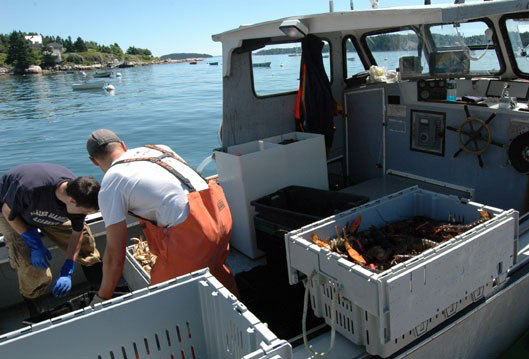
   Paul Doiron captains the Flying Spray and Kelly Doyle is the sternman. Both are in long johns through May and sometimes into June. “On top of those I wear insulated overalls and when I get to the boat I oil up,” said Kelly. “We put on oilskins, a full bib, and a jacket. It’s so you can stand in the rain for hours.”

   After they’ve cleared the North Rustico harbor the first thing Paul Doiron does is turn on his GPS to locate their traps.

   “The first guy I fished with only had a compass,” said Kelly Doyle. “But, it never really worked right for him. They fished by strings back then, by their compasses and landmarks. You would probably find your buoys, but on a dirty morning, no. They’re only so big floating in a big ocean out there.”

   Fishermen on the island are restricted to 300 traps by the Department of Fisheries and Oceans. In the early 19th century lobsters were so abundant they washed up after storms. Islanders used wooden tongs to pick them up, although many were ashamed to be seen eating lobster because it was regarded as a poor man’s dinner. There used to be no rules about harvesting lobster. But, by the 1890s there were problems with declining stock.

   “Many fishermen had from 1200 to 1500 traps,” said Norman Peters. In the latter half of the 20th century the fishing season has been shortened, fishermen must be licensed, and taking spawning lobsters isn’t allowed. “It’s the responsibility of those who are fishing today to conserve our fishery,” said Mr. Peters.

   Once out on the Gulf of St. Lawrence the Flying Spray looks for its traps. “We’ve got 37 bunches of 8 traps and one trap of 4,” said Kelly Doyle. Traps are connected by a line, eight of them along a stringer, and attached to buoys with a unique color for easy identification. “There’s 8 traps between buoys and that’s called a set, or a full trawl. They’re all numbered in our GPS and we pick them up every morning.” 

   The Prince Edward Island gulf coastline is largely ledge and sand. When the frozen shallow waters thaw in April lobsters move in from the deeper ocean. They return to warm shoal water for egg-bearing females to hatch and release in springtime and early summer.   

   “Hard rock is what you want for lobsters, rock that looks like mountains,” said Kelly. “Sometimes they’ll cross sand. Most of the time sand is full of crabs and crabs hate lobsters. When lobsters cross sand they scare the crabs out and you can have a tremendous catch the next day. You’ve got to think like a lobster, about the depth of the water, how warm it is, and when you think they’re going to be there.”

   When the fishing is good he, and often a hired hand, haul one lobster after another out of the traps they’ve pulled, slip rubber bands over the claws of the keepers, loading them into onboard tanks, and re-bait the traps. As the traps are lowered back into the ocean the most important rule for sternmen is to not step on rope, get snagged in the rope, and get dragged overboard. 

   “Lots of guys will get caught for a minute,” said Kelly, “but the last guy who drowned out of this harbor was Jackie Dussett in the 1960s. He got his leg caught and was just gone, overnight. The tide worked him loose the next day.”

   Lobster fishing on Prince Edward Island is not usually unusually dangerous, but it is hard work, in more ways than one. Everything on a boat is hard. “Everything’s hard as steel,” said Kelly. “Or, it is steel. No matter, whatever you hit hurts.”

   Boats bob and toss at sea since the ocean is never steady like dry land. “I’ve been hurt every year I’ve fished, banged up like an old man.” Working on a lobster boat means working on an exposed, slippery, and moving platform in weather that is bad as often as it is good. Tourists drown in small swimming pools. Fishermen are faced with miles of open water.

   Next to logging, commercial fishing is statistically the second deadliest kind of work to be in, deadlier even than police work or firefighting. “Fishing at sea is probably the most dangerous occupation in the world,” according to the Food and Agriculture Organization of the United Nations.

   “I come out of the cabin one morning last year, coming up the three steps, when something came off the sea and literally threw me out of the cab. The momentum of the boat picked my body up like it was weightless. I banged on the bulkhead and just like that you’re on the ground, hurting, black and bruised.”

   Unlike many fishermen on Prince Edward Island, Kelly Doyle doesn’t come from a fishing family. The first Doyle came to the north shore from Ireland in 1847. He was granted land along was is now Doyle’s Cove. They raised thoroughbred horses and later bred black silver foxes for their pelts. When fox furs went out of fashion his grandfather and father mix farmed, growing turnips, barley, and wheat.

   “I have three brothers and they all became fishermen,” said Kelly. “We weren’t fishermen, but I think it was in our blood. We were all at ease on the water. None of us got sick. But, I’m the only one who still fishes. It can be hard on you.”

   In season the Flying Spray sails for lobster every day it can. Some days, like after a storm when the 7 kilometers of line they carry are tangled and need to be untangled, they are out for up to 15 hours. “Gear starts to move. Before you know it it’s all snarled, mine and everybody else’s. You’ve got to pull it up, bind your gear, and that’s rough.”

   Lobster cages weigh about 20 pounds without the 44 pounds of concrete ballast in them. When they are wet they are more than 100 pounds. “Thank you to the man who invented hydraulics!” said Kelly. “Years ago it was all hauled by hand. The forearms of those guys in Rustico back then were like Popeye.”

   Although not born to it, although his business interests have expanded to include Coastline Cottages and PEI Select Tours, and although it is exacting, physical work, Kelly Doyle plans to continue lobstering.

   “I had been out of fishing for a few years, but bought back into it. My first year back I thought I was going to die. It was a tough spring, shitty weather, and I was going to bed at 7 o’clock, just beat up. It’s all about wind, which creates seas, which creates bouncing around like a cork.”

   Seas can be dangerous and storms terrible. But, the lives of commercial fishermen are subsumed by their boats, the waters they sail, and the work they do. “Later part of March, you’ll hear a seagull on the coast, it just seems to draw you back,” said Francis Morrissey, a fifth-generation lobsterman in Tignish, on the northwest tip of the island.

   “This is the best place in the world to be fishing,” said Mike McGeoghegan, past president of the PEI Fisherman’s Association. 

   Oceans are more ancient than anything, including mountains. Men have fished for more than 40,000 years, from about the same time modern humans moved into Europe. 1,100 kilometers of red sandstone shoreline rim Prince Edward Island, some of it sand beaches, some of it cliffs, all surrounded by the wide sea.

   “I’m going to fish this year, at least I will as long as I’m on this side of the sod,” said Kelly Doyle. “To tell you the truth, if and when I die, I hope it’s out there.”

Ed Staskus posts monthly on 147 Stanley Street http://www.147stanleystreet.com, Made in Cleveland http://www.clevelandohiodaybook.com, Atlantic Canada http://www.redroadpei.com, and Lithuanian Journal http://www.lithuanianjournal.com

A New Maritime Thriller by Ed Staskus

“Ebb Tide”

“Small book, big story.” Barron Cannon, Adventure Books

“A Down East crime mystery, wildlife and all.” Sam Winchell, Beyond Fiction

Available on Amazon: https://www.amazon.com/dp/B0CVDP8B58

Atlantic Canada, 1989. A town on the Gulf of St. Lawrence. A satchel of stolen counterfeit money. Two contract killers from Montreal. A gravel road cop stands in their way.